
A wrongful termination claim in California follows a structured legal process that employees may use when they believe they were fired in violation of state law, public policy, or an employment contract. California law, including the Fair Employment and Housing Act (FEHA) and the California Labor Code, provides strong protections for workers in Pasadena, Los Angeles, and across the state. The process involves specific deadlines, administrative filings, and potential court action. Understanding the wrongful termination process before you act can help you protect your rights, avoid common procedural mistakes, and make informed decisions about your next steps.
What evidence do you need before filing a wrongful termination claim?
Gathering evidence is one of the most important steps before any formal filing. Courts and agencies evaluate claims based on documented facts, not recollections alone. Starting this process immediately after termination gives you the strongest possible foundation.

One early step is to request your personnel file. Under Labor Code § 1198.5, current and former employees generally have a statutory right to inspect or receive copies of personnel records, subject to the statute’s procedures and limitations. Personnel files may contain performance evaluations, disciplinary notes, and written warnings that help evaluate whether the employer’s stated reason for the termination is supported by the record or may be pretextual.
Document everything related to your termination as soon as possible. Key items to gather include:
- Termination notice or letter, including the stated reason
- Email and text communications with supervisors or HR before and after the firing
- Performance reviews from the past two to three years
- Records of complaints you filed, including harassment or safety reports
- Names and contact information of witnesses who observed relevant events
- Pay stubs and timekeeping records if wage violations are part of the claim
Temporal proximity can matter in wrongful termination cases. If you were fired shortly after filing a complaint or taking protected leave, that timing may support an inference of retaliation or pretext, especially when combined with other evidence. Preserve all digital records and avoid posting about your case on social media.
Pro Tip: Create a written timeline of events leading up to your termination, including dates, names, and what was said or done. This document becomes a reference point throughout your entire claim.
How to file a step by step wrongful termination claim with the CRD
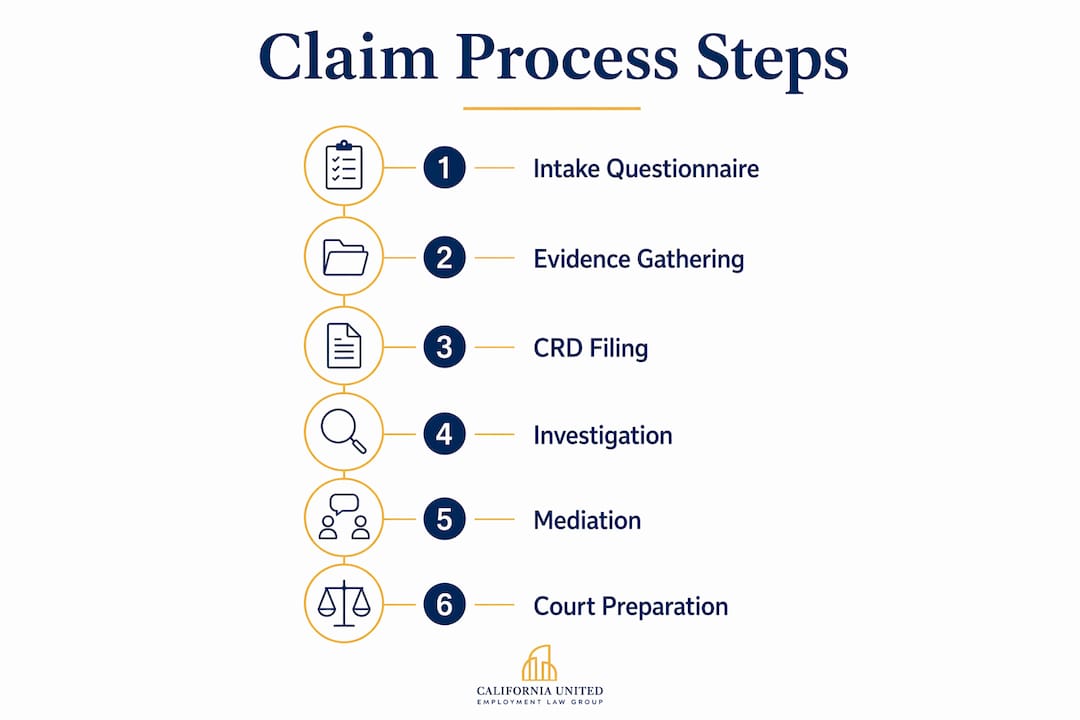
For claims involving discrimination, harassment, or retaliation under FEHA, the California Civil Rights Department (CRD) is usually the required administrative starting point before filing a FEHA lawsuit. You cannot file a FEHA lawsuit in Superior Court without first going through this administrative process. Here is how it works:
- Complete the online intake questionnaire. The CRD’s website offers a pre-complaint questionnaire that helps determine whether your claim qualifies under FEHA. This step is separate from the formal complaint process. In some cases, employees may also request an immediate right-to-sue notice through the CRD’s online system, which usually waives CRD investigation.
- Submit your formal complaint. After the intake review, you file a formal complaint with the CRD. You can do this online, by mail, or in person at a CRD office.
- CRD notifies your employer. The agency sends your employer a copy of the complaint and requests a response. This typically happens within a few weeks of filing.
- Investigation phase begins. The CRD reviews both sides, requests documents, and may interview witnesses. This phase can take months and varies depending on the facts, agency workload, and whether the employee requests an immediate right-to-sue notice.
- Voluntary mediation is offered. The CRD may offer mediation before or during the investigation. Mediation is voluntary and non-binding. Do not assume that mediation pauses any filing deadline unless an attorney confirms that a specific tolling rule applies to your claim.
- Receive your Right-to-Sue notice. If the CRD closes your case or you request early closure, you receive a Right-to-Sue notice. For FEHA claims, this document authorizes you to file a civil lawsuit in court.
| Stage | Who Handles It | Typical Timeline |
|---|---|---|
| Intake questionnaire | CRD online portal | 1–2 weeks |
| Formal complaint filed | CRD | Day of submission |
| Employer notification | CRD | 2–4 weeks after filing |
| Investigation | CRD investigators | 6–18 months |
| Mediation (optional) | CRD mediators | 1–3 months |
| Right-to-Sue notice | CRD | Upon request or case closure |
The FEHA filing deadline is three years from the date of the wrongful act. Once you receive your Right-to-Sue notice, you have one year to file a lawsuit in Superior Court. The CRD filing deadline and the post-right-to-sue lawsuit deadline are separate requirements. If you miss the CRD deadline, your FEHA claim may be barred before you ever reach court. After the CRD issues a right-to-sue notice, the notice generally starts a separate one-year deadline to file a FEHA lawsuit.
What other legal pathways exist for wrongful termination claims?
Not every wrongful termination claim goes through the CRD. Several other legal routes apply depending on the nature of your claim. Choosing the correct filing agency based on your claim type is one of the most important early decisions in this process.
Here is a breakdown of the main alternatives:
- Labor Code § 1102.5 (whistleblower retaliation). If you were fired for reporting or refusing to participate in illegal activity, you may have a whistleblower retaliation claim. Depending on the facts, this claim may proceed through the Labor Commissioner or directly in court, and it does not necessarily require CRD involvement.
- Wage and hour violations. Claims for unpaid wages, missed breaks, or overtime go to the California Labor Commissioner’s Office (also called the Division of Labor Standards Enforcement).
- Cal/OSHA safety complaints. If your termination followed a workplace safety complaint, Cal/OSHA handles the retaliation investigation.
- Common-law Tameny claims. A Tameny claim is a common-law claim for termination or other qualifying adverse employment action that violates a fundamental public policy, such as firing someone for refusing to violate the law or for exercising certain statutory rights. These claims carry a 2-year statute of limitations under Code of Civil Procedure § 335.1 and go directly to court. California courts have long recognized that at-will employment has limits. In Tameny v. Atlantic Richfield Co., the California Supreme Court held that when an employer’s discharge of an employee violates fundamental principles of public policy, the employee may maintain a tort action. Later cases explain that although an at-will employee may be terminated for no reason, an arbitrary reason, or even an irrational reason, an employer may not terminate an employee for an unlawful reason or a purpose that violates fundamental public policy.
- Contract-based claims. If you had an employment contract, a breach of contract claim carries either a 2-year deadline (oral contracts) or a 4-year deadline (written contracts). Important distinction: FEHA claims generally require CRD exhaustion, but common-law claims, including some wrongful discharge claims based on the same underlying conduct, may proceed directly in court. Do not assume one agency filing preserves every possible claim.
Pro Tip: If your termination involves multiple potential violations, such as discrimination and wage theft, each claim may require a separate filing with a different agency. Map out every possible claim type before you file anything.
The table below summarizes key differences across claim types:
| Claim type | Filing agency | Deadline |
|---|---|---|
| FEHA discrimination, harassment, or retaliation | CRD first, then court after right-to-sue | CRD filing generally within 3 years; lawsuit generally within 1 year after right-to-sue notice |
| Whistleblower retaliation | Labor Commissioner or court, depending on claim | Confirm the applicable deadline before filing |
| Tameny public policy claim | Superior Court directly | Generally 2 years |
| Wage and hour violations | Labor Commissioner or court | Deadline varies by claim and remedy |
| Written contract breach | Superior Court | Generally 4 years |
Missing a deadline can seriously harm or even bar a wrongful termination claim. Each claim type has its own clock, and no single deadline covers all of them.
What happens after you file, and how do you prepare for court?
Filing your complaint is not the end of the process. It is the beginning of a phase that requires patience, organization, and close attention to deadlines. Knowing what to expect reduces stress and keeps your claim on track.
During the CRD investigation, you may be asked to provide additional documents or participate in interviews. Respond promptly and completely. Delays on your end can slow the process and reflect poorly on your credibility.
If the CRD offers mediation, consider it seriously. Mediation can sometimes result in settlement terms, which may include monetary compensation, reinstatement, or other agreed relief, but it is voluntary and non-binding unless the parties reach a binding agreement. If mediation fails, you still need to pursue your Right-to-Sue notice and file in court if you want to continue. Mediation does not replace litigation.
Once you receive your Right-to-Sue notice, act quickly. You have one year to file in Superior Court, but building a strong case takes time. Consulting an employment attorney early in this phase can help you evaluate deadlines, procedural requirements, and how to present your evidence effectively. Court filings have technical requirements, and missing them can harm a claim even when the underlying facts are strong.
Common mistakes to avoid after filing:
- Ignoring CRD correspondence or missing response deadlines
- Assuming a mediation discussion resolves the case before there is a signed, enforceable agreement
- Waiting until the last month of the one-year court window to find an attorney
- Discussing case details casually with former coworkers, especially people who may later become witnesses
- Failing to keep records of all post-filing communications
Filing a complaint with the CRD is a significant legal step. Every document you submit, every deadline you meet, and every communication you preserve from this point forward shapes the outcome of your claim.
For many employees in Pasadena and Los Angeles, civil employment cases may be filed in the Superior Court of Los Angeles County, depending on venue, employer location, where the events occurred, and other case-specific factors. Understanding local court procedures and filing requirements is part of preparing for litigation. You can learn more about recognizing wrongful termination and your rights before taking that step.
Key Takeaways
A strong wrongful termination claim in California often depends on gathering evidence early, identifying the correct legal theory, filing with the correct agency or court, and tracking every applicable deadline.
| Point | Details |
|---|---|
| Start with evidence | Request your personnel file under Labor Code § 1198.5 and document all communications right away. |
| Know your deadlines | FEHA claims generally require CRD filing within 3 years and a lawsuit within 1 year after the Right-to-Sue notice. |
| Choose the right agency | Filing with the wrong agency can harm your claim; match your claim type to the correct agency or court. |
| Mediation is not final | CRD mediation is voluntary and non-binding; it does not replace court action if it fails. |
| Retain counsel early | An employment attorney helps you meet technical court requirements and build a complete case. |
What I’ve Learned About Wrongful Termination Claims In Pasadena And Los Angeles
After working with employees across Los Angeles County, including many in Pasadena, one pattern stands out clearly. In my experience, employees who act in the first two to four weeks after termination are often better positioned to preserve evidence, identify deadlines, and understand their options than those who wait.
The most common mistake I see is not missing a deadline. It is misidentifying the claim. An employee fired after reporting wage theft may assume they need to file a FEHA complaint. They do not. Filing with the wrong agency can waste valuable time and may jeopardize the correct legal path. Understanding your termination rights before you file is not optional. It is the foundation of everything that follows.
Employers in this region are often represented by counsel and may rely on personnel records, performance documentation, and disciplinary histories to support their termination decisions. “Employees are often better positioned when they preserve their own documentation early, including pre-termination communications, witness names, and a clear timeline of events. Pre-termination documentation, witness names, and a clear timeline of events give an attorney something real to work with.
My honest advice: do not wait to see how things develop. The legal process in California is structured but unforgiving on timing. Consult an employment attorney within the first few weeks, even if you are not sure you have a case. That free consultation can help you understand deadlines, claim options, and whether legal representation may be appropriate.
— California United Law Group
California United Law Group Is Here To Help With Your Claim
California United Law Group represents employees in Pasadena, Los Angeles, and across Southern California in wrongful termination cases under FEHA, the California Labor Code, and common-law claims. The firm assists employees with key stages of the process, including pre-litigation evidence review, agency strategy, and Superior Court litigation when appropriate. If you were recently terminated and are unsure whether your situation qualifies as wrongful dismissal, or if you need help understanding which agency to file with, contact California United Law Group for a consultation. You can also review the firm’s guidance on how to fight wrongful termination to understand what building a strong case looks like in practice.
Reach out to California United Law Group to discuss your rights and possible next steps. Reading this article does not create an attorney-client relationship, and the information here is general legal information rather than advice about your specific case.
FAQ
What is wrongful termination under California law?
Wrongful termination occurs when an employer fires an employee for a reason prohibited by law, such as discrimination, retaliation, violation of a protected public policy, or breach of an employment contract. Not every unfair or harsh termination is legally wrongful. California is an at-will employment state, but that status does not protect employers who fire workers for illegal reasons.
How long do I have to file a wrongful termination claim in California?
FEHA claims generally require filing with the CRD within three years of the wrongful act, followed by a lawsuit within one year after the CRD issues a right-to-sue notice. Tameny public policy claims generally carry a two-year deadline. Deadlines vary by claim type, so identifying your claim early is critical.
Do I need a lawyer to file a wrongful termination complaint?
You are not required to have an attorney to file with the CRD, but legal representation can help you evaluate deadlines, identify the correct claims, gather evidence, and prepare for Superior Court if litigation becomes necessary.
What is a Right-to-Sue notice and why does it matter?
A Right-to-Sue notice is a document issued by the CRD that authorizes you to file a FEHA lawsuit in Superior Court. Without a CRD right-to-sue notice, a California court generally will not allow a FEHA claim to proceed. You have one year from the date of the notice to file suit.
Can I file a wrongful termination claim if I was an at-will employee?
Yes. At-will employment means an employer may terminate an employee without cause, but not for an unlawful reason. If an employee is fired because of race, disability, protected complaints, or another legally protected reason, the employee may have a wrongful termination claim, depending on the evidence.
Recommended
- How To Fight Wrongful Termination in California – California United Law Group
- Wrongful Termination in California: What You Need to Know – California United Law Group
- Wrongful Termination in California: What You Need to Know – California United Law Group
- How to Recognize Wrongful Termination in California – California United Law Group