
California Labor Code Section 2802 generally requires employers to reimburse employees for necessary expenditures or losses incurred as a direct consequence of performing job duties or obeying employer directions. This obligation applies broadly to California employers, including employers in El Monte, but whether a particular worker or expense is covered depends on the facts. Covered expenses commonly include business mileage, cell phone use, home internet, tools, and work supplies. Many reimbursement claims are subject to strict filing deadlines, commonly discussed as three years for statutory claims and potentially four years where a written contract theory applies. Because deadlines can depend on the claim and facts, employees should seek advice promptly. California United Law Group works with El Monte employees to help them understand these rights and pursue unpaid expense claims.
What expenses are employers in El Monte required to reimburse?
California Labor Code Section 2802 requires reimbursement of necessary expenditures or losses incurred as a direct consequence of job duties or employer directions. The word “necessary” does not mean optional or convenient. It means any cost a reasonable employee would need to spend to carry out their assigned duties.
For El Monte workers, the most common reimbursable expenses include:
- Business mileage: Driving your personal vehicle to job sites, client meetings, or between work locations qualifies. Employers often use a mileage rate, but California law focuses on whether the reimbursement fully covers necessary and reasonable work-related vehicle expenses.
- Cell phone use: If your employer requires you to use your personal phone for work, California law generally requires reimbursement of a reasonable percentage of the bill. This applies even on unlimited plans, because the employer benefits from a service you are paying for.
- Home internet: Remote workers in El Monte may be entitled to reimbursement for a reasonable portion of home internet costs when those costs are necessary and incurred as a direct consequence of their job duties or employer directions.
- Tools and equipment: If your job requires specific tools, safety gear, or equipment and your employer does not provide them, the cost falls under Section 2802.
- Work supplies: Office supplies, postage, printing costs, and similar items purchased for job tasks are reimbursable.
Mixed-use expenses, such as a cell phone or internet plan used for both personal and work purposes, require a reasonable percentage reimbursement. The employer and employee do not need to track every minute of use. A reasonable allocation based on actual work use is commonly used, and the employer must reimburse a reasonable percentage when work requires use of a personal cell phone.
California courts have addressed several common reimbursement issues. In Cochran v. Schwan’s Home Service, Inc., the court held that when employees must use personal cell phones for work, the employer must reimburse a reasonable percentage of the bill. In Gattuso v. Harte-Hanks Shoppers, Inc., the California Supreme Court explained that employers may use methods such as increased salary or commission to satisfy reimbursement duties only if there is a way to identify what portion is compensation and what portion is expense reimbursement. More recently, Thai v. International Business Machines Corp. addressed remote-work expenses and confirmed that reimbursement turns on whether the expenses were incurred as a direct consequence of performing job duties.
Pro Tip: Keep a simple monthly log of work-related calls, data use, and internet hours. Consistent estimates can help support a claim, especially when paired with bills, receipts, mileage logs, emails, or other records.

An employee does not necessarily lose a reimbursement claim simply because the employer failed to provide a perfect form or process. But employees should submit written requests whenever possible, because written notice and documentation make the claim easier to prove.
How and when should El Monte employees file expense reimbursement claims?
Timing matters significantly in El Monte employee expense claims. Missing a legal deadline can eliminate your right to recover, even if the underlying claim is valid.
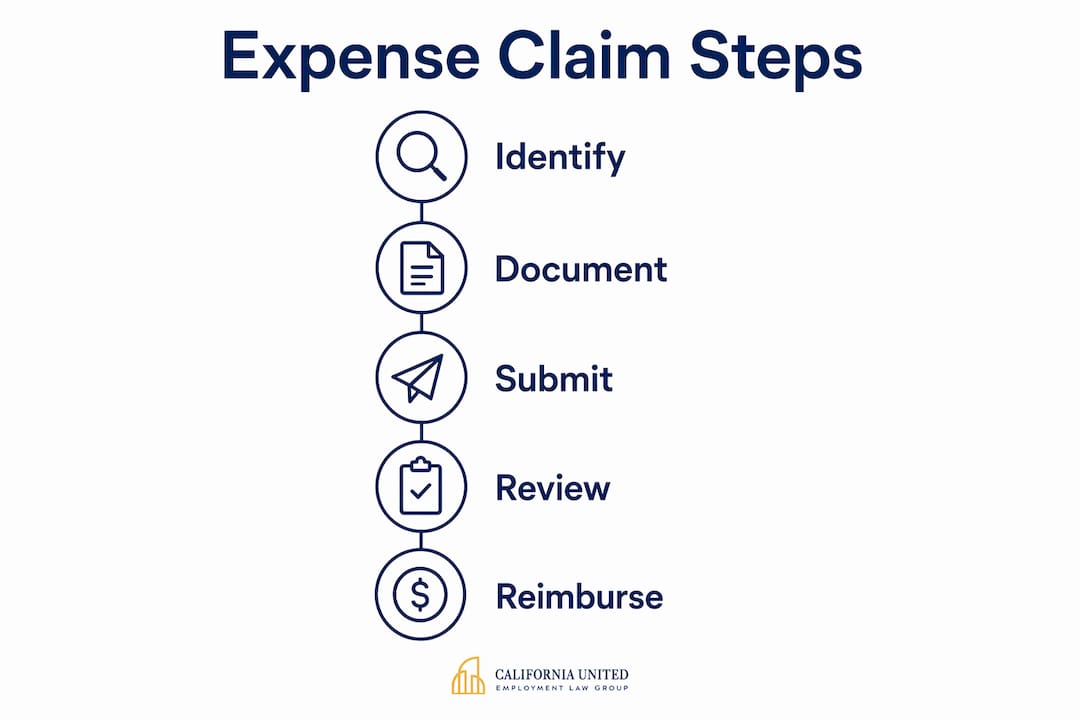
Follow these steps to protect your claim:
Track the date each expense was incurred. Track the date each expense was incurred and paid. Reimbursement claims may be subject to different deadlines depending on the legal theory, including statutory and written-contract theories, so employees should act promptly.
Submit a written reimbursement request to your employer. Send your request to HR or your direct manager by email. Written requests create a record that your employer received notice. Keep a copy of every submission.
Follow up in writing if you receive no response. A lack of response may be useful evidence that the employer received notice and did not resolve the request. Document every follow-up attempt with dates and the names of people you contacted.
File a wage claim with the California Labor Commissioner. If your employer refuses to pay, you can file a claim with the California Labor Commissioner’s Office, also known as the Division of Labor Standards Enforcement. This is a low-cost administrative process available to El Monte workers. The Labor Commissioner process may include a conference before any hearing, giving both sides an opportunity to resolve the dispute earlier.
Consider small claims court for smaller amounts. For lower-dollar claims, small claims court is another option. Small claims court may be an option for lower-dollar claims, but employees should confirm the current jurisdictional limits and procedural rules before filing.
Pro Tip: For tax-related reimbursement issues, employees should consult current IRS guidance or a tax professional. From an employment-law standpoint, submitting documentation quickly helps create a clear record.
Acting early helps preserve documents, witness memory, and filing options. Waiting too long risks losing evidence, losing witnesses, and losing your legal window entirely. If you are unsure where your situation stands, an employment lawyer in El Monte can help you assess your options before the deadline passes.
What evidence is most effective for proving unreimbursed expenses?
Documentation quality can significantly affect the outcome of an expense reimbursement case. Employers frequently dispute whether an expense was necessary or whether they had knowledge of it. Strong records remove that ambiguity.
The most effective evidence includes:
- Receipts and invoices: Save every receipt, whether paper or digital. For recurring expenses like cell phone bills, keep monthly statements going back to when the work use began.
- Mileage logs: Record the date, starting point, destination, purpose, and miles driven for every work trip. Apps or a simple spreadsheet both work. Consistency matters more than the format.
- Written reimbursement requests: Emails or letters asking your employer to reimburse specific costs are direct evidence that your employer had notice of the expense.
- Employer responses or silence: If your employer acknowledged the expense, approved the work activity that caused it, or failed to respond to a written request, that evidence may help show notice and nonpayment.
- Employer expense policies: Your company’s written reimbursement policy can work in your favor, especially if it promises reimbursement but was never followed.
“If your employer acknowledged the expense, approved the work activity that caused it, or failed to respond to a written request, that evidence may help show notice and nonpayment.”
One often-overlooked point: if records are incomplete, consistent employee estimates may still help support the claim. Employees should keep their own records whenever possible rather than relying on the employer’s records. Keeping your own records, even informal ones, puts you in a much stronger position.
What legal protections and remedies apply to El Monte employees?
California law gives El Monte employees real tools to recover unpaid expenses. Labor Code Sections 2802 and 2804 provide important reimbursement protections, though the outcome of any claim depends on the facts and available evidence.
Key protections and remedies include:
- Interest on unpaid amounts: Interest accrues on unreimbursed expenses from the date you paid them. This means the longer your employer delays, the more they owe.
- Attorney fees and litigation costs: Labor Code Section 2802 can allow recovery of reasonable attorney’s fees incurred to enforce reimbursement rights, but fee recovery depends on the claim, forum, and outcome.
- No valid waiver: Labor Code Section 2804 makes any agreement waiving your reimbursement rights null and void. An employer cannot include a clause in your employment contract that eliminates their obligation to reimburse you. Such clauses are unenforceable under California law.
- Administrative enforcement: The California Labor Commissioner’s Office may handle employee reimbursement claims through an administrative wage-claim process. The initial conference process often resolves disputes without the need for a formal hearing.
- Employer knowledge can matter: written requests, policies, assignments, schedules, and manager communications can help show the employer knew why the expense was incurred.
Understanding your California Labor Code rights as an employee is the first step toward protecting them. Many El Monte workers do not realize that a signed agreement or a company policy cannot legally strip them of these protections. California law generally does not allow employers to contract around statutory reimbursement duties, but employees should have any disputed policy or waiver reviewed in light of the specific facts.
Key Takeaways
California Labor Code Section 2802 gives employees a path to recover necessary and reasonable work-related expenditures or losses, and California law limits an employer’s ability to avoid reimbursement duties by contract or policy.
| Point | Details |
|---|---|
| Labor Code Section 2802 applies broadly | Mileage, cell phone use, internet, tools, and supplies may qualify when they are necessary, reasonable, work-related, and unreimbursed. |
| Waivers are unenforceable | Labor Code Section 2804 voids any contract clause that strips employees of reimbursement rights. |
| Act promptly | Deadlines can vary by legal theory, so employees should document expenses and seek advice quickly. |
| Documentation decides outcomes | Receipts, mileage logs, and written requests are the most effective evidence in expense claims. |
| Multiple recovery options exist | Employees can pursue claims through the Labor Commissioner, small claims court, or civil litigation. |
What I’ve Seen Working Expense Reimbursement Cases In El Monte
One common pattern in expense reimbursement disputes is delay: repeated requests to resubmit forms, long review periods, or no clear decision. Employers tell employees to “submit the form again,” or say the request is “under review,” until the employee gives up or the statute of limitations quietly expires. Delay can make claims harder to prove and may create deadline problems if the employee waits too long.
The second pattern is the policy defense. An employer points to a written policy that limits reimbursement to certain categories or caps amounts below actual costs. What many employees do not realize is that a policy cannot override Labor Code Section 2802. If the expense was necessary, reasonable, work-related, and not fully reimbursed, a restrictive company policy may not defeat the employee’s statutory claim.
My practical advice: send your reimbursement request in writing the same week you incur the expense. Do not wait for your employer to bring it up. Do not assume the company will handle it automatically. A short email with the amount, date, and business purpose creates a record the employer will have to address later.
The Los Angeles area reimbursement framework applies directly to El Monte workers, and the Labor Commissioner process is more accessible than most employees expect. Some claims can be pursued through the Labor Commissioner process instead of starting in court, and some disputes resolve before a formal hearing.
If you are sitting on unreimbursed expenses right now, the most important thing you can do is document what you have and get a clear picture of your timeline. California law provides reimbursement protections, but preserving your claim depends on timely action and adequate proof.
— California United Law Group
California United Law Group is here for El Monte workers
California United Law Group represents employees in El Monte and throughout California in wage-and-hour matters, including unpaid expense reimbursement claims. The firm can assist with documentation review, Labor Commissioner proceedings, and civil litigation when appropriate. If your employer has refused to reimburse necessary work expenses, or has delayed payment without explanation, you have legal options worth understanding.
California United Law Group’s employment law team works with workers across El Monte and the greater Los Angeles area. To discuss your situation and learn about possible next steps, contact the firm for a consultation. Acting promptly can help preserve evidence and filing options.
FAQ
What is California Labor Code Section 2802?
California Labor Code Section 2802 requires employers to reimburse employees for all necessary expenditures incurred while performing their job duties. To prove a claim, the employee generally must show the expense or loss was necessary and reasonable, was incurred as a direct consequence of job duties or employer directions, was not fully reimbursed, and the amount unpaid.
How long do El Monte employees have to file an expense claim?
Deadlines can vary depending on the legal theory and facts. Employees should document the expense date, payment date, reimbursement request date, and any employer response, then seek advice promptly. Filing as early as possible protects your claim and preserves evidence.
Can my employer refuse to reimburse me if I signed a contract waiving that right?
California law generally prevents employers from using a contract or policy to eliminate statutory reimbursement rights. If an employer relies on a waiver, cap, or restrictive policy, an employee should have the specific language reviewed.
Does cell phone reimbursement apply even if I have an unlimited plan?
Yes, if the employer requires work-related use of a personal cell phone. California authority requires reimbursement of a reasonable percentage of the bill even if the employee did not incur an additional charge for the work use.
What are lower-cost ways to pursue an unpaid expense claim in El Monte?
Filing with the California Labor Commissioner may be a lower-cost option for some employees. Depending on the amount and facts, small claims court or civil litigation may also be options.
Recommended
- Pasadena Failure to Reimburse Employee Expenses – California United Law Group –
- El Monte Meal Period Violations: Your Rights in 2026 – California United Law Group –
- Do Los Angeles Employers Have To Reimburse Work Expenses? – California United Law Group
- Do Torrance employers have to reimburse work expenses? – California United Law Group