
Criminal record discrimination can occur when a Glendale employer improperly asks about, relies on, or acts on an applicant’s conviction history without following California’s Fair Chance Act procedures.California’s Fair Chance Act generally requires covered employers to wait until after a conditional job offer before asking about or considering an applicant’s conviction history. Federal law adds another layer: under Title VII’s disparate impact doctrine, blanket exclusion policies may create liability if they disproportionately screen out protected groups and are not job-related and consistent with business necessity. Nearly 1 in 3 U.S. adults have a criminal record. That scale makes fair hiring policy a civil rights issue, not just an HR formality.
What legal protections exist in Glendale against criminal record discrimination?
California’s Fair Chance Act is the primary state law protecting many applicants and employees when employers use conviction history in hiring decisions. It applies to employers with five or more employees and prohibits asking about criminal history on a job application. An employer must make a conditional offer of employment before running a background check.
Once an employer reviews your record, the law requires an individualized assessment before any adverse action. That assessment must weigh:
- The nature and gravity of the offense or conduct
- The time elapsed since the offense or conduct and completion of the sentence
- The nature of the job sought
If the employer preliminarily decides to withdraw the offer, the applicant must have an opportunity to respond with evidence of rehabilitation, mitigating circumstances, or inaccurate conviction-history information.
In most covered positions, Glendale employers should not use a blanket policy that automatically disqualifies anyone with a record without a legally recognized exception and individualized review. Such policies often fail the job-related and business necessity test required under Title VII. That standard requires more than generalized discomfort with a person’s history; the exclusion should be tied to the duties, risks, and requirements of the specific job.
Title VII does not explicitly protect conviction status as a class, but its disparate impact provisions allow challenges when a policy disproportionately excludes racial minorities without a legitimate business reason. This matters in Glendale and the broader Los Angeles County job market, where fair hiring practices affect a diverse workforce.

There are exceptions. Exceptions may apply when another law requires a background check or restricts employment based on criminal history, including some regulated positions, criminal justice agency roles, and other legally specified jobs. If you are applying for a job in healthcare, childcare, or law enforcement, different rules may apply. Understanding which rules govern your specific situation is where legal guidance becomes valuable.
How do employers legally use criminal conviction information in hiring?
87% of employers in the United States conduct criminal background checks, and over 60% are unlikely to hire applicants with records. That reluctance is widespread, but it does not make every rejection lawful.

California’s “Ban the Box” policy, embedded in the Fair Chance Act, delays criminal history inquiries until after a conditional offer. This timing rule is critical. Lack of transparency in hiring prevents applicants from enforcing their rights, and delaying the inquiry gives you a fair chance to be evaluated on your qualifications first.
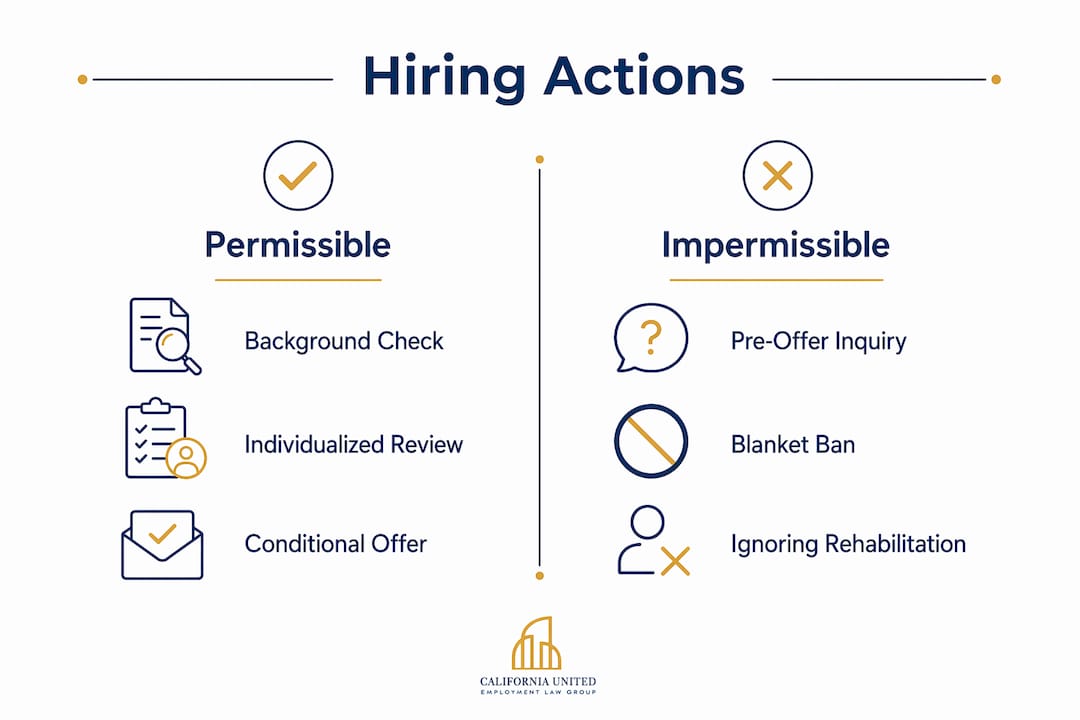
The table below shows the line between permissible and impermissible employer actions under California law:
| Permissible employer actions | Impermissible employer actions |
|---|---|
| Conducting a background check after a conditional offer | Asking about criminal history on the application |
| Performing an individualized assessment of the offense | Automatically rejecting any applicant with a record |
| Considering job-relevant convictions with recent dates | Using a blanket policy with no case-by-case review |
| Sending a preliminary written notice before a final withdrawal decision | Making a final withdrawal decision without giving the applicant the required opportunity to respond |
| Evaluating rehabilitation evidence you provide | Ignoring rehabilitation evidence entirely |
Many employers use background checks for insurance, safety, or regulatory compliance and do consider rehabilitation and job relevance. The law does not prohibit all use of criminal history. It requires that the use be fair, specific, and proportionate.
Pro Tip: If an employer withdraws a conditional offer after seeing your record, California law requires them to give you written notice and at least five business days to respond. Use that window to submit evidence of rehabilitation, character references, or job training.
Blanket policies on criminal convictions can raise serious legal concerns, especially when the employer cannot show that the exclusion is job-related and consistent with business necessity. If you were rejected without any individualized review, that is a red flag worth examining with an attorney.
What recourse do you have if a Glendale employer discriminates based on your record?
You have concrete legal options if a Glendale employer refuses to hire or fires you based on your criminal history in violation of California law. The process generally follows these steps:
Document the rejection. Write down the date, the employer’s name, the position, and any statements made about your criminal record. Save all written communications.
Request the employer’s reasoning. Under the Fair Chance Act, if a covered employer preliminarily decides to withdraw a conditional offer based on conviction history, the employer must provide notice and give you an opportunity to respond before making a final decision. Ask for the specific conviction they relied on and how it relates to the job.
File a complaint with the Civil Rights Department. California’s Civil Rights Department (formerly DFEH) handles Fair Chance Act violations. You can file online or by phone. The EEOC handles federal Title VII claims and coordinates with state agencies.
Consult an employment attorney. The employment lawsuit process in California involves administrative filings, investigation periods, and potential litigation. An attorney helps you understand which claims apply and what evidence matters.
Understand potential outcomes. Depending on the facts, forum, and claims asserted, potential remedies may include job-related relief, back pay, compensatory damages, and changes to the employer’s hiring policies.
Evidentiary challenges are real. Evidence may differ by claim: a disparate treatment theory often focuses on whether the employer’s stated reason was pretextual, while a disparate impact theory usually requires proof that a neutral policy caused a significant adverse effect on a protected group without adequate business justification.
California United Law Group represents employees and applicants in Glendale facing hiring discrimination, wrongful termination, and related employment claims under California and federal law. If you believe your rights were violated, a consultation can clarify what your specific situation supports.
How can you improve your employment prospects in Glendale with a conviction?
Second-chance employment is a defined approach in which employers review applicants with records individually rather than excluding them through blanket policies. It does not ignore your history. It evaluates it in context. Some employers in industries such as construction, logistics, food service, manufacturing, and technology participate in fair chance or second-chance hiring programs.
Practical steps that strengthen your position:
- Research fair chance employers. Many large companies in Los Angeles County have signed fair chance pledges. Glendale’s proximity to major employers in the region gives you access to a broad pool.
- Build a skills record. Certifications, vocational training, and completed programs demonstrate rehabilitation and job readiness. These carry real weight in an individualized assessment.
- Be transparent, not apologetic. If an employer is legally permitted to ask about your record, explain the conviction briefly, describe what changed, and connect your skills to the role. Defensiveness raises more concern than the record itself.
- Know your probation conditions. Probation conditions can restrict job types and schedules, which affects which positions you can realistically pursue. Review your conditions before applying to roles with travel, irregular hours, or specific location requirements.
- Use your network. Personal referrals reduce the weight of background check results. A trusted contact who can speak to your character and work ethic shifts the employer’s focus toward your qualifications.
Pro Tip: Before any interview, prepare a two-sentence statement about your conviction that is honest, forward-looking, and job-relevant. Practice it until it sounds natural. Employers respond better to composure and clarity than to lengthy explanations.
Second-chance hiring improves outcomes by reviewing applicants as whole people. Your record is one data point, not your entire profile.
Key Takeaways
California law gives workers with convictions real protections, but enforcing those rights requires knowing exactly what employers can and cannot do under the Fair Chance Act and Title VII.
| Point | Details |
|---|---|
| Fair Chance Act timing rule | Employers cannot ask about criminal history until after a conditional job offer. |
| Individualized assessment required | Employers must weigh offense severity, time elapsed, and job relevance before rejecting you. |
| Blanket policies can be legally risky | Automatic exclusions may violate Title VII or California law if they are not job-related, consistent with business necessity, or supported by a valid legal exception. |
| You can respond before final rejection | California law generally gives applicants at least five business days to respond after a preliminary decision based on conviction history. |
| Legal recourse is available | Filing with the Civil Rights Department or EEOC preserves your right to pursue damages or reinstatement. |
What I’ve Seen Working These Cases In Glendale
In employment discrimination matters across the Los Angeles area, a recurring issue is that applicants often do not recognize the legal significance of a conditional offer before a background check. That moment is legally significant. Once that offer exists, the employer’s ability to withdraw it is constrained by law. Many employers either do not know this or count on applicants not knowing it.
The racial dimension of this issue is real and documented. Policies that screen out applicants with records may disproportionately affect protected groups, including racial and national-origin groups, which is why blanket criminal-history exclusions can raise Title VII concerns. A policy that looks neutral on paper can still violate Title VII if its effect falls unevenly on protected groups without a genuine business reason.
What I find most frustrating is the silence. Employers rarely explain their decisions in writing, and applicants rarely push back because they assume the rejection was legal. Transparency in hiring is not just good practice. It is the mechanism through which anti-discrimination laws get enforced. Without a written reason, it can be harder to evaluate and challenge a discriminatory decision.
My advice: do not accept a rejection as final until you understand the reason. If an employer withdrew a conditional offer after seeing your record, ask for the written notice the law requires. That document is your starting point. If you do not receive it, that itself may be a violation worth examining with a Glendale employment attorney.
Courts have recognized that criminal-record screening can raise disparate impact issues, but they also examine whether the employer can prove business necessity. In El v. Southeastern Pennsylvania Transportation Authority, the court found business necessity where a paratransit driver applicant’s decades-old murder conviction was tied to passenger-safety concerns. California employment guidance also looks to whether a conviction-history policy is narrowly tailored to the job, considering the nature and gravity of the offense, the time passed, and the nature of the position. This is why the details matter: the same conviction may be treated differently depending on the job, the timing, and the employer’s actual justification.
— California United Law Group
California United Law Group and Glendale Workers With Conviction Records
California United Law Group represents employees and applicants in Glendale who face hiring discrimination or termination tied to criminal history. The firm handles claims under California’s Fair Chance Act, FEHA, and Title VII, and works with clients at every stage from initial complaint filings through litigation. If a Glendale employer refused to hire you or fired you after reviewing your record, you may benefit from a clear explanation of your legal options. Contact us for a consultation on your situation. California United Law Group also handles related claims including workplace retaliation for employees who face pushback after asserting their rights.
FAQ
Can a Glendale employer legally refuse to hire me because of a conviction?
In most covered jobs, a Glendale employer may consider conviction history only after a conditional offer and only after following the required individualized assessment process. A blanket refusal without that process may violate California’s Fair Chance Act unless a legal exception applies.
What is the Fair Chance Act and how does it protect me?
California’s Fair Chance Act generally prohibits employers with five or more employees from asking about conviction history before making a conditional job offer. If the employer intends to deny employment based on conviction history, it must conduct an individualized assessment and follow notice-and-response procedures.
Can my employer fire me because of a criminal record they just discovered?
If an employer discovers a criminal record after hiring, the legal analysis depends on the job, the timing, the employer’s policies, and any applicable background-check or licensing rules. If the termination appears tied to criminal history, an employment attorney can evaluate whether California law, FEHA, Title VII, or another protection applies.
How do I file a complaint if I was discriminated against in Glendale?
File a complaint with California’s Civil Rights Department or the EEOC. Deadlines are strict, so acting quickly after the adverse employment action protects your right to pursue a claim.
Does Title VII protect people with criminal records from discrimination?
Title VII does not list conviction status as a protected class, but its disparate impact doctrine may allow challenges when an employer’s criminal-history policy disproportionately excludes protected groups, such as racial or national-origin groups, without a valid business necessity justification.