
Workplace retaliation is defined as any adverse employment action an employer takes against an employee because that employee engaged in a legally protected activity. In Glendale and throughout California, protected activities include reporting workplace safety violations, filing a discrimination complaint, or cooperating with a government investigation. California Labor Code §1102.5 and the Fair Employment and Housing Act (FEHA) both prohibit this conduct and give employees meaningful legal recourse. Glendale workplace retaliation attorneys regularly see cases where employees miss early warning signs, which is why understanding those signs matters before a situation escalates. This article explains what retaliation looks like in practice, how California law defines and proves it, and what you can do to protect your rights.
What are the common signs of employer retaliation in Glendale workplaces?
Recognizing employer retaliation signs early is the most practical step you can take to protect yourself. Retaliation rarely announces itself. Employers seldom say, “We are punishing you for your complaint.” Instead, the changes are gradual, sometimes subtle, and often framed as routine business decisions.
The most frequently reported signs of workplace retaliation include:
- Sudden negative performance reviews after a period of positive or neutral evaluations
- Demotion or removal of responsibilities without a clear business justification
- Pay cuts or denial of a raise that colleagues in similar roles received
- Exclusion from meetings, projects, or communications you were previously included in
- Hostile scheduling changes, such as undesirable shifts or reduced hours
- Increased scrutiny from supervisors who previously showed no concern with your work
- Denial of promotion despite qualifications and prior positive feedback
Timing is one of the most telling factors. When adverse treatment follows closely after a protected activity, such as filing an HR complaint or reporting a safety issue, that temporal proximity is recognized by courts as strong circumstantial evidence of retaliation. It does not prove the case on its own, but it raises a legitimate question that demands an explanation from the employer.
Negative performance reviews following protected activity are often attempts to create a paper trail that justifies a later termination or demotion. Recognizing this pattern early gives you the opportunity to respond and document.

Pro Tip: Start a written log the moment you notice any change in how your employer treats you. Record dates, times, what was said or done, and who was present. This contemporaneous record becomes your strongest evidence if you pursue a workplace retaliation claim.
How does California law define and prove workplace retaliation?
California law provides some of the strongest employee protections in the country, and understanding the legal framework helps you evaluate your situation realistically.
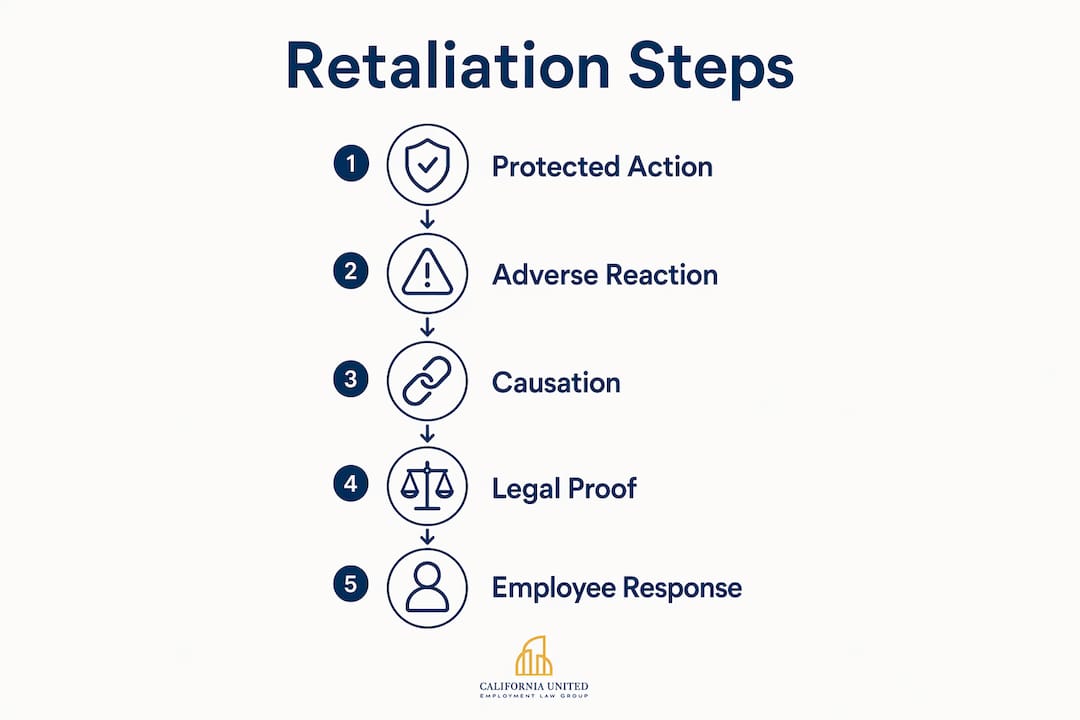
To prove retaliation under California Labor Code §1102.5, an employee must establish three elements:
- Protected activity. You engaged in conduct the law protects, such as reporting a legal violation, filing a complaint with a government agency, or refusing to participate in illegal conduct.
- Adverse employment action. Your employer took a materially negative action against you, such as termination, demotion, or a significant change in working conditions.
- Causal connection. There is a link between the protected activity and the adverse action. Under §1102.5, the employee must show the protected disclosure was a “contributing factor” in the employer’s decision.
One detail that surprises many employees: you do not need to prove the underlying violation you reported was actually occurring. Legal protection requires only that you had a reasonable belief a violation was taking place. This distinction matters enormously in practice.
The California Supreme Court in Lawson v. PPG Architectural Finishes, Inc. (2022) 12 Cal.5th 703 confirmed a two-step burden-shifting process for §1102.5 claims. Once an employee shows the protected disclosure was a contributing factor, the burden shifts to the employer to prove by clear and convincing evidence that it would have taken the same action regardless of the protected activity. This is a high standard for employers to meet, and it represents a significant advantage for employees compared to the older McDonnell Douglas framework used in federal cases.
SB 497, effective January 1, 2024, expanded retaliation protections under related statutes. Specifically, it added a rebuttable presumption of retaliation under Labor Code §98.6—which covers complaints to the Labor Commissioner and related protected activities—and under Labor Code §1197.5, the Equal Pay Act, when an adverse action occurs within 90 days of qualifying protected activity under those provisions. If your situation involves wage complaints, Labor Commissioner filings, or equal pay disclosures, this 90-day presumption may directly apply to your case. For §1102.5 whistleblower claims, the contributing-factor framework under Lawson remains the operative standard, and temporal proximity between protected activity and adverse action is strong circumstantial evidence of causation.
FEHA claims follow a similar structure for discrimination-based retaliation, covering complaints about harassment, discrimination based on protected characteristics, and requests for accommodation. One important distinction: FEHA retaliation claims use a ‘substantial motivating reason’ causation standard, meaning the protected activity must have substantially motivated the adverse action—a slightly different (though still employee-favorable) framing from the ‘contributing factor’ standard that applies to §1102.5 whistleblower claims. Together, these statutes give Glendale employees a layered set of protections that apply across most private and public employers.
What adverse actions qualify as retaliation under California law?
Not every unpleasant workplace experience qualifies as retaliation. California law defines a qualifying adverse action as one that materially and adversely affects the terms, conditions, or privileges of employment. The California Supreme Court in Yanowitz v. L’Oreal USA, Inc. (2005) 36 Cal.4th 1028 held that ‘adverse treatment that is reasonably likely to impair a reasonable employee’s job performance or prospects for advancement or promotion’ falls within the scope of actionable retaliation—but minor or trivial actions that merely anger or upset an employee do not. This standard is broader than many people expect.
California courts have applied this standard broadly. In Yanowitz v. L’Oreal USA, Inc. (2005) 36 Cal.4th 1028, the California Supreme Court confirmed there is no requirement that an employer’s retaliatory acts constitute ‘one swift blow’—a series of subtle, cumulative actions can collectively amount to an adverse employment action. Courts have also recognized constructive discharge as a cognizable form of retaliation under Turner v. Anheuser-Busch, Inc. (1994) 7 Cal.4th 1238. And in People ex rel. Garcia-Brower v. Kolla’s, Inc. (2023) 14 Cal.5th 719, the California Supreme Court confirmed that §1102.5(b) protects employees who disclose unlawful activity even when the recipient already knows about it—reinforcing the statute’s broad protective reach.
| Adverse Action | Example |
|---|---|
| Termination | Fired within weeks of filing an HR complaint |
| Demotion | Moved from manager to individual contributor after reporting safety violations |
| Pay reduction | Salary cut following a complaint about wage theft |
| Hostile transfer | Reassigned to a less desirable location or shift after cooperating with an investigation |
| Negative performance review | Sudden poor evaluation after years of positive reviews, timed after a complaint |
| Exclusion from opportunities | Removed from high-visibility projects or client meetings after reporting misconduct |
| Constructive discharge | Working conditions made so intolerable that resignation becomes the only reasonable option |
Constructive discharge deserves special attention. When an employer intentionally creates or knowingly permits working conditions so intolerable—typically through an aggravated or continuous pattern of conduct—that a reasonable person in the employee’s position would have no reasonable alternative but to resign, California courts treat that resignation as a termination for legal purposes. A hostile work environment linked to protected activity can qualify as retaliation under this theory, even though no formal termination occurred.
What does not qualify: minor personality conflicts, general workplace friction, or a single rude comment from a coworker. The conduct must be materially significant and connected to the protected activity. Understanding this distinction helps you assess your situation accurately before taking any steps.
Pro Tip: If you are unsure whether what you experienced crosses the legal threshold, consult a Glendale retaliation lawyer for a case evaluation. Many employment attorneys offer free consultations, and an early conversation can clarify whether your situation warrants further action.
How can Glendale employees document and respond to signs of employer retaliation?
Documentation is the foundation of any workplace retaliation claim. Courts and attorneys rely on contemporaneous records far more than memory, and the quality of your documentation often determines whether a claim moves forward successfully.
Here is what Glendale employees should focus on preserving:
- Written logs. Record every incident with the date, time, location, what was said or done, and the names of anyone present. Write these entries as close to the event as possible.
- Emails and messages. Save all relevant communications, including performance feedback, scheduling changes, and any messages that reflect a shift in your supervisor’s tone or treatment of you.
- Performance records. Keep copies of past performance reviews, commendations, and any documentation that establishes your standing before the protected activity occurred.
- HR and complaint records. Preserve any written complaints you filed, confirmation emails, and any responses you received from HR or management.
- Witness information. Note the names of colleagues who observed the adverse treatment. Their accounts can corroborate your timeline.
Patterns matter as much as individual incidents. A single scheduling change means little. A series of scheduling changes, pay adjustments, and exclusions from meetings, all beginning after a complaint, tells a very different story. Glendale employees who document retaliation carefully give their attorneys the clearest possible picture of what occurred and when.
This article provides general educational information only and is not legal advice. Employment law issues are fact-specific, and outcomes vary based on individual circumstances. If you believe you are experiencing retaliation, consulting a qualified employment attorney is the most important step you can take. An attorney can evaluate your specific facts, explain your rights under California law, and help you understand your options before you take any action that could affect your claim.
Key Takeaways
Employer retaliation in Glendale workplaces is proven through protected activity, adverse action, and causation, with California law placing a high evidentiary burden on employers once an employee establishes the contributing-factor standard.
| Point | Details |
|---|---|
| Recognize the signs early | Sudden negative reviews, demotion, exclusion, and hostile scheduling after a complaint are key red flags. |
| California law favors employees | The Lawson v. PPG framework and SB 497 shift significant burden to employers to disprove retaliation. |
| Timing creates a presumption | Adverse action within 90 days of protected activity triggers a rebuttable presumption of retaliation under SB 497 for claims brought under Lab. Code §98.6 (Labor Commissioner complaints) and §1197.5 (Equal Pay Act). For §1102.5 whistleblower claims, temporal proximity remains strong circumstantial evidence of causation. |
| Documentation is your foundation | Contemporaneous logs, preserved emails, and performance records are the core of any retaliation claim. |
| Consult an attorney early | Early legal consultation preserves evidence, protects your rights, and clarifies whether your situation meets the legal threshold. |
What I’ve Learned About Retaliation Cases That Most Employees Miss
After working closely with California employment law cases, one pattern stands out consistently: employees wait too long. By the time someone reaches out for a retaliation attorney consultation, weeks or months of evidence have gone undocumented, emails have been deleted, and the timeline has blurred.
The second thing employees consistently misunderstand is the legal standard itself. Many people believe they need to prove their employer acted with obvious malice or that the violation they reported was definitively real. Neither is true. California law requires only that the protected activity was a contributing factor in the adverse action, and that you had a reasonable belief a violation occurred. That is a meaningfully lower bar than most people expect.
What I find equally important is the SB 497 presumption. If your employer took adverse action within 90 days of your complaint, the law presumes retaliation occurred. That is a powerful starting position, but only if you have documented the timeline clearly. Timing without documentation is a missed opportunity.
Glendale employees also sometimes confuse general workplace conflict with retaliation. Not every difficult manager or unfair policy crosses the legal line. The legal definition of adverse action requires material harm, not just discomfort. Staying clear-eyed about that distinction helps you focus your energy where it actually matters.
If something feels wrong after you reported a violation or filed a complaint, trust that instinct enough to write it down and speak with an attorney. You do not need certainty to start protecting yourself.
Talk To California United Law Group About Your Retaliation Case
If you are a Glendale employee who believes you are facing retaliation, California United Law Group, P.C. is here to help.
California United Law Group represents employees across Glendale and the greater Southern California area in workplace retaliation claims under California Labor Code §1102.5 and FEHA. The firm handles cases from pre-litigation through trial, including wrongful termination, demotion, hostile work environment, and constructive discharge claims. California United Law Group offers free initial consultations and works on a contingency fee basis in qualifying cases, meaning you pay no attorneys’ fees unless the firm recovers for you. Please note that clients may remain responsible for certain case costs regardless of outcome; this will be addressed clearly in your fee agreement. Contact California United Law Group today to discuss your situation and understand your rights before more time passes.
FAQ
What counts as a protected activity under California law?
Protected activities include reporting workplace safety violations, filing a complaint about discrimination or harassment, cooperating with a government investigation, and refusing to participate in illegal conduct. California Labor Code §1102.5 and FEHA both cover a broad range of reporting and complaint activity.
How soon after a complaint can retaliation legally be presumed?
SB 497, effective January 1, 2024, added a rebuttable presumption of retaliation under specific statutes: Labor Code §98.6 (covering Labor Commissioner complaints and related protected activities) and Labor Code §1197.5 (the Equal Pay Act). Under those statutes, adverse action within 90 days of qualifying protected activity shifts the burden to the employer to prove the action was unrelated to the complaint. For §1102.5 whistleblower claims, there is no statutory 90-day presumption, but close timing between a protected disclosure and an adverse action is recognized by courts as strong circumstantial evidence of retaliation.
Does my employer have to fire me for it to be considered retaliation?
No. Retaliation includes any materially adverse action, such as demotion, pay cuts, hostile transfers, exclusion from opportunities, or constructive discharge. Termination is the most obvious form, but courts recognize a wide range of employer conduct as retaliatory.
Do I need proof that the violation I reported was actually happening?
California law protects employees who had a reasonable belief a violation was occurring, even if the violation is later found not to have happened. You do not need to prove the underlying wrongdoing was real, only that your belief was reasonable.
How do Glendale retaliation lawyers evaluate a potential case?
Attorneys at firms like California United Law Group assess the three core elements: protected activity, adverse action, and causal connection. They also examine the timeline, documentation, and whether the employer’s stated reason for the adverse action holds up under scrutiny.