
Rounding work hours can violate California law when it results in employees not being paid for all time actually worked, and meal-period rounding is prohibited. If your employer adjusts clock-in or clock-out times to a preset increment and the practice consistently reduces pay over time, that may support a California wage claim. California law strongly protects payment for all hours worked, and recent decisions have narrowed the circumstances in which rounding can be defended, especially where the employer’s records show meal-period violations or recurring unpaid time.
Key legal fact: The 2021 California Supreme Court decision in Donohue v. AMN Services, LLC established that rounding meal period time punches is flatly prohibited. Time records showing noncompliant meal periods create a rebuttable presumption of a meal-period violation, meaning the employer must come forward with evidence to rebut that presumption.
This article is for general educational purposes only and does not constitute legal advice. Employment law issues are fact-specific and outcomes vary.
How California Timekeeping Laws Govern Hour Rounding In Torrance
California sets a higher standard for wage protection than federal law. The California Labor Code and Industrial Welfare Commission wage orders require employers to pay for compensable hours worked, and California courts have rejected use of the federal de minimis doctrine to avoid paying recurring small amounts of off-the-clock work. Understanding where rounding is still debated, and where it is clearly off the table, is the starting point for any Torrance hourly worker.

Where Rounding Has Historically Been Allowed
Older California appellate decisions, drawing on guidance in the Division of Labor Standards Enforcement manual, permitted a practice called “neutral rounding.” Under this standard, an employer could round time to the nearest preset increment (commonly 5, 6, or 15 minutes) as long as the policy did not systematically undercompensate employees over time. The idea was that rounding up and rounding down would roughly balance out across a pay period.
However, the continued validity of neutral time rounding for work-time payroll calculations is under review by the California Supreme Court, so employers and employees should treat this area as developing law.
That tolerance has eroded sharply. Courts now scrutinize neutral rounding policies far more closely, and the trend in California is toward pay-to-the-minute as the default standard.
What The Courts Have Changed
Three rulings reshaped the legal landscape for Torrance employers and employees:
- Troester v. Starbucks Corp. (2018): The California Supreme Court rejected the federal “de minimis” doctrine, holding that California law requires payment for all time worked, even small recurring amounts.
- Donohue v. AMN Services, LLC (2021): Rounding meal period punches is prohibited entirely. A 21-minute lunch rounded to 30 minutes on paper does not satisfy the legal requirement for a 30-minute off-duty meal period.
- Camp v. Home Depot USA, Inc.: A California Court of Appeal rejected summary judgment for the employer in a rounding case involving exact time records, but the California Supreme Court granted review, so the final statewide rule remains pending.
California courts and jury instructions now draw an important distinction between meal-period rounding and shift-time rounding. Donohue rejected rounding for meal periods because California’s meal-period rules require precise timing, while CACI No. 2775 still frames shift-time rounding claims around whether the policy is fair and neutral and whether it underpaid employees over time. The California Supreme Court’s pending review in Camp and Woodworth may further clarify whether neutral rounding remains permissible for work-time payroll calculations.
| Case | Year | Core Holding |
|---|---|---|
| Troester v. Starbucks Corp. | 2018 | De minimis doctrine does not apply; all time must be paid |
| Donohue v. AMN Services, LLC | 2021 | Meal period rounding is prohibited; noncompliant records create presumption of violation |
| Camp v. Home Depot USA, Inc. | 2022 | Court of Appeal questioned rounding where exact time data exists; California Supreme Court review granted, so final rule pending. |
What Torrance Employers Are Legally Required To Do
Compliance with California timekeeping laws is not optional, and the obligations are specific.
- Record exact hours worked. Employers must keep accurate payroll records showing hours worked and wages paid; for meal periods, employers must keep accurate records of the start and end times.
- Pay for all recorded time. If a system captures exact time, employers should evaluate whether paying rounded time creates unpaid wages, particularly because California’s law in this area is moving toward greater scrutiny of rounding.
- Never round meal period punches. Following Donohue, rounding any meal period time punch is prohibited. A meal period that was actually 27 minutes cannot be recorded or paid as 30 minutes.
- Audit rounding policies regularly. Employers who maintain any rounding policy should audit the policy regularly to assess whether it is fair and neutral and whether it results in underpayment over time.
- Avoid pay-by-schedule practices. Paying employees based on a fixed schedule rather than actual hours worked is legally risky when employees regularly start early, finish late, or work through breaks.
- Ensure wage statement accuracy. Inaccurate time records may also create wage-statement issues, depending on what the wage statements report and whether the statutory requirements are met.
- Update systems as technology improves. Courts have noted that modern timekeeping technology makes precise time capture straightforward, reducing any administrative justification for rounding.
Torrance employers who continue rounding without careful review may face individual, class, or representative claims if the practice results in unpaid wages.
Your Rights As A Torrance Hourly Employee
You have the right to be paid for every minute you work. California law does not allow employers to use rounding to underpay employees, and recent decisions have strengthened protections against unpaid work time and meal-period rounding.
Here is what to watch for on your own pay records:
- Clock-in times that are always later than you actually arrived. If you badge in at 7:53 AM and your timesheet consistently shows 8:00 AM, that is a red flag.
- Clock-out times that are always earlier than you actually left. Rounding down at the end of a shift is one of the most common forms of underpayment.
- Meal breaks recorded as exactly 30 minutes when they were shorter. After Donohue, a recorded meal period of less than 30 minutes can create a rebuttable presumption of a meal-period violation, and rounding cannot be used to make a short meal period appear compliant.
- Paychecks that never reflect overtime you know you worked. Rounding can push hours just below overtime thresholds, costing you premium pay.
- Wage statements that do not match your own recollection of hours. You may have the right to inspect payroll records, and those records can help determine whether your reported hours match the hours you actually worked.
If you spot any of these patterns, you may want to have your records reviewed to determine whether you have a wage claim. Employees can recover unpaid wages, interest, and in some cases penalties through the California Labor Commissioner’s office or civil litigation. You can also learn more about California Labor Code rights that apply to your situation.
Pro Tip: Keep a personal log of your exact clock-in times, clock-out times, and actual meal break durations every day. A simple notes app or a small notebook works. If your employer’s records differ from yours, your personal log can be critical evidence in a wage claim.
Common Unlawful Rounding Practices Seen In Torrance Workplaces
Torrance has a large concentration of manufacturing, retail, healthcare, and warehouse employers, and unlawful time tracking tends to show up in predictable ways across these industries.
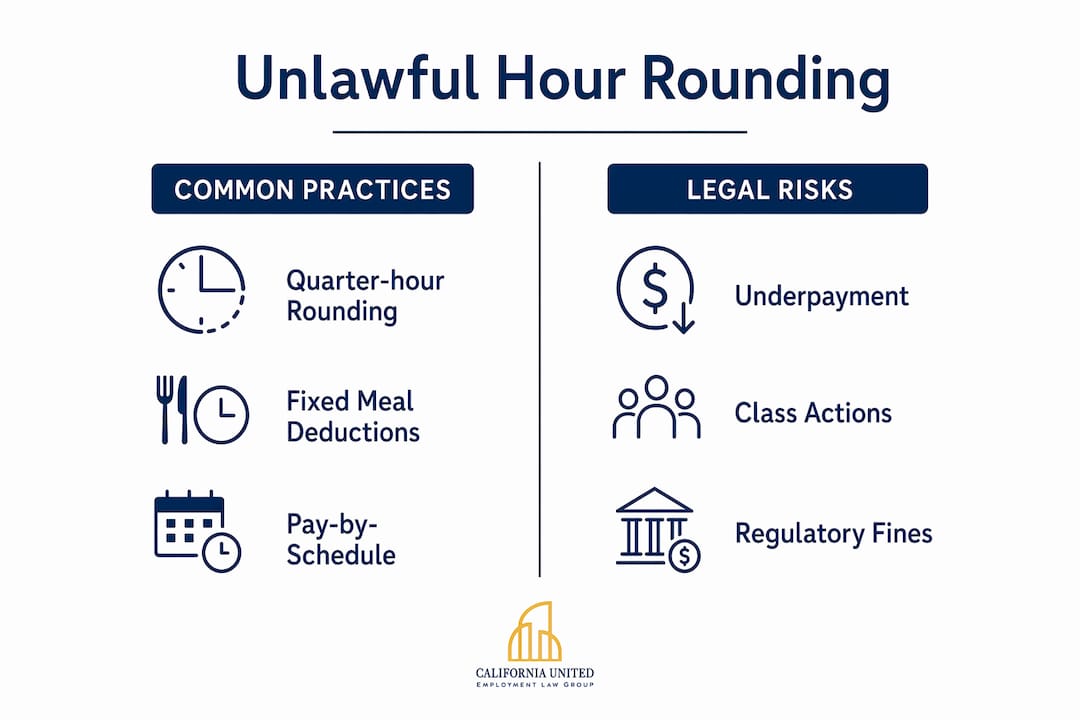
Systematic rounding to the nearest quarter-hour. A 15-minute rounding increment sounds neutral, but if an employee consistently clocks in at 8:07 AM and the system records 8:15 AM, that employee loses 8 minutes every single morning. Over a year, that adds up to hours of unpaid work.
Rounding meal breaks to exactly 30 minutes. A healthcare worker in Torrance who takes a 24-minute lunch because the floor was busy does not get a compliant meal period just because the timekeeping system rounds it to 30 minutes. Under Donohue, rounding cannot make a short meal period compliant, and records showing short meal periods can support a rebuttable presumption of a violation. If a required meal period was not provided, premium pay may be owed.
Pay-by-schedule for shift workers. Some Torrance employers pay based on a posted schedule rather than actual punch times. If your employer knows or should know that you are working before your official start time or after your scheduled end time, that time may be compensable.
Rounding that only benefits the employer. A policy that rounds up when an employee clocks in late but rounds down when an employee clocks out early is not neutral. A one-sided rounding policy is difficult to defend because lawful rounding, where still recognized, must be fair and neutral and must not undercompensate employees over time. Employer liability for inaccurate timesheets is well-established in California case law.
Automatic deductions for breaks not actually taken. Some payroll systems automatically deduct 30 minutes for a meal break regardless of whether the employee actually took one. If you worked through lunch and your paycheck reflects an automatic deduction anyway, that may indicate unpaid wages or a meal-period violation.
Penalties And Remedies For Unlawful Rounding Under California Law
California law gives employees real tools to recover what they are owed. The penalties for employers who violate timekeeping laws can be substantial.
Employees who prove they were underpaid due to unlawful rounding may recover unpaid wages and, where available, interest and statutory remedies. Additional remedies may be available for final-pay and wage-statement violations, depending on the facts and statutory requirements.
Class action lawsuits are a significant risk for Torrance employers with widespread rounding policies. When a rounding practice affects multiple employees, a representative claim under California’s Private Attorneys General Act may be considered if statutory prerequisites are satisfied. PAGA claims have become one of the primary enforcement mechanisms for wage and hour violations in California.
The California Labor Commissioner’s office may investigate wage claims and, where appropriate, award unpaid wages through the administrative process. Filing a wage claim with the Labor Commissioner is a no-cost option for many employees.
Where Torrance Workers Can Get Help
Several agencies and resources are available to Torrance hourly workers dealing with timekeeping violations.
The California Labor Commissioner’s Office (also called the Division of Labor Standards Enforcement, or DLSE) handles wage claims, investigates employer violations, and can order payment of unpaid wages. The DLSE website provides claim forms and information on the process.
The California Department of Industrial Relations oversees wage and hour enforcement statewide and publishes guidance on employee rights under the Labor Code and IWC wage orders.
For workers in the Los Angeles area, including Torrance, legal aid organizations and worker centers can provide general information about wage rights, though they do not substitute for legal counsel on specific claims.
Employees who believe their hours have been rounded unlawfully should also consider consulting an employment attorney. Many wage and hour attorneys in California handle appropriate cases on a contingency basis, meaning no upfront attorney’s fee to the employee.
California United Law Group’s Perspective On Torrance Rounding Cases
The legal standards around time rounding have become more employee-protective, particularly after Troester and Donohue. Camp v. Home Depot raised significant questions about rounding when employers have precise digital time records, but the California Supreme Court has granted review, so the final rule remains pending.
The burden of proving that a rounding policy is neutral and does not result in aggregate underpayment falls on the employer, not the employee. That is a meaningful shift. Employees may be able to prove unpaid time through reasonable estimates when an employer failed to keep accurate records, but the available proof and burden issues depend on the facts. Documenting the pattern, as described earlier, is the most practical first step.
California United Law Group handles California Labor Code and wage-and-hour claims, including cases involving time rounding, off-the-clock work, and related violations. The firm represents employees at all stages, from initial consultation through litigation, and serves workers throughout the greater Los Angeles area, including Torrance.
California United Law Group Can Review Your Potential Unpaid Wage Claim
If you are a Torrance hourly worker and your paychecks do not reflect the hours you actually worked, you have legal options worth understanding. California United Law Group represents employees in wage-and-hour disputes, including cases where time-rounding practices may have reduced pay over months or years. The firm handles California Labor Code claims and can evaluate whether your employer’s timekeeping practices cross the line under current law.
Contact California United Law Group to discuss your situation with an employment attorney who handles California wage-and-hour matters.
This article is for general educational purposes only, does not constitute legal advice, and does not create an attorney-client relationship. Employment law issues are fact-specific, and outcomes vary.
Key Takeaways
California law requires employers to pay for compensable time worked, and recent court rulings have made meal-period rounding and undercompensating rounding policies significant wage-and-hour risks.
| Point | Details |
|---|---|
| Meal period rounding is prohibited | Donohue v. AMN Services, LLC (2021) bans rounding meal period punches and creates a presumption of violation. |
| Exact time capture requires exact pay | Camp v. Home Depot questioned rounding where precise digital timekeeping exists, but California Supreme Court review is pending. |
| Employer bears the burden of proof | A rounding policy, where legally recognized, must be fair and neutral and must not undercompensate employees over time. |
| Document your own hours | Keeping a personal log of clock-in, clock-out, and break times strengthens any wage claim you may file. |
| California United Law Group | A rounding policy, where legally recognized, must be fair and neutral and must not undercompensate employees over time. |
Recommended
- Rounding Time Entries: What Alhambra Employees Need To Know – California United Law Group
- Torrance Unpaid Wages: Recovering Missing Compensation – California United Law Group –
- Off-the-clock work in El Monte warehouses: Know your rights – California United Law Group
- Glendale Off-the-Clock Work Violations: Know Your Rights – California United Law Group –