
Most employees file a workplace lawsuit for one of five reasons: discrimination, harassment, retaliation, wrongful termination, or unpaid wages. The remedies and deadlines differ by claim type. Discrimination, harassment, and many FEHA retaliation claims usually require an administrative filing with the EEOC or California’s Civil Rights Department before a lawsuit, while wage-and-hour and common law claims may follow different paths, including the Labor Commissioner or direct civil litigation. Employment law firms typically begin here before any complaint is drafted.
TL;DR:
- Federal deadlines can be as short as 180 or 300 days, while many California FEHA claims require a CRD filing within three years, subject to limited exceptions.
- Discrimination claims often involve patterns of biased behavior over time, such as repeated passes over-qualified employees or age-based replacements.
- Retaliation cases are supported by timing, such as firing soon after a harassment complaint or refusal to falsify records, but require a causal link.
- Most employment disputes resolve through agency settlement or mediation, with lawsuits often taking one to three years to conclude.
- Complex or high-stakes claims often warrant legal guidance, especially when they involve significant wage loss, retaliation, or class or representative claims.
Table of Contents
- Situations That Actually Lead Employees to Sue
- The Legal Grounds Behind These Claims
- Filing an Agency Charge: Where and How
- How Long It Takes and Deadlines You Cannot Miss
- What You Might Gain, and What It Might Cost You
- When an Employment Attorney Changes the Outcome
- What We See in Practice
- Talk to Someone Before a Deadline Passes
- Sources
Situations That Actually Lead Employees to Sue
Not every bad day at work becomes a lawsuit. What separates a frustrating job from an actionable claim usually comes down to whether the employer’s conduct crosses a specific legal line, not just an ethical one.
Discrimination tied to a protected characteristic is the most common trigger. A qualified employee passed over for promotion three times in favor of less-experienced colleagues, all while managers make comments about her being “better suited for maternity leave,” has a discrimination pattern worth examining. The same is true when a 58-year-old worker is replaced by someone half his age after being told he “doesn’t fit the new culture.”
Harassment claims usually involve conduct that is severe or pervasive, not a single rude remark. A supervisor who repeatedly propositions a subordinate, or a workplace where slurs and degrading jokes about someone’s disability go unaddressed after complaints, may present facts that warrant legal review. Our guide on what counts as workplace harassment breaks down the legal threshold in more detail.
Retaliation shows up when an employee reports misconduct, requests a disability accommodation, or takes protected leave, and then faces demotion, a sudden negative review, or termination shortly after. Timing alone does not prove causation, but a close sequence of events can help support a retaliation claim when combined with other evidence.
Common triggers include:
- Being fired within weeks of filing an internal harassment complaint
- Losing a promised bonus after requesting FMLA or CFRA leave
- Getting written up for the first time only after joining a union organizing effort
- Facing termination after refusing to falsify safety or financial records
Wrongful termination claims may arise when an employee is fired for a reason that violates public policy, such as refusing to break the law. Separate contract-based claims may arise when an employer breaches a specific enforceable promise, such as a written policy or agreement. Wage-and-hour violations, including unpaid overtime or missed meal breaks across an entire department, frequently expand into class or representative actions once one employee comes forward.
The Legal Grounds Behind These Claims
Federal law and California law overlap but aren’t identical, and knowing which applies changes both your options and your deadlines.
At the federal level, Title VII of the Civil Rights Act bars discrimination based on race, color, religion, sex, and national origin. The Americans with Disabilities Act (ADA) covers disability discrimination and accommodation failures. The Age Discrimination in Employment Act (ADEA) protects workers 40 and older, and the Equal Pay Act addresses sex-based wage disparities for equal work.
California adds broader protections through the Fair Employment and Housing Act (FEHA), which covers more categories than federal law, including marital status and gender identity, and generally applies to employers with five or more employees. The California Labor Code governs wage claims and, under Section 98.6, protects employees from retaliation for filing them.
California courts emphasize that employment claims are fact-specific. In Harris v. City of Santa Monica, the California Supreme Court addressed the “substantial motivating reason” standard used in FEHA cases. CACI explains that a substantial motivating reason must actually contribute to the adverse employment action and must be more than a remote or trivial reason, although it does not have to be the only reason. In Yanowitz v. L’Oreal USA, Inc., the California Supreme Court described retaliation claims as requiring protected activity, an adverse employment action, and a causal link between the two. These standards are why documentation, timing, witness accounts, and the employer’s stated reason for the decision matter so much.
Most discrimination and retaliation claims focus on several core questions:
- Did the employee have a protected trait or engage in protected activity?
- Did the employer take an adverse action, such as firing, demotion, a pay cut, or denial of promotion?
- Was the protected trait or activity a substantial motivating reason for the adverse action?
- Did the employee suffer harm, and did the adverse action substantially cause that harm?
Contract and wage claims work differently. They often turn on documents, not motive, so a signed offer letter, an employee handbook, or timecards can carry more weight than testimony about intent.
Filing an Agency Charge: Where and How
Before most FEHA or federal discrimination, harassment, or retaliation lawsuits reach a courtroom, they pass through an administrative agency. This step isn’t optional for federal claims; it’s a legal prerequisite called exhaustion.
- Consider the EEOC process if your claim involves Title VII, the ADA, or the ADEA. Equal Pay Act claims can involve different filing options and deadlines, so employees should confirm the correct path before filing.
- File with California’s Civil Rights Department (CRD), the state agency that enforces FEHA, if your employer has five or more employees and your claim fits California’s broader protected categories.
- Ask whether cross-filing applies. California and the EEOC have a work-sharing agreement, but employees should confirm that the filing preserves every claim and deadline that matters to their situation.
- Wait for agency action, which can include investigation, an offer of mediation, or dismissal with a right-to-sue letter that clears the way for a civil lawsuit.
USA.gov outlines general routes for employees who are not sure where to start.
How Long It Takes and Deadlines You Cannot Miss
Agency charges typically resolve or convert to a right-to-sue letter within several months, while a full lawsuit through trial can take one to three years, sometimes longer if it involves class claims.
Deadlines are unforgiving. The EEOC generally requires filing within 180 or 300 days of the discriminatory act, depending on whether a state agency also covers the claim. For many FEHA claims, California generally gives employees three years from the unlawful practice to file with the CRD, subject to limited exceptions. After the CRD issues a right-to-sue notice, a civil lawsuit generally must be filed within one year. Cross-filing can extend certain deadlines, but it doesn’t erase them. Miss the window, and even a strong claim can be barred entirely.
What You Might Gain, and What It Might Cost You
Filing a workplace lawsuit isn’t just about being right. It’s about weighing a realistic outcome against a real cost in time and stress.
Possible remedies include:
- Back pay and lost benefits
- Reinstatement, though this is less common than a monetary settlement
- Emotional distress damages
- Punitive damages in some cases involving especially wrongful conduct, if the legal standard is met
- Policy changes at the company, even without a personal payout
Pro Tip: A settlement does not require a jury verdict, but the strength of the evidence still affects negotiation leverage. Many disputes resolve during the agency investigation or mediation stage, long before a courtroom is ever involved.
The trade-offs are real. Litigation can stretch over months or years, strain workplace relationships if you’re still employed, and take an emotional toll regardless of outcome. Agency data shows that many charges resolve through settlement, mediation, or administrative processing rather than trial, which is important to understand before assuming every claim will involve years in court.
When an Employment Attorney Can Help
Some claims are simple enough to navigate with agency help alone. Others involve stakes or complexity where legal representation makes a meaningful difference.
Cases involving significant lost wages, retaliation layered on top of discrimination, class or representative wage claims, or conflicting witness accounts tend to benefit most from attorney involvement. An employment attorney can help preserve evidence, prepare agency paperwork, evaluate deadlines, and negotiate settlement terms based on the facts and applicable law.
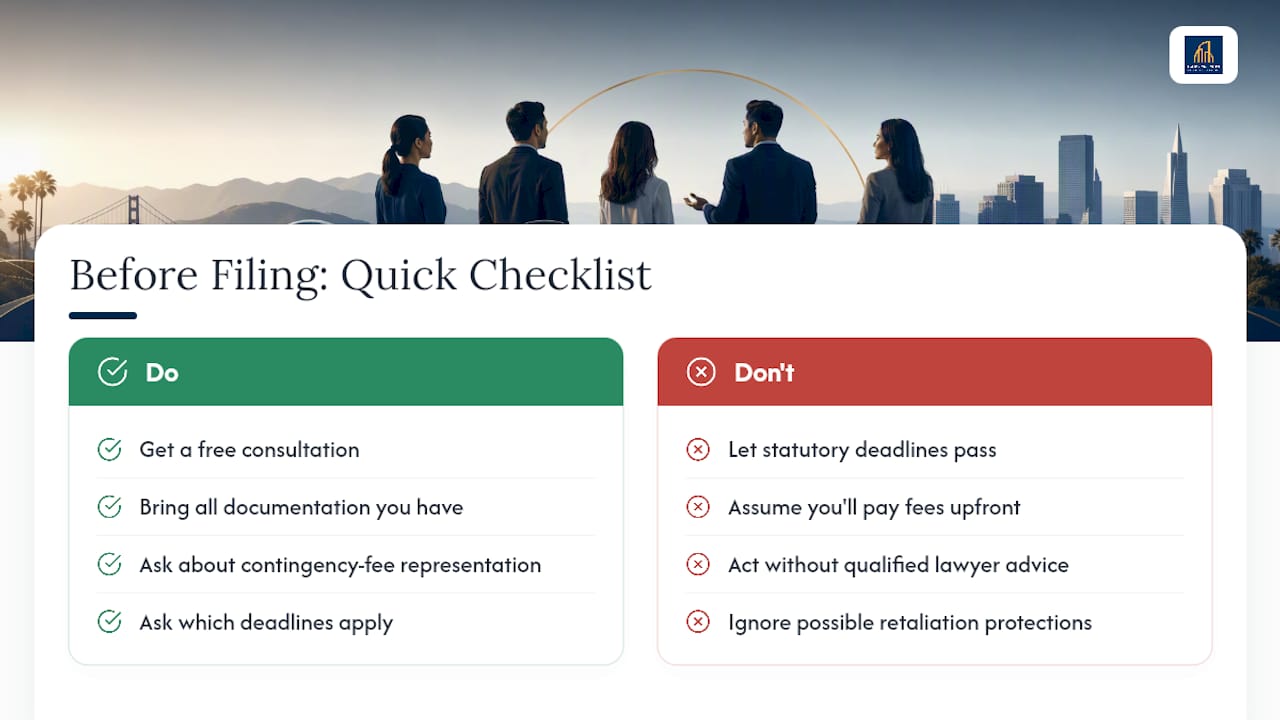
Many employment firms work on a contingency-fee basis, meaning attorney fees are typically paid from a settlement or award rather than upfront. Ask whether you may still be responsible for litigation costs or expenses. Bring documentation to a consultation: pay stubs, performance reviews, emails, and a written timeline of events. If you are weighing whether your termination itself was lawful, our overview of California termination rights is a useful starting point before contacting an employment attorney, including a Burbank-based firm serving employees throughout California.
What We See in Practice
Employment law firms handling FEHA and California Labor Code claims typically focus on documentation, timing, and whether an administrative deadline is approaching. Clients often bring emails, performance reviews, and termination letters, and case timelines vary widely depending on whether a claim settles during agency mediation or proceeds toward litigation. Law teams treat every evaluation as fact-specific, because in employment law, it always is.
— California United Law Group
Talk to Someone Before a Deadline Passes
If you are weighing whether your situation fits the discrimination, harassment, retaliation, or wage patterns described above, a free consultation can help identify the deadlines and legal issues that may apply. Some employment law firms represent California employees on a contingency-fee basis, meaning attorney fees may come from a settlement or award rather than upfront. Ask whether costs or expenses remain the client’s responsibility. Attorneys evaluate the strength of your evidence, the deadlines that apply to your specific claim, and whether administrative filing or direct litigation makes more sense for your facts. If retaliation is part of your situation, our page on retaliation rights in California covers the protections that may apply. To find out where your case stands, reach out for a consultation and bring whatever documentation you have.
This article is general information, not a substitute for advice from a qualified lawyer. Reading this article or contacting the firm through the website does not by itself create an attorney-client relationship. Consult a qualified legal professional about your own circumstances before acting on anything here.
Sources
- Filing A Charge of Discrimination – EEOC
- Discrimination, harassment, and retaliation | USAGov
- California Workplace Discrimination Law: FEHA Rights & Protections (2026)
- California Labor Code, LAB 98.6