
Yes, many non-exempt Burbank employees who worked over 8 hours in a workday or 40 hours in a workweek without receiving overtime pay may have a claim under California Labor Code § 510 and § 1194, depending on their exemption status, industry wage order, and pay arrangement. You can pursue it through the Labor Commissioner’s office or civil court. Start by pulling together your paystubs and any record of hours worked, since that documentation shapes everything that follows.
TL;DR:
- Non-exempt Burbank employees generally earn 1.5 times their regular rate after 8 hours in a workday, after 40 hours in a workweek, and for the first 8 hours on the seventh consecutive workday in a workweek; double time generally applies after 12 hours in a workday and after 8 hours on the seventh consecutive workday, subject to exemptions, valid alternative workweek schedules, CBAs, and applicable wage orders.
- Accurately calculating the regular rate requires including bonuses and commissions, which employers often overlook, increasing underpayment risks.
- Filing a wage claim with the DLSE requires gathering pay records and submitting specific forms; people without legal counsel can often resolve straightforward cases.
- Evidence such as time-clock records, personal logs, and communication references significantly strengthens unpaid overtime claims.
- Misclassification as exempt or a contractor remains a common cause of unpaid overtime, especially in industries with irregular schedules like entertainment and logistics.
Table of Contents
- How does California overtime law apply to Burbank employees?
- How do you file a wage claim with the Labor Commissioner in Burbank?
- What evidence strengthens an unpaid overtime claim?
- Could misclassification be why you’re not getting overtime?
- What’s the deadline to file an unpaid overtime claim?
- What compensation can you recover for unpaid overtime?
- Should you file with the DLSE or consult an attorney?
- Do local Burbank rules affect overtime claims beyond state law?
- California United Law Group’s perspective on Burbank overtime cases
- How can California United Law Group help with your Burbank overtime claim?
- Official forms and statutes to consult
- Sources
How does California overtime law apply to Burbank employees?
California overtime law provides strong protections for non-exempt employees, but whether overtime is owed can depend on the employee’s duties, schedule, wage order, and pay structure. Under Labor Code § 510, non-exempt employees earn 1.5 times their regular rate for any hours worked beyond 8 in a day or 40 in a week. Overtime also applies to the first 8 hours worked on the seventh consecutive day in a workweek, and double time applies after 12 hours in a workday and after 8 hours on that seventh consecutive workday. Rutter summarizes California law as requiring time-and-a-half for hours over 8 in a day, over 40 in a week, and for the first 8 hours on the seventh consecutive workday, with double time after 12 hours in a day and after 8 hours on the seventh consecutive workday.
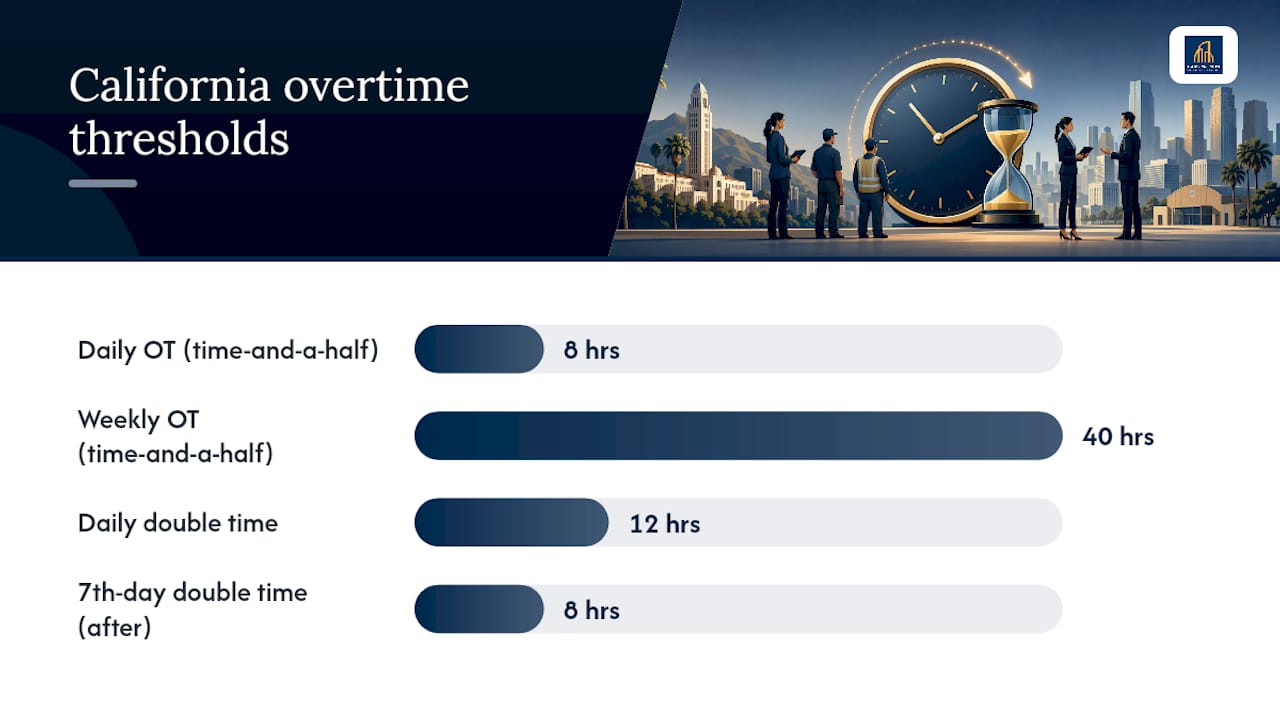
The “regular rate” trips up a lot of Burbank workers, especially those who earn bonuses or commissions on top of a base wage. Your regular rate isn’t just your hourly wage. It often must include non-discretionary bonuses and commissions, but the calculation depends on the type of compensation and the applicable formula. For example, California uses a specific formula for flat-sum bonuses, while commissions and other incentive pay may be handled differently. The California Supreme Court has held that a flat-sum bonus must be factored into the regular rate by dividing the bonus by non-overtime hours actually worked in the pay period and using a 1.5 multiplier for overtime. Alvarado v. Dart Container Corp. of California (2018) 4 Cal.5th 542 addressed how flat-sum bonuses are included in the regular rate for California overtime purposes. Employers frequently miscalculate this, and the gap between what you were paid and what you were owed can be larger than it looks on a paystub.
Statutory Fact: Non-exempt Burbank employees generally are entitled to double time for hours worked past 12 in a single workday under California overtime rules, subject to any applicable wage order, valid alternative workweek schedule, or qualifying collective bargaining agreement.
A few other factors that affect eligibility:
- Off-the-clock work can count. If your employer knew or should have known you were working overtime, that time may be compensable even if the work was not formally authorized.
- Alternative workweek schedules exist, but they require a properly adopted schedule, including the required employee approval process and compliance with Labor Code and wage-order rules.
- Some industries have unique rules, including healthcare and certain unionized trades, where wage orders adjust standard thresholds.
If your job involves answering emails after clocking out, prepping before a shift officially starts, or working through unpaid breaks, those facts may need to be included when evaluating whether overtime was underpaid.
How do you file a wage claim with the Labor Commissioner in Burbank?
The Division of Labor Standards Enforcement, commonly called the DLSE or the Labor Commissioner’s office, offers a no-cost administrative path for recovering unpaid overtime. You don’t need to hire an attorney to file, though the process rewards preparation.
Here’s the general sequence:
- Gather your records. Paystubs, schedules, any written communication about hours, and your own notes on when you actually worked.
- Complete DLSE Form 1, the Initial Report or Claim, which starts the administrative process.
- Fill out DLSE Form 55, the computation worksheet, to estimate the overtime hours and wages you believe you’re owed.
- Submit your claim online, by mail, or in person at a local DLSE office. There is no filing fee.
- Wait for a determination on next steps, which may include a conference, hearing, or other action by the Labor Commissioner depending on the claim.
- Attend a hearing if settlement fails. A hearing officer reviews evidence from both sides and issues a decision, called an Order, Decision, or Award.
A few practical notes make the difference between a clean filing and a frustrating one:
- Submit copies of your documents, never originals. The DLSE keeps your file, and originals can get lost in the shuffle.
- If your hours varied week to week, use the Form 55 worksheet to organize your best estimate by pay period, workweek, or workday where possible, rather than relying on a single rough number.
- Forms and instructions are available in multiple languages, so language barriers shouldn’t keep you from filing.
The DLSE’s wage hearing process is designed to be accessible without legal representation for straightforward claims. That said, claims involving misclassification, multiple employees, or complicated pay structures often move more efficiently with counsel involved from the start.
What evidence strengthens an unpaid overtime claim?
Documentation often makes wage claims stronger. The stronger your paper trail, the harder it is for an employer to dispute what you’re owed.
Employer-generated records carry the most weight: time-clock printouts, payroll registers, posted schedules, and paystubs showing hours and rate. But you don’t need to perfect employer records to file. California law requires employers to maintain accurate time and payroll records, and gaps in those records may make an employee’s reasonable estimates and supporting evidence more important.
Your own records matter too. The DLSE regularly accepts personal documentation when official records are incomplete or unavailable, including:
- A personal calendar or diary noting arrival and departure times
- Text messages or emails referencing work hours or tasks completed after hours
- Photos of posted schedules
- Trip sheets or delivery logs if your work involves travel
Pro Tip: Start a simple daily log today, even if you’re unsure whether you’ll file a claim. Write down your start time, end time, and any unpaid tasks performed before or after your shift. A contemporaneous log carries more credibility than a reconstruction six months later.
When calculating what you’re owed, avoid the most common miscalculation: leaving bonuses or commissions out of the regular-rate formula. This single error, documented by the DLSE, causes many employees to underestimate their own claims before they even file.
Could misclassification be why you’re not getting overtime?
Being paid a salary doesn’t automatically mean you’re exempt from overtime. That’s one of the most persistent misunderstandings among Burbank workers, and employers sometimes exploit it, intentionally or not.
Exemption depends on a duties test and a minimum salary threshold, not your job title. A worker classified as a “manager” who spends most of the workday doing the same tasks as hourly staff, with little independent decision-making authority, may not qualify for the executive exemption regardless of what the offer letter says.
The main exempt categories include:
- Executive employees who primarily manage a department and direct the work of at least two other employees
- Administrative employees who exercise independent judgment on significant business matters
- Professional employees in recognized fields like law, medicine, or licensed accounting
Beyond these categories, IWC wage orders create industry-specific rules, and healthcare workers in particular face distinct scheduling exceptions.
Independent contractor misclassification is a related trap. If your employer controls your schedule, provides your equipment, and directs how you perform your work, the contractor label may be subject to challenge depending on the full facts and applicable legal test. Courts and the DLSE look at the actual working relationship, not the label on your paperwork.
What’s the deadline to file an unpaid overtime claim?
Waiting rarely helps a wage claim, and it can actively hurt one. California wage claims often involve a three-year limitations period for unpaid overtime or minimum wage claims, while some written-contract theories may involve a longer period and some penalty claims may have shorter deadlines. The exact deadline depends on the legal theory, facts, and forum. Some penalty claims, including those tied to bounced paychecks or missing payroll records, carry shorter windows.
Key Timing Fact: Each underpaid paycheck starts its own three-year clock, according to California’s statute of limitations framework. That means older violations may age out even while more recent underpayments may still be timely, depending on the claim and filing date.
This per-paycheck rule matters practically:
- You don’t lose your entire claim just because some violations happened years ago.
- Filing sooner preserves your ability to recover the widest span of paychecks.
- Delay narrows your available window one paycheck at a time, not all at once.
The DLSE’s filing deadline guidance confirms these general windows, though exact deadlines depend on the type of violation involved. Acting within the current window, rather than assuming you have unlimited time, keeps more of your claim intact.
What compensation can you recover for unpaid overtime?
A successful claim can cover more than the overtime hours themselves.
- Unpaid overtime and double time for all qualifying hours, calculated at the correct regular rate
- Meal and rest period premiums, where legally available, usually measured as one additional hour of pay for qualifying meal or rest period violations under the applicable wage order and Labor Code rules.
- Waiting-time penalties under Labor Code § 203 if your final paycheck was late after separation
- Interest and, in a civil action, attorney’s fees, available under Labor Code § 1194
Administrative awards through the DLSE and civil judgments differ in scope and enforcement mechanics. A DLSE Order, Decision, or Award resolves the specific claim filed, while a civil lawsuit can address broader issues, including class or representative claims affecting multiple coworkers. Every case turns on its own facts, and recovery amounts vary accordingly.
Should you file with the DLSE or consult an attorney?
Simple, single-employee claims with decent documentation often move fine through the DLSE without legal representation. If your situation fits that description, filing on your own is a reasonable place to start.
Cases tend to benefit from counsel when they involve:
- Suspected misclassification as exempt or as an independent contractor
- Multiple employees facing the same violation, which can support a class or representative action
- Complex pay structures involving commissions, bonuses, or multiple pay rates
- An employer disputing basic facts about your hours or job duties
Legal representation adds value in specific ways: accurate regular-rate calculations that account for every pay component, preservation of evidence before it disappears, and access to civil litigation remedies that go beyond what an administrative claim can reach. For workers dealing with these more complicated scenarios, resources on wage and hour rights outline when the added complexity of a lawsuit makes sense.
Pro Tip: Bring your paystubs, any written schedule, and a written timeline of events to a consultation, even a rough one. Attorneys can assess a claim far faster when the basic facts are organized.
Contingency-fee representation, which many employment firms offer, often means you pay no attorney’s fees upfront and fees are paid from a settlement or award if the case succeeds. Ask any lawyer you consult to explain in writing whether you may be responsible for litigation costs or expenses, regardless of outcome. Every situation is fact-specific, and this article offers general information rather than legal advice tailored to your circumstances.
Do local Burbank rules affect overtime claims beyond state law?
As of the date of this article, Burbank does not appear to maintain a separate municipal wage ordinance that changes California’s statewide overtime thresholds. Employees should still check current local rules because city ordinances can change. Unlike some California cities that have adopted their own minimum wage ordinances, Burbank employees fall under the statewide framework established by Labor Code § 510 for overtime calculations.
That doesn’t mean location is irrelevant. Burbank’s economy leans heavily on entertainment, media production, and logistics, industries where irregular schedules, on-call demands, and long production days are common. These industry patterns often create the exact conditions where overtime violations happen, even though the underlying legal rules are the same statewide standards that apply anywhere in California.
Workers in Burbank’s studio and production sector, in particular, should pay attention to how “wrap time,” prep time, and travel between locations get logged, since these are frequent sources of unpaid hours. If your employer operates under an industry-specific wage order, that order may adjust some scheduling rules, but the core overtime math under state law still governs. For most Burbank employees, the DLSE wage-claim process will follow the same statewide procedures used elsewhere in California, with local office assignment depending on current DLSE practices.
California United Law Group’s perspective on Burbank overtime cases
In Burbank’s production and logistics-heavy job market, recurring wage-and-hour issues can include unpaid prep or wrap time, salaried employees performing primarily non-exempt work, and missed meal premiums that do not appear on paystubs. The common thread is documentation that started too late.
Our strongest advice stays consistent regardless of the specific facts: start logging hours as early as possible when you suspect a problem, even before you are certain, to preserve evidence. Every case is different, and this article is educational rather than legal advice. Case-specific guidance requires a conversation about your actual facts.
— California United Law Group
How can California United Law Group help with your Burbank overtime claim?
California United Law Group helps Burbank employees evaluate and pursue unpaid overtime claims, including claims that may be handled on a contingency-fee basis. In contingency-fee matters, attorney’s fees are typically paid from a successful settlement or award rather than upfront. Cost responsibility can vary by agreement, so any fee arrangement should be reviewed carefully before representation begins.
We offer free case evaluations to help you understand whether your situation fits an administrative DLSE claim, a civil lawsuit, or both. Our team assists with accurate regular-rate calculations, evidence preservation, and, when a case calls for it, full civil litigation to pursue remedies beyond what an administrative claim allows.
Before reaching out, gather your paystubs, any notes on your work schedule, and a rough timeline of when the unpaid hours occurred. Every case is fact-specific, and initial guidance is general rather than a guarantee of outcome. If you suspect unpaid overtime, contact our team for a free case evaluation to discuss potential options based on your specific facts.
Official forms and statutes to consult
Before filing, check these official sources directly, since forms and translations update periodically:
California courts have also addressed key overtime issues. In Alvarado v. Dart Container Corp. of California, the California Supreme Court explained how flat-sum bonuses must be included in the regular-rate calculation for overtime. In Ramirez v. Yosemite Water Co., the Court addressed exemption analysis and confirmed that exemption status depends on the employee’s actual work, not just a job title. These cases illustrate why overtime claims often turn on detailed facts about pay structure, duties, and hours worked. CACI cites Alvarado for flat-sum bonus regular-rate calculations and Ramirez for the rule that exemption is an affirmative defense involving law and fact.
- California Labor Code § 510 for overtime and double-time thresholds
- California Labor Code § 1194 for civil recovery rights
- DLSE wage claim filing instructions for Form 1, Form 55, and supporting document requirements
- DLSE filing deadline guidance for current statute-of-limitations details
This article is general information, not a substitute for advice from a qualified lawyer. Consult a qualified legal professional about your own circumstances before acting on anything here.
Sources
Recommended
- Start Documenting Hours Now, Long Beach Overtime Claims and DLSE Steps
- Glendale Off-the-Clock Work Violations: Know Your Rights
- Burbank Employee Legal Help for Workplace Rights, Counseling, and Filing Options
- How Disney’s Wage Lawsuit Changed Overtime Compliance in Southern California: Lessons from Grace v. Disney