
Yes, Pasadena employees can sue for wrongful termination when the firing violates California or federal law, including FEHA discrimination protections, Title VII, ADA and ADEA, Labor Code retaliation rules, or the Tameny public-policy doctrine. The right path depends on your facts: some claims require a CRD or EEOC filing first, others go straight to civil court. Your immediate move is to preserve every relevant document, avoid signing any severance agreement, release, waiver, arbitration agreement, or admission without legal review, and get a consultation to map your deadlines before they lapse.
TL;DR:
- Employees generally must file a verified complaint with the California Civil Rights Department within three years for FEHA claims, and must file a civil lawsuit within one year after the CRD issues a right-to-sue notice.
- Wrongful termination based on discrimination, retaliation, whistleblowing, or breach of contract often hinges on timing and documentation, such as recent performance reviews or witness statements.
- Missing filing deadlines, such as three years for FEHA or 300 days for federal claims, can result in losing the right to sue, emphasizing the need for prompt legal review.
- Evidence like termination letters, emails, and employment policies play a crucial role in proving pretext or discriminatory motives during litigation.
- Consulting an employment attorney early can help preserve claims, navigate procedural choices, and avoid costly mistakes like signing waivers or revealing case theories prematurely.
Table of Contents
- What laws let you sue after a wrongful termination in Pasadena
- Real examples of wrongful termination Pasadena workers should recognize
- Deadlines that decide whether you can still sue
- Evidence that actually moves a wrongful termination case
- What compensation looks like in a wrongful termination case
- What to do next and how a Pasadena employment attorney can help
- A Pasadena attorney’s perspective: common mistakes and realistic expectations
- Talk to an employment attorney about your termination
- Sources
What laws let you sue after a wrongful termination in Pasadena
California is an at-will employment state, meaning employers can generally fire workers for any reason or no reason at all. But at-will status is not absolute. Several recognized exceptions and legal theories can turn an ordinary firing into an illegal termination under California law, including breach of an express or implied contract, wrongful discharge in violation of public policy, discrimination, retaliation, and whistleblower protections.
The Fair Employment and Housing Act (FEHA) is the backbone of most California wrongful termination claims. It bars firing someone based on protected characteristics such as race, sex, age, disability, religion, national origin, sexual orientation, gender identity, pregnancy, and other protected categories. For many discrimination claims, FEHA applies to employers with five or more workers, which means many Pasadena employees have state-level protection even in situations where narrower federal statutes would not reach. Most FEHA claims require you to file with California’s Civil Rights Department (CRD) before heading to court, a process known as administrative exhaustion.
Federal law runs alongside FEHA and sometimes covers ground FEHA does not. Title VII, the ADA, and the ADEA prohibit similar categories of discrimination, and you can often file with the EEOC and CRD simultaneously through a dual-filing arrangement. The EEOC’s data and guidance explain how federal charges move through the system once filed.
Beyond discrimination, several other legal theories matter:
- Tameny claims allow a wrongful termination lawsuit when a violation of fundamental public policy was a substantial motivating reason for the firing, even if the claim is framed as a common-law tort rather than a statutory FEHA claim.
- Labor Code retaliation protections cover employees fired for reporting safety violations, filing a workers’ compensation claim, or refusing to break the law at an employer’s request.
- Contract-based claims arise when a written or implied agreement promised job security or listed specific grounds for termination, and your employer ignored those terms.
- Federal leave retaliation can apply when someone is fired for taking protected time off, an area the DOL’s FMLA guidance addresses directly.
California courts have long recognized that an at-will employee may still have a claim when the firing violates fundamental public policy. In Tameny v. Atlantic Richfield Co., the California Supreme Court recognized that an employee discharged for refusing to participate in unlawful conduct may pursue tort damages. CACI 2430 frames the core issue for juries as whether the protected public-policy conduct was a substantial motivating reason for the discharge. Later cases also recognize public-policy claims tied to workplace safety, whistleblowing, discrimination, and other statutory policies, depending on the facts.
Identifying which theory fits your situation is often the difference between a claim that survives and one that gets dismissed early. A neutral government overview can be a useful starting point if you are still sorting out which category applies.
Real examples of wrongful termination Pasadena workers should recognize
Legal theories are abstract until you see them play out. Here are common fact patterns that tend to signal an unlawful firing rather than a lawful business decision.
- Sudden performance complaints after a protected disclosure. An employee with years of solid reviews gets fired within weeks of requesting a disability accommodation or reporting harassment. The timing itself often raises questions about the employer’s real motive.
- Termination shortly after a workers’ compensation claim. California law protects employees who file for benefits after a workplace injury, and firing someone in that window invites scrutiny under Labor Code retaliation rules.
- Firing after whistleblowing on safety or legal violations. An employee who reports unsafe conditions, fraud, or regulatory violations internally or to a government agency may be protected, depending on the statute involved and the connection between the report and the adverse action.
- Selective enforcement of policy. One employee is fired for an infraction that coworkers outside a protected class commit regularly without consequence.
- Breach of an employment contract. A written agreement guarantees a term of employment or lists specific grounds for termination, and the employer fires the worker outside those terms.
- Retaliation after an internal HR complaint. An employee reports harassment, and instead of investigating, the employer terminates them within days, a pattern the EEOC’s retaliation guidance treats as a recognized red flag.
None of these examples guarantee a winning case on their own. Motive and pretext are usually proven through a combination of timing, comparison to how other employees were treated, and documentation, not a single smoking-gun email.
Deadlines that decide whether you can still sue
Wrongful termination claims run on strict clocks, and missing one can permanently close the door on an otherwise strong case. The timelines differ depending on which legal theory applies to your firing.
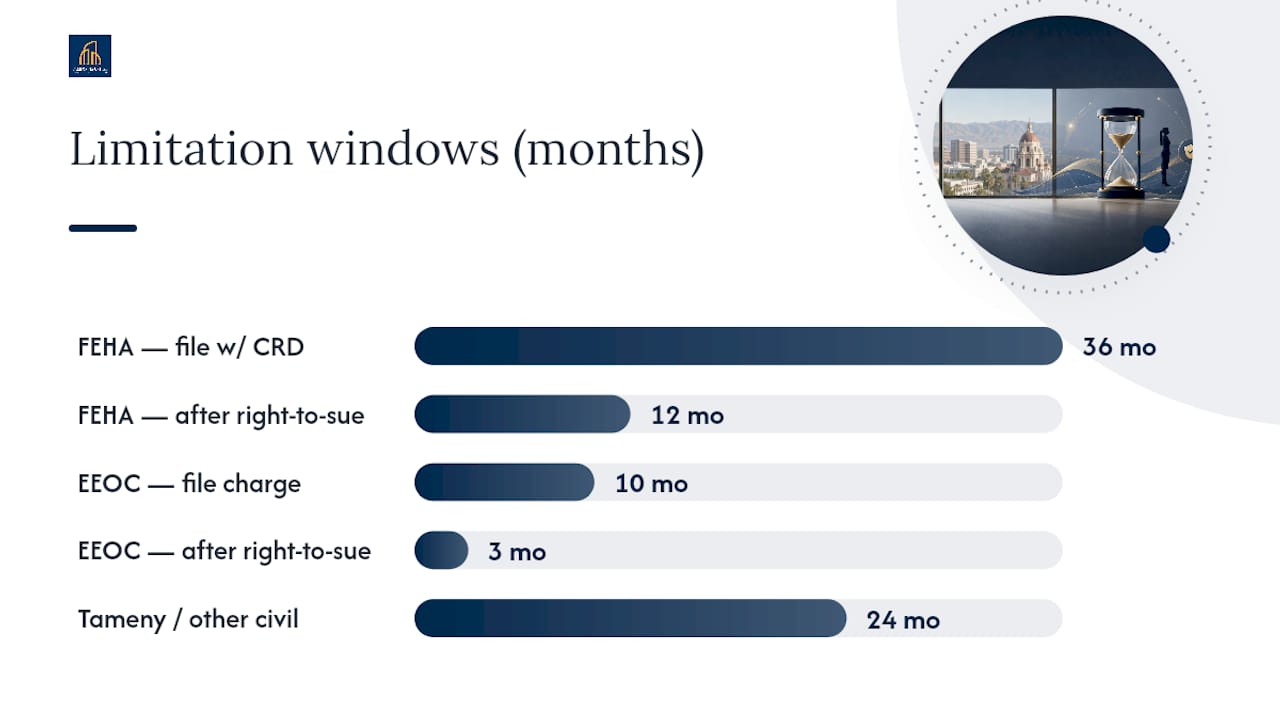
- FEHA/CRD claims: You generally have three years from the alleged unlawful employment practice to file a verified complaint with the Civil Rights Department; in a termination case, that date is often the termination date. Once you receive a right-to-sue letter, you then have one year to file in state court, according to a California retaliation statute of limitations summary.
- EEOC federal claims: California employees get a 300-day window from the adverse action to file an EEOC charge, longer than the 180 days available in states without a parallel state agency. After the EEOC issues a right-to-sue notice, you have 90 days to file in federal court.
- Tameny and other civil claims: These generally follow a two-year statute of limitations, though the exact period can shift based on how the claim is framed.
- Labor Code whistleblower claims: Timelines vary by the specific statute involved, which makes early legal review particularly important.
By the numbers: California employees have an extended window to file an EEOC charge compared to states without their own fair employment agency, per the EEOC’s data. FEHA claimants have a multi-year period to file with the CRD and additional time after receiving a right-to-sue letter to file in state court, as detailed in Employment Law Aid’s timeline breakdown.
One procedural decision deserves special attention: you can request an immediate right-to-sue letter from the CRD instead of waiting for an investigation. That choice can significantly affect the path of the case and should be made strategically. Skipping the investigation gets you to court faster, but it also forfeits any chance the agency might build a record supporting your claim. Attorneys typically weigh the value of that investigation against the benefit of speed before advising a client either way, a tradeoff explained in Setareh Law’s guide to choosing an employment lawyer. Working through the step-by-step process for a California wrongful termination claim with someone familiar with these tradeoffs helps you avoid an unforced procedural error.
Evidence that actually moves a wrongful termination case
Agencies and courts do not take your word for it. They look for a paper trail that either supports or undercuts your employer’s stated reason for the firing. Start collecting these categories of evidence as soon as termination is even a possibility.
- Termination letters and written notices, which often contain the employer’s official stated reason.
- Performance reviews, especially recent ones that contradict a sudden claim of poor performance.
- Emails and HR correspondence, particularly anything discussing your protected activity, medical condition, complaint, or leave request.
- Company policy documents, including the employee handbook and any progressive discipline policy the employer may have skipped.
- Witness statements from coworkers who observed disparate treatment or heard relevant comments.
Contemporaneous notes matter more than people realize. Writing down what happened, when, and who was present, right after each incident, creates a record that is far more credible than a reconstruction built months later during litigation. This kind of documentation is central to showing pretext, the gap between an employer’s stated reason and the real one.
Pro Tip: Preserve lawful copies of relevant text messages, emails, photos, and employment documents you are entitled to access, and write down where key work-account evidence is located before access disappears. Do not take confidential, proprietary, privileged, or trade-secret materials without legal advice.

If your employer offers a severance package, do not sign the release before an attorney reviews it. Many severance agreements include releases or waivers in exchange for a payment, and an attorney can help evaluate whether the offer fairly accounts for the potential claims and risks. A guide to recognizing wrongful termination in California walks through the document categories worth gathering before that conversation.
What compensation looks like in a wrongful termination case
Damages in a wrongful termination case usually fall into a few recognized buckets, and the categories that apply depend heavily on which legal theory succeeds.
- Back pay covers wages and benefits lost between the termination date and the resolution of the case.
- Front pay addresses future lost earnings when reinstatement is not realistic or wanted.
- Emotional distress damages compensate for the psychological toll of an unlawful firing, particularly in discrimination and harassment-related terminations.
- Punitive damages may be available in cases involving malice, oppression, or fraud, though courts apply a demanding standard before awarding them.
- Reinstatement or injunctive relief is available in limited circumstances where returning to the position is appropriate and practical.
- Attorneys’ fees may be recoverable under FEHA and some Labor Code provisions when the employee prevails, which can affect the financial calculus of pursuing a claim.
By the numbers: The EEOC’s enforcement data tracks charge resolutions and monetary benefits recovered through federal discrimination enforcement each year, giving a sense of how frequently these claims resolve in the employee’s favor rather than proceeding to a jury verdict.
Courts calculating lost earnings typically look at your salary history, benefits, bonus structure, and how long a similarly situated worker would reasonably take to find comparable employment. None of these categories are automatic, and the value of any case depends entirely on its specific facts.
What to do next and how a Pasadena employment attorney can help
The period right after termination is when people often make avoidable mistakes that can affect their claims. Resist the urge to vent on social media, avoid signing any severance release without review, and be careful about giving detailed explanations to HR before you understand your rights and obligations. Preserve every document listed earlier, and do it before access to work systems disappears.
An employment attorney’s first job is untangling which deadlines apply to your situation and making sure none of them are missed. That typically includes:
- Filing a verified CRD complaint and, where appropriate, a parallel or dual-filed EEOC charge to preserve state and federal options.
- Advising on the timing tradeoff between requesting an immediate right-to-sue letter and allowing an agency investigation to proceed.
- Reviewing severance agreements before you sign anything that could waive valuable claims.
- Negotiating settlements and preparing litigation strategy if a resolution cannot be reached administratively.
California United Law Group represents Pasadena employees across the full range of wrongful termination claims, from discrimination and retaliation to whistleblower and contract-based cases. Attorney Jennifer A. Clingo works with clients through each stage of this process, from the initial evaluation of the facts through administrative filings and, when necessary, litigation. This article is educational and general in nature. It is not legal advice, does not create an attorney-client relationship, and outcomes in any employment law matter depend entirely on the specific facts involved.
A Pasadena attorney’s perspective: common mistakes and realistic expectations
The mistakes we see most often are not legal errors. They are timing errors. Someone signs a severance release the week they are fired because the number looks reasonable in the moment, without knowing what their claim might actually be worth. Someone tells HR their entire theory of the case during an exit interview, thinking honesty will help, when it mostly hands the employer a preview of what is coming.
Realistic timelines matter too. Administrative processing through the CRD or EEOC takes months before a right-to-sue letter even issues, and litigation afterward can run considerably longer. Many strong claims still resolve through settlement rather than trial, but every case turns on its own facts, and no attorney should promise a specific outcome before reviewing the evidence. The best early move is usually the simplest one: preserve what you have, and get an assessment before any deadline starts running out.
— California United Law Group
Talk to an employment attorney about your termination
California United Law Group offers case evaluations for Pasadena employees who want to understand their options before a deadline quietly expires. The firm offers free consultations and handles qualifying wrongful termination matters on a contingency-fee basis, meaning you owe no attorney fees unless the case results in a settlement or award; depending on the fee agreement, clients may still be responsible for litigation costs or case expenses. A consultation typically covers a review of your termination facts, identification of which filing deadlines apply to your situation, and a candid discussion of what happens next.
If you were recently terminated in Pasadena and suspect the reason was not the one your employer gave you, reach out through the contact page to schedule a consultation with Jennifer A. Clingo, or learn more about the firm’s approach on its employment lawyer Pasadena page. The sooner your deadlines are mapped, the more options stay open.
This article is general information, not a substitute for advice from a qualified lawyer, and reading it does not create an attorney-client relationship. Consult a qualified legal professional about your own circumstances before acting on anything here.
Sources
- EEOC data
- U.S. Department of Labor — whistleblower protections
- Employment Law Aid — California retaliation statute of limitations
- EEOC — Guidance on retaliation