
Yes, a termination in Alhambra can be wrongful under California law even when an employer calls the job “at-will.” California Labor Code section 2922 generally presumes that employment with no fixed term may be ended by either party, but that presumption can be limited by statute, contract, or recognized public-policy protections. A firing may be unlawful if it violates FEHA, the California Labor Code, an enforceable employment agreement, or a fundamental public policy. The agencies that commonly handle these issues include the California Civil Rights Department, known as CRD, and the California Labor Commissioner’s Office, also called DLSE.
If you were recently let go and something feels off, the most important things to do right now are:
- Preserve every document you have access to: emails, texts, performance reviews, offer letters, and pay stubs
- Write down names and contact information for any coworkers who witnessed relevant events
- Request your personnel file from your former employer in writing. California law gives employees inspection and copy rights, but the timing and procedure depend on the type of record requested.
- Get a case evaluation from an employment attorney before signing any severance agreement
California United Law Group works with employees in Alhambra and the surrounding area on exactly these kinds of claims. This article is general educational information, not legal advice. Employment law outcomes depend on the specific facts of your situation.
Table of Contents
- What employer tactics commonly hide wrongful termination?
- How does California law limit the at-will rule?
- What does FEHA protect, and what must you do before filing a lawsuit?
- CRD, DLSE, or civil court: which path fits your claim?
- What should you document immediately after a termination in Alhambra?
- What timelines, costs, and outcomes should you realistically expect?
- How can an Alhambra employment law firm help you?
- Key Takeaways
- Why early documentation changes everything
- California United Law Group is ready to evaluate your Alhambra case
- Official sources for further reading
What employer tactics commonly hide wrongful termination?
Employers rarely say, “We’re firing you because you filed a discrimination complaint.” Instead, they frame the termination in neutral-sounding language that is harder to challenge. Recognizing these patterns is the first step toward understanding whether your firing may have been unlawful.
Common explanations that may warrant closer review include:
- “We’re going in a different direction.” Vague and difficult to evaluate on its face, this phrase gives no specific performance reason and may warrant closer review when it follows protected activity or conflicts with the employee’s documented work history.
- Performance issues that appear out of nowhere. If your reviews were positive for years and a sudden negative evaluation appears shortly after you complained about discrimination or took protected leave, the timing may matter, especially when combined with inconsistent explanations, comparator evidence, or weak documentation.
- Downsizing or restructuring. Layoffs are lawful, but pattern evidence showing that only employees in a protected class were selected, or that your position was quickly refilled, can indicate pretext.
- Policy violations. Citing a minor policy breach that was never enforced against other employees is a common tactic, especially when the violation is selectively applied.
- Job abandonment. Claiming an employee “voluntarily quit” by missing a shift, when the employee was actually on approved leave or had a medical issue, is another way employers try to reframe a termination.
- Mutual agreement. Framing a forced resignation as a mutual parting does not automatically make it lawful if the employee had no real choice.
When an employer’s explanation shifts over time, that inconsistency may be evidence of pretext depending on the surrounding facts. Practitioners look for three parallel indicators of pretext: proximate timing after a protected activity, inconsistent or shifting employer explanations documented over time, and comparators showing that employees outside the protected class were treated differently under the same circumstances.
Pro Tip: Write down the exact words your manager or HR used when they told you about the termination, and note the date. If the stated reason changes in a later letter or legal filing, that discrepancy may be significant when evaluating whether the employer’s explanation is credible.
The timing question is particularly telling. A termination that occurs within days or weeks of protected activity, such as filing a harassment complaint, requesting a reasonable accommodation, or taking FMLA or CFRA leave, is a fact employment attorneys examine closely. Timing alone does not prove wrongful termination, but it can become important when combined with shifting explanations, weak documentation, or different treatment of similarly situated employees. Lawful business decisions tend to be documented in advance; pretextual ones often are not.

How does California law limit the at-will rule?
At-will employment is the starting point, not the whole story. Lab. Code §2922 establishes the presumption, but California courts and the Legislature have carved out meaningful exceptions that protect workers in Alhambra and across the state.
“An employment, having no specified term, may be terminated at the will of either party on notice to the other.” — California Labor Code §2922. The exceptions to this rule are where most wrongful termination claims arise.
California courts have long recognized that the at-will presumption has limits. In Foley v. Interactive Data Corp., the California Supreme Court explained that the presumption of at-will employment may be rebutted by evidence of an express or implied agreement limiting termination rights. In Guz v. Bechtel National, Inc., the Court emphasized that handbook disclaimers are relevant but not always conclusive when deciding whether an implied promise exists. And in Tameny v. Atlantic Richfield Co., the Court recognized a tort claim when an employer discharges an employee for reasons that violate fundamental public policy.
The core exceptions include:
- Express or implied contract. A written offer letter, an employment agreement, personnel policies, or repeated managerial statements may support an implied-contract argument if it was reasonable for the employee to understand that termination would occur only for good cause. Oral assurances and handbook language may help rebut the at-will presumption, but courts consider all surrounding facts, including any written at-will acknowledgments or disclaimers.
- Breach of the implied covenant of good faith and fair dealing. California recognizes an implied duty in contracts not to act in bad faith to deprive the other party of contractual benefits, but this theory depends on the existence and terms of an employment contract and does not, by itself, eliminate at-will employment.
- Tameny claims / public policy violations. Under Tameny v. Atlantic Richfield Co., firing an employee for reasons that violate fundamental public policy can support a tort claim for wrongful termination in violation of public policy. Examples may include firing an employee for refusing to engage in illegal conduct or for exercising certain statutory rights.
- Discrimination under FEHA. Terminations substantially motivated by protected characteristics, such as race, sex, disability, age, pregnancy, religion, national origin, gender identity, military or veteran status, reproductive health decisionmaking, or other protected characteristics, may violate the Fair Employment and Housing Act.
- Retaliation. California law prohibits firing an employee for many protected activities, including opposing harassment or discrimination, requesting certain accommodations, filing or assisting with a FEHA complaint, pursuing workers’ compensation rights, or taking protected leave.
- Whistleblower protections. California whistleblower protections may apply when employees report suspected legal violations to government agencies, law enforcement, supervisors, or other employees with authority to investigate or correct the violation, depending on the statute and facts.
One nuance worth understanding: handbook disclaimers (“this handbook is not a contract”) can undercut an implied-contract argument, but they do not always win. Courts look at the totality of circumstances, including what managers actually said and how consistently the employer followed its own policies. Documenting what you were told, in writing, early in your employment, reduces ambiguity later.
What does FEHA protect, and what must you do before filing a lawsuit?
The Fair Employment and Housing Act is California’s primary employment anti-discrimination statute. For Alhambra employees, understanding its scope and its procedural requirements is critical before taking any legal action.
Protected characteristics under FEHA include:
- Race, color, and national origin
- Sex and gender (including gender identity and gender expression)
- Pregnancy, childbirth, and related medical conditions
- Disability (physical and mental) and medical condition
- Age (40 and older)
- Religion and creed
- Sexual orientation
- Marital status
- Military and veteran status
- Genetic information
Employer-size thresholds matter. FEHA’s discrimination protections apply to employers that meet certain size thresholds. FEHA’s employer-size rules differ by claim type. Discrimination claims generally require an employer with five or more employees, while harassment claims can apply to smaller workplaces. Because employer size can affect available claims and remedies, employees should have counsel evaluate the specific facts. If your employer has fewer than five employees, you may still have harassment claims under FEHA, and potentially other claims under the Labor Code.
The administrative exhaustion requirement. For most employment claims brought under FEHA, you generally must first file with CRD and obtain a right-to-sue notice before filing a civil lawsuit. You must first file a complaint with the CRD (formerly the Department of Fair Employment and Housing, or DFEH). Here is the general sequence:
- File a complaint with CRD. You can file online, by mail, or in person. CRD will investigate or offer mediation.
- Request a right-to-sue notice. You can request this immediately upon filing, or CRD may issue one after its process concludes.
- File in civil court. Once you have the right-to-sue notice, you have a limited window to file your lawsuit. In many FEHA cases, the civil lawsuit must be filed within one year after the right-to-sue notice, but deadlines can vary based on the claim and procedural posture, so acting promptly matters.
The Equal Employment Opportunity Commission (EEOC) handles federal anti-discrimination claims. California and federal agencies may coordinate through work-sharing or cross-filing procedures, but employees should confirm whether their CRD filing also preserves any federal EEOC deadlines.
CRD, DLSE, or civil court: which path fits your claim?
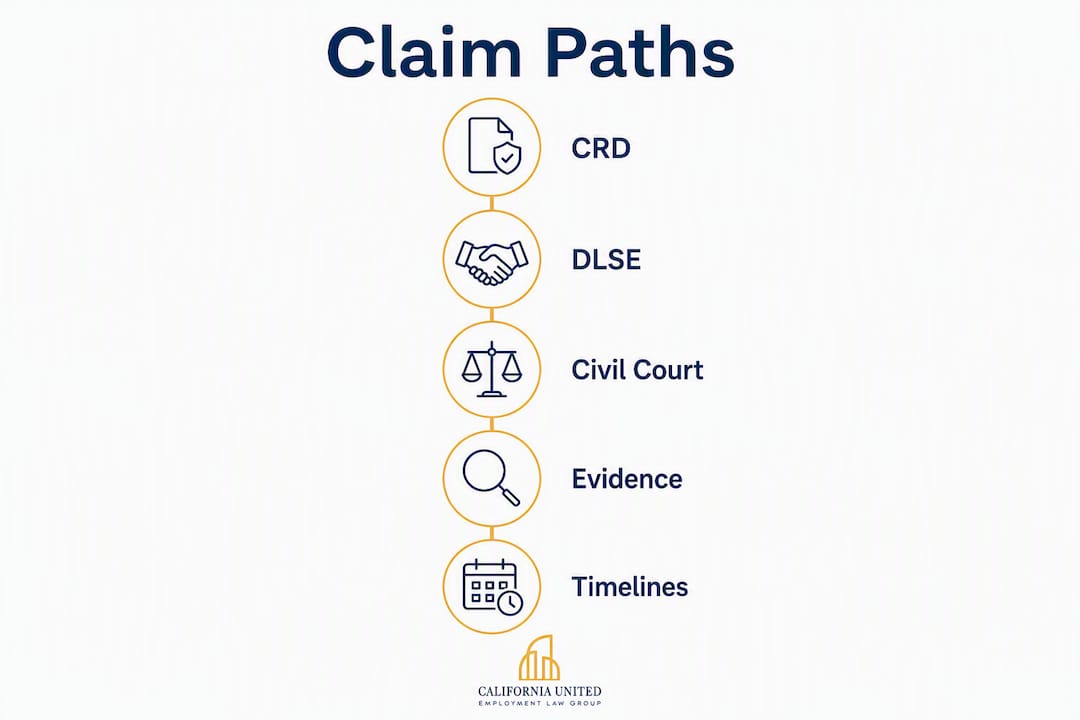
Not every wrongful termination claim follows the same route. Where you file depends on the legal theory behind your claim.
California Civil Rights Department (CRD) handles:
- Discrimination and harassment claims under FEHA
- Retaliation for opposing FEHA-protected activity
- Pregnancy and disability accommodation disputes
California Division of Labor Standards Enforcement (DLSE / Labor Commissioner) handles:
- Unpaid wage claims
- Certain Labor Code retaliation claims (e.g., retaliation for filing a wage complaint or reporting a safety violation)
- Certain whistleblower and retaliation complaints within the Labor Commissioner’s jurisdiction
Civil court may be available, either directly or after administrative exhaustion where required, for:
- Wrongful termination in violation of public policy (Tameny claims)
- Breach of express employment contract
- Some statutory whistleblower or retaliation claims, depending on whether the statute requires an administrative filing first
The practical path for a wrongful termination claim often involves more than one agency or route. A single termination can involve both a CRD complaint, such as for discrimination or FEHA retaliation, and a DLSE wage claim, such as for unpaid final wages or commissions. Whether to pursue one route or multiple routes is a strategic decision that depends on the facts, deadlines, and remedies.
CRD process overview:
- File administrative complaint with CRD
- CRD investigates or offers mediation
- Request right-to-sue notice
- File civil lawsuit within the applicable deadline after receiving the notice
DLSE process overview:
- File a wage claim or retaliation complaint with the Labor Commissioner
- Attend a settlement conference or hearing
- If unresolved, the matter may proceed to a hearing before a deputy labor commissioner
- Either party may appeal to civil court
One important note: administrative exhaustion with CRD does not prevent you from gathering evidence and requesting personnel records at the same time. Preserving your claim and building your file can happen concurrently with the agency process.
What should you document immediately after a termination in Alhambra?
The evidence you preserve in the first days after a termination often determines what options remain available later. Here is what to focus on:
Collect and secure:
- All emails, texts, and written communications with your employer, manager, or HR, especially any related to your performance, complaints you made, or the termination itself. Do not take, forward, or download confidential employer documents that you are not authorized to possess; instead, make a list of what exists and discuss lawful preservation options with an attorney.
- Your offer letter, employment agreement, and any written promises about job security
- Performance reviews, both positive and negative
- Pay stubs, commission statements, and any final paycheck documentation
- Any WARN Act notices or layoff documentation
- Severance agreements or separation papers (consider having an attorney review these before signing)
- Notes on dates, times, and the exact words used during termination meetings
Write down witness information:
- Names and contact details of coworkers who observed relevant events or heard relevant statements
- Any HR personnel or managers who were present during key conversations
Avoid these missteps:
- Do not delete emails, texts, or files, even ones that seem unfavorable
- Be cautious about detailed social media posts criticizing your former employer while a claim is pending
- Do not sign a severance or separation agreement without having an attorney review it first
Pro Tip: Under California law, you have the right to inspect and receive a copy of your personnel file. Submit a written request to your former employer promptly. This file often contains performance documentation, disciplinary records, and other materials that can be central to a claim.
California Labor Code provisions give employees the right to request their personnel records within a reasonable time. Getting that file early can be one of the most useful steps you take because it may preserve a snapshot of the employer’s documented reasons, performance records, and disciplinary history.
What timelines, costs, and outcomes should you realistically expect?
Filing deadlines vary, and they matter. California law sets different windows depending on the legal theory. The following are general guideposts, not a substitute for legal advice about a specific deadline.
- FEHA claims: You generally have three years from the date of the discriminatory or retaliatory act to file a complaint with CRD (this deadline was extended from one year by AB 9 in 2020).
- Labor Code retaliation claims: Deadlines vary by statute and by forum, so the specific Labor Code section matters.
- Breach of contract claims: These may involve two- or four-year limitation periods depending on whether the alleged contract is oral or written, but the facts and documents should be reviewed.
- Public policy / Tameny claims: These are often analyzed under a two-year limitations period, but the deadline should be confirmed based on the specific facts and defendants.
These are general ranges. The specific deadline for your situation depends on the facts and the legal theories involved. Acting promptly preserves all options; waiting can eliminate some.
How attorneys are typically paid. Many employment attorneys who represent employees in wrongful termination matters offer contingency-fee arrangements. Under this type of agreement, attorney fees are typically paid from a settlement or award rather than upfront. Litigation costs, such as filing fees, deposition costs, and expert fees, may be handled differently depending on the fee agreement, so clients should review whether they may be responsible for costs regardless of the outcome. Many firms also offer free initial consultations.
Potential remedies in a successful wrongful termination matter may include, depending on the claim and facts:
- Back pay: Wages lost from the date of termination to the date of resolution
- Front pay: Projected future lost earnings when reinstatement is not practical
- Reinstatement: Return to your former position, though this is less common in practice
- Emotional distress damages: Compensation for psychological harm caused by the unlawful termination
- Punitive damages: Potentially available in some cases involving fraud, malice, or oppression, subject to statutory standards and proof requirements
- Statutory penalties: Certain Labor Code violations carry per-violation penalties
- Attorney’s fees: FEHA and some other statutes may allow fee recovery, but availability depends on the claim, outcome, and governing statute
CRD materials describe possible FEHA remedies that may include back pay, reinstatement, policy changes, and attorney’s fees. Punitive damages may be available in some circumstances, depending on the claim, defendant, and proof. Outcomes depend entirely on the facts of each case, and no result can be guaranteed.
How can an Alhambra employment law firm help you?
Working with a local employment attorney gives you more than legal representation. It gives you a structured process for evaluating your situation and understanding your options under California law.
Services a firm typically provides in wrongful termination matters:
- Free case evaluation, if offered by the firm: An initial consultation to review the facts, identify potential legal theories, and explain possible administrative and court options
- Administrative filings: Preparing and submitting complaints with CRD or DLSE, including meeting deadlines and responding to agency inquiries
- Evidence preservation support: Guidance on what to collect, how to request personnel records, and how to document witness information
- Settlement negotiations: Communicating with the employer or its counsel to explore resolution before or during litigation
- Litigation: Filing and pursuing a civil lawsuit if administrative processes do not resolve the matter
- Severance agreement review: Analyzing what you are being asked to sign and what rights you may be releasing
What to expect from the process:
- An initial free consultation where you share the facts and receive a preliminary assessment
- A written fee agreement if the firm takes your case, which may be a contingency-fee agreement depending on the matter. The agreement should explain attorney fees and whether the client may be responsible for litigation costs.
- An investigation phase involving document review, personnel record requests, and witness identification
- A demand or administrative filing phase, followed by negotiation
- Litigation if a fair resolution is not reached through earlier steps
California United Law Group assists employees in Alhambra and throughout California with evaluating potential wrongful termination, discrimination, retaliation, wage, CRD, and DLSE matters.

Key Takeaways
California employees in Alhambra whose terminations appear “at-will” may still have valid wrongful termination claims under FEHA, the Labor Code, or public policy, and acting quickly to preserve evidence is the single most important step after a firing.
| Point | Details |
|---|---|
| At-will has real limits | Lab. Code §2922 is the presumption, but FEHA, contract, and public policy exceptions can make a firing unlawful. |
| Recognize pretext patterns | Shifting explanations, sudden performance issues, and terminations shortly after protected activity are key red flags. |
| FEHA covers most Alhambra employers | Discrimination protections apply to employers with five or more employees; harassment protections apply regardless of size. |
| File with CRD before suing | Most FEHA claims require an administrative complaint with CRD and a right-to-sue notice before you can go to civil court. |
| California United Law Group | Offers case evaluations and may offer contingency-fee representation for Alhambra employees in wrongful termination matters, depending on the facts and written fee agreement. |
Why Early Documentation Changes Everything
Most people focus on whether they have a case. The more pressing question is whether they have the evidence to support one.
California wrongful termination law gives employees meaningful protections, but those protections are only as strong as the record behind them. An employer who fires someone for discriminatory reasons rarely puts that reason in writing. What they do put in writing, often hastily, are the pretextual reasons. And those written reasons, when compared against the employee’s actual performance history, the timing of the termination, and how other employees were treated, are frequently where the real story emerges.
In many employment cases, employees who act quickly, preserve available communications, request their personnel file, and write down exactly what was said and when are often in a stronger position than those who wait. Evidence disappears. Witnesses move on. Memories fade. The administrative deadlines under FEHA and the Labor Code are not suggestions; they are hard cutoffs that can end a claim before it begins.
A termination that feels wrong may be worth examining, especially if it followed protected activity, involved inconsistent explanations, or affected employees differently based on a protected characteristic. You do not need certainty before speaking with an attorney. A free consultation exists precisely to help you understand whether the facts of your situation align with a legal claim. An initial consultation, if offered at no charge, can help clarify whether the facts suggest a legal claim.
California United Law Group Is Ready To Evaluate Your Alhambra Case
If you were recently terminated and believe the stated reason does not tell the whole story, California United Law Group, P.C., doing business online as California United Law Group, offers case evaluations for employees in Alhambra and throughout California. The firm handles wrongful termination, discrimination, retaliation, and wage claims. In matters accepted on a contingency-fee basis, attorney fees are typically paid from a settlement or award, but the written fee agreement should explain whether the client may be responsible for litigation costs.
Contact California United Law Group to schedule your free consultation.
When you reach out, bring or have ready:
- Your termination letter or any written communication about the firing
- Performance reviews and any relevant emails or texts
- Dates of any complaints you made or protected activities you engaged in
- Names of witnesses who may have relevant information
This article is general educational information about California employment law and is not legal advice. Reading this article or contacting the firm does not create an attorney-client relationship. Employment law matters are fact-specific, deadlines can be short, and outcomes vary. Consult a qualified employment attorney for guidance on your specific situation.
Official Sources For Further Reading
These primary and authoritative sources can help you verify the rules and agency procedures discussed in this article:
- California Civil Rights Department (CRD): The state agency that enforces FEHA, accepts discrimination and harassment complaints, and administers the right-to-sue process. Start here for FEHA filing information.
- CRD Employment FAQ: Answers common questions about complaint deadlines, the right-to-sue process, and what CRD can and cannot do for you.
- California Labor Code §2922 (leginfo.legislature.ca.gov): The full text of the at-will employment statute, the legal starting point for any wrongful termination analysis.
- California Division of Labor Standards Enforcement (DLSE): The Labor Commissioner’s office, which handles wage claims and certain Labor Code retaliation complaints. Useful if your termination involved unpaid wages or a retaliation claim under the Labor Code.
- California United Law Group: Wrongful Termination Guide: A practical local resource on identifying wrongful termination red flags and understanding your options under California law.
- California employee termination rights: An overview of the legal protections California employees have when facing termination, including FEHA and Labor Code claims.
Recommended
- Was Your Termination Illegal in Pasadena? California Law Explained – California United Law Group
- Wrongful Termination in California: What You Need to Know – California United Law Group
- Wrongful Termination in California: What You Need to Know – California United Law Group
- Alhambra Age Discrimination in the Workplace: Know Your Rights – California United Law Group –