
Depending on the facts, a claim may allow recovery of statutory penalties, actual damages, costs, and reasonable attorney’s fees, and may be pursued through a DLSE wage claim or a private civil action.
Here is the bottom line:
- If the statutory requirements are met, including injury and a knowing and intentional violation, statutory penalties may be $50 for the initial pay period violation and $100 for each subsequent violation, up to $4,000 per employee.
- Actual damages if they exceed the statutory penalty amount
- Costs and reasonable attorney’s fees if you prevail
- Two enforcement paths: file a wage claim with the California Division of Labor Standards Enforcement (DLSE) or pursue a private civil lawsuit in state court
A common first step is either filing a DLSE wage claim with the Labor Commissioner’s Office or consulting an employment attorney about whether a private §226 action, representative action, or class action fits your situation.
Table of Contents
- What does California Labor Code §226 require on every wage statement?
- When is a wage statement legally “incomplete” and what does “injury” mean?
- What can you recover under §226 and related remedies?
- Enforcement choices for Long Beach employees: DLSE claim or private lawsuit?
- What deadlines apply to a §226 wage statement claim?
- What evidence should you collect for a §226 claim in Long Beach?
- What defenses do employers typically raise in paystub cases?
- When should Long Beach employees consult an employment attorney?
- Key Takeaways
- What California United Law Group sees in Long Beach wage statement cases
- California United Law Group is ready to help Long Beach employees
- Useful sources for Long Beach employees
What does California Labor Code §226 require on every wage statement?
California Labor Code §226 requires your employer to furnish an accurate, itemized wage statement at every payment. Not annually, not on request. Every single pay period.
The statute lists these required elements:
- Gross wages earned during the pay period
- Total hours worked (with limited exceptions for salaried exempt employees)
- Piece-rate units and applicable rates, if you are paid on a piece-rate basis
- All deductions made from gross wages
- Net wages earned
- Inclusive dates of the pay period (start and end dates)
- Your name and the last four digits of your Social Security number, or an employee ID number
- Your employer’s name and address
- All applicable hourly rates in effect during the pay period and the corresponding hours worked at each rate
Following is the statutory wording: “California wage statements generally must include: gross wages earned; total hours worked by the employee, except for certain exempt employees; the number of piece-rate units earned and applicable piece rate if the employee is paid on a piece-rate basis; all deductions; net wages earned; the inclusive dates of the pay period; the employee’s name and the last four digits of the employee’s Social Security number or employee identification number; the employer’s name and address; and all applicable hourly rates in effect during the pay period and the corresponding number of hours worked at each hourly rate.”
Beyond the statement itself, your employer must keep payroll and deduction records on file for at least three years, either at the place of employment or at a central location in California. Employees and former employees may also request inspection or copies of payroll records, and failure to provide access within the required timeframe can create a separate statutory issue. That retention obligation matters when you need to reconstruct missing information for a claim.
Pro Tip: If your employer provides electronic paystubs, check that every one of the nine elements appears on the digital document. Electronic delivery may satisfy California wage-statement requirements when legally compliant, but the content requirements remain the same. Confirm your employer’s name and full address are present, not just a logo, and that only the last four digits of your SSN appear.
“Each time you are paid, your employer must provide you with a paystub or detailed wage statement. This itemized wage statement must contain your name, wages earned, dates of the pay period, your employer’s name, address and telephone number, as well as all deductions and hours of paid sick leave accrued.” — Division of Labor Standards Enforcement (DLSE)
When is a wage statement legally “incomplete” and what does “injury” mean?

Not every paystub mistake creates a compensable claim. The legal standard under §226(e) is specific: you suffer an “injury” when you cannot promptly and easily determine required information from the wage statement alone, without referring to other documents.

That phrase, “promptly and easily determine,” does real legal work. If you have to cross-reference your own notes, call HR, or dig through bank records just to figure out your hourly rate or the number of hours you were paid for, the statement has likely caused you a cognizable injury under the statute.
Common omissions that may support an injury argument include:
- Missing total hours worked, making it impossible to verify overtime calculations
- Deduction entries that prevent the employee from promptly and easily determining the aggregate deduction amount or which deductions were made from gross wages
- Absent or incorrect employer name and address, which prevents you from identifying who employs you
- Missing pay period dates, so you cannot confirm which work period the payment covers
- Omission of all applicable hourly rates when you worked at more than one rate during the period
“An employee is deemed to suffer injury if they cannot promptly and easily determine from the wage statement alone the required information, including gross wages, net wages, hours worked, deductions, and employer identification.” — California Labor Code §226(e)
California courts have treated wage-statement claims as highly fact-specific. For example, Rutter notes that in Morgan v. United Retail Inc., the court found a statement listing regular and overtime hours, although not added together, still showed total hours worked. Rutter also notes that in Gola v. University of San Francisco, the court applied a ‘predicate facts’ test to whether the employer knew facts existed that triggered the wage-statement obligation, while the California Supreme Court granted review in Naranjo v. Spectrum Security Services, Inc. on whether a good-faith belief in compliance can preclude a ‘knowing and intentional’ finding.
A one-time typographical error in a field that does not affect your ability to verify your pay is unlikely to meet this standard. The distinction matters: isolated, trivial clerical mistakes may not support statutory penalties if the employee can still promptly and easily determine the required information and the violation was not knowing and intentional. Repeated omissions, or a pattern where employees cannot verify their own compensation, is a different situation entirely.
What can you recover under §226 and related remedies?
Employees may seek injunctive relief for wage-statement violations. If the employee suffered injury from a knowing and intentional failure to provide accurate wage statements, the employee may recover the greater of actual damages or statutory penalties, plus costs and reasonable attorney’s fees.
The statutory penalty schedule under §226(e) works by imposing a $50 penalty for the first pay period violation and $100 for each subsequent violation, capped at $4,000 per employee.
Statutory penalty example: On a biweekly pay schedule, the $4,000 maximum penalty is reached after multiple pay periods of violations spanning several months of ongoing noncompliance, with the $50 penalty applying to the initial violation and $100 to each subsequent violation until the cap is met.
Beyond the §226 penalty itself, related claims may be available depending on your situation:
- Unpaid wages and overtime if the missing paystub information reflects underlying wage theft
- Waiting-time penalties under Labor Code §203 if wages were not paid on termination
- A $750 penalty under §226(f) if your employer fails to permit inspection or provide copies of payroll records within the statutory timeframe
Attorney’s fees may be available to a prevailing employee. If you work with a contingency-fee firm, the fee arrangement should be explained in writing, including whether you may be responsible for litigation costs regardless of the outcome.
Enforcement choices for Long Beach employees: DLSE claim or private lawsuit?
You have two primary options, and the right one depends on your specific circumstances.
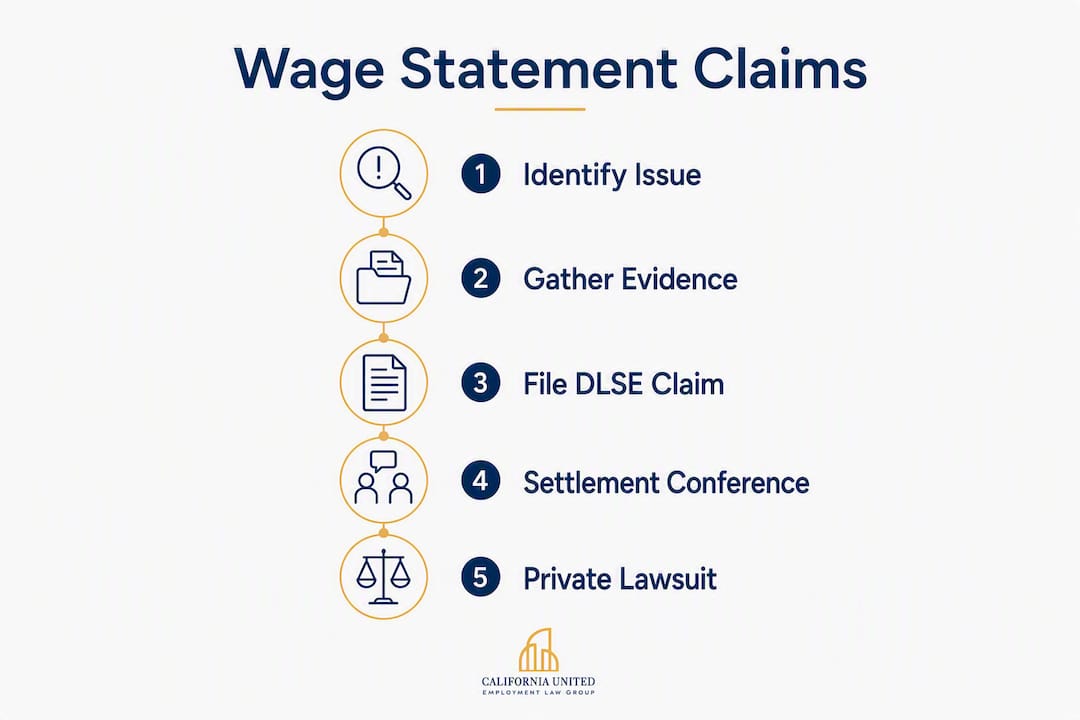
1. File a DLSE wage claim with the Labor Commissioner
- Download and complete the Initial Report or Claim (DLSE Form 1), which covers regular wages, overtime, meal and rest premiums, waiting-time penalties, and statutory penalties.
- Attach copies (not originals) of any paystubs, time records, notices of employment information, and dishonored checks you have.
- Submit the form to the nearest DLSE district office. Long Beach employees can contact the DLSE or file online through the Labor Commissioner’s Office portal.
- A deputy labor commissioner will review the claim, may schedule a settlement conference, and, after the applicable process, may award wages or penalties if the claim is substantiated.
2. File a private civil lawsuit in state court
- Retain an employment attorney to evaluate whether a private §226 action, a representative action under PAGA (the Private Attorneys General Act), or a class action is appropriate.
- Your attorney files suit in California Superior Court, initiating formal discovery to obtain payroll records, time records, and employer communications.
- The case proceeds through motions, potential mediation, and, if unresolved, trial.
Comparing the two routes:
- DLSE: Administrative process, no jury, generally faster initial handling, limited discovery, lower cost to initiate
- Private lawsuit: Formal discovery rights, potential for class or representative actions covering multiple employees, broader remedies, and legal representation is strongly recommended, especially for class or representative claims
Filing checklist for Long Beach employees:
- Copies of all available paystubs (even partial or electronic)
- Bank statements showing net deposits for each pay period
- Time records, schedules, or personal logs of hours worked
- Any notices of employment information (required under Labor Code §2810.5)
- Text messages or emails about pay, deductions, or hours
- Copies of any dishonored checks
- Employer’s name, address, and any identifying information from paperwork
If you are unsure which employer entity is responsible, the DLSE recommends documenting any identifying details from paperwork, mailing labels, or vehicle plates and attaching them to your claim. For Long Beach employees considering representation, California United Law Group provides local support for both DLSE filings and private litigation.
What deadlines apply to a §226 wage statement claim?
Time limits vary by the type of claim, and missing a deadline can bar recovery entirely.
Key timing rules to know:
- §226 statutory penalty claims are generally subject to a one-year statute of limitations under Code of Civil Procedure §340(a) when pursued as a standalone penalty claim
- Underlying wage claims may have different limitations periods depending on the legal theory, including statutory wage claims, contract claims, and other related remedies. Because limitations periods can change the value and scope of the case, employees should get case-specific advice promptly.
- PAGA representative actions require filing a notice with the California Labor and Workforce Development Agency (LWDA) before filing suit, which adds a procedural step with its own timing requirements. Some wage-statement PAGA allegations may also implicate statutory cure procedures, so the pre-suit process should be evaluated before filing.
- Waiting-time penalty claims under Labor Code §203 carry a three-year limitations period
Record-retention callout: Because employers must keep payroll and deduction records for at least three years, you can often request those records even if you no longer have your own copies. That three-year window gives Long Beach employees a meaningful opportunity to reconstruct missing information.
On the administrative side, DLSE claims typically move through an initial review, a settlement conference, and, if unresolved, a hearing before a deputy labor commissioner. The full process can take several months to over a year depending on case complexity and office caseload. Private civil cases generally take longer, particularly when formal discovery and motion practice are involved.
What evidence should you collect for a §226 claim in Long Beach?
The strength of a wage statement claim often comes down to documentation. You do not need perfect records to file, but the more you can provide, the faster the DLSE can evaluate your claim.
Priority evidence to gather:
- Paystubs or wage statements for every pay period at issue, including electronic versions (screenshot or PDF with a timestamp)
- Bank statements showing net deposits, which corroborate the net wages you actually received
- Time records such as punch-in logs, scheduling apps, or personal calendars noting hours worked
- Notices of employment information (the written notice your employer is required to provide under Labor Code §2810.5 showing your rate of pay and pay schedule)
- Text messages and emails about your pay, deductions, hours, or any employer response to your questions
- Dishonored or bounced checks, which are a separate basis for penalties under the DLSE claim form
- Any employer identification documents such as business cards, letterhead, or paperwork showing the legal name and address of your employer
Preservation steps matter. Save digital copies to a personal email or cloud account your employer cannot access. Photograph physical documents and note the date you obtained each item. The DLSE explicitly requests copies of informal records such as personal notes, calendars, and time logs because those documents can speed the agency’s review and help compute unpaid wages or penalties.
What defenses do employers typically raise in paystub cases?
Knowing what to expect from the other side helps you evaluate the strength of your claim. Employers in wage statement disputes commonly raise several arguments.
- “It was a clerical error.” Employers often characterize omissions as isolated, inadvertent mistakes. Under §226, a knowing and intentional failure is required for the statutory penalty. However, repeated errors across multiple pay periods may support an argument that the violation was knowing and intentional, depending on the facts.
- “You weren’t injured.” This is the most common defense. If the employer can show you could still determine your pay, hours, and deductions from the statement without difficulty, the injury standard may not be met. Detailed, specific omissions that genuinely obscure pay calculations undercut this argument.
- “You consented to electronic delivery.” Electronic paystubs are permissible under California law, but consent to the delivery method does not waive the content requirements. All nine elements must still appear on the electronic statement.
- “Deductions were aggregated, not itemized.” Some employers group deductions under a single line. California law requires wage statements to identify deductions in a way that allows employees to determine the aggregate deduction amount and which deductions were made from gross wages.
- “You can’t identify which entity employed you.” When a business operates under multiple entities, employers sometimes argue the wrong party was named. Documenting every identifying detail on your paperwork from the start protects against this defense.
Repeated violations across multiple pay periods, or a situation where employees genuinely cannot verify their own compensation, can strengthen an employee’s response to these defenses before the DLSE or a court.
When should Long Beach employees consult an employment attorney?
Some wage statement issues can be addressed through a straightforward DLSE claim. Others call for legal representation from the start.
Consider consulting an employment attorney if:
- Violations are repeated across multiple pay periods, suggesting a systemic practice rather than a one-time mistake
- Your employer refuses to provide payroll records or does not respond to requests for copies of your wage statements
- You have related unpaid-wage claims such as missing overtime, unpaid meal period premiums, or final wages not paid on termination
- Your pay structure is complex, involving commissions, piece rates, multiple pay rates, or bonuses that should appear on your wage statement
- You cannot identify your employer from the information on your paystubs
- You received bounced checks in addition to incomplete wage statements
- You believe other employees are affected, which may support a representative or class action
An employment attorney can evaluate your claim, help you preserve evidence, assist with DLSE filings, and, where appropriate, pursue a private civil action or representative claim on your behalf. California United Law Group represents Long Beach employees in wage statement disputes, unpaid-wage claims, and related employment matters. The firm offers free case evaluations and may handle qualifying cases on a contingency-fee basis. Any fee agreement should explain how attorney’s fees and litigation costs are handled, including whether the client could be responsible for costs.
This article is for general educational purposes only and is not legal advice. Employment law issues are fact-specific and outcomes vary. Consult a qualified employment attorney or the DLSE for guidance specific to your situation.
Key Takeaways
California employees whose employers fail to provide accurate, itemized wage statements under Labor Code §226 can recover statutory penalties up to $4,000 per employee, plus actual damages, costs, and attorney’s fees through either a DLSE wage claim or a private civil lawsuit.
| Point | Details |
|---|---|
| Nine required elements | Every wage statement must include gross wages, hours, deductions, net wages, pay period dates, employee name, last four SSN digits, and employer name and address. |
| Statutory penalties | Violations carry $50 for the first pay period and $100 for each subsequent period, capped at $4,000 per employee. |
| Two enforcement routes | File a DLSE wage claim with the Labor Commissioner or pursue a private §226 civil lawsuit, each with different timelines and remedies. |
| Preserve your records | Collect paystubs, bank statements, time records, and employer notices; employers must retain payroll records for at least three years. |
| California United Law Group | The firm offers free case evaluations and may offer contingency-fee representation for Long Beach employees with qualifying wage statement and unpaid-wage claims, subject to a written fee agreement. |
What California United Law Group sees in Long Beach wage statement cases
In many wage-statement matters, the issue is not a single dramatic violation. It is the quiet, recurring omission: hours that do not add up, deductions listed as a single lump sum, or an employer address that is missing entirely from every paystub for months. Workers often notice something feels off long before they know they have a legal claim.
What makes these cases worth taking seriously is precisely that repetition. A one-time error may be a clerical mistake. The same error across many consecutive pay periods may support a stronger argument that the violation was knowing and intentional. The $4,000 cap may be only one part of the analysis because related unpaid-wage claims, waiting-time penalties, and attorney’s fees may affect the total potential recovery, depending on the facts.
California United Law Group works with Long Beach employees to gather the records that tell the full story, whether that means requesting payroll files from the employer, filing with the DLSE, or building a private civil case. The firm does not promise outcomes. What it does offer is a clear-eyed evaluation of what the evidence shows and what options are realistically available.
California United Law Group is ready to help Long Beach employees
If your paystubs are missing required information or your employer has stopped providing wage statements altogether, you may have legal options under California law. California United Law Group offers case evaluations for Long Beach employees dealing with incomplete or missing wage statements, and the firm handles the full range of related claims: evidence preservation, DLSE claim filing, private civil litigation, and representative or class actions when the facts support them.
For qualifying cases handled on a contingency-fee basis, attorney’s fees are typically tied to recovery. The written fee agreement should explain all terms, including how litigation costs are handled. A free case evaluation can help you understand whether the firm can assist with your situation. There is no financial barrier to getting a professional assessment of your situation.
Request a case evaluation to discuss your potential wage-statement claim with California United Law Group’s Long Beach employment team.
Useful sources for Long Beach employees
- California Labor Code §226 — Full statutory text covering the nine required wage statement elements, the definition of injury, penalty provisions, and employer record-retention obligations.
- DLSE: How to File a Wage Claim — The Labor Commissioner’s Office guide to filing options, required information, and supporting documents.
- Initial Report or Claim (DLSE Form 1) — The primary claim form covering wages, overtime, meal and rest premiums, waiting-time penalties, and statutory penalties.
- DLSE Wage Claim Forms — Index of DLSE forms including specialized computation forms (Form 55, Form 155) for irregular hours and specific claim types.
- DLSE Opinion Letter: Electronic Wage Statements — DLSE guidance on when electronic delivery of wage statements satisfies Labor Code §226(a).
- California United Law Group: Long Beach Employment Lawyer — Local practice page for Long Beach employees seeking representation in wage statement and employment disputes.
For case-specific questions, consult the DLSE directly or speak with a qualified California employment attorney.
Recommended
- Can Long Beach Workers Claim Unpaid Wages? Your Rights Explained – California United Law Group
- Inglewood Paystub Rights: What You’re Owed And How To Act – California United Law Group –
- Rest break rights for Long Beach retail workers explained – California United Law Group
- Burbank Paystub Violations: When Missing Details Break the Law – California United Law Group –