
If your paycheck stub is missing information or does not add up, one common option is a wage claim with the California Labor Commissioner, although some situations may also support civil litigation or representative claims depending on the facts. You also have a legal right to inspect your payroll records. For Los Angeles employees dealing with recurring or complex errors, an employment attorney, including firms like California United Law Group, can help evaluate whether the problem is a simple mistake or a bigger compliance failure.
TL;DR:
- Employers must include specific wage statement information, including gross and net wages, deductions, pay period dates, employer information, and total hours worked for nonexempt employees.
- Supporting evidence like pay stubs, time records, and correspondence can strengthen a wage claim, with employers legally obligated to permit record inspection within 21 days.
- Filing a wage claim involves submitting Form 1 and possibly additional forms for disputes involving commissions or variable hours, often resulting in settlement talks before a hearing.
- Employee remedies may include actual damages or statutory amounts calculated by pay period, subject to a cap, plus costs and reasonable attorney’s fees when the violation is knowing and intentional. Separate civil penalties may also apply in some enforcement contexts.
- Consulting an employment attorney is advisable if errors are widespread, records are unavailable, or retaliation occurs, especially in complex cases or class action scenarios.
Table of Contents
- What Legally Counts as a Paystub Violation in California?
- How Do You Gather Evidence of a Paystub Error?
- How Do You File a Wage Claim With the Labor Commissioner?
- What Can You Actually Recover?
- When Does It Make Sense to Talk to an Employment Attorney?
- What Happens After You File a Wage Claim?
- Our Perspective on Paystub Violations in Los Angeles
- Talk to California United Law Group About Your Pay Stub
- Authoritative Statutes and DLSE Resources
- Sources
- FAQ
What Legally Counts as a Paystub Violation in California?
California law doesn’t leave wage statement requirements to guesswork. Labor Code §226 requires every itemized statement to let an employee “promptly and easily determine” nine specific things. If an employee cannot promptly and easily determine required information from the wage statement itself, that may support a Labor Code § 226 issue.
Required items include:
- Gross wages and net wages earned
- Total hours worked, unless the employee is exempt from this requirement
- All deductions, itemized separately
- The inclusive dates of the pay period
- The date of payment
- Your name and either your employee ID or the last four digits of your Social Security number
- Your employer’s legal name and address
- All applicable hourly rates and the hours worked at each rate
- Piece-rate units and rates, when applicable
The legal consequences can turn on more than whether a pay stub contains an error. Employee penalties under Labor Code § 226(e) generally require a knowing and intentional violation, while civil penalty enforcement may account for whether the issue was an isolated clerical or inadvertent mistake. A single typo an employer fixes fast reads differently than a payroll system that has miscalculated overtime for months across dozens of Los Angeles employees.
California courts have treated wage statement compliance as a fact-specific issue. In Morgan v. United Retail Inc. (2010) 186 Cal.App.4th 1136, the court found that a statement listing regular and overtime hours, although not added together, showed total hours worked. In Savea v. YRC Inc. (2019) 34 Cal.App.5th 173, the court held that an employer’s use of a registered fictitious business name on wage statements did not violate Labor Code § 226(a). These cases show why the details of the wage statement, not just the existence of an error, matter.
How Do You Gather Evidence of a Paystub Error?
Before filing anything, pull together what you already have. A thin paper trail makes any claim harder to evaluate, whether you handle it yourself or bring in counsel.
Useful documents include:
- Every pay stub you’ve received, even ones that look correct
- Canceled or bounced paychecks
- Personal time notes, punch records, or shift schedules
- Any written notice of your pay rate, job classification, or terms of employment
- Emails or texts where you raised the issue with a manager or HR
You also have a direct legal right to your own payroll records. Under DLSE guidance, an employer generally must allow a current or former employee to inspect or copy payroll records within 21 calendar days of a proper request. Failure to do so can expose the employer to a separate $750 penalty. You’re not required to have these records to file a claim, but supporting documents help the Labor Commissioner’s Office evaluate a wage claim faster.
Pro Tip: Put your records request in writing, even a short email, and note the date you sent it. That single detail can matter later if your employer misses the 21-day deadline.
How Do You File a Wage Claim With the Labor Commissioner?
Filing starts with the DLSE Initial Report or Claim, commonly called Form 1. This is the document that opens your case with the Labor Commissioner’s Office, and it asks for basic details: your employer’s information, your pay history, and a description of the violation.
Depending on your situation, you may need to attach additional forms:
- DLSE-55 if your hours vary week to week and a standard calculation won’t capture your actual pay
- DLSE-155 if the dispute involves unpaid or miscalculated commissions
- Vacation wage forms, when accrued time off is part of the dispute
You can submit your claim online, by mail, by email, or in person at a DLSE office, and it helps to include copies of every pay stub, timekeeping record, and any correspondence with your employer about the discrepancy. Keep the originals for yourself.
After filing, the DLSE commonly schedules a settlement conference before any formal hearing. This is an informal meeting where both sides discuss the claim, often with a deputy labor commissioner helping broker a resolution. Many wage claims resolve at this stage without ever reaching a hearing.
If the conference doesn’t produce a settlement, the case moves to a hearing, sometimes called a “Berman hearing.” Both sides present evidence, and the Labor Commissioner issues a written Order, Decision, or Award afterward. Although the Berman hearing process is designed to be informal and more affordable than court litigation, the timeline can still take months, especially if the employer contests the claim or the case involves multiple pay periods.
What Can You Actually Recover?
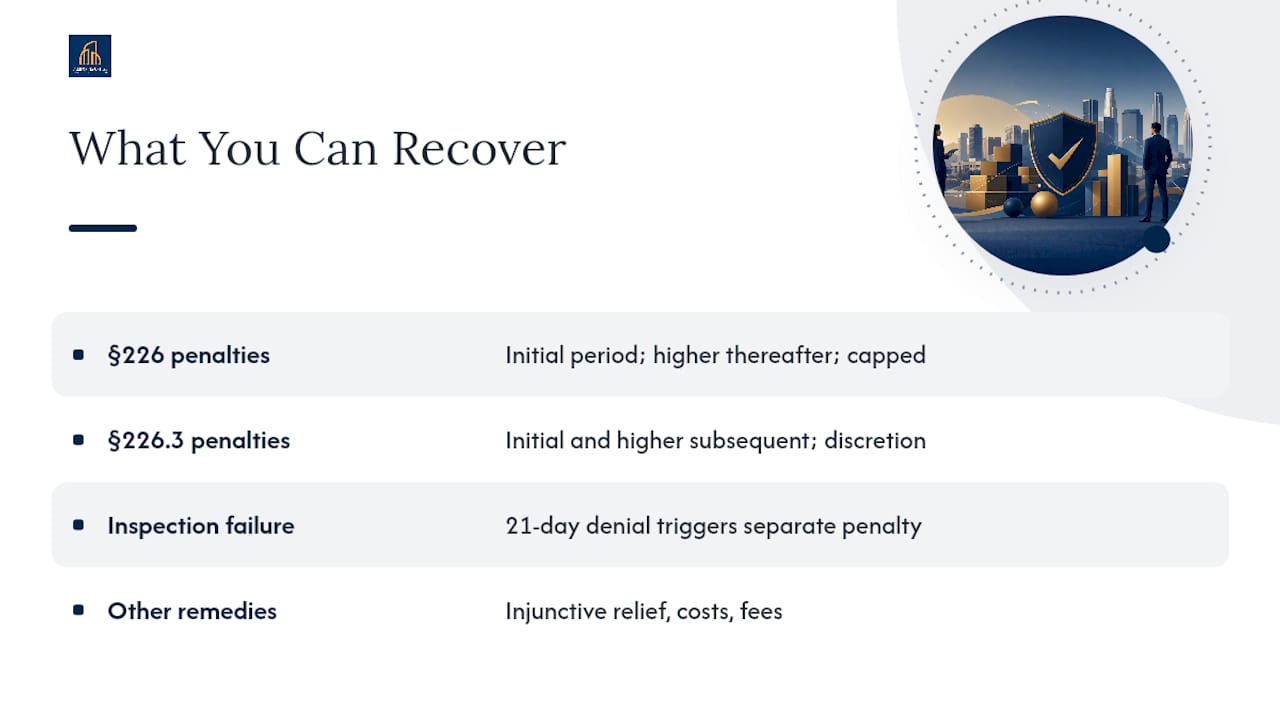
Statutory penalties under §226 follow a specific formula, not a flat number. For employee claims under Labor Code § 226(e), a worker may recover the greater of actual damages or $50 for the initial pay period in which a violation occurs and $100 for each subsequent violation, up to an aggregate penalty of $4,000, if the violation is knowing and intentional. The statute also allows recovery of costs and reasonable attorney’s fees in appropriate cases.
Because courts have addressed different penalty theories differently, the available penalties can depend on whether the claim is brought as an individual § 226 claim, a Labor Commissioner enforcement matter, or a representative PAGA claim.
If your employer failed to let you inspect records within the 21-day window, that alone can trigger the separate penalty already noted above. In some cases, employees can also pursue injunctive relief to force ongoing compliance, and the statute allows recovery of costs and reasonable attorney’s fees. Remedies here are calculated, not guaranteed, and every case depends on its specific facts.
When Does It Make Sense to Talk to an Employment Attorney?
Some paystub problems are simple enough to resolve directly with HR or through a DLSE claim on your own. Others point to something bigger.
You might benefit from talking to an attorney when:
- The error appears across many pay periods, not just one
- Your employer can’t or won’t produce complete payroll records
- You’ve raised the issue and now sense retaliation, like reduced hours or sudden write-ups
- The math involves overtime, multiple pay rates, or commission structures that are hard to untangle alone
- Similar errors seem to affect coworkers, which can point toward a broader class action or PAGA exposure
Some employment attorneys represent Los Angeles employees in wage and hour disputes, including paystub and wage statement violations, on a contingency-fee basis. That usually means legal fees are owed only if there is a recovery, but clients should confirm in writing whether they may be responsible for litigation costs or expenses. This article is educational information, not legal advice, and every situation depends on its own facts.
What Happens After You File a Wage Claim?
Once your claim is on file, the settlement conference comes first. The deputy labor commissioner reviews both sides’ documents and tries to broker a resolution without a formal hearing. Many straightforward paystub disputes end here.
If no agreement is reached, a hearing follows, where you and your employer present evidence and testimony. The Labor Commissioner then issues a written decision, called an Order, Decision, or Award, which sets payment deadlines and outlines either party’s right to appeal in court.
Outcomes vary. Some claims settle for back penalties and corrected wage statements going forward. Others result in a formal penalty award, and a smaller number are dismissed if the evidence doesn’t support a violation. Wage claims often surface alongside other wage and hour issues, such as unpaid overtime or missed breaks. Those related compensation issues may be reviewed if they fall within the Labor Commissioner’s wage-claim authority, but some broader legal claims may need to be pursued separately.
Our Perspective on Paystub Violations in Los Angeles
Some law firms representing Los Angeles employees in wage and hour matters encounter paystub violations, sometimes as the first sign of a larger payroll problem. We’ve written this guide for education, not as legal advice, because every wage statement dispute turns on its own facts. If you’re unsure whether what you’re seeing rises to a violation, a consultation can help you understand your options.
— California United Law Group
Talk to California United Law Group About Your Pay Stub
California United Law Group handles wage and hour cases, including paystub disputes, on a contingency-fee basis. That means attorney’s fees are typically owed only if there is a recovery, but the fee agreement should explain whether the client may be responsible for litigation costs or expenses. Having counsel review your pay history can help identify which issues are simple wage statement errors and which may connect to broader wage and hour violations.
The firm’s employment law practice covers wrongful termination, retaliation, and discrimination claims alongside wage and hour disputes, which matters if your paystub issue is tangled up with a bigger workplace problem. If you are in Los Angeles and want help evaluating whether your pay stub may reflect a wage statement violation, contact California United Law Group for a case evaluation.
Authoritative Statutes and DLSE Resources
- California Labor Code §226
- How to File a Wage Claim — DLSE
- DLSE Initial Report or Claim (Form 1)
- Laws Relating to Time, Manner, and Payment of Wages — DLSE
This article is general information, not a substitute for advice from a qualified lawyer. Consult a qualified legal professional about your own circumstances before acting on anything here.
Sources
- California Labor Code §226
- How to File a Wage Claim — California Labor Commissioner (DLSE)
- DLSE FAQ — Right to inspect personnel files
- Laws relating to the time, manner and payment of wages — DLSE
FAQ
What Are the Laws Regarding Paystubs in California?
Labor Code § 226 requires employers to provide accurate, itemized wage statements listing required information, including gross and net wages, deductions, pay period dates, employer information, and total hours worked where required.
Can You Sue a Company for Messing Up Your Paycheck?
Yes, depending on the issue. Employees may file a wage claim with the Labor Commissioner for unpaid wages or related penalties, and some wage statement disputes involving knowing and intentional violations may also support civil claims.
How Long Does an Employer Have to Correct a Paycheck Error in California?
The law doesn’t set one universal correction deadline for every paycheck error, but employers must respond to a records inspection request within 21 calendar days or face a $750 penalty. Prompt correction may reduce future exposure, but whether penalties apply depends on the type of error, whether the statutory requirements are met, and whether the violation was knowing and intentional.
What Are Illegal Things an Employer Cannot Do Regarding Pay Stubs?
An employer cannot omit required wage statement information, refuse a valid and timely payroll-record inspection request, or retaliate against an employee for exercising Labor Code rights, including raising wage concerns or filing a wage claim. Each of these can carry separate statutory penalties under California wage payment law.