
Wage theft commonly refers to situations where an employee receives less pay than the law requires. In Los Angeles workplaces, inaccurate or falsified timesheets can lead to unpaid wages, overtime errors, missed meal or rest break premiums, and inaccurate wage statements. California wage and hour law generally requires employers to pay nonexempt employees for all hours worked, including off-the-clock work the employer knew or should have known about, even when the employer’s timekeeping process is incomplete or inaccurate. These protections most often apply to nonexempt employees in Los Angeles County, including hourly workers and some salaried employees who are not legally exempt from wage-and-hour protections. Understanding your rights under California labor law is the first step toward protecting your paycheck.
How do California laws regulate timesheet accuracy in Los Angeles?
California law places the primary legal responsibility for required time and payroll records on the employer. Employers must maintain legally required payroll and time records, including daily hours worked and wages paid, and meal-period records may be critical when meal-break compliance is disputed. California recordkeeping rules, including Labor Code sections 226 and 1174, require employers to maintain wage and time records, including daily hours worked and wages paid.
Pay stubs must also itemize wages, hours worked, and all deductions. Accurate pay stub records are not optional. Employers who provide inaccurate wage statements may face statutory penalties or civil penalties, depending on the violation, the claim asserted, and whether the required legal elements are met.

California retention periods vary by record type. Some payroll and time records must be kept for at least two years, records showing wage deductions must be kept for three years, and job title and wage rate history records must generally be kept for the duration of employment plus three years after employment ends. Those records must be accessible for employee inspection. That three-year retention rule gives you a meaningful window to request records and verify your pay history.
Key employer obligations under California wage and hour law include:
- Tracking all hours worked daily, including overtime and meal break periods
- Paying wages on time regardless of whether an employee submitted a timesheet late or incorrectly
- Providing itemized pay stubs with every paycheck showing gross wages, hours, and deductions
- Retaining payroll, time, deduction, and wage-rate records for the legally required period and making covered records available for inspection when required.
Pro Tip: If your employer uses an electronic timekeeping system, California law still requires the same level of accuracy and accessibility as paper records. Digital records can be important evidence, but they should be accurate, complete, and accessible when the law requires inspection.
What are common false or inaccurate timesheet scenarios in Los Angeles?
Timesheet inaccuracies take many forms in Los Angeles workplaces, and most employees do not realize their pay is affected until they compare their hours to their paycheck. The most common situations include:
- Missing hours. A manager fails to log hours you worked before or after your scheduled shift. For nonexempt employees, work performed before or after a scheduled shift may be compensable when the employer knew or should have known the work was being performed.
- Rounded or deleted break time. Some employers round down meal or rest breaks in ways that reduce total pay. California law requires compliant meal and rest breaks for covered employees, and missed, short, late, or noncompliant breaks may support premium-pay claims.
- Lost timesheets. An administrative error causes your timesheet to go missing. A missing timesheet generally does not excuse an employer from paying wages that are due for hours the employer knows or should know were worked.
- Late submission penalties. Your employer threatens to dock pay because you submitted your timesheet after the deadline. An employer may impose lawful, nonretaliatory discipline for failing to follow timekeeping procedures, but that does not generally allow the employer to withhold wages for hours actually worked.
- Incorrect approvals. A supervisor approves the wrong hours, either by mistake or intentionally. The employer remains responsible for correcting the error and paying what you are owed.
The critical point in each scenario is the same. Employers cannot avoid paying wages that are legally owed simply because a timesheet was late, missing, or inaccurate. California law and the Fair Labor Standards Act both require payment for all hours actually worked. The employer’s administrative process does not override that obligation.
Inaccurate timesheets directly affect overtime calculations, minimum wage compliance, and rest break premiums. If your hours are underreported, your overtime threshold shifts. If meal or rest breaks were not legally provided, you may be owed premium pay, often calculated by workday and type of violation rather than by every individual missed break.
Pro Tip: Keep a personal log of your daily start time, end time, and any missed or interrupted breaks. This record can become important evidence if your employer’s records are incomplete, inaccurate, or disputed.
What legal protections and remedies exist for Los Angeles employees?
California law gives employees several potential tools to address wage losses caused by inaccurate or falsified timesheets. These protections apply to workers across Los Angeles, including those in Inglewood, Torrance, and Long Beach.
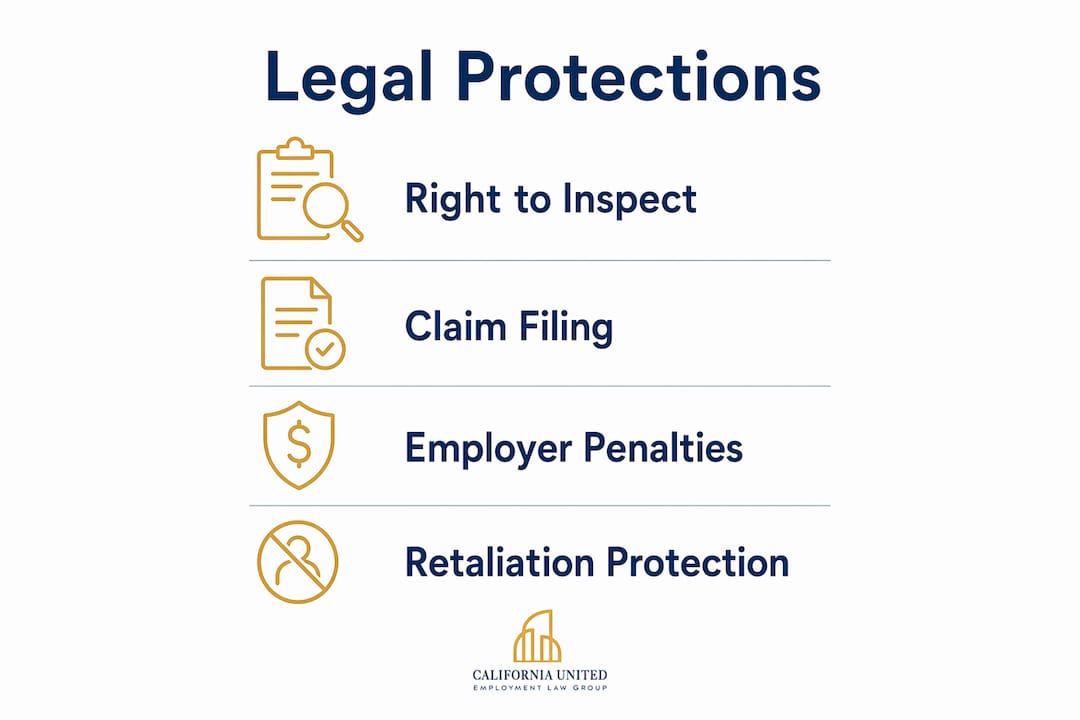
Your right to inspect records. You have the legal right to inspect and obtain copies of your payroll and time records by submitting a written request to your employer. For payroll records, employers generally must provide copies within 21 days after a request or permit the employee to inspect those records. That written request creates a documented timeline, which is useful if you later file a wage claim.
Filing a claim with the Labor Commissioner. The California Labor Commissioner’s Office, part of the Division of Labor Standards Enforcement, accepts wage claims from employees who believe they have been underpaid. You do not need an attorney to file. The process is designed to be accessible to all workers.
Statutes of limitations. Acting within the correct time window matters. California wage claim deadlines vary by claim type:
| Claim Type | Common Time Limit |
|---|---|
| Statutory wage claims | 3 years |
| Written contract claims | 4 years |
| Oral contract claims | 2 years |
| Certain penalty-based claims | 1 year |
| Unfair competition claims based on unpaid wages | 4 years |
These deadlines can vary based on the legal theory, the type of wages or penalties sought, and whether the claim is filed in court or with an agency.
Missing these deadlines can bar your claim entirely, so acting promptly protects your options.
Employer penalties. Employers who withhold wages or provide inaccurate pay stubs face real financial consequences. Penalties for inaccurate wage statements and unpaid wages depend on the statute invoked, the nature of the violation, and the facts. Some wage statement penalties require proof of a knowing and intentional violation, while other civil penalties may be available under different provisions. Employers who willfully fail to pay final wages on time after termination may owe waiting time penalties of up to 30 days of wages under Labor Code section 203.
Retaliation protections. California law prohibits employers from retaliating against employees who assert their wage rights. If your employer threatens you, cuts your hours, or terminates you after you raise a timesheet or pay dispute, that retaliation may itself be a separate legal violation. Retaliation protections are an important part of California wage-and-hour law, but whether a retaliation claim exists depends on the timing, facts, and employer’s stated reason for the action.
How can Los Angeles employees document and protect their rights?
Documentation is your most reliable protection when timesheet disputes arise. In appropriate wage cases, employee logs and reasonable estimates may help prove hours worked when employer records are incomplete or inaccurate. The U.S. Supreme Court recognized this burden-shifting principle in Anderson v. Mt. Clemens Pottery Co., and California authority similarly recognizes that imprecise employee evidence may support damages when employer records are inaccurate. For example, Furry v. East Bay Publishing, LLC applied this principle in a California unpaid wage/overtime context. Rutter cites Anderson v. Mt. Clemens Pottery Co. for the rule that when an employer fails to produce precise evidence, a court may award approximate damages. Rutter also states that Furry v. East Bay Publishing, LLC held that “imprecise evidence” by the employee can provide a sufficient basis for damages when an employer fails to keep accurate records. Your personal records can fill the gap when your employer’s records are wrong or missing.
Courts have recognized that employees should not be penalized when employers fail to keep accurate wage and hour records. In Anderson v. Mt. Clemens Pottery Co., the U.S. Supreme Court recognized a burden-shifting approach when employer records are inadequate. California authority follows a similar practical approach: Furry v. East Bay Publishing, LLC recognized that imprecise employee evidence may support damages where an employer fails to keep accurate records, and Donohue v. AMN Services, LLC recognized a rebuttable presumption involving noncompliant meal-period records. Rutter cites Anderson v. Mt. Clemens Pottery Co. for the rule that approximate damages may be awarded where the employer fails to produce precise evidence. Rutter cites Furry v. East Bay Publishing, LLC for the rule that “imprecise evidence” can support damages when employer records are inaccurate. Rutter states that Donohue v. AMN Services, LLC creates a rebuttable presumption when employer records show no meal period, a meal period under 30 minutes, or a meal period delayed past the fifth hour.
Practical steps to protect your wages include:
- Keep a daily work log. Record your start time, end time, and any breaks each day. A simple notes app or paper notebook works. Consistency matters more than format.
- Save all pay stubs. Compare each pay stub to your personal log. Flag any discrepancy immediately and in writing.
- Request records in writing. When you suspect an error, submit a written request for your payroll and timesheet records. Written requests create a paper trail that supports your claim.
- Document communications. Save emails, texts, or written notes from supervisors about your schedule, hours, or any timesheet disputes.
- Know the difference between discipline and a wage violation. Employers may discipline employees for administrative failures like late timesheet submission, but they cannot dock pay for hours you actually worked. If your paycheck is short because you were not paid for compensable hours worked, that may be a wage violation rather than merely a disciplinary issue.
Wage claim deadlines often run from the date of the violation, so employees should act quickly after discovering a discrepancy. Acting quickly after noticing a discrepancy preserves your full range of options. If you work in Los Angeles and your pay does not match your hours, California law may provide options to investigate and address the discrepancy. Understanding employer obligations for inaccurate timesheets can help you recognize when an administrative error may become a legal issue.
Pro Tip: If your employer asks you to sign a corrected timesheet that does not reflect your actual hours, do not sign it without noting your objection in writing. Signing an inaccurate record can complicate a future wage claim.
Key Takeaways
California law generally requires employers to pay nonexempt employees for compensable hours worked, including work the employer knew or should have known about, and Los Angeles employees may have remedies when those obligations are violated.
| Point | Details |
|---|---|
| Employer bears legal recordkeeping responsibility | California law requires employers to maintain required payroll and time records, even if employees are asked to submit timesheets. |
| Late or inaccurate timesheets do not erase earned wages | Employers generally cannot avoid paying wages legally owed for compensable hours worked because a timesheet was late, missing, or inaccurate. |
| Claim deadlines vary by type | Some wage claims have three-year limitations periods, some contract claims have two- or four-year periods, and some penalty claims may have shorter deadlines. |
| Personal records may help prove a claim | Employee logs and reasonable estimates may be useful evidence when employer records are incomplete, inaccurate, or missing. |
| Retaliation is a separate violation | Employers who punish workers for raising wage disputes face additional legal liability under California law. |
What I’ve Seen Employers Get Wrong About Timesheets
After years of watching wage disputes play out in Los Angeles workplaces, one pattern stands out clearly. Some employers treat timesheet administration as a tool for managing payroll costs rather than as a legal compliance obligation. That misunderstanding creates real harm for real workers.
A damaging misconception is the idea that an employee who submits a timesheet late or incorrectly has forfeited the right to be paid for compensable hours actually worked. California law generally does not work that way. The obligation to pay for compensable hours worked generally exists independently of an internal payroll process. An employer’s administrative convenience does not override a worker’s legal right to their wages.
What concerns me most in 2026 is how often employees accept short paychecks without questioning them. They assume the employer’s records are correct, or they fear that raising the issue will cost them their job. California’s retaliation protections exist precisely to address that fear. California law prohibits employers from retaliating against employees for asserting protected wage rights, including raising good-faith concerns about pay.
California wage-and-hour law continues to impose detailed pay, break, and recordkeeping obligations on employers. Employers who fail to keep pace with these requirements face growing financial exposure. For workers in Los Angeles, that means there are detailed legal frameworks that may support claims involving unpaid wages, inaccurate time records, meal and rest breaks, and retaliation. Understanding it is not just reassuring. It can be an important starting point for evaluating whether a wage claim exists.
— California United Law Group
California United Law Group Supports Los Angeles Wage Disputes
If your paycheck does not reflect the hours you actually worked, you have legal options worth understanding.
California United Law Group represents employees across Los Angeles in wage and hour disputes, including cases involving false or inaccurate timesheets, missing pay, and employer retaliation. The firm assists with California Labor Code claims from initial evaluation through litigation when appropriate. Whether your situation involves a single paycheck discrepancy or a pattern of wage violations, California United Law Group can help you understand what the law may require and what options may be available. Contact California United Law Group to discuss your situation with no pressure and no obligation.
FAQ
Can my employer dock my pay for a late timesheet in California?
Generally, no. An employer cannot avoid paying wages legally owed for compensable hours worked simply because a timesheet was late or contained errors. The employer may impose lawful, nonretaliatory discipline for failing to follow timekeeping procedures, but that does not usually permit withholding earned wages.
How do I dispute an inaccurate timesheet in Los Angeles?
Submit a written request to your employer for payroll and time records, then compare those records to your personal logs, schedules, messages, and pay stubs. If discrepancies remain, you may be able to file a wage claim with the California Labor Commissioner’s Office or speak with an employment attorney about your options.
What is the deadline to file a wage claim in California?
Deadlines often range from 1 to 4 years depending on the claim type. Some statutory wage claims use a three-year period, some contract claims use two- or four-year periods, and some penalty claims may have shorter deadlines. Because the deadline depends on the legal theory, employees should act quickly after discovering a pay discrepancy.
Can I use my own records to prove unpaid wages?
Yes, in appropriate cases. Personal logs, schedules, messages, and reasonable estimates may help prove unpaid wages when employer records are inaccurate, incomplete, or missing. Courts have recognized burden-shifting principles in cases such as Anderson v. Mt. Clemens Pottery Co., and California authority recognizes that imprecise employee evidence can support damages when employers fail to keep accurate records. Rutter cites Anderson v. Mt. Clemens Pottery Co. for the rule that an employee may prove uncompensated work by just and reasonable inference when employer records are inadequate. Rutter cites Furry v. East Bay Publishing, LLC for the California rule that “imprecise evidence” can support damages when an employer fails to keep accurate records.
What happens if my employer retaliates after I raise a wage dispute?
Retaliation for asserting protected wage rights may be a separate violation under California law. Employees who face termination, reduced hours, discipline, or other adverse actions after raising a good-faith pay dispute may have claims beyond the original wage issue.
Recommended
- Off-the-clock work in El Monte warehouses: Know your rights – California United Law Group
- Santa Monica Off-the-Clock Work Violations: Know Your Rights – California United Law Group –
- Glendale Employer Liability For Inaccurate Timesheets – California United Law Group
- At-will employment used to hide wage violations in LA? – California United Law Group