
A severance agreement is a legally binding contract that trades financial compensation for your release of claims against your employer. Pasadena severance and separation agreements review before you sign is not just a good idea. California and federal law give many employees mandatory time to review severance agreements and consult counsel before signing. Signing without understanding what you are waiving can permanently close the door on valid legal claims, including wrongful termination, discrimination, and retaliation. California United Law Group works with Pasadena employees to clarify exactly what these agreements mean before a signature makes them final.
What are the legally required review periods for Pasadena severance agreements?
California law sets firm timelines for reviewing severance and separation agreements. These timelines are not courtesy periods. They can affect whether particular waivers, especially age-discrimination waivers under federal law, are enforceable.
The three core review timelines are:
5 business days (California baseline): California Government Code 12964.5 requires employers to give every employee at least 5 business days to review a severance agreement and consult an attorney. This applies regardless of age or how many employees are affected.
21 days (OWBPA individual layoff): Employees aged 40 or older receive at least 21 days to consider an agreement in an individual separation. The employer cannot force a shorter period or offer better terms for early signing, although an employee may choose to sign earlier if the decision is knowing and voluntary.
45 days (OWBPA group layoff): When a layoff affects multiple employees, workers aged 40 and above get 45 days to review. This extended window applies because group exit programs require additional information and time for review under OWBPA.
For employees 40 or older who are asked to waive federal age-discrimination claims, a 7-day revocation window applies after signing. Under OWBPA, employees over 40 can revoke their signature within 7 days of signing, and the agreement does not become effective until that period expires. No employer can waive this right on your behalf.
One detail many employees miss: material changes to severance terms during the review period reset the full OWBPA clock. If your employer makes a material change to the final offer during the review period, the OWBPA consideration period may restart, unless the agreement validly provides otherwise.

Pro Tip: Never let an employer pressure you to sign before your review period ends. Pressure to sign early is a red flag worth documenting because it may matter when evaluating whether the waiver was knowing and voluntary.
What rights can you waive or keep when signing a separation agreement in Pasadena?
Most separation agreements ask you to release a broad set of legal claims. Understanding what you are giving up, and what you are not, is the most consequential part of any severance agreement review.
Claims typically waived in a severance agreement include:
- Wrongful termination claims under California law and FEHA
- Discrimination and harassment claims based on race, sex, age, disability, or other protected characteristics
- Retaliation claims related to protected activities such as reporting safety violations
- Certain wage-and-hour claims, depending on the wording of the release, the facts, and applicable law
- Unknown claims, when the agreement includes a California Civil Code 1542 waiver, which releases claims you do not yet know about at the time of signing
Claims you generally cannot waive:
- Workers’ compensation-related rights may require special handling and, in some situations, approval from the Workers’ Compensation Appeals Board before they are effectively released. Do not assume a general severance agreement automatically waives them.
- The right to file or participate in an administrative charge with the EEOC or California Civil Rights Department (CRD) generally cannot be eliminated by a severance agreement, although the agreement may affect private claims or individual recovery depending on its terms.
- The right to report unlawful conduct to a government agency cannot be contractually eliminated.
Non-disparagement and confidentiality clauses deserve close attention. Under California’s Silenced No More Act (SB 331), non-disparagement clauses must include explicit carve-outs allowing employees to discuss suspected unlawful conduct in the workplace. A clause that lacks the required carve-out may be unenforceable or may need revision before it can be safely relied on. Employers who use outdated agreement templates may not realize their clauses fail this test.
Pro Tip: Read every defined term in the agreement. Words like “claims,” “released parties,” and “affiliates” often have broader meanings than they appear to have at first glance.
How do group layoffs change severance terms and employee rights in Pasadena?
Group layoffs, formally called exit incentive programs or group termination programs under OWBPA, trigger additional legal requirements that individual separations do not. Pasadena employees affected by a group reduction in force have stronger procedural protections than most realize.
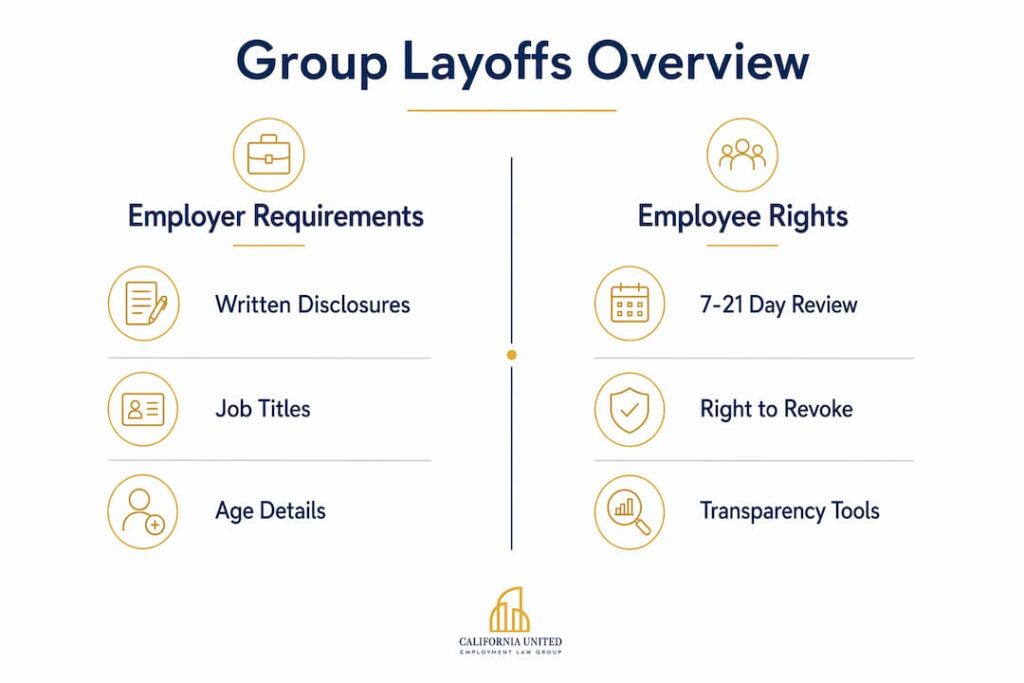
When a group layoff occurs, employers must provide specific written disclosures alongside the severance offer. These disclosures are not optional. The table below outlines what OWBPA requires employers to share with employees aged 40 and older in a group exit.
| Required Disclosure | Purpose |
|---|---|
| Job titles or job categories of employees selected and not selected in the decisional unit | Allows employees to identify who was selected for layoff |
| Ages of employees selected and not selected in the decisional unit | Helps identify whether older workers were disproportionately targeted |
| Eligibility criteria for the severance program | Clarifies who qualifies and why |
| Time limits for the program | Confirms the 45-day consideration window |
Failure to provide required OWBPA disclosures can invalidate the waiver of federal age-discrimination claims. This means an employee who signed a severance agreement may still be able to pursue an ADEA age-discrimination claim if the employer’s OWBPA disclosures were incomplete. That is a significant legal consequence for employers who skip this step.
The OWBPA group layoff disclosure is also a transparency tool. Reviewing the ages and job titles of everyone in your decisional unit can reveal patterns that suggest age discrimination concerns were present in the selection process. If older workers were disproportionately selected, that pattern may be legally significant, although it is not automatically proof of unlawful age discrimination.
What practical steps should Pasadena employees take before signing?
Receiving a severance offer can feel urgent. Employers sometimes frame the offer as time-sensitive to discourage careful review. The steps below reflect what a thorough separation agreements evaluation looks like in practice.
Retain all documents. Keep every version of the agreement you receive, including any emails or letters that accompanied it. If the terms change, you need a record of each version.
Verify that the severance pay is genuine consideration. Severance provides valid consideration only when it offers something beyond what you are already legally owed, such as final wages, accrued vacation, or commissions. If the “severance” is simply money already owed, such as final wages or accrued vacation, the release may lack adequate consideration.
Do not sign immediately. Use your full review period. California law gives you at least 5 business days. OWBPA gives eligible employees 21 or 45 days. These periods exist for a reason.
Request clarification on unclear terms. Ask your employer to explain any provision you do not understand, and document all responses in writing.
Check the non-disparagement clause. Confirm it includes the carve-out required by the Silenced No More Act. If it does not, the clause may be unenforceable, but you should know that before you sign.
Document any pressure to sign early. If a manager or HR representative tells you to sign before your review period ends, write down what was said, who said it, and when. That conduct may itself be legally significant.
Consult a Pasadena employment attorney. A severance agreement review by an attorney familiar with California and federal employment law can help Pasadena employees understand what they are signing and what they may be giving up.
Pro Tip: Refusing to sign a severance agreement does not forfeit your right to final pay or accrued vacation. Those wages are owed regardless of whether you sign.
Key Takeaways
Pasadena employees who review severance agreements carefully, understand their mandatory timelines, and consult qualified legal counsel before signing are far better positioned to protect their rights under California and federal law.
| Point | Details |
|---|---|
| Mandatory review periods apply | California law generally requires at least 5 business days; OWBPA requires 21 or 45 days for employees 40 or older who are asked to waive federal age-discrimination claims. |
| Material changes reset the clock | A material revision may restart the OWBPA consideration period unless the agreement validly provides otherwise. |
| Not all claims can be waived | Certain workers’ compensation-related rights and the right to file or participate in agency proceedings may survive a severance agreement. |
| Group layoffs trigger extra disclosures | In covered group programs, employers must provide required OWBPA age and job-title/job-category disclosures; missing disclosures can invalidate ADEA waivers. |
| Consideration must be genuine | Severance pay that only covers wages already owed may not constitute valid legal consideration for a waiver. |
What I Have Learned Rrom Reviewing Severance Agreements In Pasadena
Most employees I speak with assume a severance agreement is a formality. They believe the employer controls all the terms and that signing is the only realistic option. That assumption costs people real money and real rights.
The most common mistake I see is treating the review period as a countdown to signing rather than a window for evaluation. California law built that period into the process precisely because these agreements are not simple. A Civil Code 1542 waiver, for example, releases claims you do not even know you have yet. “California courts recognize that broad severance releases can be enforceable when they are clear, supported by consideration, and knowingly and voluntarily signed. For example, Rutter cites Skrbina v. Fleming Cos., Inc. for the rule that a voluntary release of state employment claims in exchange for severance benefits can include FEHA discrimination and harassment claims, while Rutter also explains that OWBPA imposes separate minimum requirements for valid ADEA waivers by employees 40 or older. That is an extraordinary thing to agree to without understanding it fully.
The second mistake is assuming that the agreement is final as written. Severance terms are often negotiable, particularly when the employer has not complied with OWBPA disclosure requirements or when the non-disparagement clause lacks the Silenced No More Act carve-out. An incomplete agreement is not a strong agreement. Employees who understand these issues are better positioned to evaluate whether negotiation is appropriate.
My honest view is that employees make more informed decisions when they treat the review period as seriously as the employer treats the signing. You have rights under California law that exist specifically to protect you in this moment. Use them. And if you are unsure what those rights mean in your specific situation, get a Pasadena employment law consultation before the clock runs out.
— California United Law Group
California United Law Group Helps Pasadena Employees Review Severance Agreements
California United Law Group represents employees across Pasadena who need a clear, thorough review of severance and separation agreements before signing. The firm’s attorneys review severance agreements for Pasadena employees under applicable California and federal employment laws, including California severance-review protections, OWBPA requirements, FEHA-related releases, and confidentiality or non-disparagement limits. If you have received a severance offer and want to understand what you are agreeing to, what you may be giving up, and whether the terms raise legal concerns, consider scheduling a consultation before signing.
Contact California United Law Group to schedule a severance agreement consultation before you sign.
FAQ
How long do I have to review a severance agreement in California?
California severance-review protections generally require at least 5 business days to review and consult an attorney. Employees 40 or older who are asked to waive federal age-discrimination claims generally receive 21 days for individual separations or 45 days for covered group programs under OWBPA.
Can I still file an EEOC charge after signing a severance agreement?
Yes. A severance agreement generally cannot eliminate your right to file or participate in an administrative charge with the EEOC or California Civil Rights Department, although it may affect private claims or individual recovery depending on the release language.
What happens if my employer changes the severance offer during my review period?
A material change may restart the OWBPA consideration period, unless the agreement validly provides otherwise. If the offer changes, ask whether the 21-day or 45-day period starts again before signing.
Does signing a severance agreement mean I give up all my rights?
No. Certain rights may survive signing, including the right to report unlawful conduct to government agencies and some workers’ compensation-related rights that require special handling.
Is it worth consulting an attorney before signing a severance agreement in Pasadena?
Yes. An employment attorney can help identify potentially unenforceable clauses, assess whether the severance pay appears to provide valid consideration, and clarify which claims the agreement asks you to release under California and federal law.
Recommended
- Pasadena CA Employment Law: What Workers Need To Know – California United Law Group –
- Pasadena Failure to Reimburse Employee Expenses – California United Law Group –
- Are Pasadena Layoffs Violating California Employment Laws? – California United Law Group
- Wrongful Termination in Pasadena: Know Your Rights – California United Law Group –