
Unpaid overtime wages are defined as compensation owed but not paid when an employee works beyond the legal daily or weekly thresholds set by California Labor Code §510. Alhambra employees are entitled to recover unpaid overtime wages calculated at 1.5 times their regular rate for hours over 8 per day or 40 per week, and 2 times their regular rate after 12 hours in a single day. The California Labor Commissioner’s Office and private employment attorneys both enforce these rights. California United Law Group represents Alhambra workers at every stage of the recovery process, from initial claim filing through full litigation.
How To Identify And Calculate Unpaid Overtime Wages In Alhambra
Recognizing unpaid overtime starts with knowing California’s daily and weekly thresholds. Many employees only track their weekly hours, but California law also triggers overtime on a daily basis. That distinction alone can mean thousands of dollars in missed pay.

California’s Overtime Thresholds
Under California Labor Code §510, non-exempt employees earn:
- 1.5x their regular rate for hours over 8 in a single workday
- 1.5x their regular rate for hours over 40 in a single workweek
- 1.5x their regular rate for the first 8 hours worked on the seventh consecutive day of a workweek
- 2x their regular rate for all hours over 8 worked on the seventh consecutive day of a workweek
- 2x their regular rate for all hours worked on the seventh consecutive day of a workweek
These thresholds apply independently. Working 9 hours on Monday triggers daily overtime even if you only work 35 hours total that week.
The Regular Rate Is Not Just Your Base Wage
This is where most employees undercount what they are owed. Your regular rate legally includes non-discretionary bonuses, commissions, and shift differentials, not just your hourly wage. That means if you earned a $200 production bonus during a week when you also worked overtime, that bonus must be factored into your overtime calculation.
Here is a simple example. If your base wage is $20 per hour and you earned a $100 non-discretionary bonus during a 45-hour week, your true regular rate is higher than $20. Dividing total straight-time earnings by total hours worked gives you the correct regular rate. Overtime pay is then calculated from that higher figure.
Pro Tip: Save every pay stub and bonus notice. If your employer paid you a bonus but did not recalculate your overtime rate for that pay period, you likely have an unpaid overtime claim.
Forensic accounting is sometimes used to reconstruct wages when records are incomplete. Employment attorneys work with payroll data, schedules, and time records to calculate exactly what you are owed, even when your employer’s records are disorganized or missing.
What are the legal deadlines for recovering unpaid overtime?
Time limits on wage claims are strict, and missing them can eliminate your right to recover. California sets two separate deadlines depending on how you file.
| Claim Type | Deadline | Legal Basis |
|---|---|---|
| Standard wage claim or lawsuit | 3 years from the violation | California Labor Code |
| Extended claim under UCL | 4 years from the violation | Business and Professions Code §17200 |
| Agency claim with Labor Commissioner | 3 years from the violation | California Labor Code |
| Private lawsuit for unpaid overtime (Lab.C. § 1194) | 3 years from the violation | CCP § 338(a); Lab.C. § 1194 |
The standard statute of limitations for California wage claims is 3 years. California’s Unfair Competition Law extends that window to 4 years for certain claims. That extra year can make a significant difference if your employer’s violations go back several years.
Agency claims filed with the California Labor Commissioner’s Office follow the same 3-year window. Private lawsuits filed in civil court can pursue the same three-year period, with the added benefit of recovering attorney fees and interest on unpaid wages under Labor Code § 1194. The 4-year extension under Business and Professions Code §17200 applies when you frame the claim as an unfair business practice, which an employment attorney can help you do.
Acting promptly protects your claim. Every month you wait, older pay periods may fall outside the recoverable window. If you believe your Alhambra employer has shorted your overtime pay, the clock is already running.
How can Alhambra employees file claims to recover unpaid wages?
You have two main paths: file a wage claim with the California Labor Commissioner’s Office, or file a private lawsuit in civil court. Each has real advantages and trade-offs.
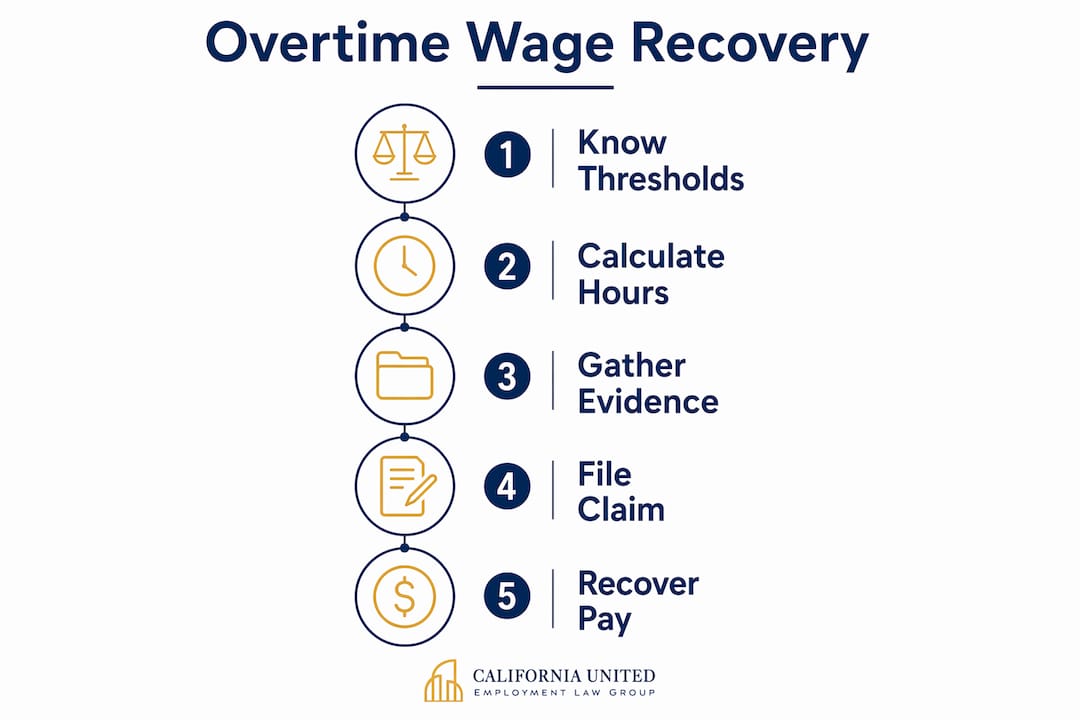
Step-By-Step: Filing Your Claim
Gather your evidence. Collect pay stubs, work schedules, time records, text messages, emails, and any written communications about your hours or pay. Documentation is critical evidence for both agency claims and lawsuits.
File with the Labor Commissioner. The California Labor Commissioner’s Office provides free wage claim filing and dispute resolution. This is faster and less formal than court, but remedies are more limited.
Consider a private lawsuit. Filing a private lawsuit for unpaid overtime under California Labor Code § 1194 allows recovery of unpaid wages, accrued interest, reasonable attorney fees, and costs of suit. An attorney can evaluate whether additional penalties apply to your specific situation.
Claim waiting time penalties. Under Labor Code §203, if you have left the job and your employer failed to pay wages owed at separation, waiting time penalties can add up to 30 days of additional pay.
Consult an employment attorney. California United Law Group offers free case evaluations for Alhambra workers. An attorney can assess whether your claim qualifies for class action status, which can significantly increase your recovery.
Pro Tip: Private lawsuits often recover more because they allow recovery of attorney fees and interest on unpaid wages, and may include additional penalties depending on the circumstances. Agency claims can resolve faster. An attorney can help you choose the right path based on your specific situation.
The evidence you collect in step one drives everything else. Employers frequently dispute hours worked, so your own records are your strongest defense. Keep screenshots of scheduling apps, written shift confirmations, and any messages where your employer acknowledged your hours.
For workers who are salaried but still entitled to overtime, the same filing steps apply. Being paid a salary does not automatically exempt you from overtime protections under California law.
Common Wage Theft Tactics Alhambra Workers Should Recognize
Wage theft is not always obvious. Employers sometimes use practices that look routine but are actually illegal under California law.
Common wage theft tactics include:
- Off-the-clock work: Requiring employees to set up, clean up, or attend pre-shift meetings without pay
- Time rounding: Rounding clock-in and clock-out times in ways that consistently reduce your recorded hours
- Misclassification: Labeling you as an independent contractor or exempt employee to avoid paying overtime
- Illegal deductions: Taking money from your paycheck for uniforms, tools, or cash register shortages
- Inaccurate pay stubs: Failing to list hours worked, pay rates, or gross wages as required by California law
Alhambra workers in retail, food service, healthcare, and warehouse jobs face these tactics most often. Rounding time entries is a particularly common issue locally. California law permits rounding only when it is neutral over time. If your employer’s rounding always cuts your hours, it is illegal.
Check your pay stubs carefully. California requires employers to list specific information on every pay stub, including total hours worked and the applicable pay rates. If your stub is missing this information, that is a separate violation. You can learn more about Alhambra paystub violations and what they mean for your claim.
Document everything you observe. Write down dates, times, and descriptions of any practice that reduces your recorded hours or pay. That contemporaneous record becomes powerful evidence if you file a claim.
Key Takeaways
California employees in Alhambra can recover unpaid overtime wages by understanding their legal thresholds, calculating the correct regular rate, and filing claims before the statute of limitations expires.
| Point | Details |
|---|---|
| Daily overtime triggers | California law requires 1.5x pay after 8 hours in a day, not just 40 hours in a week. |
| Regular rate calculation | Include bonuses, commissions, and shift differentials, not just base hourly pay. |
| Filing deadlines | Standard claims have a 3-year limit; the Unfair Competition Law extends this to 4 years. |
| Private lawsuits recover more | Private lawsuits under Lab.C. § 1194 allow recovery of back wages, interest, and attorney fees. Agency claims before the Labor Commissioner do not provide attorney fees in the same way and have more limited remedies. An attorney can assess which path maximizes your recovery. |
| Document everything | Pay stubs, schedules, and messages are the foundation of any successful wage claim. |
What I’ve Learned From Overtime Cases In Alhambra
I have seen a consistent pattern across wage claims in Alhambra and the surrounding San Gabriel Valley. Workers almost always underestimate what they are owed because they calculate overtime only from their base hourly wage. They forget that regular rate calculations must include every form of non-discretionary compensation. That mistake can cut their recovery in half before they even file.
The other pattern I see is delay. Workers wait months or even years before acting, often because they fear retaliation or assume the amount is too small to pursue. California law prohibits retaliation for filing wage claims. And the amounts are rarely small once you calculate three or four years of missed overtime at the correct rate.
My honest advice: do not wait for your employer to correct the error. They rarely do. The employees who recover the most are the ones who act quickly, document thoroughly, and get experienced legal support early. An employment attorney can often identify violations the worker never noticed, including misclassification, illegal rounding, and missing pay stub information.
Results in wage and hour cases vary based on the specific facts, evidence available, applicable exemptions, and other individual circumstances. Past observations do not guarantee a particular outcome in your matter.
California United Law Group: wage recovery support for Alhambra workers
California United Law Group represents Alhambra employees in unpaid overtime and wage and hour disputes. The firm handles claims under California Labor Code §510, including back pay, liquidated damages, waiting time penalties, and attorney fees. If you believe your employer has shorted your overtime pay, a free case evaluation can clarify your options and potential recovery. California United Law Group’s attorneys understand local enforcement patterns and the full range of wage and hour claims available to California workers. Visit the firm’s employment law services page to learn more or schedule your consultation.
FAQ
What is the overtime rate under California law?
California Labor Code §510 requires 1.5 times the regular rate for hours over 8 per day or 40 per week, and 2 times the regular rate after 12 hours in a single day.
How long do I have to file an unpaid overtime claim in Alhambra?
The standard deadline is 3 years from the date of the violation. California’s Unfair Competition Law can extend that window to 4 years for certain claims.
Can I recover more by filing a lawsuit instead of an agency claim?
It depends on your situation, but private lawsuits often provide broader remedies. Under California Labor Code § 1194, a civil action can recover the full amount of unpaid overtime wages, accrued interest, reasonable attorney fees, and costs of suit. Agency claims with the Labor Commissioner are faster and free but generally offer more limited remedies. An attorney can evaluate which path is better suited to your specific circumstances.
What evidence do I need to support my wage claim?
Pay stubs, schedules, time records, and written communications about your hours are the core evidence for any unpaid wage claim.
Does a salary mean I am not entitled to overtime?
Not necessarily. Many salaried workers in California still qualify for overtime depending on their job duties and pay level. California’s exemption rules are strict, and misclassification is a common wage theft tactic.