
Retaliation against an employee for engaging in legally protected activity is illegal in California. If you reported harassment, filed a wage complaint, or refused to do something unlawful and your employer responded by cutting your hours, demoting you, or firing you, you may have a claim under the California Fair Employment and Housing Act (FEHA) or Labor Code §1102.5. Both laws may protect Culver City employees, including employees of private employers and public agencies, but public-sector claims can involve additional notice requirements and deadlines.
Here is what to do first, before anything else:
- Preserve everything. Save emails, texts, Slack messages, performance reviews, and schedules. Do not rely on memory.
- Write down the timeline. Note the date you engaged in protected activity (a complaint, a report, a refusal) and the date of every negative action that followed.
- Consider filing promptly. Depending on your situation, you may file with the California Civil Rights Department (CRD, formerly DFEH), the California Labor Commissioner’s Office (DLSE), Cal/OSHA, the EEOC, or, if you are a Culver City municipal employee, the City of Culver City Human Resources Division.
- Talk to an employment attorney early. Deadlines vary by agency, and evidence disappears quickly once retaliation begins.
California law treats an employee’s good-faith, reasonable belief that something unlawful occurred as enough to trigger protection, even if the underlying complaint is never proven. Where available, employers who violate Labor Code § 1102.5 can face civil penalties of up to $10,000 per employee per violation, along with remedies such as reinstatement and back pay.
“Put simply, Labor Code § 1102.5 protects employees from retaliation when they disclose information they reasonably believe shows a violation of law, or when they refuse to participate in unlawful activity.” This is the core protection built into Labor Code §1102.5, and it applies regardless of whether the employee’s underlying suspicion turns out to be correct.
Key Takeaways
California law protects employees from retaliation after protected activity, and preserving evidence early is the single most important step toward a viable claim.
| Point | Details |
|---|---|
| Retaliation is illegal | FEHA and Labor Code §1102.5 both prohibit punishing employees for protected activity. |
| Good-faith belief is enough | You don’t need to prove the underlying complaint, only that your belief was reasonable. |
| Deadlines vary by agency | DLSE claims often run one year; FEHA allows up to three years to file administratively. |
| Documentation strengthens claims | Save emails, timelines, and performance reviews before evidence disappears. |
| Local resources exist | California United Law Group offers free consultations and handles many retaliation matters on a contingency-fee basis; whether costs or fees apply depends on the written fee agreement. |
Table of Contents
- Culver City Workplace Retaliation Against California Employees: The Direct Answer
- What Legally Counts as Retaliation in Culver City?
- Common Illegal Employer Actions After You Speak Up
- Which California Laws and Agencies Protect You?
- Where to File Your Complaint and What Deadlines Apply
- How to Prove Retaliation in California
- Practical Steps to Take if You Experience Retaliation
- Remedies Available in a Retaliation Claim
- How a Culver City Employment Attorney Can Help
- A Local Perspective on Retaliation Cases in Culver City
- How California United Law Group Can Help With Your Retaliation Claim
- Primary Sources for Filing and Research
- Sources
Culver City Workplace Retaliation Against California Employees: The Direct Answer
If you’re asking whether Culver City workplace retaliation against California employees is illegal, the answer is straightforward: yes, when the retaliation follows a legally protected activity. “In many retaliation contexts, California does not require you to prove your original complaint was ultimately correct, so long as your belief was reasonable and made in good faith. It requires you to show you acted in good faith and that your employer punished you for it.
This protection exists because California lawmakers recognized a basic problem: employees who fear retaliation stay silent about discrimination, wage theft, and safety hazards. FEHA and Labor Code §1102.5 exist specifically to remove that fear, or at least give employees legal recourse when it happens anyway.
What Legally Counts as Retaliation in Culver City?
Retaliation claims rest on a simple structure: you did something the law protects, and your employer punished you for it. The hard part is knowing what counts as “protected” and what counts as “punishment” in the eyes of California courts and agencies.
Protected activities typically include:
- Reporting discrimination or harassment, internally or to a government agency.
- Filing a wage claim or complaining about unpaid overtime.
- Whistleblowing about a suspected legal violation to a supervisor, a government agency, or another employee with authority to investigate.
- Participating in a workplace investigation as a witness.
- Requesting a disability accommodation or protected medical leave.
- Refusing to participate in an activity that would violate the law.
- Attending jury duty, responding to a subpoena, or exercising other legally protected workplace rights.
Adverse employment actions typically include:
- Termination or forced resignation (sometimes called constructive discharge).
- Demotion or reassignment to a less desirable role.
- Reduced hours, pay cuts, or unfavorable schedule changes.
- Exclusion from meetings, projects, or promotional opportunities.
- Sudden negative performance reviews with no prior documented issues.
- Increased scrutiny or discipline that did not exist before the protected activity.
FEHA covers retaliation tied to discrimination and harassment complaints, while Labor Code §1102.5 covers whistleblowing more broadly, including reports about safety violations, fraud, or other legal violations unrelated to a protected class. For refusal-to-participate claims under Labor Code § 1102.5, the activity the employee refused must actually have violated or failed to comply with a statute, rule, or regulation. One detail employees frequently overlook: you do not need to be right about the alleged violation. A reasonable, good-faith belief is sufficient, which means an employee who reports suspected wage theft that turns out to be a bookkeeping error is still protected, as long as the belief was genuine and reasonable at the time.
Common Illegal Employer Actions After You Speak Up
Retaliation rarely looks like a single dramatic event. It usually unfolds as a pattern, and Culver City employees across industries, from media production to retail to hospitality, tend to report similar tactics.
Common retaliatory actions include:
- Sudden termination shortly after a complaint or report.
- Demotion disguised as a “reorganization.”
- Hours quietly cut on the schedule without explanation.
- Shift changes that make the job harder to keep (like moving a parent to overnight shifts).
- Exclusion from team meetings, projects, or communication chains.
- A wave of write-ups or performance criticism that appears only after the complaint.
- Increased hostility or harassment from supervisors or coworkers.
- Threats related to immigration status, which are separately illegal regardless of a worker’s status.
A short checklist helps here. Ask yourself:
- Did the negative treatment start shortly after I reported something or asked for an accommodation?
- Was I treated differently than coworkers who did not complain?
- Did my employer offer a shifting or inconsistent explanation for the action?
- Am I being excluded from opportunities I previously had access to?
If you answered yes to any of these, it is worth documenting the pattern and getting legal advice about whether the facts support a retaliation claim.
Pro Tip: Retaliation frequently escalates gradually rather than happening all at once. An employee who reports a safety violation might first be excluded from a project, then given a poor review, and only later face termination. Documenting each step as it happens builds a far stronger record than trying to reconstruct events months later.
Consider a general pattern seen often enough to be worth noting: an employee flags a supervisor’s comments as harassing, is praised in a performance review two months earlier, and then receives a written warning within weeks of the complaint for issues never previously mentioned. That kind of timing can matter because investigators and courts often consider temporal proximity, prior performance history, and shifting explanations when evaluating retaliation.

Which California Laws and Agencies Protect You?
Several laws and agencies overlap in this space, and choosing the right one depends on the type of retaliation you experienced. Here is how the landscape typically breaks down.
| Law or Agency | Typical Claim Type | What It Handles |
|---|---|---|
| FEHA (via California Civil Rights Department) | Discrimination or harassment retaliation | Adverse action tied to reporting bias, harassment, or requesting accommodations |
| Labor Code §1102.5 (via DLSE) | Whistleblower retaliation | Retaliation for reporting suspected legal violations, fraud, or safety issues |
| DLSE / Labor Commissioner’s Office | Wage and hour retaliation | Retaliation after wage claims, overtime disputes, or meal break violations |
| EEOC | Federal discrimination retaliation | Overlapping federal claims, often filed alongside or instead of state claims |
| Cal/OSHA (or federal OSHA) | Safety-related retaliation | Retaliation for reporting workplace hazards or refusing unsafe work |
| City of Culver City HR Division | Municipal-employee complaints | Internal complaints involving Culver City municipal employment |
The California Civil Rights Department’s retaliation fact sheet outlines FEHA’s administrative process, which generally requires filing with the agency before pursuing a lawsuit. Labor Code § 1102.5 claims often do not require DLSE exhaustion before filing in court, though a DLSE complaint may still be useful or required for some related Labor Code retaliation issues. Federal claims under the EEOC run on a separate track and sometimes overlap with state filings, which is one reason many employees consult an attorney before choosing where to file.
If your employer is the City of Culver City itself, the city’s Human Resources Division complaint form provides a direct path for reporting discrimination, harassment, or retaliation involving municipal employees.
Where to File Your Complaint and What Deadlines Apply
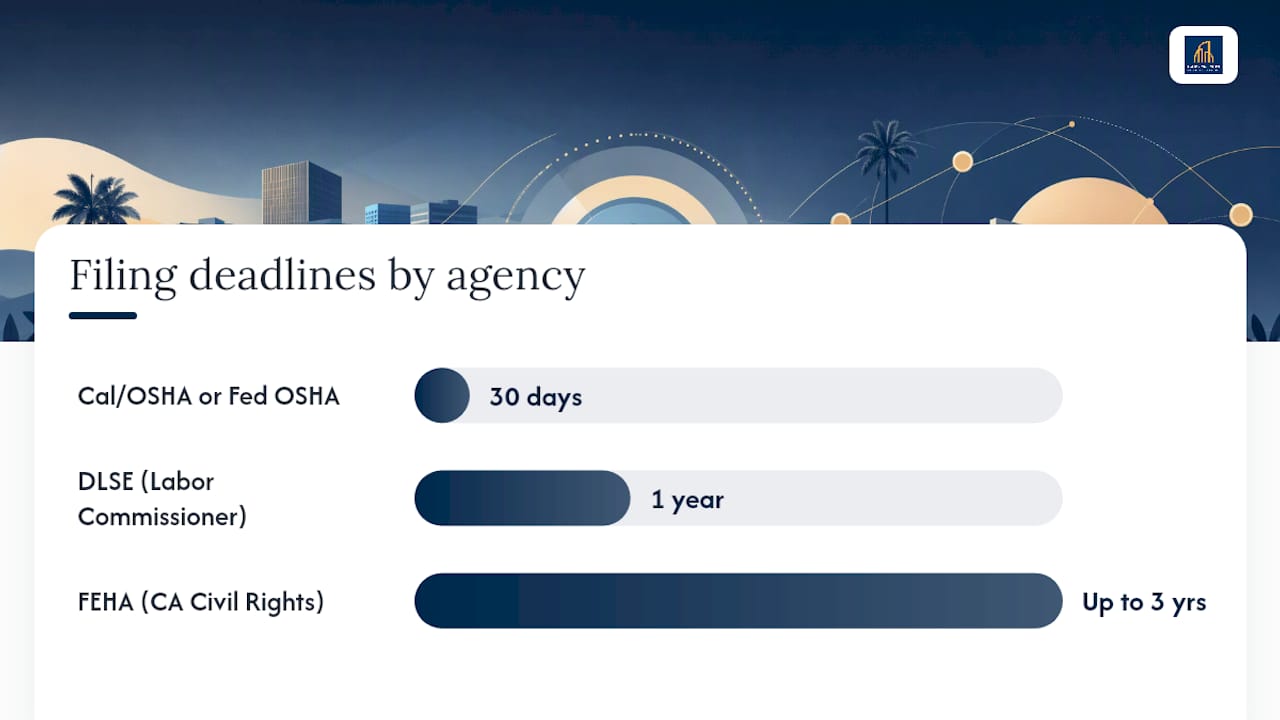
Filing deadlines vary significantly by agency, and missing one can end an otherwise strong claim. The deadlines below are general guideposts, not a substitute for checking the specific statute, agency rule, public-employer notice requirement, or federal deadline that applies to your facts.
| Agency | Typical Filing Window | Notes |
|---|---|---|
| DLSE (Labor Commissioner) | Generally within one year of the retaliatory act | Covers many Labor Code retaliation claims, including wage-related retaliation |
| California Civil Rights Department (FEHA) | Up to three years to file administratively | Required before filing most FEHA lawsuits in court |
| EEOC | Often short and fact-dependent | Federal claims may overlap with CRD filings, but employees should verify the applicable EEOC deadline promptly |
| Cal/OSHA or federal OSHA | As short as 30 days for certain safety retaliation | Applies specifically to workplace safety-related retaliation |
| City of Culver City HR | Varies by internal policy | Applies only to city employee complaints |
The DLSE’s retaliation complaint procedure generally gives employees about one year to file many Labor Code retaliation claims, though some provisions differ. FEHA claims allow up to three years to file administratively, which is longer than many employees expect, but waiting rarely helps a case. Evidence weakens, witnesses forget details, and employers often use the delay to argue the claim lacks merit. Public employees may also face separate government-claim or internal administrative deadlines, so they should not rely only on the general DLSE or CRD filing windows.
How to Prove Retaliation in California
Most retaliation claims, including FEHA retaliation and Labor Code § 1102.5 whistleblower claims, focus on three core issues:
- You engaged in protected activity. This could be a complaint, a report, a refusal to break the law, or a request for accommodation.
- You suffered a materially adverse employment action, such as termination, demotion, pay loss, schedule changes, or other conduct that materially affected the terms, conditions, or privileges of employment. Termination is the clearest example, but demotions, pay cuts, and schedule changes count too.
- A causal connection exists between the two. This is usually the most contested element, and it’s where timing and documentation matter most.
Timing matters, but California does not apply a single 90-day presumption to every retaliation claim. Some Labor Code provisions create a rebuttable presumption when adverse action occurs within 90 days of protected activity, while FEHA and Labor Code § 1102.5 claims generally require a fact-specific causation analysis. Close timing can still be important evidence, especially when combined with inconsistent explanations, prior positive reviews, or different treatment of employees who did not complain.
For Labor Code § 1102.5 whistleblower claims, once the employee shows by a preponderance of the evidence that protected whistleblowing was a contributing factor in the adverse action, the employer must prove by clear and convincing evidence that it would have taken the same action for legitimate, independent reasons even without the protected activity. That’s a considerably higher bar than the older standard courts used to apply, and it reflects how seriously California treats whistleblower protections under §1102.5.
California courts have reinforced these protections in several important decisions. In Lawson v. PPG Architectural Finishes, Inc., the California Supreme Court held that Labor Code § 1102.6, not the older McDonnell Douglas framework, supplies the burden-shifting standard for Labor Code § 1102.5 whistleblower claims. In Ross v. County of Riverside, the court explained that an employee does not have to identify the exact law being violated, so long as the employee discloses information they reasonably believe shows unlawful activity. In FEHA retaliation cases, Yanowitz v. L’Oreal USA, Inc. remains a key California Supreme Court decision explaining that retaliation claims turn on protected activity, adverse employment action, and a causal link.
Useful evidence typically includes:
- Emails or texts referencing the complaint or the retaliatory action.
- Performance reviews before and after the protected activity, showing a shift in tone.
- Witness statements from coworkers who observed the treatment.
- A documented timeline connecting the complaint to the adverse action.
- Comparator evidence showing how similarly situated employees who did not complain were treated differently.
Direct evidence of retaliatory intent, like a manager stating outright “you’re being let go because you complained,” is rare. Most cases rely on circumstantial evidence: suspicious timing, inconsistent explanations, and a documented change in treatment. California courts and agencies often evaluate circumstantial evidence rather than requiring a single ‘smoking gun.’
Practical Steps to Take if You Experience Retaliation
The period right after retaliation begins is often the most important window for protecting your position. What you do (and don’t do) in the following weeks can shape the strength of a future claim.
- Preserve every relevant document. Emails, text messages, schedules, pay stubs, and performance reviews all matter. Back them up somewhere outside your work email or company systems.
- Build a dated timeline. Note when you engaged in the protected activity, who you told, how you told them (email, verbal, written complaint), and every negative action that followed.
- Request your personnel file. California employees generally have rights to inspect or obtain certain personnel records, but the scope and timing of those rights can vary; these records may reveal what the employer documented, including anything inconsistent with prior reviews.
- File an internal complaint if it feels safe to do so. Many companies encourage or require internal reporting, and a written complaint can create a paper trail showing the employer was on notice; however, employees should get advice if reporting internally could create safety, immigration, or retaliation concerns.
- Identify potential witnesses. Coworkers who observed the treatment or heard relevant comments may become important later.
- Avoid impulsive reactions. Confrontations or public complaints on social media can complicate a claim. Documentation, not drama, is what strengthens your position.
Pro Tip: Keep your timeline in a format outside company control, like a personal notebook or a private cloud document. Employees who rely solely on work email or company-issued devices sometimes lose access to their own evidence the moment they’re terminated.
Remedies Available in a Retaliation Claim
Outcomes vary significantly depending on the facts of each case, the agency involved, and whether the matter resolves administratively or through litigation. That said, California law may provide a meaningful range of remedies when retaliation is proven, depending on the statute, forum, and facts.
- Reinstatement to your former position, where appropriate.
- Back pay for wages lost due to the retaliatory action.
- Removal of negative personnel records created as part of the retaliation.
- Emotional distress damages, where authorized and supported by the facts, particularly in FEHA cases.
- Statutory penalties, including civil penalties of up to $10,000 per employee per violation under Labor Code §1102.5.
- Injunctive relief, requiring an employer to stop a retaliatory practice.
- Attorneys’ fees and costs, where authorized by the applicable statute or agreement.
Administrative agencies like the DLSE and the Civil Rights Department may provide certain remedies through their processes, while other remedies may require litigation or a court judgment. No outcome is guaranteed, and the strength of your documentation often determines which remedies are realistically available.
How a Culver City Employment Attorney Can Help
Retaliation cases involve overlapping deadlines, competing agencies, and evidentiary standards that shift depending on which law applies. An employment attorney familiar with Culver City workplaces and California’s retaliation framework typically provides:
- Guidance on which agency (DLSE, Civil Rights Department, EEOC, or Cal/OSHA) fits your specific facts.
- Help preserving and organizing evidence before it disappears.
- Representation during administrative filings and agency investigations.
- Settlement negotiation with your employer or its counsel.
- Litigation support if the matter proceeds to court.
- Clarity on filing deadlines so a claim isn’t lost to a missed window.
Many employment attorneys, including California United Law Group, handle qualifying retaliation cases on a contingency-fee basis, meaning attorney fees are typically paid from a settlement or award rather than upfront; clients should review the written fee agreement to understand whether they may be responsible for costs or expenses. Early consultation often matters more than people expect, since evidence and witness memory both degrade quickly once retaliation begins. This article is educational and does not constitute legal advice; every case depends on its specific facts.
A Local Perspective on Retaliation Cases in Culver City
Retaliation concerns raised by Culver City employees often follow recognizable patterns: a complaint about a supervisor’s conduct, followed within weeks by a sudden shift change or an unexplained write-up. The timing may become clearer once events are laid out on paper, but employees often do not realize how much that timeline matters until they document it.
What we emphasize with clients is straightforward. The employees who preserve records early, save the email, note the date, keep a copy of the schedule before it changes, tend to have far more options later than those who wait and hope the situation resolves itself. Retaliation claims often turn on details most people do not think to save in the moment.
We also remind clients that acting on suspicion doesn’t require certainty. California’s good-faith standard exists precisely because employees shouldn’t have to be legal experts to be protected. If something feels retaliatory and it followed a complaint, a report, or a refusal to do something unlawful, that pattern deserves a closer look rather than a shrug.
How California United Law Group Can Help With Your Retaliation Claim
If you are dealing with retaliation in Culver City, California United Law Group can review your situation and explain whether contingency-fee representation may be available. For qualifying cases, the firm may represent employees on a contingency-fee basis, meaning attorney fees are generally paid from a settlement or court award; the written fee agreement explains whether the client may be responsible for litigation costs or expenses. This fee structure can make it easier for employees to seek legal help before deciding what to do next.
The firm’s services for qualifying retaliation claims may include evidence review, administrative filings with agencies like the DLSE or Civil Rights Department, settlement negotiation, and litigation when appropriate. A free initial consultation lets you walk through your situation and understand your options before deciding anything. This content is provided for general education and is not legal advice; outcomes depend entirely on the specific facts of each case.
If you believe you have experienced workplace retaliation, contact California United Law Group to request a consultation and discuss your options with an employment-law attorney.
Primary Sources for Filing and Research
Confirming current filing steps and deadlines directly with the relevant agency is always worthwhile, since procedures can change.
- DLSE: How to file — Labor Code references, covering §1102.5 protections and filing basics.
- DLSE: Retaliation complaint procedure, detailing the Labor Commissioner’s process and typical remedies.
- California Civil Rights Department: Retaliation fact sheet, outlining FEHA protections and the three-year filing window.
- City of Culver City: Discrimination and retaliation complaint form, for complaints involving city employees.
- EEOC: Retaliation, covering federal retaliation protections and enforcement.
For further reading on related topics, see this overview of workplace retaliation and your legal options in California and guidance on reporting workplace retaliation in Culver City.
This article is general information, not a substitute for advice from a qualified lawyer. Consult a qualified legal professional about your own circumstances before acting on anything here.
Sources
- DLSE: How to file — link code sections (Labor Code references)
- DLSE: Retaliation complaint procedure — Labor Commissioner’s Office
- California Civil Rights Department: Retaliation fact sheet (English)
- California Legislative Information: Labor Code section text (1102.5 and related)
- EEOC: Retaliation