
Yes. Marital status is a protected characteristic under California’s Fair Employment and Housing Act, and El Monte employees who face discrimination because they are married, single, separated, or divorced can bring a claim. The California Civil Rights Department accepts intake filings within a limited statutory window from the last discriminatory act. In most FEHA employment cases, the CRD filing deadline is three years from the alleged unlawful practice, and a civil lawsuit generally must be filed within one year after the CRD issues a right-to-sue notice. If this sounds like your situation, start preserving records now: save emails, note dates and witnesses, and consider a CRD intake or a consultation with an employment attorney.
TL;DR:
- Filing with the CRD within the applicable deadline is crucial, and evidence like emails, witness names, payroll records, and written policies can strengthen your case.
- California law allows employers to reasonably regulate spouses working in the same department, division, or facility in limited circumstances, but that rule does not permit blanket marital-status discrimination.
- Direct evidence, comparator evidence, timing, and documentation can help prove that marital status was a substantial motivating reason for the adverse employment decision.
- Filing with the CRD is mandatory before pursuing a lawsuit, and requesting a Right-to-Sue allows for direct litigation if investigation delays or unfavorable outcomes occur.
- Document every relevant incident early, preserve communications and pay records, and consider legal counsel to help evaluate deadlines, evidence, and filing strategy.
Table of Contents
- What law protects you: FEHA, Government Code §12940, and the CRD
- Concrete workplace examples of marital status discrimination
- How claims are proved: direct evidence, comparators, and preserving proof
- How to file a claim: CRD intake process, the three-year window, and what to expect
- Remedies you can seek if the claim succeeds
- Federal context: EEOC guidance and when Title VII matters
- What to do now: immediate steps for El Monte employees and how counsel helps
- Marital status discrimination and El Monte workplaces
- Common challenges and defenses employers may raise against marital status discrimination claims
- Role of human resources and internal complaint procedures before filing with CRD
- Potential impact of marital status discrimination on workplace culture and employee rights
- Differences in protections for full-time, part-time, and unionized El Monte employees
- Why early documentation changes the outcome of these claims
- How California United Law Group supports El Monte employees
- Sources
- FAQ
What law protects you: FEHA, Government Code §12940, and the CRD
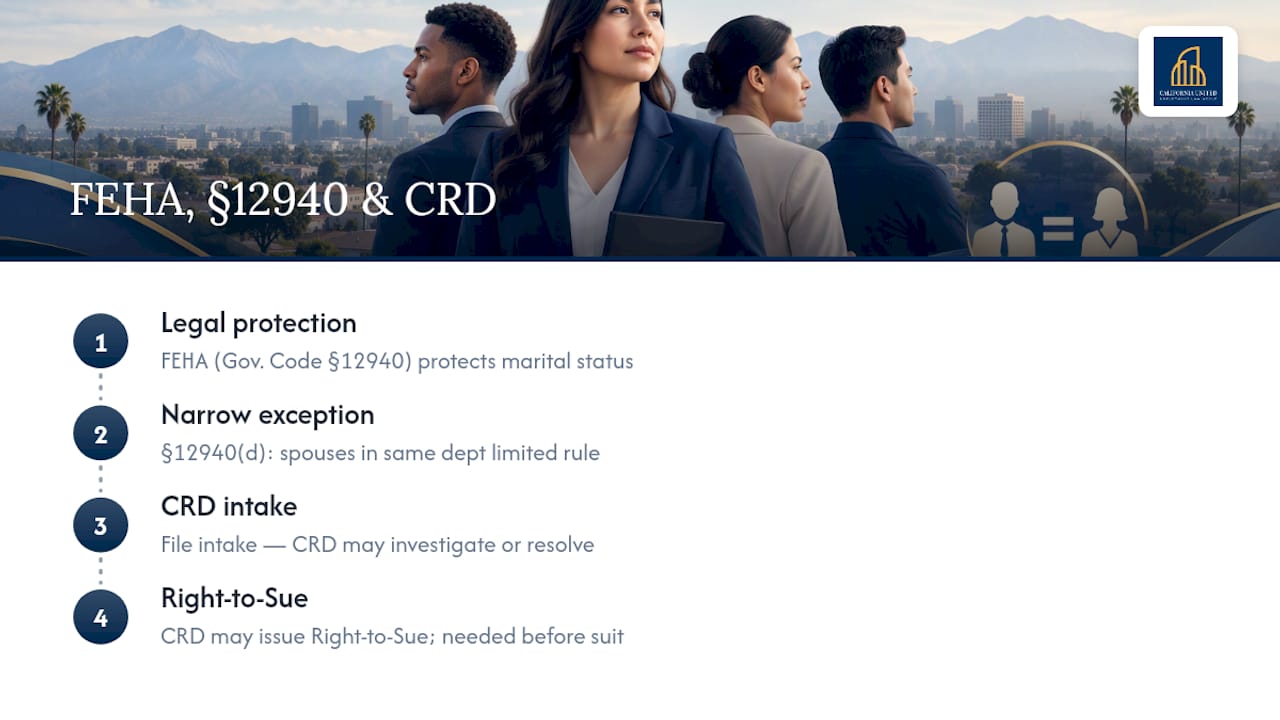
California’s Fair Employment and Housing Act is the backbone of your protection. The California Civil Rights Department lists marital status among the characteristics employers cannot use against you when making decisions about hiring, firing, pay, or promotion. This protection applies to marital states such as marriage, non-marriage, divorce, dissolution, separation, widowhood, annulment, and other marital states.
Government Code section 12940 makes it unlawful for a covered employer to discriminate in hiring, termination, compensation, or other terms and conditions of employment because of marital status. This is a statutory employment protection. It is a specific statutory bar, and it applies to private employers, most public agencies, and labor organizations operating in California.
There is one narrow rule worth understanding. Government Code section 12940(a)(3)(A) allows employers to reasonably regulate spouses working in the same department, division, or facility. For example, an employer may have a policy addressing direct spousal supervision if the policy is applied reasonably and not as a blanket exclusion. That exception is narrow, though, and it does not give an employer license to reject a candidate outright, deny a promotion, or cut someone’s hours simply because they are married.
The CRD’s role is to receive your complaint, investigate it, and determine whether the evidence supports your claim. Once you file an intake, the agency may investigate, attempt to resolve the matter, or issue what is called a Right-to-Sue notice, which allows you to bring a civil lawsuit in court. Many employees choose to request an immediate Right-to-Sue so they can proceed directly to litigation, particularly when they already have legal representation. Others let the CRD investigate first. Either path starts with the same administrative step, and skipping it is not an option: you generally cannot sue under FEHA without going through the CRD first.
Understanding this framework matters because it shapes your entire strategy. Knowing that the spousal-workplace rule is limited, and that the CRD process is generally required before filing a FEHA lawsuit, helps you avoid missed deadlines and filing mistakes.
Concrete workplace examples of marital status discrimination
Marital status discrimination rarely announces itself with an outright confession. It shows up in patterns and decisions that, taken together, point to an unlawful motive. Under California employment discrimination law, the key question is often whether marital status was a substantial motivating reason for the employer’s adverse action.
- Hiring rejections tied to family assumptions: an employer asks whether you are married or have young children, then declines to hire you based on assumptions about your availability or commitment.
- Promotions and raises denied to married employees: a manager passes over a married candidate for a leadership role, assuming family obligations will limit their hours, while promoting a less qualified single coworker.
- Unequal benefits access: dependent health coverage, spousal leave policies, or scheduling flexibility applied inconsistently depending on marital status.
- Scheduling penalties after a divorce or marriage: shift changes, reduced hours, or exclusion from overtime opportunities that begin shortly after a supervisor learns about a personal status change.
- Harassment tied to marital status: repeated or severe comments about your spouse, divorce, separation, or marital state that create a hostile work environment or are connected to an adverse employment action.
A useful signal is timing. If a manager learns you just got married or divorced, and your schedule, workload, or evaluation changes within weeks, that timeline itself becomes part of your evidence.
Pro Tip: Write down the exact date and wording of any comment about your marital status as soon as you can. Memory fades fast, and a contemporaneous note carries more weight than a recollection built months later.
How claims are proved: direct evidence, comparators, and preserving proof
Proving a marital status discrimination claim depends on the quality of your evidence, not just the strength of your memory. Courts, the CRD, and opposing counsel typically evaluate several categories of proof.
- Direct evidence. Emails, text messages, performance reviews, or verbal statements that explicitly reference your marital status as a factor in a decision are the strongest form of proof. For example, a manager writing that an employee will be distracted because she is married could be direct evidence if it is connected to a hiring, promotion, scheduling, pay, or termination decision.
- Comparator evidence. When direct statements are missing, you can show that similarly situated coworkers, people with comparable roles, tenure, and performance, were treated differently based on marital status. If a similarly situated single coworker received a promotion you were denied despite comparable or weaker qualifications, that comparison may matter.
- Pre-employment inquiry evidence. Questions asked during interviews about marital status, spouse, children, or family plans can serve as circumstantial evidence of intent, especially if they are asked selectively or followed by an adverse decision.
- Documentation preservation. Save calendar entries, payroll records, benefit statements, and the names of anyone who witnessed relevant conversations or heard discriminatory remarks.
The overlap between these categories often builds the strongest case. California courts use a substantial motivating reason standard in FEHA discrimination cases. In Harris v. City of Santa Monica, the California Supreme Court explained that discrimination need not be the only reason for an employment decision, but it must be more than a remote or trivial reason. An employer’s pre-employment question about your spouse’s job, paired with a rejection letter and a comparator who was hired despite similar qualifications, tells a more complete story than any single piece of evidence on its own.
How to file a claim: CRD intake process, the three-year window, and what to expect
Filing with the CRD can be more approachable than employees expect, but the steps matter and missed deadlines can jeopardize a claim.
- Complete the CRD pre-complaint inquiry or intake process. The CRD’s employment page provides the intake portal along with instructions on required details, including dates, names of involved parties, and a description of the discriminatory conduct.
- Attach supporting documents. Include emails, text messages, performance reviews, pay stubs, or any written communication that supports your account. Organized documentation speeds up the intake review.
- Track the three-year filing window. You generally must file with the CRD within three years from the date the alleged unlawful practice occurred, subject to limited exceptions. Continuing-violation arguments may affect the deadline in some cases, but you should not rely on that possibility without legal advice. File as soon as you can.
- Decide between state and federal filing. If your employer is also covered by federal law, you may have the option to file concurrently with the EEOC. Many employees focus first on the CRD because California expressly protects marital status under FEHA, while federal law does not list marital status as a stand-alone protected category.
- Wait for investigation or request a Right-to-Sue. After intake, the CRD may investigate, mediate, or issue a Right-to-Sue notice on request, which lets you file a civil lawsuit.
Procedural timelines vary by case complexity, agency workload, and whether the employee requests an immediate right-to-sue notice or asks the CRD to investigate.
Remedies you can seek if the claim succeeds
A successful marital status discrimination claim may result in several forms of relief, depending on the facts, available evidence, employer status, and procedural posture.
- Back pay: wages and benefits lost between the discriminatory act and the resolution of your case.
- Front pay: compensation for future lost earnings when reinstatement is not practical.
- Emotional distress damages: compensation for the psychological toll of discrimination, when supported by evidence.
- Punitive damages: additional damages that may be available against a nongovernmental employer when the required legal standard is met.
- Attorney’s fees and costs: potentially recoverable by a prevailing employee under FEHA.
- Reinstatement or policy changes: non-monetary remedies that can include returning you to your position or requiring the employer to revise discriminatory policies and retrain staff.
The exact combination of remedies depends heavily on the facts of your case and the strength of your proof. Two employees with similar claims can see very different outcomes depending on documentation quality, the size of the employer, and whether the conduct was isolated or part of a broader pattern. No article can predict the value or result of a FEHA claim without reviewing the evidence, employer defenses, damages, and procedural history. This variability is one more reason early evidence preservation matters so much.
Federal context: EEOC guidance and when Title VII matters
Federal law does not name marital status as its own protected category, but it intersects with your claim in an important way. EEOC guidance explains that questions about marital status or number of children can serve as evidence of sex or pregnancy discrimination when an employer uses them to exclude or disadvantage one sex more than the other.
EEOC guidance recognizes that marital-status or family-responsibility questions can become evidence of discriminatory intent when they are used in a way that disadvantages applicants or employees based on sex, pregnancy, or another federally protected category. If an employer questioned only female candidates about marriage plans, that pattern may support a sex discrimination theory under federal law, in addition to a FEHA marital status theory under California law.
Dual filing with the CRD and EEOC often makes sense when your employer is covered by both laws and your facts touch on sex or pregnancy alongside marital status. An attorney can help determine which combination gives you the strongest position.
What to do now: immediate steps for El Monte employees and how counsel helps
If you believe you have experienced marital status discrimination, a few immediate actions protect your position.
- Document every incident with dates, direct quotes, and the names of anyone present.
- Preserve communications including emails, texts, and any written policy that treated you differently.
- Collect payroll and benefits records that show pay, hours, or benefit changes around the time of the incident.
- Identify witnesses who can corroborate what happened, and note their contact information before memories fade or coworkers change jobs.
Deciding whether to file with the CRD on your own or speak with an attorney first is an important practical choice. Filing alone is possible, but early legal guidance can help identify relevant evidence, preserve deadlines, and frame the claim if the case later moves to litigation.
Legal representation is available to California employees in FEHA claims, including marital status discrimination, with assistance for CRD filing strategy and litigation when cases do not resolve administratively. Such representation may be offered on a contingency fee basis. If the article states or implies that no fee is owed unless there is a recovery, also disclose whether the client may remain responsible for litigation costs or case expenses.
Marital status discrimination and El Monte workplaces
El Monte’s employment base includes warehouse, logistics, retail, service, and small manufacturing workplaces, and some smaller employers may operate without dedicated human resources departments. That structure matters because marital status discrimination in smaller or less formalized workplaces often shows up through informal scheduling decisions or verbal comments rather than written policy.
There is no separate El Monte municipal ordinance that expands on FEHA’s marital status protection. Your rights come from state law, applied the same way whether you work in a warehouse near the San Gabriel Valley or an office elsewhere in the county. What differs locally is how discrimination tends to surface. El Monte workplaces, a supervisor’s remark about your marriage, divorce, or separation, followed by a schedule change or reduced hours, may be important evidence worth documenting immediately.
Company policies matter too. If your employer has a written handbook addressing anti-discrimination protections, review it. A policy that promises fair treatment regardless of marital status, followed by conduct that contradicts it, becomes useful evidence that the employer knew the standard and violated it anyway.
Common challenges and defenses employers may raise against marital status discrimination claims
Employers often deny discriminatory intent and may raise several recurring defenses.
The most common is a legitimate, nondiscriminatory reason for the decision, arguing that a termination or denied promotion was based on performance, budget cuts, or restructuring rather than marital status. Employers may also invoke the limited spousal-workplace rule under Government Code section 12940(a)(3)(A), even when the facts do not actually fit that rule. Some employers argue that the employee cannot identify a proper comparator, claiming no similarly situated coworker existed to prove differential treatment.
Timing defenses are common as well: an employer may argue that too much time passed between the alleged discriminatory act and your CRD filing, which is exactly why tracking the three-year window matters. Finally, some employers argue that the decision-maker had no knowledge of the employee’s marital status, undercutting the claim that it factored into the decision.
These defenses do not automatically defeat a claim, but each one highlights why documentation, dates, and comparator evidence carry significant weight. A well-preserved paper trail closes the gaps these defenses try to exploit.
Role of human resources and internal complaint procedures before filing with CRD
Many employees ask whether they need to complain internally before going to the CRD. FEHA generally does not require an employee to exhaust an internal HR complaint process before filing with the CRD, but there may be practical reasons to consider an internal written complaint.
Filing an internal complaint creates a documented record showing the employer was on notice of the alleged discrimination. It can also trigger an internal investigation that either resolves the issue or produces additional evidence, such as witness statements gathered by HR, that later supports your CRD filing.
There is a tradeoff. Some employees worry that raising the issue internally invites retaliation or gives the employer time to build a defense before an official complaint is filed. If you go the internal route, keep a copy of your written complaint and any response, and note the date you submitted it. If retaliation follows an internal complaint about unlawful discrimination, that conduct may support an additional retaliation claim.
Potential impact of marital status discrimination on workplace culture and employee rights
Marital status discrimination does more than harm the individual employee facing it. It signals to coworkers that personal life choices, unrelated to job performance, can affect pay, promotions, and job security. That signal tends to erode trust across a team, particularly in smaller workplaces where employees notice how colleagues are treated.
Left unaddressed, this kind of discrimination often normalizes broader boundary violations, including intrusive questions about family planning, relationship status, or caregiving responsibilities during interviews and performance reviews. Employees who see a coworker penalized for getting married or divorced may become reluctant to disclose personal information, even when it is relevant to legitimate benefits or leave requests.
Pursuing your rights under FEHA may do more than address your individual claim. It reinforces the standard that employment decisions should rest on job performance and qualifications, not personal status, and it puts employers on notice that this protection is actively enforced rather than a rule that exists only on paper.
Differences in protections for full-time, part-time, and unionized El Monte employees
FEHA’s marital status protection applies broadly, but the practical path to a claim can differ depending on your employment arrangement.
Full-time employees typically have the most straightforward path, since their pay, benefits, and promotion history offer clear comparators and documentation. Part-time employees are equally protected under FEHA, but proving lost wages or denied benefits can require more detailed payroll records, since hours and eligibility for benefits often fluctuate.
Unionized employees may face one added layer: some collective bargaining agreements include grievance procedures that address workplace disputes, including discrimination. A union grievance process does not replace the CRD filing requirement for FEHA claims, and reviewing the collective bargaining agreement can help determine whether a parallel grievance may preserve rights or create a useful evidentiary record. Independent contractors may face different coverage issues under FEHA, and misclassification may need separate analysis if the worker was treated as an employee in practice.
Whatever your employment category, the underlying right stays the same: your employer cannot treat you differently because of your marital status.
Why early documentation changes the outcome of these claims
Claims supported by contemporaneous notes, saved messages, payroll records, policies, and named witnesses tend to be easier to evaluate than claims reconstructed from memory months later. The CRD’s three-year filing window feels generous until you try to recall exact dates and wording after time has passed.
El Monte’s mix of warehouse, logistics, and retail employers often means informal verbal exchanges rather than written policies drive these decisions, which makes early documentation even more valuable. If you are weighing whether to file on your own or speak with counsel first, a free case evaluation can help clarify what evidence may matter most before the filing window narrows.
— California United Law Group
How California United Law Group supports El Monte employees
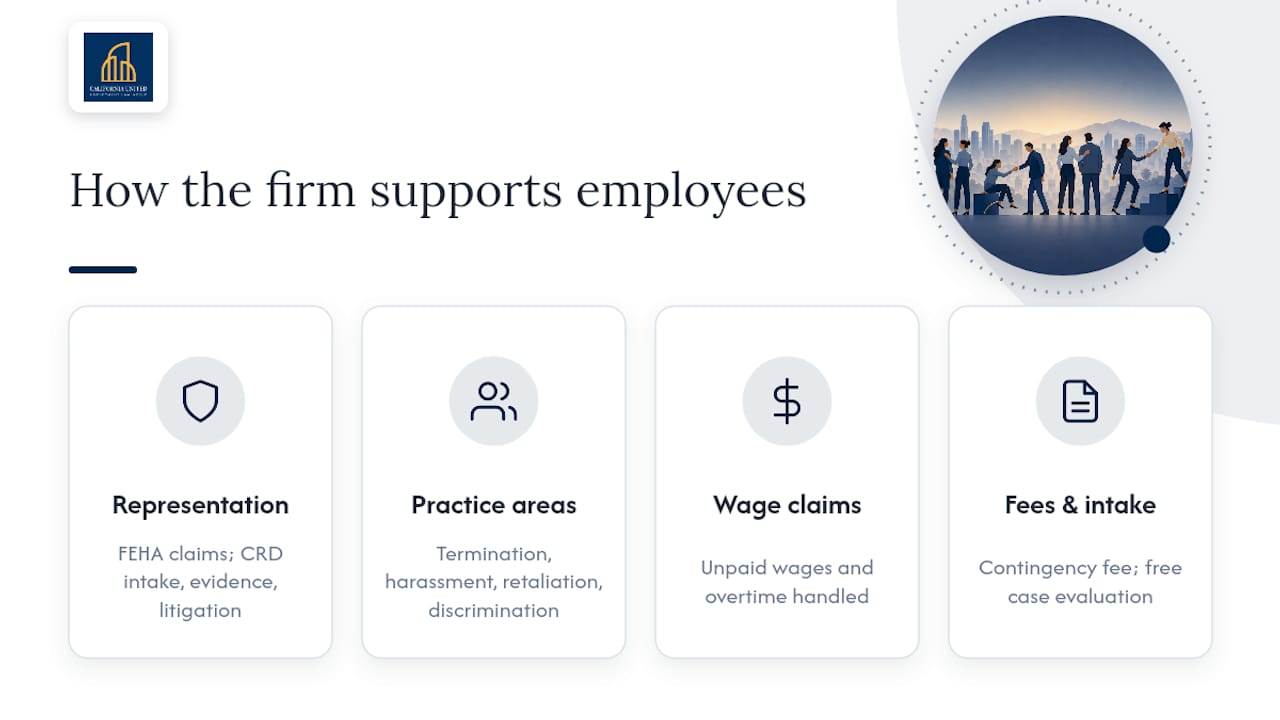
You do not have to evaluate statutes, filing deadlines, and right-to-sue options on your own. California United Law Group represents California employees in FEHA claims, including marital status discrimination cases, and helps with CRD intake strategy, evidence organization, and litigation when a claim does not resolve at the administrative stage.
The firm’s employment law practice covers wrongful termination, harassment, retaliation, and discrimination claims tied to marital status, sex, race, disability, and other protected categories. If your situation also involves unpaid wages or overtime, the firm’s wage and hour team handles those claims as well.
Representation may be offered on a contingency fee basis, meaning attorney’s fees are owed only if there is a recovery. The fee agreement should also explain whether the client may be responsible for litigation costs or case expenses. A free case evaluation can help you understand your options, deadlines, and possible next steps. If you believe you have faced marital status discrimination in El Monte, consider reaching out promptly to discuss your situation and preserve your options before the filing window closes.
This article is general information, not a substitute for advice from a qualified lawyer. Consult a qualified legal professional about your own circumstances before acting on anything here. Past results, examples, or general legal outcomes do not guarantee or predict the result of any individual case.
Sources
- Employment | CRD
- California Code, GOV 12940
- Pre-Employment Inquiries and Marital Status or Number of Children | U.S. Equal Employment Opportunity Commission
FAQ
Can employers discriminate based on marital status?
No. Under California’s Fair Employment and Housing Act, covered employers cannot make hiring, firing, promotion, pay, or other employment decisions because of marital status. California law does allow limited reasonable regulation of spouses working in the same department, division, or facility, but it does not allow blanket discrimination based on marriage, divorce, separation, widowhood, or other marital states.
How hard is it to win a discrimination lawsuit?
Case difficulty depends heavily on the facts, employer defenses, damages, deadlines, and quality of evidence, including direct statements, comparator treatment, timing, and preserved documentation. Claims supported by contemporaneous notes, saved communications, payroll records, and witnesses are generally easier to evaluate than claims reconstructed from memory long after the events occurred.
What are some examples of marital status discrimination?
Common examples include rejecting a job candidate after asking about their marriage or children, denying a promotion because a manager assumes a married employee will have less availability, and offering unequal access to dependent benefits based on marital status. Repeated or severe comments about a coworker’s marriage, divorce, separation, or marital state may also support a harassment or discrimination claim when the legal elements are met.
What are 5 examples of unfair discrimination?
Under California law, protected categories include marital status, race or color, sex or gender, disability, age, and other characteristics protected by FEHA. Unlawful employment discrimination occurs when a covered employer takes an adverse employment action because of a protected characteristic, rather than because of legitimate job-related reasons.