
Yes. Culver City employees can bring gender discrimination claims under California’s Fair Employment and Housing Act (FEHA), which covers sex, gender, gender identity, and gender expression. For most FEHA claims, an employee must first file a timely pre-complaint inquiry or complaint with the California Civil Rights Department through the CCRS portal before filing a FEHA lawsuit. If you are weighing your options, an employment law attorney can help evaluate whether the facts may satisfy the applicable FEHA standards.
TL;DR:
- CRD complaints generally must be filed within three years of the alleged unlawful practice, and documentation like emails, pay records, performance reviews, and witness information can strengthen the claim.
- FEHA generally applies to employers with five or more employees for discrimination claims and covers protected characteristics that include sex, gender, gender identity, gender expression, pregnancy, childbirth, breastfeeding, and related medical conditions.
- Hostile work environment claims may involve persistent misgendering, sexual comments, or denial of gender-transition-related workplace changes when the conduct is tied to a protected characteristic and is severe or pervasive enough to alter the work environment.
- A CRD right-to-sue notice is generally required before filing a FEHA lawsuit, and the lawsuit generally must be filed within one year from the date CRD issues the notice.
- Early documentation and timely filing with the CCRS portal can help preserve the claim and create a clearer record, especially in layered management or subtle discrimination cases.
Table of Contents
- What FEHA Covers and Who Is Protected
- What Gender Discrimination Looks Like on the Job
- How to Start a Claim: CRD Intake and Key Deadlines
- Evidence and Documentation Employees Should Preserve
- Remedies, Retaliation Protections, and Realistic Outcomes
- A Culver City Perspective on Gender Discrimination Cases
- How California United Law Group Can Help
- Where to Verify Deadlines and File Your Intake
- Sources
- FAQ
What FEHA Covers and Who Is Protected
FEHA prohibits covered employers from discriminating or harassing employees based on protected characteristics that include sex, gender, gender identity, gender expression, pregnancy, childbirth, breastfeeding, and related medical conditions. FEHA generally applies to employers with five or more employees for discrimination claims; harassment provisions may apply more broadly depending on the employment relationship and the specific defendant. That five-employee threshold may cover many Culver City businesses, from production companies to larger tech, media, and creative employers headquartered or operating in the city.
A FEHA harassment claim does not require termination, demotion, or loss of a promotion. A single severe incident or sufficiently pervasive conduct may support a hostile work environment claim if the conduct is tied to a protected characteristic and creates a work environment that is hostile, intimidating, offensive, oppressive, or abusive. The statute spells out what employers must do to prevent and address this conduct, not just what happens after the fact.
California courts evaluate hostile work environment claims under the totality of the circumstances, including frequency, severity, whether the conduct was physically threatening or humiliating, and whether it interfered with work performance. In Miller v. Department of Corrections, the California Supreme Court applied that totality-of-the-circumstances framework to workplace harassment claims.
Here are common threshold issues that may affect whether FEHA applies to your situation:
- Your employer has five or more employees (for most discrimination claims).
- The conduct relates to your sex, gender, gender identity, or gender expression.
- The treatment materially affected the terms, conditions, or privileges of employment, or the conduct was severe or pervasive enough to create a hostile work environment.
- For coworker or nonsupervisor harassment, the employer or its agents knew or should have known about the conduct and failed to take immediate and appropriate corrective action. If the harasser is a supervisor, different employer-liability rules may apply.
What Gender Discrimination Looks Like on the Job
Gender discrimination rarely announces itself. It usually shows up in decisions or comments that seem small in isolation but form a pattern once you look at them together. Depending on the facts, these scenarios may support a FEHA claim:
- Unequal pay for substantially similar work. You discover a colleague of a different sex, gender, or gender identity earns more for substantially similar work, and the employer cannot justify the difference with a lawful factor such as seniority, merit, quantity or quality of production, or another bona fide factor.
- Pregnancy-related demotion. You’re moved to a lesser role, denied a promotion, or pushed out shortly after announcing a pregnancy.
- Refusal to honor gender-transition accommodations. Your employer refuses to recognize reasonable name or pronoun usage, restroom access, or dress code treatment consistent with your gender identity, depending on the facts and workplace context.
- Persistent misgendering. Coworkers or supervisors repeatedly use the wrong name or pronoun after being corrected, especially after you have raised the concern and the conduct is severe or pervasive enough to affect the work environment.
- Sexually denigrating comments. Jokes, remarks, slurs, or comments tied to sex, gender, gender identity, or gender expression that are severe or pervasive enough to create a hostile, intimidating, offensive, oppressive, or abusive work environment.
Discrete actions like termination or demotion are easier to timestamp and prove. Hostile environment claims, built on an accumulation of conduct, rely more heavily on dates, witnesses, and your own contemporaneous notes. If unequal pay is part of your situation, our Culver City unequal pay guide walks through how those claims typically get evaluated.
How to Start a Claim: CRD Intake and Key Deadlines
For FEHA claims, the administrative process usually starts with a pre-complaint inquiry or complaint through the California Civil Rights System (CCRS) portal, the state’s official online system for CRD matters. The intake asks for basic facts: relevant dates, the people involved, and a description of what happened. You do not need a finished legal argument to begin, but the intake should accurately identify the employer, relevant dates, protected basis, adverse actions or harassment, and people involved. CRD’s current portal instructions should be reviewed carefully because filing procedures and portal rules can change.
Statistic Callout: FEHA administrative complaints generally must be filed within three years of the alleged unlawful practice, subject to limited exceptions. Missing that window can prevent you from pursuing a FEHA administrative complaint, although other claims may have different deadlines.
A few procedural points worth understanding before you file:
- A CRD right-to-sue notice is generally required before filing a FEHA lawsuit in court.
- After CRD issues a right-to-sue notice, a FEHA civil lawsuit generally must be filed within one year from the date of that notice.
- Federal law may run on a different clock, including different EEOC deadlines and special rules for federal employees, so employees should confirm which deadline applies before relying on any single filing period.
- The CCRS portal supports multiple languages, which matters in a workforce as varied as Culver City’s.
These timelines run independently, so it’s worth understanding which one applies to your specific employment situation before deciding how to proceed.
Evidence and Documentation Employees Should Preserve
The strength of a gender discrimination claim often comes down to what you can document, not just what you remember. CRD investigators and, later, courts rely on contemporaneous records to build a timeline and assess credibility.
Items worth preserving as soon as you suspect a problem:
- Lawfully obtained emails, texts, and Slack or chat messages referencing the conduct or decision.
- Pay stubs and compensation records, especially if pay disparity is part of your claim.
- Personnel files, performance reviews, and any written warnings or evaluations.
- Lawful screenshots of messages, schedules, or postings that you are permitted to access and preserve.
- Names and contact information for witnesses, even if you’re not sure they’ll cooperate.
- Calendar entries or personal notes made close to the time events occurred.
- Avoid taking, forwarding, or downloading confidential, privileged, trade secret, or proprietary employer materials without legal advice.
Pro Tip: Save lawful copies of relevant, nonconfidential documents that you are permitted to access, and keep personal notes with dates, witnesses, and what happened. Do not remove confidential, privileged, trade secret, or proprietary employer materials without legal advice.
Records created near the time of an incident carry more weight than recollections written months later. Waiting to document what happened makes it harder to track down witnesses and recall specifics accurately.

Remedies, Retaliation Protections, and Realistic Outcomes
FEHA may allow several categories of relief if a gender discrimination claim succeeds, though available remedies depend heavily on the specific facts, claims, defenses, and proof. Common remedies include:
- Back pay for wages lost due to the discriminatory action.
- Front pay in some cases, covering future lost earnings.
- Emotional distress damages, depending on the evidence and the facts.
- Injunctive relief, requiring the employer to change a policy or practice. Attorney’s fees and costs may also be available in appropriate cases, depending on the claims, outcome, and applicable law.
Retaliation is treated as its own violation under FEHA. To prove FEHA retaliation, an employee generally must show protected activity, an adverse employment action, and a causal link between the protected activity and the employer’s action. If your employer demotes you, cuts your hours, terminates you, or otherwise materially changes the terms, conditions, or privileges of employment because you reported discrimination or participated in a protected process, that conduct may support a separate retaliation claim. Our Culver City workplace retaliation overview covers how those protections typically function.
Outcomes vary widely based on the specific facts of each case, the quality of available evidence, and how an employer responds during the investigation. No attorney can promise a particular result or timeline, and you should treat any such promise with skepticism.
A Culver City Perspective on Gender Discrimination Cases
Culver City’s mix of production studios, tech offices, staffing arrangements, and creative agencies can involve layered management structures, making it important to identify the correct employer, joint employer, or responsible entity. Naming the wrong entity can delay the process, create exhaustion issues, or complicate a later lawsuit. In some cases, the underlying conduct may be difficult to prove because the paper trail is thin or documentation was created only months later.
Starting the CRD process early, while details and witnesses are still fresh, can help create a more complete record for CRD or a later lawsuit. Employment law attorneys can help employees identify the proper employer, preserve evidence, and evaluate whether the facts support a FEHA claim.
How California United Law Group Can Help
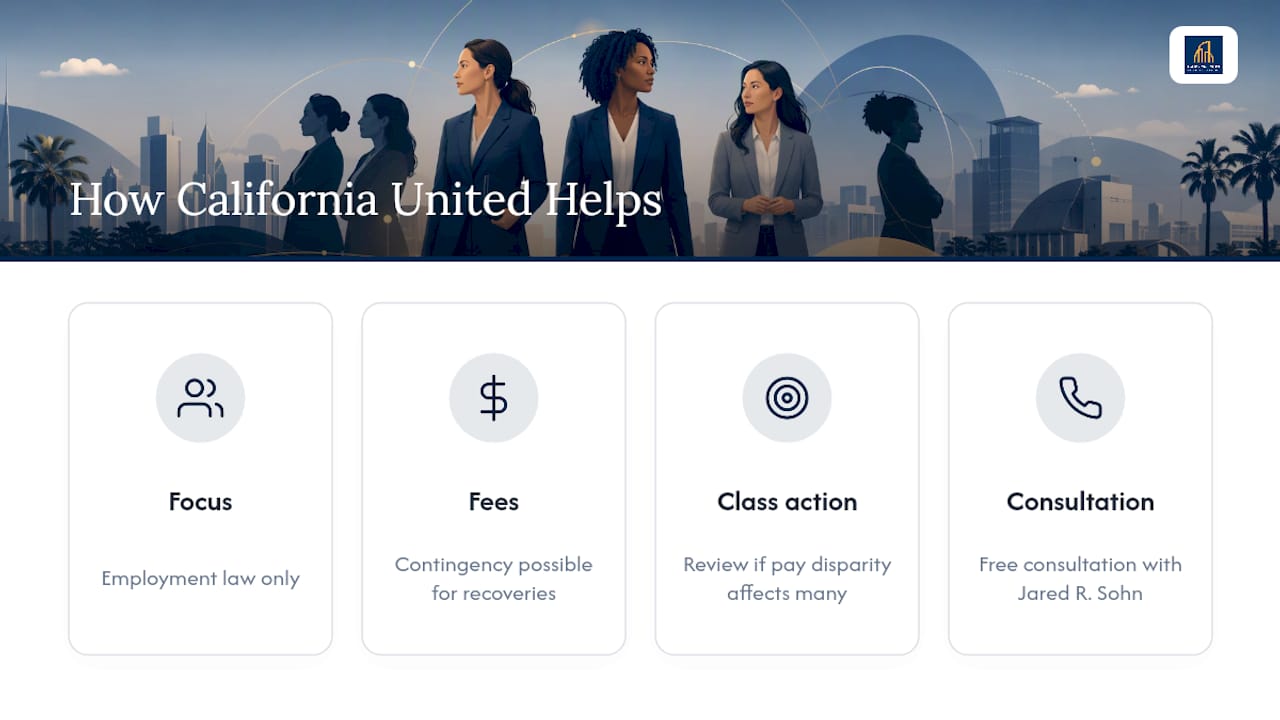
If you are weighing whether to report gender discrimination or have already started the CRD process, California United Law Group can evaluate your situation from an employee-side perspective. The firm handles employment law matters including gender or sex discrimination, harassment, retaliation, and wrongful termination, and attorney experience may help assess both employee-side claims and likely employer defenses.
In some matters, employment lawyers may offer contingency-fee arrangements, but fee terms, costs, and client responsibilities should be confirmed in a written agreement. If pay disparity or a broader pattern affecting multiple employees is part of the situation, an attorney can evaluate whether individual, representative, or class claims may be appropriate. This article is educational only and isn’t a substitute for legal advice tailored to your situation.
👉 Contact Jared R. Sohn and the team at California United Law Group for a free consultation to discuss your situation before applicable deadlines narrow your options.
Where to Verify Deadlines and File Your Intake
Three starting points can help verify deadlines and filing steps: the CRD complaint process page, the CCRS portal, and the FEHA statute. These sources do not replace legal advice about your specific facts or deadlines. CRD also publishes downloadable intake forms for those who prefer to review the paperwork before starting online.
This article is general information, not a substitute for advice from a qualified lawyer. Consult a qualified legal professional about your own circumstances before acting on anything here.
Sources
- Employment discrimination | California Civil Rights Department
- California Government Code §12940 (FEHA) — Unlawful practices
- California Government Code §12960 — CRD filing deadlines
- California Government Code §12965 — right-to-sue notices and civil action deadlines
- Harris v. City of Santa Monica, 56 Cal.4th 203
- Miller v. Department of Corrections, 36 Cal.4th 446
- Yanowitz v. L’Oreal USA, Inc., 36 Cal.4th 1028
- California Civil Rights System (CCRS)
FAQ
Is gender discrimination in the workplace illegal in California?
Yes. FEHA prohibits covered employers from discriminating based on protected characteristics that include sex, gender, gender identity, and gender expression. This applies to hiring, pay, promotions, discipline, and termination decisions.
How do you prove unfair discrimination at work?
Proof often relies on documentation such as emails, pay records, performance reviews, witness accounts, timing, comparator evidence, and facts showing that a protected characteristic was a substantial motivating reason for the adverse action. Contemporaneous records created close to the time of the incident tend to carry more weight during a CRD investigation than recollections written later.
What is the 80% rule in discrimination?
It is a statistical screening concept sometimes used in adverse impact analyses, but it is not a standalone FEHA liability standard. Disparate impact claims depend on the challenged practice, statistical proof, causation, and any applicable employer defenses.
Is misgendering someone a hate crime in California?
Misgendering someone in the workplace is not automatically a hate crime or a FEHA violation. Repeated, severe, or pervasive misgendering in the workplace may support a FEHA harassment claim if it is tied to gender identity or gender expression and creates a hostile, intimidating, offensive, oppressive, or abusive work environment.
How long do I have to report discrimination in Culver City?
FEHA administrative complaints generally must be filed with CRD within three years of the alleged unlawful practice, subject to limited exceptions. Waiting past that window can prevent you from pursuing a FEHA administrative complaint, so confirming deadlines early is safer than waiting.