
California law protects Burbank employees from workplace discrimination based on gender identity or gender expression. Students may also have protections under California education laws and, where the school receives federal funding, Title IX. The California Fair Employment and Housing Act (FEHA) prohibits workplace discrimination based on gender identity and gender expression, and the California Civil Rights Department (CRD, formerly DFEH) enforces those protections. If you believe your rights have been violated, here are three immediate steps:
- Report internally to your supervisor or HR department, if it is safe to do so.
- Preserve evidence — save emails, texts, performance reviews, and any written communications related to the incident.
- Contact the California Civil Rights Department (CRD) or consult a California employment attorney to understand your filing options, deadlines, and whether a state, federal, internal, or school-based complaint process applies.
The U.S. Equal Employment Opportunity Commission (EEOC) handles parallel federal claims, and Title IX applies to students in schools receiving federal funding. California United Law Group represents Burbank employees navigating these exact situations.
Table of Contents
- What does California law actually protect under FEHA?
- What conduct counts as unlawful at work or school?
- What are employers in Burbank required to do?
- How do you report gender identity discrimination in Burbank?
- What evidence should you collect and preserve?
- What outcomes are possible after filing a complaint?
- How California United Law Group can help Burbank employees
- Key Takeaways
- A perspective from California United Law Group
- Authoritative sources and next-step links
What does California law actually protect under FEHA?
FEHA prohibits discrimination based on gender identity and gender expression in hiring, firing, promotion, and all other terms of employment. The Civil Rights Department enforces these protections across California, including Burbank.
California law defines these terms broadly:
- Gender identity means each person’s internal understanding of their gender, or the perception of a person’s gender identity, which may include male, female, a combination of male and female, neither male nor female, a gender different from the person’s sex assigned at birth, or transgender.
- Gender expression means a person’s gender-related appearance or behavior, or the perception of that appearance or behavior, whether or not stereotypically associated with the person’s sex assigned at birth.
These definitions come directly from FEHA regulations and are broader than most federal standards.
How FEHA Compares To Federal Protections
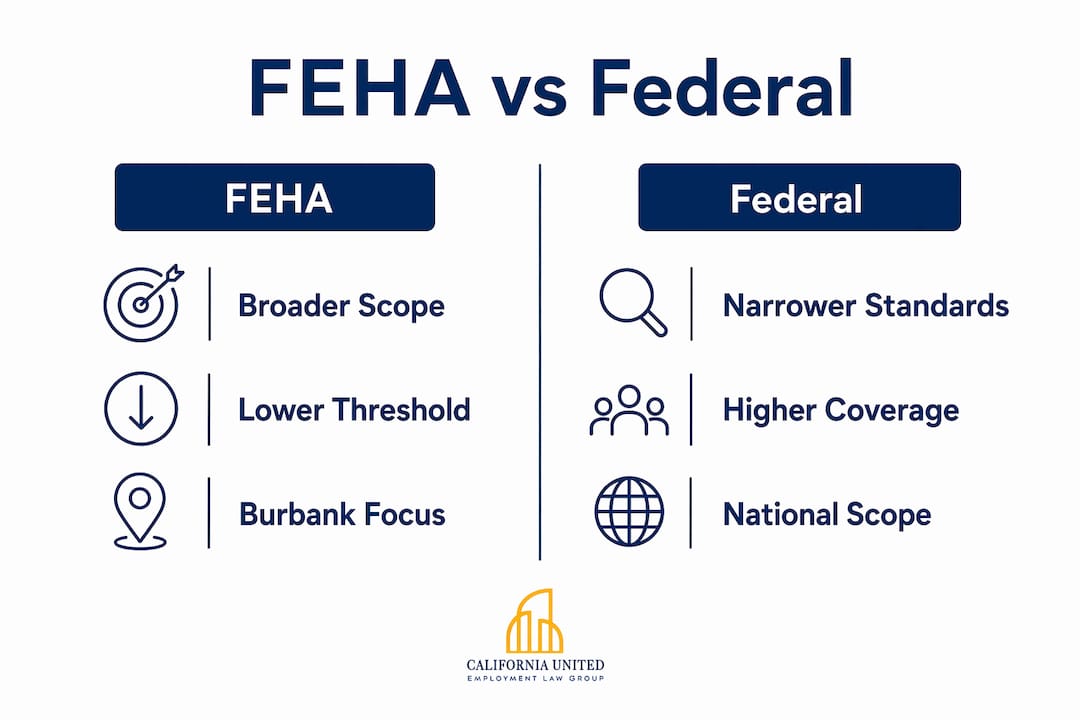
California’s threshold for employer coverage is lower than the federal standard, which matters if you work for a smaller employer in Burbank.
| Protection | Governing Law | Employer Size Threshold |
|---|---|---|
| Gender identity/expression discrimination | FEHA (California) | 5 or more employees |
| Sex/gender discrimination | Title VII (federal) | 15 or more employees |
| Harassment protections | FEHA (California) | Coverage can differ from discrimination claims; consult counsel or CRD guidance for the specific employer and harasser involved. |
Title IX is the federal education nondiscrimination law that applies to schools receiving federal funds, including K–12 districts and colleges. Title IX applies to schools receiving federal funds, including many K-12 districts and colleges. School employees may have FEHA workplace protections, while students may have separate federal and California-law protections depending on the school and the facts. FEHA’s protections for school employees are equally strong.
What conduct counts as unlawful at work or school?
Recognizing discrimination is the first step toward addressing it. Under FEHA and Title IX, the following actions can be unlawful:
- Intentional misgendering or refusing to use an employee’s or student’s chosen name and pronouns
- Denying access to restrooms consistent with a person’s gender identity
- Enforcing dress codes or grooming policies inconsistently based on gender identity or expression
- Firing, demoting, or passing over someone for promotion because of their gender identity or expression
- Making hostile comments, slurs, or jokes targeting a person’s gender identity
- Disciplining an employee for changing their name or pronouns at work
- Creating or tolerating a work environment that is intimidating or offensive based on gender identity
A workplace scenario: An employee at a Burbank company begins transitioning and asks coworkers to use updated pronouns. A supervisor repeatedly uses the wrong pronouns in front of the team and dismisses complaints. Under California law, intentional misgendering that creates a hostile work environment can constitute unlawful harassment.
California courts and federal courts have recognized several important principles in this area. In Harris v. City of Santa Monica, the California Supreme Court held that FEHA discrimination must be a “substantial motivating factor” in the challenged employment decision, not merely a remote or trivial reason. In Bostock v. Clayton County, the U.S. Supreme Court held that Title VII is violated when an employer fires someone merely for being gay or transgender. In Roby v. McKesson Corp., the California Supreme Court explained that discrimination and harassment are distinct FEHA claims, but the same evidence may overlap and support both theories depending on the facts.
A school scenario: A student at a Burbank school is excluded from activities or subjected to repeated slurs about their gender expression. Title IX and California law both provide avenues for reporting and redress.

One point many people miss: employer liability can attach even when the harassment comes from customers, contractors, or vendors. Employer liability may arise when the employer knew or should have known about harassment by a customer, vendor, contractor, coworker, or other third party and failed to take immediate and appropriate corrective action. For a deeper look at what qualifies, see what counts as workplace harassment under California law.
What are employers in Burbank required to do?
Employers have affirmative obligations under FEHA, not just prohibitions. The table below outlines key employer responsibilities.
| Employers Must | Employers Must Not |
|---|---|
| Apply dress codes and grooming policies consistently across all employees | Ask unnecessary or intrusive questions about sex assigned at birth, gender identity, medical history, or transition-related care unless the information is legally required and handled appropriately. |
| Honor an employee’s chosen name and pronouns | Enforce gendered dress codes in a way that singles out transgender or nonconforming employees |
| Provide access to restrooms consistent with gender identity | Retaliate against employees who file complaints or request accommodations |
| Consider reasonable workplace adjustments related to a gender transition and address requests through a respectful, documented process, including any legally required accommodation process when disability, medical leave, or other protected rights are involved. | Discriminate in employer-provided benefits, including medical insurance benefits, based on gender identity or gender expression. |
| Take corrective action when harassment by third parties is reported | Ignore or dismiss internal complaints about gender-based harassment |
On the health insurance point: California guidance generally prohibits discriminatory exclusions in employer-provided health benefits based on gender identity or gender expression, including exclusions targeting medically necessary gender-affirming care. Because health-plan rules can vary by plan type and employer, employees should review the plan documents and seek legal advice before assuming a particular remedy.
The interactive process obligation is worth emphasizing. When an employee requests adjustments related to a gender transition, the employer must engage in a genuine, documented conversation about what accommodations are possible. Refusing to discuss a legally protected accommodation request can create additional legal risk, especially where disability, medical leave, or another accommodation law applies.
How do you report gender identity discrimination in Burbank?
The reporting path generally moves from internal to external, though you are not required to exhaust internal options before filing with a state agency.
- Report to HR or a supervisor — Document the date, what you said, and the response. Keep a copy for yourself.
- File an intake with the Civil Rights Department (CRD/DFEH) — The CRD handles FEHA complaints in California and may offer mediation or a formal investigation. You can submit an intake online, by phone, or in person.
- File with the EEOC — If your employer has 15 or more employees, you may also have federal claims. The EEOC handles federal charge intake and coordinates with the CRD on dual-filed complaints.
Timing matters. Timing matters. For most FEHA employment claims, you generally must begin the CRD complaint/intake process within three years of the last alleged unlawful act, but deadlines can vary based on the claim and forum. Waiting too long can close the door on a state investigation entirely.
For students, the Burbank Unified School District has a Title IX coordinator who handles complaints at the school level. Federal complaints can also be filed with the U.S. Department of Education’s Office for Civil Rights.
What evidence should you collect and preserve?
Strong documentation makes a meaningful difference when you file a complaint or consult an attorney. Focus on gathering:
- Termination letters, written reprimands, or performance reviews that followed a complaint or disclosure
- Emails, texts, or chat messages that contain discriminatory language or document adverse actions
- Schedules showing shift reductions or reassignments that coincided with protected activity
- Notes from meetings where discriminatory conduct occurred, written as close to the event as possible
- Names and contact information of witnesses who observed the conduct
- Any HR responses (or non-responses) to prior complaints
- Medical or transition-related documentation only when directly relevant, and only after considering privacy, confidentiality, and whether the same point can be proven through less sensitive evidence.
Pro Tip: Keep a running log with dates, times, locations, and the names of everyone present for each incident. A simple dated journal entry, written the same day an event occurs, may be more useful than a summary written weeks later.
For guidance on building a harassment case, California United Law Group’s resource on proving workplace harassment in California walks through the evidentiary standards in detail.
What outcomes are possible after filing a complaint?
Remedies available under FEHA and through the CRD or courts include:
- Injunctive relief — a court or agency order requiring the employer to stop the unlawful conduct
- Back pay — wages and benefits lost as a result of the discrimination
- Front pay — compensation for future lost earnings when reinstatement is not practical
- Compensatory damages — for emotional distress and other non-economic harm
- Punitive damages, when legally available and proven — in cases involving malice, oppression, or fraud.
- Policy changes and training — the CRD can require employers to implement anti-discrimination training and revise workplace policies
The CRD process typically begins with an intake review, then moves to investigation or mediation. Court litigation is a separate path that usually requires satisfying administrative prerequisites, such as obtaining or being issued a right-to-sue notice, and timelines vary based on the claim, forum, and case complexity.
Statute of limitations reminder: Under FEHA, you generally have three years from the last unlawful act to submit your intake to the CRD. Missing that deadline can seriously limit or prevent a FEHA claim, although other deadlines, exceptions, or claims may need to be evaluated by counsel.
How California United Law Group Can Help Burbank Employees
If you have experienced gender identity or expression discrimination in Burbank and are considering your options, speaking with an employment attorney can help you understand what your situation may involve before any deadlines pass.
California United Law Group represents California employees in FEHA-based discrimination and harassment claims. The firm offers:
- Confidential case evaluations to review the facts of your situation
- Assistance with CRD administrative filings and intake preparation
- Litigation and arbitration representation if your case proceeds beyond the agency stage
- Settlement negotiation on your behalf
This article is for general educational purposes only and is not legal advice. No attorney-client relationship is formed by reading this article. Employment law outcomes depend on the specific facts of each case. If you believe your rights have been violated, prompt action protects your options.
Contact California United Law Group for a confidential consultation about your Burbank employment matter. Past results, case examples, or general legal information do not guarantee any particular outcome.
Key Takeaways
California law gives Burbank employees and students strong, enforceable protections against gender identity and expression discrimination, and acting promptly is the single most important step you can take.
| Point | Details |
|---|---|
| FEHA covers Burbank employers | FEHA often reaches smaller employers than Title VII | FEHA discrimination protections generally apply to employers with five or more employees, while Title VII generally applies to employers with 15 or more employees. |
| Three-year filing window | You must submit a CRD/DFEH intake within three years of the last unlawful act for most employment cases. |
| Document everything promptly | Dated logs, emails, witness names, and personnel records form the foundation of a strong complaint. |
| Title IX may apply in schools | Students at federally funded schools may have Title IX protections, and California education or civil rights laws may provide additional protections depending on the facts. |
| California United Law Group | The firm offers confidential case evaluations and represents Burbank employees in FEHA discrimination and harassment claims. |
A Perspective From California United Law Group
What strikes us most about gender identity and expression cases in Burbank is how often employees wait too long to act, not because they are unaware of their rights, but because they hope the situation will resolve on its own. In many cases, waiting can make the situation harder to document. California’s FEHA framework provides important workplace protections, and the CRD is the state agency that receives and investigates many FEHA complaints. The three-year filing window can feel generous, but evidence fades, witnesses move on, and internal records get harder to obtain. The employees who are best positioned when they come to us are the ones who documented incidents as they happened and reached out before the situation escalated further. This article is educational, not legal advice, and every situation is different. But if something at your Burbank workplace feels wrong, the right time to get informed is now, not later.
Authoritative Sources And Next-Step Links
- Civil Rights Department (CRD) — Employment Protections
- CRD Complaint Process and Intake Filing
- CRD Fact Sheet: Rights of Transgender and Gender Nonconforming Employees
- CRD Poster: Transgender and Gender Nonconforming Employee Rights
- FEHA Regulatory Text — California Amends Employment Regulations
- U.S. EEOC — Sex-Based Discrimination
- U.S. Department of Education — Title IX Overview
- Burbank Unified School District — Title IX Information