
Disability discrimination at work is defined as treating a qualified employee or job applicant unfavorably because of a physical or mental disability, a history of disability, or a perceived disability. In Burbank, this conduct is prohibited under both the federal Americans with Disabilities Act (ADA) and California’s Fair Employment and Housing Act (FEHA). These laws cover a wide range of employment decisions, from hiring and pay to promotions, terminations, and the right to receive reasonable accommodations. Understanding how disability discrimination happens at work in Burbank gives you a clearer picture of your rights and what to watch for in your own workplace.
How Disability Discrimination Happens At Work In Burbank
Disability discrimination rarely looks like an outright statement of bias. More often, it appears in patterns of behavior that, taken together, signal that an employer is treating an employee differently because of a disability.
The most common form is the denial of reasonable accommodations. Reasonable accommodations include schedule adjustments, modified equipment, temporary leave, or changes to job duties that allow a qualified person with a disability to perform their role. When an employer refuses these adjustments without a legitimate reason, that refusal can constitute discrimination.

A closely related pattern involves adverse employment actions that follow an accommodation request. In one widely cited enforcement case, Buc-ee’s faced EEOC action after allegedly denying shift modifications to a worker with a disability and then terminating that employee. The sequence of request, denial, and termination is a recognized discrimination pattern under both the ADA and FEHA.
Stereotyping is another driver of discrimination. Employers cannot rely on assumptions about absenteeism, productivity, or cost when making decisions about employees with disabilities. A manager who interprets a medical limitation as a performance problem, rather than as a signal to begin an accommodation discussion, may be acting on exactly this kind of unlawful stereotype.
Common discriminatory acts in Burbank workplaces include:
- Refusing to modify schedules or equipment despite a documented medical need
- Demoting or reassigning an employee after they request an accommodation
- Excluding a qualified applicant from hiring based on a perceived disability
- Retaliating against an employee who files an internal complaint about disability treatment
- Associational discrimination, which means treating an employee negatively because they have a family member or close associate with a disability
- Failing to engage in any good-faith discussion about accommodation options
Pro Tip: If your employer responds to your accommodation request with silence, delay, or a flat refusal, document the date and content of your request and every response you receive. That record may matter significantly later.
What legal protections exist for Burbank employees facing disability discrimination?
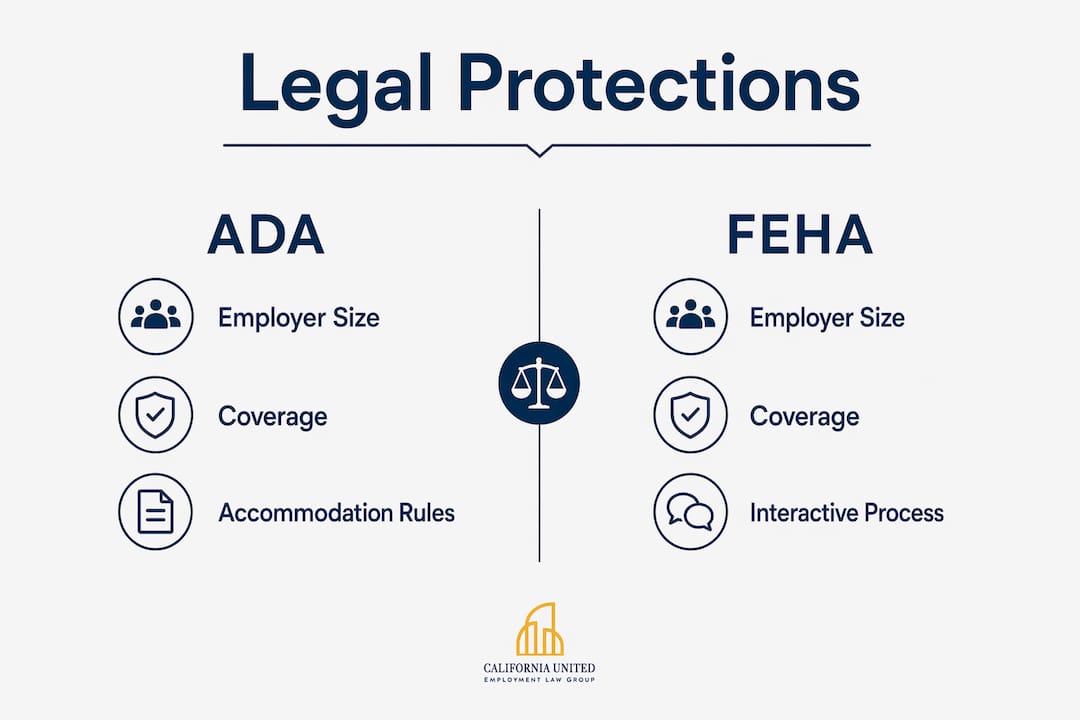
California employees in Burbank benefit from two overlapping legal frameworks. The federal ADA applies to employers with 15 or more employees. FEHA, California’s state law, applies to employers with five or more employees and provides broader protections in several important respects.
Under both laws, a “qualified individual with a disability” is someone who can perform the essential functions of a job with or without reasonable accommodation. The definition of disability under FEHA is intentionally broad, covering physical and mental conditions that limit a major life activity, as well as conditions that are perceived as limiting even if they do not actually do so.
The table below compares key aspects of both laws as they apply to Burbank employees.
| Protection area | ADA (federal) | FEHA (California) |
|---|---|---|
| Employer size threshold | 15 or more employees | 5 or more employees |
| Definition of disability | Substantially limits a major life activity | Limits a major life activity; broader scope |
| Reasonable accommodation duty | Yes, unless undue hardship | Yes, unless undue hardship |
| Interactive process required | Yes | Yes, explicitly required |
| Protection from retaliation | Yes | Yes |
| Enforcement agency | EEOC | California Civil Rights Department (CRD) |
Both laws require employers to engage in what is called the interactive process, a good-faith dialogue between employer and employee to identify and evaluate accommodation options. An employer who refuses to participate in this process, or who participates only superficially, may be violating the law independent of any other discriminatory act.
Several California courts have affirmed these protections. In Gelfo v. Lockheed Martin Corp., 140 Cal.App.4th 34 (2006), the court confirmed that employers must engage in an interactive process to determine reasonable accommodations for employees “regarded as” disabled — not only those with confirmed disabilities. In Moore v. Regents of University of California, 248 Cal.App.4th 216 (2016), the court held that a pretextual termination in lieu of engaging in the interactive process does not insulate an employer from liability, and that failure to accommodate and failure to engage in the interactive process are separate, independent causes of action under FEHA. In Castro-Ramirez v. Dependable Highway Express, Inc., 2 Cal.App.5th 1028 (2016), the court held that FEHA’s prohibition on disability discrimination extends to associational discrimination — where an employer takes adverse action against an employee because of that employee’s association with a disabled person.
Employees are also protected from harassment based on disability and from retaliation for asserting their rights. This means that if you request an accommodation or file a complaint, your employer cannot legally punish you for doing so.
How can you recognize and document disability discrimination at work?
Recognizing discrimination requires distinguishing between a legitimate employment decision and one that is driven by disability-related bias. The distinction is not always obvious, but certain patterns are telling.
Here is a practical sequence for recognizing and documenting what you are experiencing:
- Note the timing. If a negative employment action follows closely after you disclosed a disability or requested an accommodation, that sequence is worth documenting carefully.
- Compare your treatment to colleagues. If employees without disabilities in similar roles are treated more favorably under the same circumstances, that disparity is relevant.
- Record every accommodation request. You do not need formal paperwork or legal language to trigger your employer’s duty. Informally notifying your employer of a need for adjustment due to a disability is legally sufficient to start the process. As the court held in Nealy v. City of Santa Monica, 234 Cal.App.4th 359 (2015), FEHA “requires an informal process with the employee to attempt to identify reasonable accommodations, not necessarily ritualized discussions.”
- Keep copies of all written communications. Emails, texts, and written responses from HR or management form the factual record of what was said and when.
- Document employer responses and delays. Failure to evaluate accommodation requests thoroughly is a recognized litigation issue. Note whether your employer responded promptly and in good faith, or whether requests were ignored or dismissed.
A real-world example illustrates how documentation matters. In an EEOC-resolved case, a Maryland manufacturer paid a $100,000 settlement after denying a $1,700 piece of hearing protection equipment to a qualified employee with hearing loss and then demoting her. The disproportion between the cost of the accommodation and the employer’s response was central to the case. Clear records of what was requested and what was denied made the employer’s conduct visible.
Pro Tip: When describing your accommodation needs to your employer, focus on your functional limitations rather than your medical diagnosis. Saying “I need a modified schedule because I cannot stand for more than two hours continuously” is more useful than a diagnosis name alone, and it directly connects your need to a specific job function.
What steps can Burbank employees take if they believe they face discrimination?
If you believe you are experiencing disability discrimination at work in Burbank, several options are available to you. These are general steps, not legal advice, and the right path depends on your specific situation.
- Engage the interactive process. If you have not already made a formal accommodation request, doing so in writing gives your employer the opportunity to respond and creates a record of the exchange.
- Use internal reporting channels. Many Burbank employers have HR departments or written complaint procedures. Filing an internal complaint creates a documented record and may trigger an investigation.
- File a complaint with a government agency. In California, you can file a complaint with the California Civil Rights Department (CRD), formerly known as the Department of Fair Employment and Housing. You can also file with the federal EEOC. California employees generally have three years from the date of the discriminatory act to file a complaint with the California Civil Rights Department (CRD), formerly known as the Department of Fair Employment and Housing. Federal EEOC timelines differ, so consulting with an employment attorney promptly after a discriminatory event is advisable.
- Understand the difference between a complaint and a lawsuit. Filing with the CRD or EEOC is an administrative step that typically precedes any civil lawsuit. Mediation and settlement are common outcomes at this stage.
- Seek legal counsel. An employment attorney familiar with FEHA and California Labor Code claims can help you evaluate your situation, understand your options, and decide whether to pursue further action. Resources for legal aid for discrimination matters are available throughout the Los Angeles area, including Burbank.
- Preserve all evidence. Before taking any formal step, gather and secure all relevant documents, communications, and records of events.
Disability awareness training for managers and HR staff can reduce the frequency of these situations, but it does not eliminate them. Knowing your Burbank employment rights puts you in a stronger position regardless of what your employer does or does not do.
Key Takeaways
Disability discrimination in Burbank workplaces is defined by a pattern of denial, adverse action, and failure to engage in the legally required interactive process under FEHA and the ADA.
| Point | Details |
|---|---|
| FEHA provides broader coverage | California’s FEHA covers employers with 5+ employees, going further than the federal ADA’s 15-employee threshold. |
| Accommodation requests need no formal language | Informally telling your employer about a disability-related need is legally sufficient to trigger accommodation duties. |
| Adverse actions after requests are a red flag | Demotion or termination following an accommodation request is a recognized discrimination pattern under both laws. |
| Documentation is your strongest defense | Recording dates, requests, and employer responses creates the factual record that supports any future complaint. |
| Interactive process failures carry legal weight | An employer who refuses to engage in good-faith accommodation discussions may be violating the law on that basis alone. |
Courts have broadly interpreted what constitutes a reasonable accommodation. In Sanchez v. Swissport, Inc., 213 Cal.App.4th 1331 (2013), the court held that a finite leave of greater than four months may constitute a reasonable accommodation for a known disability under FEHA — illustrating that accommodation obligations can be substantial.
What I’ve Observed About How Disability Discrimination Actually Unfolds
From watching how these cases develop, the most consistent finding is that discrimination rarely starts with a dramatic act. It starts with a manager who does not understand what the law requires, or who assumes that an accommodation will be too costly or too disruptive without actually investigating it.
The Buc-ee’s case and the Maryland manufacturer settlement are useful examples precisely because they show how ordinary workplace decisions, denying a shift change, refusing inexpensive protective equipment, can become serious legal violations. The gap between what the accommodation would have cost and what the employer ultimately paid is striking in both cases.
What I find most important for Burbank employees to understand is that the interactive process is not optional. It is a legal requirement, and an employer who skips it or handles it carelessly is already on the wrong side of the law. Many employees do not realize that they do not need a formal diagnosis letter or HR-approved form to start that process. A clear, direct statement of need is enough.
The other thing worth saying plainly: documenting your own experience is not adversarial. It is practical. If your situation resolves without a formal complaint, you will never need those records. If it does not resolve, you will be glad you kept them.
How California United Law Group Supports Burbank Employees Facing Disability Discrimination
If you believe your workplace disability rights have been violated in Burbank, California United Law Group, P.C. is here to help.
California United Law Group represents California employees in disability discrimination claims under FEHA and the ADA, from pre-litigation through full litigation. The firm handles cases involving denial of reasonable accommodations, adverse employment actions, retaliation, and failures of the interactive process. Whether you are still employed and trying to understand your options, or you have already been terminated, the team at California United Law Group can evaluate your situation and explain what your rights may be.
Learn more about your options on the California United Law Group employment law page, or explore the employment lawsuit process to understand what pursuing a claim looks like in California.
FAQ
What is disability discrimination under California law?
Disability discrimination under California’s FEHA is defined as treating a qualified employee unfavorably because of a physical or mental disability, a perceived disability, or a history of disability. FEHA covers employers with five or more employees and provides broader protections than the federal ADA in several areas.
Do I need a formal diagnosis to request a workplace accommodation?
No. You only need to inform your employer of your need for an adjustment due to a disability. No formal paperwork, medical terminology, or specific legal language is required to trigger your employer’s duty to engage in the interactive process.
What is the interactive process and why does it matter?
The interactive process is a legally required, good-faith dialogue between an employer and employee to identify reasonable accommodation options. An employer who refuses to participate or who delays the process without justification may be committing a separate violation of FEHA and the ADA.
How long do I have to file a disability discrimination complaint in California?
California employees generally have three years from the date of the discriminatory act to file a complaint with the California Civil Rights Department. Federal EEOC timelines differ, so consulting with an employment attorney promptly after a discriminatory event is advisable.
Can my employer retaliate against me for requesting an accommodation?
Retaliation for requesting an accommodation or filing a discrimination complaint is prohibited under both FEHA and the ADA. If you experience adverse employment actions after asserting your rights, that retaliation may itself constitute a separate legal violation.