
Unequal pay discrimination can occur when employees are paid less than comparable coworkers for substantially similar work because of sex, race, ethnicity, or another protected characteristic covered by California employment discrimination law. Under California’s Equal Pay Act, the core comparison focuses on sex, race, and ethnicity, while FEHA may apply to broader protected characteristics depending on the facts. In West Hollywood, as throughout California, this practice is prohibited under the California Equal Pay Act and the Fair Employment and Housing Act (FEHA). California provides broad protections against pay discrimination, and recent legislative updates discussed below have expanded certain rights and deadlines for employees. Understanding West Hollywood unequal pay discrimination, what you need to know, and how the law applies to your situation is the first step toward protecting your rights. California United Law Group provides this guide for general educational purposes only.
What laws protect West Hollywood employees from unequal pay discrimination?
California Labor Code Section 1197.5 is the primary statute prohibiting wage disparities based on sex, race, and ethnicity for substantially similar work. West Hollywood employees are covered by this law, along with FEHA, which extends protections to a broader set of characteristics including gender identity and expression.
Recent updates and guidance should be reviewed carefully for how California pay equity protections apply to nonbinary and transgender employees. In addition, FEHA expressly protects employees based on gender identity and gender expression. California’s Equal Pay Act requires equal pay regardless of gender identity or expression, not just between men and women. This expansion reflects California’s commitment to West Hollywood pay equity across the full spectrum of gender identity.

The law’s definition of wages is broad. Wages and compensation may include more than base salary, including bonuses, equity-based compensation, benefits, allowances, and other forms of pay, depending on the statute and facts. Pay disparities cannot hide behind differences in non-salary benefits. That means if a coworker receives a larger annual bonus or better health coverage for the same work, that gap may qualify as an unequal pay violation.
Key protections under California law include:
- California Labor Code Section 1197.5: Prohibits lower wage rates based on sex, race, or ethnicity for substantially similar work, regardless of job title.
- FEHA protections: FEHA protections: Cover race, sex, gender identity, gender expression, religion, disability, and other protected characteristics when the pay disparity is tied to unlawful discrimination.
- California Labor Code Section 432.3: Prohibits employers from asking about or relying on salary history when setting pay
- Pay transparency obligations: California law requires certain pay scale disclosures to applicants and employees, depending on the request, role, and employer coverage.
- Extended recovery periods: Recent updates may allow employees to seek a longer period of lost wages in some continuing-violation situations, depending on the facts and applicable filing deadlines.
Pro Tip: If your employer refuses to provide pay range information after a request covered by California law, document the request, the date, and the response.
How can employees identify and prove unequal pay discrimination in West Hollywood workplaces?
For a California Equal Pay Act claim, an employee generally must show lower pay than employees of the opposite sex, another race, or another ethnicity who perform substantially similar work under similar working conditions. FEHA pay discrimination claims may require a different analysis, including evidence that the pay decision was tied to a protected characteristic. “Substantially similar work” means work that is similar when viewed as an overall combination of skill, effort, and responsibility, and performed under similar working conditions.
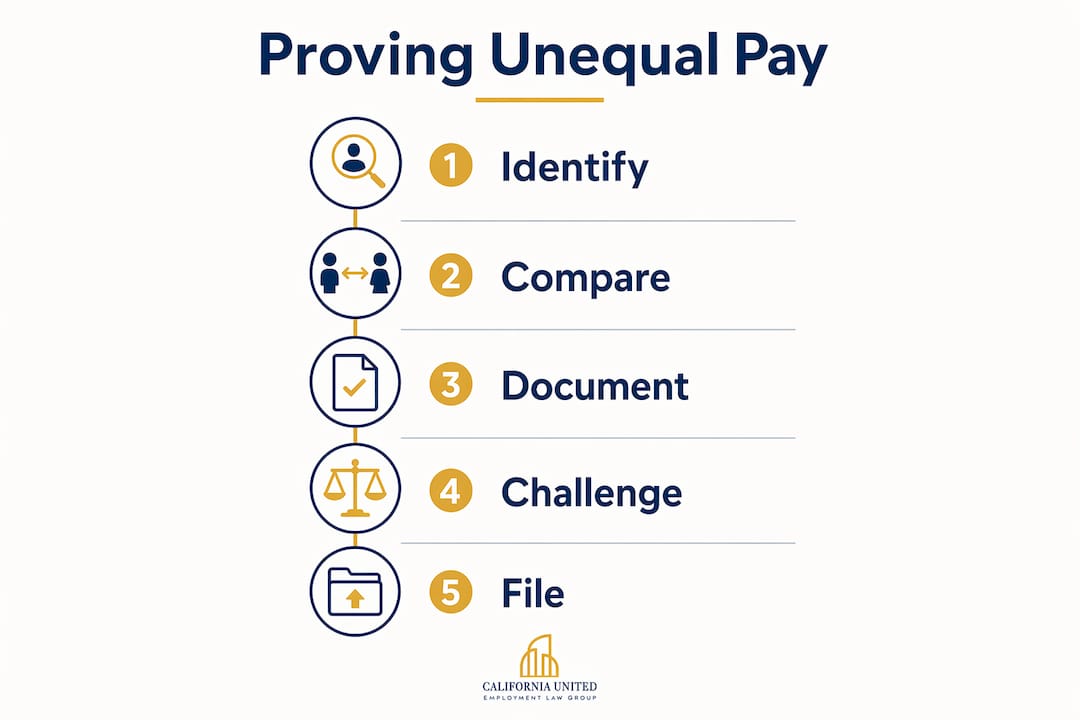
In many FEHA disparate treatment cases, courts use the McDonnell Douglas burden-shifting framework at pretrial stages such as summary judgment. At trial, the employee generally must prove discrimination by a preponderance of the evidence. Under FEHA, disparate treatment discrimination occurs when an employer intentionally treats an employee less favorably because of a protected characteristic. For FEHA discrimination claims, California jury instructions use the ‘substantial motivating reason’ standard. You do not need to prove discrimination was the only reason for the pay gap. You need to show it was a substantial factor.
The types of evidence that support a pay discrimination claim include:
- Comparator evidence: Pay stubs, salary data, or testimony showing that employees of the opposite sex, another race, or another ethnicity earned more for substantially similar work under similar working conditions.
- Timing evidence: Pay decisions made shortly after you disclosed a protected characteristic, such as a pregnancy or gender transition
- Decision-maker statements: Comments or written communications from managers that reflect bias, even if indirect
- Procedural departures: Instances where your employer skipped its own internal pay review process or applied different standards to your compensation review
Procedural departures help demonstrate discriminatory motivation concealed by a false justification. Courts may consider procedural departures as evidence that an employer’s stated reason is pretextual, depending on the facts. An employer who claims your lower pay reflects performance concerns but never documented those concerns has a harder time defending that position.
Mixed-motive cases are common in pay discrimination. An employer may cite a legitimate reason, such as seniority, while discrimination also plays a role. In FEHA mixed-motive cases, a claim may proceed if discrimination was a substantial motivating reason for the challenged action, although remedies can be affected if the employer proves it would have made the same decision anyway.
Pro Tip: Start keeping a private log of pay-related conversations, performance reviews, and any comments about your identity or background. Contemporaneous notes carry significant weight as evidence.
What recent legal updates in 2026 affect unequal pay claims in West Hollywood?
California’s 2026 pay equity updates, including SB 642 as discussed in the linked legislative materials, changed several rules for pay discrimination claims. West Hollywood employees benefit directly from these updates.
The most significant changes include:
- Extended statute of limitations: The filing period for pay discrimination claims increased to 3 years from the date of the discriminatory act
- Extended recovery period: Under a continuing violations theory, employees can recover lost pay for up to 6 years, double the previous recovery window
- Good faith pay estimates: Covered employers may now have to provide more specific compensation information at hire, depending on the statute’s requirements and the position involved.
- Expanded protected classes: Gender identity and expression protections: FEHA expressly protects gender identity and gender expression, and recent pay equity developments should be reviewed for how they apply to nonbinary and transgender employees.
- Broader compensation issues: Pay equity analysis may include bonuses, equity, benefits, allowances, and other compensation, depending on the statute and facts.
The good faith estimate requirement is a meaningful shift. Pay transparency laws aim to prevent discriminatory wage-setting from the first day of employment. When an employer gives you a vague range at hire rather than a specific estimate, that may now constitute a compliance failure.
| Change | Previous Rule | 2026 Rule |
|---|---|---|
| Statute of limitations | 2 years | 3 years |
| Wage recovery period | 3 years | 6 years |
| Pay disclosure at hire | Broad pay scale | Good faith specific estimate |
| Gender identity coverage | Protected under FEHA | FEHA protections continue to apply to gender identity and expression; review linked 2026 updates for pay-specific changes |
| Compensation considered | Base pay often central | Broader compensation, including bonuses, equity, benefits, and allowances, may be relevant |
These changes give West Hollywood employees more time to recognize a pay gap, gather evidence, and file a claim. Pay equity remains a concern for many West Hollywood workers, and these updates may provide stronger tools to identify and challenge unlawful pay disparities.
What practical steps can West Hollywood employees take if they suspect unequal pay discrimination?
Taking organized, timely action is the most important thing you can do if you believe you are experiencing pay discrimination. The steps below are general educational guidance and do not constitute legal advice.
- Collect your pay records: Gather pay stubs, offer letters, bonus statements, and any written communications about your compensation. These documents establish your baseline pay history.
- Document comparator information: If you have access to information about coworkers in similar roles who earn more, note it carefully. This includes job titles, responsibilities, and any public pay disclosures your employer has made.
- Save performance reviews: Your documented performance history matters. Strong reviews alongside lower pay strengthen a discrimination claim.
- Record relevant communications: Save emails or messages where pay was discussed, especially any that reference your gender, race, or other protected characteristics.
- Know your filing deadlines: Depending on the claim, employees may need to act within specific administrative or court deadlines. Some claims may involve the California Civil Rights Department, and some may also implicate federal filing requirements.
- Understand the investigation process: After you file, the agency may investigate, attempt mediation, or issue a right-to-sue letter. Each path has different timelines and implications.
Statutes of limitation are strict. Missing a deadline can severely limit or even bar a claim, regardless of the underlying facts. If you are unsure when the clock started running, that question alone is worth discussing with a qualified employment attorney.
West Hollywood employees in industries such as entertainment, hospitality, and retail may encounter pay equity concerns where compensation is set informally or inconsistently. Understanding pay discrimination in California requires knowing that informal pay decisions are still subject to the same legal standards as formal ones.
For employees in West Hollywood who also face gender identity-related workplace issues, LGBTQ worker protections under California law often intersect directly with pay equity claims.
Key Takeaways
California’s 2026 pay equity updates may give West Hollywood employees stronger tools, longer filing windows, and broader protections in certain pay discrimination cases.
| Point | Details |
|---|---|
| Core legal standard | California Labor Code Section 1197.5 prohibits lower wage rates based on sex, race, or ethnicity for substantially similar work, while FEHA may apply when a pay disparity is tied to a protected characteristic. |
| Extended recovery period | Employees can now recover lost wages for up to 6 years under a continuing violations theory. |
| Broader wage definition | Bonuses, stock options, benefits, and allowances may all be relevant to a pay equity analysis, depending on the statute and facts. |
| Filing deadline | You must file with the California Civil Rights Department within 3 years of the discriminatory act. |
| Evidence matters | Comparator pay data, timing, manager statements, and procedural departures all support a discrimination claim. |
What I’ve Learned About Proving Pay Discrimination In West Hollywood
Pay discrimination cases are rarely simple. Strong claims are usually built on documentation, comparator evidence, and a careful analysis of the employer’s stated reasons for the pay difference. Employees often come forward with a strong sense that something is wrong, but each claim depends on the specific facts, available comparators, and the employer’s explanation. But a feeling, even a well-founded one, does not win a case.
The “substantial motivating factor” standard is genuinely useful for employees, but it is also misunderstood. Many people assume they need a smoking gun, a manager who said something overtly discriminatory on the record. That almost never happens. What often builds a stronger case is a pattern: a measurable pay gap, substantially similar work, a performance record that does not explain the difference, skipped procedures, and a valid comparator who was paid more. Each piece alone is weak. Together, they tell a story.
The 2026 updates to California’s pay equity laws are significant, and I think the good faith pay estimate requirement is the most underappreciated change. Vague or inconsistent pay information at hire can make it harder for employees to identify whether compensation was set fairly and lawfully. Requiring a specific estimate closes that gap in a meaningful way.
My honest advice is this: do not wait to see if things improve. Document now, even if you are not sure you have a claim. Employees are often better positioned to evaluate potential equal pay rights when they keep records before a dispute arises, although documentation alone does not guarantee a claim.
— California United Law Group
How California United Law Group Supports West Hollywood Employees
If you believe you are experiencing unequal pay discrimination in West Hollywood, California United Law Group can help you evaluate your options based on the facts, deadlines, and available evidence.
California United Law Group represents employees in workplace discrimination matters, including pay equity claims under the California Equal Pay Act and FEHA. The firm handles cases at every stage, from initial evaluation through litigation. West Hollywood employees dealing with wage gaps, pay transparency issues, or related retaliation can contact California United Law Group for a case evaluation. For location-specific guidance, the firm’s West Hollywood employment lawyers are available to assess your situation. This article is for general educational purposes and does not constitute legal advice.
FAQ
What is unequal pay discrimination under California law?
Under California’s Equal Pay Act, unequal pay may occur when an employee is paid less than employees of the opposite sex, another race, or another ethnicity for substantially similar work under similar working conditions. FEHA may also apply when a pay disparity is tied to a protected characteristic such as sex, race, gender identity, gender expression, disability, religion, or another protected status.
How long do I have to file a pay discrimination claim in West Hollywood?
Deadlines depend on the type of claim and the facts. Recent 2026 pay equity updates may extend certain filing or recovery periods, and a continuing-violation theory may affect how far back some wage losses can be pursued.
Does California’s equal pay law cover nonbinary employees?
California law protects nonbinary and transgender employees from workplace discrimination. FEHA expressly protects gender identity and gender expression, and pay equity claims involving nonbinary or transgender employees should be evaluated under the Equal Pay Act, FEHA, and any applicable recent statutory updates.
What counts as a “wage” under California’s equal pay laws?
California pay equity analysis may consider more than base salary, including bonuses, stock options, benefits, allowances, and other compensation, depending on the claim and facts. Pay disparities in any of these categories can support an unequal pay claim.
What evidence do I need to prove pay discrimination?
Comparator pay data is often central. For an Equal Pay Act claim, the key comparison is whether employees of the opposite sex, another race, or another ethnicity were paid more for substantially similar work under similar working conditions. Supporting evidence includes timing, manager statements, performance records, and any instances where your employer skipped its own internal procedures.
Recommended
- West Hollywood Gender Identity Discrimination: Know Your Rights – California United Law Group –
- Unequal Pay In Santa Monica: Your Rights Under California Law – California United Law Group
- Culver City Unequal Pay: Are You Being Paid Less Unfairly? – California United Law Group –
- Sexual Orientation Discrimination: West Hollywood Employee Rights – California United Law Group