
TL;DR:
- California and West Hollywood offer strong legal protections for LGBTQ employees against workplace discrimination.
- Filing an administrative complaint with the Civil Rights Department is a necessary step before litigation.
- Documentation and legal support are essential for successfully pursuing claims of discrimination or retaliation.
Many LGBTQ employees in West Hollywood believe fighting workplace discrimination is too hard, too risky, or simply not worth it. That belief is wrong. California has some of the strongest employee protections in the country, and West Hollywood workers have every right to hold employers accountable. Whether you’ve been passed over for a promotion, subjected to offensive comments, or fired because of your sexual orientation or gender identity, California law provides meaningful protections you have every right to enforce. This guide walks you through exactly what protections apply, what qualifies as discrimination, and how to take legal action step by step.
Table Of Contents
- Understanding your rights as an LGBTQ worker in West Hollywood
- What counts as workplace discrimination or harassment?
- How to file a discrimination complaint in West Hollywood
- What to expect when suing for discrimination
- The reality of fighting workplace discrimination: What most guides miss
- Get support and protect your rights today
- Frequently asked questions
Key Takeaways
| Point | Details |
|---|---|
| Strong legal protections | LGBTQ workers in West Hollywood are shielded by powerful state anti-discrimination laws. |
| Step-by-step process | You must file a CRD complaint before you can sue for workplace discrimination. |
| Harassment and retaliation | Both discrimination and retaliation are illegal and can be grounds for legal action. |
| Get legal support | Working with an experienced employment attorney helps you navigate the process, avoid procedural mistakes, and present the strongest possible case. |
Understanding Your Rights As An LGBTQ Worker In West Hollywood
If you work in West Hollywood, you are covered by California’s Fair Employment and Housing Act, commonly called FEHA. This is the state’s primary law protecting employees from workplace discrimination, harassment, and retaliation. And it is broader and stronger than federal law.
FEHA prohibits employment discrimination based on sexual orientation, gender identity, and gender expression, among many other protected traits. That means your employer cannot legally treat you worse because you are gay, lesbian, bisexual, transgender, nonbinary, or queer. These protections apply at every stage of employment, including hiring, promotions, pay, job assignments, discipline, and termination.
Who is covered?
FEHA applies to employers with five or more employees. It is important to note that for harassment claims specifically, FEHA applies to employers of even one employee — meaning virtually no employer is exempt from California’s anti-harassment protections. Most businesses in West Hollywood easily meet that threshold, including restaurants, hotels, retail stores, entertainment companies, and healthcare providers.
Here is a quick overview of what FEHA protects you from:
- Discrimination based on sexual orientation, gender identity, or gender expression
- Harassment that creates a hostile or abusive work environment
- Retaliation for reporting discrimination or participating in a complaint process
- Failure to accommodate gender transition or related medical needs
- Wrongful termination tied to your LGBTQ identity
West Hollywood has also adopted local ordinances reinforcing these protections, making it one of the most legally supportive cities in California for LGBTQ workers. The city has a long history of affirming LGBTQ rights through municipal policy, which signals that courts and local agencies take these claims seriously.
Your sexual orientation rights as an employee go beyond just keeping your job. They cover equal treatment in every aspect of the employment relationship. Similarly, your termination protections mean that if you lose your job in whole or in part because of your identity, you may have a strong wrongful termination claim.
Quick stat: California’s workforce discrimination laws cover a broader range of protected classes than almost any other state, giving LGBTQ employees meaningful legal power that many workers in other states simply do not have.
What Counts As Workplace Discrimination Or Harassment?
Once you understand your rights, it’s crucial to recognize what kinds of behaviors legally count as discrimination or harassment. Not every uncomfortable situation rises to that level, but many do.
Actions that may qualify as discrimination or harassment:
- Being denied a promotion or raise because of your sexual orientation
- Receiving consistently worse performance reviews without legitimate reason
- Being assigned inferior shifts, tasks, or locations compared to coworkers
- Hearing derogatory slurs, jokes, or comments about LGBTQ people in the workplace
- Being excluded from meetings, events, or social opportunities at work
- Having a supervisor or coworker repeatedly misgender or deadname you
- Being forced out of your job through intolerable working conditions, known legally as constructive discharge
Understanding Hostile Work Environment Claims
A hostile work environment exists when discriminatory conduct is severe or pervasive enough to interfere with your ability to do your job. FEHA defines discrimination to include harassment based on protected traits, and courts look at the totality of circumstances. While a single offhand remark typically will not rise to the legal threshold, California law is clear that even one sufficiently serious incident can create a hostile work environment — particularly if it unreasonably interfered with your ability to do your work or created an objectively offensive or intimidating environment.
California and federal courts have confirmed strong protections for LGBTQ workers. In Bostock v. Clayton County, Georgia, the U.S. Supreme Court held that an employer who fires an individual merely for being gay or transgender violates Title VII’s prohibition on sex discrimination — extending federal protection to LGBTQ employees nationwide. In Hughes v. Pair, the California Supreme Court reaffirmed that to prevail on a hostile work environment claim under FEHA, an employee must show harassing conduct ‘severe enough or sufficiently pervasive to alter the conditions of employment and create a work environment that qualifies as hostile or abusive.’ And in Turner v. Anheuser-Busch, Inc., the California Supreme Court established that constructive discharge occurs when an employer intentionally creates or knowingly permits working conditions so intolerable that a reasonable person would have no reasonable alternative except to resign — making clear that California law reaches well beyond formal terminations.

| Behavior | Legal Definition | Real-Life Example |
|---|---|---|
| Offensive comments | Verbal harassment based on protected trait | Coworker repeatedly uses slurs after being told to stop |
| Unequal treatment | Discriminatory employment action | LGBTQ employee denied promotion given to less qualified peer |
| Retaliation | Adverse action after protected activity | Demotion after filing an internal HR complaint |
| Hostile environment | Severe or pervasive discriminatory conduct | Manager mocks gender identity in front of the team regularly |
Retaliation is its own claim. If your employer takes action against you because you reported discrimination or participated in an investigation, that is a separate and serious violation of FEHA. Retaliation can look like a sudden negative review, a schedule change, or even termination.
Understanding hostile work environment factors helps you evaluate whether what you experienced meets the legal standard. Knowing how courts approach proving harassment prepares you to build a stronger record.
Pro Tip: Start a written log the moment something happens. Include the date, time, location, what was said or done, who was present, and any witnesses. This documentation can become your strongest evidence.
How To File A Discrimination Complaint In West Hollywood
Now that you know what discrimination looks like, here’s how to officially take action if it happens to you.
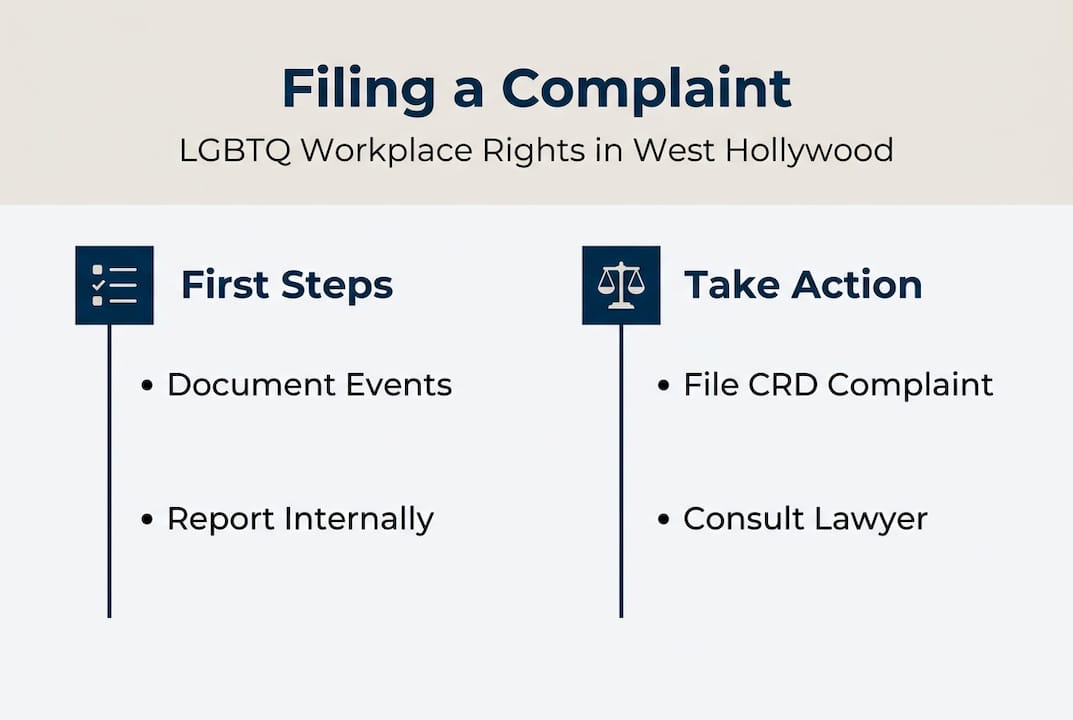
Before filing a lawsuit, most California employees must go through an administrative complaint process. This is not optional in most cases. It is a legal prerequisite.
Step-by-step guide to filing:
- Gather your evidence. Collect emails, texts, performance reviews, witness names, and your personal incident log. The stronger your documentation, the more credible your complaint.
- File a complaint with the Civil Rights Department (CRD). The CRD, formerly known as the DFEH, is the state agency that investigates workplace discrimination. You must file with CRD before most lawsuits can proceed.
- Choose your path. You can request an immediate right-to-sue notice if you plan to move quickly to court, or you can ask the CRD to investigate your claim on your behalf.
- CRD investigation. If the CRD investigates, they will contact your employer and review evidence. This process can take several months.
- Receive your right-to-sue notice. Once issued, you generally have one year to file a civil lawsuit in California court.
- File your lawsuit. With the notice in hand, you can pursue your case in court with full legal authority.
“The CRD process exists to give employers a chance to resolve complaints before litigation. But it also builds a formal record that can strengthen your case significantly.”
Common pitfalls to avoid:
Missing the CRD filing window. You generally have three years from the date of the discriminatory act to file your complaint with the CRD. If you did not discover the unlawful conduct until after that three-year period, you may have up to 90 additional days from the date of discovery. Missing this window can permanently bar your claim.
- Waiting too long. Deadlines matter, and missing them can cost you your case.
- Filing incomplete information. Vague complaints are harder to investigate.
- Assuming HR will handle it. Internal HR reports do not replace a CRD complaint.
You can and often should consult an attorney before or during this process. Understanding the lawsuit steps specific to your situation helps you avoid costly mistakes.
Pro Tip: You can request an immediate right-to-sue notice from the CRD without waiting for a full investigation. This is useful if your case is time-sensitive or your evidence is already strong.
What To Expect When Suing For Discrimination
Filing the complaint is just the start. Here’s what happens if you decide to sue.
Once you have your right-to-sue notice, you may file in civil court to pursue your claims. This is where your case moves into the litigation phase.
Key steps in a typical lawsuit:
- File the civil complaint. Your attorney drafts and files the complaint outlining your claims against the employer.
- Discovery phase. Both sides exchange evidence, take depositions, and gather information. This phase often lasts six to twelve months.
- Mediation or settlement negotiations. Most cases resolve here. Employers often settle to avoid trial costs and public exposure.
- Trial. If no settlement is reached, your case goes before a judge or jury.
- Verdict and remedies. A successful outcome can result in back pay, front pay, emotional distress damages, punitive damages, and attorney’s fees.
Possible outcomes of a discrimination lawsuit:
| Outcome | What It Means For You |
|---|---|
| Settlement | Employer pays agreed amount, case closes privately |
| Plaintiff verdict | Court awards damages including back pay and emotional distress |
| Defense verdict | Employer wins, no award issued |
| Dismissal | Case dismissed before trial, often due to procedural issues |
Retaliation claims can be added to your lawsuit even if the retaliation happened after you filed your initial complaint. Courts take this seriously, and juries often respond strongly to evidence that an employer punished someone for speaking up.
Working with an experienced employment lawyer helps ensure your complaint is properly drafted, your evidence is effectively organized, and your rights are protected throughout the process — from the administrative stage through any potential trial.
The Reality Of Fighting Workplace Discrimination: What Most Guides Miss
Legal protections in California are genuinely strong. But here’s what most articles won’t tell you: the process is emotionally demanding, and the biggest obstacles are often personal, not legal.
Retaliation is frequently subtle. It doesn’t always look like a termination. It looks like suddenly being left off meeting invites, receiving vague negative feedback, or getting passed over in ways that feel impossible to prove. This is exactly why documentation is so critical from day one.
Most cases settle before trial. But the quality of your settlement depends entirely on how well you’ve prepared. Settlement outcomes vary based on the strength of your evidence, the specific facts of your case, and the applicable law. Being thorough, organized, and properly advised puts you in the best position to present your claim effectively.
Many LGBTQ workers also worry about being outed during a lawsuit, especially in industries where reputation matters. Know this: California courts have rules to protect sensitive personal information. A good attorney will fight to keep your privacy intact throughout the process.
Choosing the right advocate matters more than most people realize. Not just any employment attorney will do. You need someone who understands LGBTQ workplace dynamics, FEHA nuances, and the emotional weight of these cases. The right support changes outcomes.
Get Support And Protect Your Rights Today
Understanding your rights is empowering, and expert help makes the process smoother. Here’s how you can move forward.
At California United Law Group, P.C., we represent LGBTQ employees in West Hollywood and across California who have faced discrimination, harassment, and retaliation at work. Our employment law expertise covers the full range of FEHA claims, from hostile work environments to wrongful termination.
👉 If you’re ready to take action, we can walk you through the lawsuit process overview and help you understand what counts as workplace harassment under California law.
Schedule a confidential consultation today. You don’t have to figure this out alone, and you shouldn’t have to.
Frequently asked questions
Can I sue my employer directly, or do I have to file a complaint first?
In most cases, you must first file a complaint with California’s Civil Rights Department before suing. The CRD complaint is required as an administrative prerequisite, and after the investigation you may receive a right-to-sue notice.
Does FEHA protect both sexual orientation and gender identity?
Yes, FEHA covers discrimination and harassment based on sexual orientation, gender identity, and gender expression. FEHA prohibits discrimination across all these protected categories in every aspect of employment.
What should I do if I experience retaliation after reporting discrimination?
Document all incidents of retaliation immediately and include them in your complaint or lawsuit. Discrimination claims include retaliation for reporting discrimination, and courts treat this as a serious, separate violation.
Are small businesses covered by California’s discrimination laws?
It depends on the type of claim. For discrimination claims (such as being passed over for a promotion or wrongful termination), FEHA applies to employers with five or more employees. For harassment claims, however, FEHA applies to employers with even one employee — meaning harassment protections are nearly universal under California law. If you are unsure whether your employer is covered, consulting with an employment attorney can clarify your options.