
TL;DR:
- No public evidence confirms age bias in Toyota Torrance layoffs, but concerns remain valid.
- California law offers strong protections against age discrimination, including pattern and impact analysis.
- Acting quickly and documenting carefully are crucial to pursuing a legal claim for age bias.
When Toyota announced layoffs at its Torrance, California facilities, many employees over 40 were left asking a troubling question: were older workers targeted? It’s a fair concern. Large-scale workforce reductions in manufacturing often raise red flags about age discrimination, especially when tenured employees with higher salaries and pensions are disproportionately affected. But no public evidence confirms that Toyota’s Torrance layoffs were age biased. That doesn’t mean your concerns are wrong. It means you need facts, not assumptions. This article breaks down what we know, what California law says, and exactly what to do if you believe age played a role in your layoff.
Table of Contents
- Understanding the Toyota Torrance layoffs: What we know (and don’t)
- How California law protects older workers in layoffs
- Red flags: When layoffs might be age biased (and how to spot them)
- What to do if you suspect age discrimination in your layoff
- Why proving age bias is tough — but not impossible in California
- How California United Law Group can help you fight age discrimination
- Frequently asked questions
Key Takeaways
| Point | Details |
|---|---|
| No proven bias | There is no public evidence or lawsuits confirming age discrimination in Toyota Torrance layoffs. |
| Legal protections exist | California law (FEHA) offers robust safeguards for employees 40 and older facing layoffs. |
| Watch for red flags | Look for patterns like older workers disproportionately let go or neutral criteria such as salary being used. |
| Document and act | Gather evidence and consult an employment lawyer promptly if you suspect discrimination. |
Understanding the Toyota Torrance layoffs: What we know (and don’t)
Before drawing conclusions, it’s important to separate confirmed facts from speculation. Large company layoffs generate a lot of noise, and it can be hard to know what’s legally significant and what isn’t.
Here’s what is publicly available about Toyota’s Torrance workforce reductions:
- Toyota did conduct layoffs at its Torrance, CA operations as part of broader restructuring
- Some of those layoffs affected long-tenured employees in manufacturing and administrative roles
- Torrance has a large population of skilled workers, many of whom are over 40
Here’s what is not publicly available:
- No age-related EEOC or California Civil Rights Department (CRD) complaints have been filed publicly
- No OWBPA (Older Workers Benefit Protection Act) age demographic disclosures or EEOC/CRD statistical data have surfaced
- No lawsuits specifically alleging age discrimination in these layoffs have been filed
| What exists | What is missing |
|---|---|
| News reports of layoffs | Age breakdown of affected employees |
| General restructuring announcements | EEOC or CRD complaints |
| Employee accounts and concerns | Court filings or settlements |
| Auto industry layoff context | Statistical age bias data |
Important: As of now, no public lawsuits or CRD/EEOC complaints confirm that Toyota Torrance layoffs were age biased. Absence of proof is not proof of absence, but it does raise the evidentiary bar for individual claims.
Why does this matter? Because without company-wide data showing that older workers were disproportionately let go, proving a systemic age bias claim becomes much harder. That said, general auto and manufacturing layoffs can raise legitimate age bias concerns, particularly when higher-salaried, longer-tenured employees are consistently chosen for cuts.
The EEOC’s significant cases across industries show that large employers can face liability when layoff selection criteria, even neutral ones on paper, end up targeting protected groups. The key is pattern and evidence.
So what does that mean for you? If you’re a Torrance manufacturing worker who was laid off, you may have concerns that are worth investigating even without publicly known lawsuits.
How California law protects older workers in layoffs
California offers stronger age discrimination protections than federal law. Understanding the legal framework is your first step toward knowing whether you have a viable claim.
The Fair Employment and Housing Act (FEHA) is California’s primary anti-discrimination statute. FEHA protects employees 40+ from being terminated, laid off, or otherwise treated adversely because of their age. Unlike the federal Age Discrimination in Employment Act (ADEA) — which applies only to employers with 20 or more employees — FEHA covers employers with five or more employees, making it accessible to far more California workers. FEHA also sets a lower standard of proof: while the ADEA requires employees to show that age was the “but-for” cause of the adverse action, FEHA only requires showing that age was a “substantial motivating factor” in the decision — a meaningfully more favorable standard for plaintiffs.
Here’s a quick comparison of what counts as evidence versus what is a lawful layoff decision:
| Signs of illegal age bias | Lawful layoff reasons |
|---|---|
| Older workers disproportionately selected | Company-wide budget cuts |
| Age-related comments from managers | Elimination of a specific role |
| Younger, less qualified workers retained | Performance-based selections |
| Pattern of replacing older hires with younger ones | Documented business necessity |
Four elements of a prima facie age discrimination case under FEHA:
- Show you are 40 or older. FEHA protects employees who were 40 years of age or older at the time of the adverse employment action.
- Show you were performing satisfactorily. You need a record of adequate performance to establish you were not laid off for cause.
- Show circumstances that suggest age played a role. In a standard case, this means a significantly younger person was retained in a comparable role. In a group layoff (RIF), statistical patterns or other circumstantial evidence may substitute.
- Prove the employer’s stated reason was a pretext. If the company says it was a budget decision but retained younger, lower-salaried employees, that inconsistency matters.
Pro Tip: Save every performance review, commendation, and email that supports your work record. If a manager ever made a comment about your age, retirement plans, or “fresh talent,” document it immediately with dates and witnesses.
California courts have recognized clear legal standards for these claims. In Guz v. Bechtel National, Inc. (2000) 24 Cal.4th 317, the California Supreme Court confirmed that FEHA age discrimination cases use the same McDonnell Douglas burden-shifting framework applied in federal discrimination law — meaning the employee first establishes a prima facie case, the burden then shifts to the employer to articulate a legitimate reason, and the employee must then show that reason is pretextual. And in Harris v. City of Santa Monica (2013) 56 Cal.4th 203, the California Supreme Court held that under FEHA, employees need only prove that discrimination was a “substantial motivating factor” in the adverse action — not that it was the sole or “but-for” cause. This distinction gives California plaintiffs a meaningful advantage over their federal counterparts.
The employment lawsuit process in California requires administrative filings before a lawsuit can move forward, so timing and preparation matter from day one. Also review wrongful termination law as a related claim, because age-based layoffs can sometimes qualify.
California age discrimination protections go further than many workers realize. Use them.
Red flags: When layoffs might be age biased (and how to spot them)
Not every layoff that affects older workers is discriminatory. But some patterns should put you on alert. One of the most important concepts here is disparate impact, where a seemingly neutral policy ends up disproportionately harming a protected group.

For example, salary-based layoffs disproportionately affecting tenured employees may violate FEHA under a disparate impact theory. In Toyota’s and other Torrance employers’ manufacturing context in Torrance, higher salaries for long-tenured staff create exactly this kind of risk factor.
California’s Government Code section 12941 expressly adopts disparate impact theory for age discrimination, and courts have confirmed this protection extends to layoff selection criteria that disproportionately affect older workers as a group — even without proof of discriminatory intent.
Common red flags of age discrimination in layoffs:
- Older employees are consistently chosen over younger ones with similar or less experience
- Layoff lists track closely with employee age or years of service
- Management made remarks about “new energy,” “fresh starts,” or retirement eligibility
- Recently hired younger workers in comparable roles were retained
- Your performance reviews were positive, yet you were selected
- The company restructured roles but filled them with younger employees after your departure
How to document what you observe:
- Keep a written log with dates, times, and names of any suspicious comments or decisions
- Note the ages of coworkers who were laid off versus those who were kept
- Save any internal communications that reference headcount, roles, or selection criteria
- Write down your own recollection of conversations while they are still fresh
Pro Tip: Do not discuss your discrimination concerns openly at work or on social media. Retaliation is real, and protecting your legal options means keeping your strategy private. Talk to an attorney before you act.
Exploring age bias in Torrance manufacturing and reviewing legal insights on employment law can help you understand how these patterns have played out in similar cases.
What to do if you suspect age discrimination in your layoff
If you believe age played a role in your layoff, the steps you take now will shape the strength of any future legal claim. Acting early matters, because evidence fades and deadlines are real.
Step-by-step guide:
- Document everything immediately. Gather your performance reviews, layoff notice, any communications about selection criteria, and notes on who was retained versus let go.
- Identify the pattern. Compare your age, salary, and tenure with those who were kept. This data can reveal a statistical picture.
- Consult a California employment attorney. An attorney can assess whether your facts meet the legal threshold for an age discrimination claim under FEHA.
- File with the CRD or EEOC. In California, you must file an administrative complaint before suing. The California CRD allows up to three years to file an age bias complaint. Filing with the CRD is generally advisable because it preserves both state and federal options and avoids the shorter federal deadline. The EEOC federal deadline is 300 days.
- Obtain a right-to-sue notice. After filing with the CRD or EEOC, you receive a notice that allows you to pursue a lawsuit in court.
Key evidence to collect:
- Layoff demographics: ages of those let go versus those retained
- Your own performance evaluations and commendations
- Any written or verbal comments about age, retirement, or “new direction”
- Company announcements, org charts, and restructuring plans
- Comparisons of job duties between you and younger retained employees
The CRD filing process for age discrimination requires that employees show satisfactory performance and demonstrate age as a substantial motivating factor. Gathering evidence right after your layoff gives you the best chance of building that record.
Understanding the lawsuit process for age discrimination in California will also help you set realistic expectations about timelines and outcomes.
Why proving age bias is tough — but not impossible in California
Here’s something most articles won’t tell you directly: age discrimination cases are among the hardest employment claims to win. Not because the law is weak, but because the evidence is often buried inside corporate decision-making that employees never see.
Group layoffs are especially difficult. When dozens or hundreds of employees are cut at once, individual targeting becomes harder to isolate. Companies often rely on documented business reasons that look legitimate on paper. Without empirical data specific to a facility like Toyota Torrance, employees face a real proof burden: they must show satisfactory performance and that age was a substantial motivating factor — not just a coincidence, but a real and significant reason for the decision.
What many workers and even some attorneys overlook is the power of comparative data. If you can show that 70% of the people laid off were over 50, while only 30% of the overall workforce was over 50, that statistical imbalance speaks loudly. The challenge is getting that data, which often requires formal legal discovery.
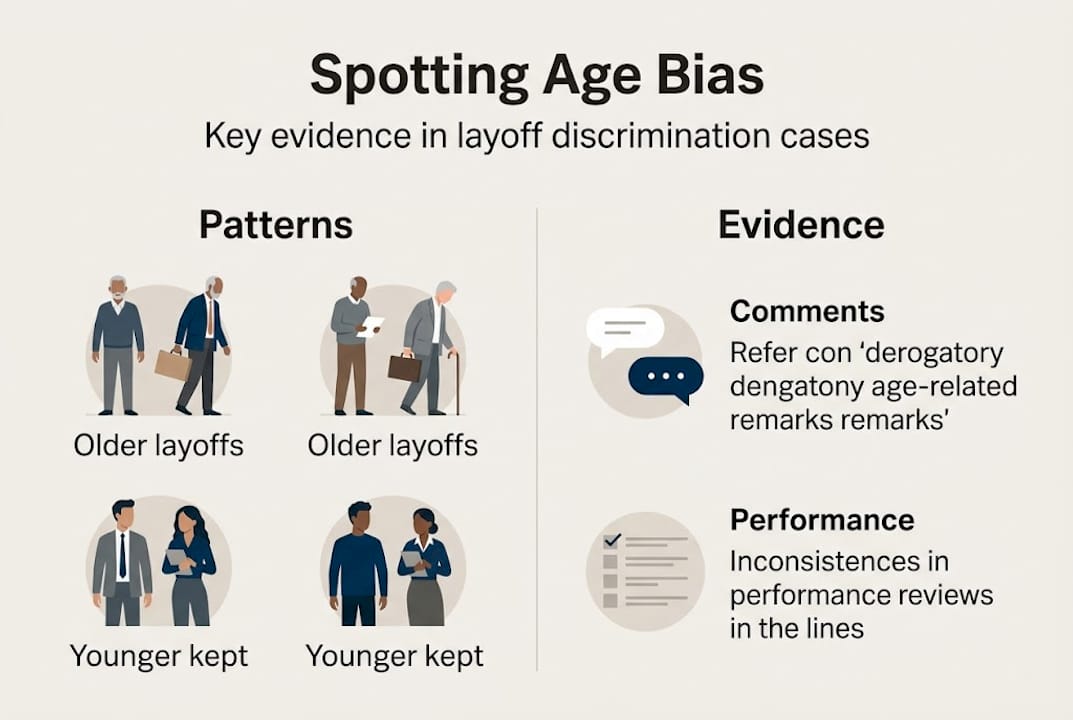
This is why acting quickly and working with experienced legal strategies matters so much. Evidence becomes harder to obtain the longer you wait. But don’t let difficulty discourage you. California’s FEHA is genuinely protective, and well-documented cases do succeed. If your concerns are real and your records are solid, they deserve to be heard.
Courts have recognized that direct evidence of age bias — such as a manager’s statement that the company wanted “somebody younger” — can be sufficient to establish discriminatory animus. (DeJung v. Superior Court (2008) 169 Cal.App.4th 533.) Even without such direct statements, circumstantial evidence showing a pattern of terminating older, experienced workers while retaining younger ones has supported age discrimination findings. (Hersant v. Department of Social Services (1997) 57 Cal.App.4th 997.) These cases illustrate that while proof is challenging, it is not insurmountable when the facts are carefully documented.
How California United Law Group can help you fight age discrimination
If you were laid off from Toyota, Honda, or another Torrance employer and you believe age played a role, you don’t have to figure this out alone. At California United Law Group, P.C., we represent California employees at every stage of employment disputes, from the first consultation through litigation.
We’ve helped workers understand their rights under FEHA, build discrimination claims, navigate CRD and EEOC filings, and pursue wrongful termination cases when layoffs cross legal lines. Prior results in individual cases do not guarantee or predict similar outcomes in future matters. Our employment law services are designed specifically for California employees who need clear, honest guidance.
👉 Contact California United Law Group today for a confidential consultation. Your rights under California law are real, and we’re here to help you understand them.
Frequently asked questions
Is there any proof that Toyota layoffs in Torrance were age biased?
No public lawsuits or statistical data confirm that Toyota Motor Corporation layoffs in Torrance were age biased. However, the absence of public complaints does not rule out individual experiences that may warrant legal review.
What evidence do I need to prove age discrimination after a layoff?
You need to show a pattern of older workers being let go, biased comments, or younger people retained, plus strong performance records. Under FEHA, you must ultimately show that age was a substantial motivating factor in your employer’s decision — not merely a background consideration. An employment attorney can help you assess whether your evidence meets this standard.
How long do I have to file an age discrimination complaint in California?
You have up to three years to file a complaint with the California Civil Rights Department. The CRD’s three-year window is longer than the federal EEOC deadline of 300 days, giving California employees more time to act.
If salary-based layoffs affect mostly older workers, is that illegal?
Yes, if neutral layoff criteria produce a disparate impact on older employees, that can violate FEHA. Disparate impact claims are recognized under California law even when no discriminatory intent is proven.
Who can help me if I think my layoff was discriminatory?
Consulting a California employment attorney or filing a complaint with the CRD or EEOC are your best first steps. An experienced attorney can evaluate your facts and help you meet the legal standard under FEHA.