
TL;DR:
- California law strongly protects employees from retaliation for reporting workplace violations.
- Snap Inc. cannot legally fire or penalize employees who report harassment, discrimination, or safety issues in good faith.
- Proper documentation and seeking external legal help are crucial for those facing retaliation.
- Time limits apply to retaliation claims — acting promptly is essential to preserving your legal options.
If you work at Snap Inc. and worry that speaking up about a workplace problem could cost you your job, you are not alone. Many California employees hesitate to report harassment, discrimination, or safety concerns because they fear retaliation. The good news is that California has some of the strongest employee protection laws in the country, and those laws apply directly to Snap Inc. workers. This guide walks you through what retaliation means legally, how California law shields you, what Snap’s own history tells us about enforcement, and exactly what steps to take if you ever feel targeted for raising a concern.
Table of Contents
- Understanding retaliation and whistleblower protections in California
- Snap Inc. and California law: How company rules intersect with employee rights
- What happens when you report concerns: Outcomes, risks, and protections
- Practical steps: How to report issues and what to do if you suspect retaliation
- A fresh perspective: The reality behind protection vs. fear in tech workplaces
- Connect with expert help for workplace retaliation concerns
- Frequently asked questions
Key Takeaways
| Point | Details |
|---|---|
| Protected reporting | California law shields Snap Inc. employees from retaliation for reporting violations. |
| Legal enforcement | State agencies actively enforce anti-retaliation laws, as seen in Snap’s $15M settlement. |
| Actionable steps | Employees should document reports and seek legal help if they suspect retaliation. |
| Company policy limits | Snap Inc. must comply with California labor laws, overriding any internal rule. |
Understanding retaliation and whistleblower protections in California
Retaliation happens when an employer punishes an employee for engaging in a legally protected activity. That punishment can look like a termination, a demotion, a pay cut, a schedule change designed to make your life harder, or even a sudden wave of negative performance reviews that appeared out of nowhere after you filed a complaint.
Whistleblower protection is the legal shield that prevents employers from doing exactly that. In California, the primary law covering this is California Labor Code section 1102.5, which prohibits employers from retaliating against employees who report violations of state or federal law, regulations, or rules to a government agency, a law enforcement agency, a person with authority over the employee, or a person with authority to investigate, discover, or correct the employer’s violation or noncompliance — including internal reports to a supervisor or HR.
What types of reporting qualify for protection?
- Reporting wage theft or unpaid overtime
- Reporting workplace safety hazards
- Reporting harassment or discrimination
- Reporting financial fraud or regulatory violations
- Reporting pay disparities or gender-based discrimination
One of the most important things to understand is that you do not need to be right about the violation to be protected. You only need a reasonable, good-faith belief that something illegal is happening. That is a meaningful distinction.
California courts have confirmed that these protections are deliberately broad. In Green v. Ralee Engineering Co. (1998) 19 Cal.4th 66, the California Supreme Court recognized that Labor Code section 1102.5 reflects a “broad public policy interest in encouraging workplace whistleblowers to report unlawful acts without fearing retaliation.” More recently, in People ex rel. Garcia-Brower v. Kolla’s, Inc. (2023) 14 Cal.5th 719, the California Supreme Court held that the statute protects employees even when the employer or agency receiving the report already knew about the violation being disclosed — broadening employee protections further.
“California Labor Code section 1102.5 prohibits employers, including Snap Inc., from firing or retaliating against employees for reporting violations.”
Here is a quick look at how protected and unprotected reporting differ:
| Situation | Protected? |
|---|---|
| Reporting harassment to HR | Yes |
| Reporting pay violations to a supervisor | Yes |
| Reporting safety concerns to Cal/OSHA | Yes |
| Complaining about personal preferences | No |
| Reporting a coworker for non-legal reasons | No |
Pro Tip: You do not have to go to a government agency first. Your rights after reporting misconduct are protected even when you report internally to a manager or HR representative.
Snap Inc. and California law: How company rules intersect with employee rights
Snap Inc. is headquartered in Santa Monica, California, and as a California employer, it is fully subject to California labor law. That matters because California law is not optional. No company handbook or internal policy can strip away the protections that state law provides. While some employers require arbitration of employment disputes, an arbitration agreement cannot waive your substantive rights under California law — it can only affect the forum in which those rights are enforced.
Some employees assume that if their company’s policy does not explicitly mention retaliation protections, those protections do not exist. That is incorrect. State law fills every gap. If Snap’s internal policies conflict with California labor law, state law wins.
Here is a side-by-side look at how company policy and California law compare on key issues:
| Issue | Company policy | California law |
|---|---|---|
| Reporting harassment | Encouraged internally | Legally protected |
| Reporting pay violations | May vary | Fully protected under Labor Code |
| Retaliation for reporting | Prohibited by policy | Prohibited by law, with legal remedies |
| Who you can report to | Usually HR or manager | HR, supervisor, or government agency |
Snap’s 2024 gender discrimination settlement with the California Civil Rights Department is a real-world example of state law enforcement in action. It shows that California regulators will hold even major tech companies accountable.
How to report issues safely at Snap Inc.:
- Identify the specific concern (harassment, pay violation, safety issue, discrimination).
- Gather any supporting evidence before making a formal report.
- Submit your report in writing to HR or your supervisor, and keep a copy.
- Note the date, time, and names of everyone involved in the conversation.
- Follow up in writing if you do not receive a response within a reasonable timeframe.
- If internal reporting does not resolve the issue, contact the California Civil Rights Department or the Labor Commissioner’s Office.
Pro Tip: Reporting to HR or a supervisor does not mean you waive your right to escalate. You can always take your concern to a government agency if the internal process fails. Your anti-retaliation protections remain fully intact throughout the process — reporting internally does not waive your right to escalate to a government agency.
What happens when you report concerns: Outcomes, risks, and protections
When you bring a concern forward at Snap Inc., a few things typically happen. HR opens an investigation, relevant parties are interviewed, and a determination is made. In the best cases, the issue is addressed and corrective action follows. In other cases, the outcome is less clear, and employees sometimes notice changes in how they are treated after reporting.
That shift in treatment is where retaliation risk lives. It is rarely a dramatic firing the next day. More often, it looks like:
- Being left out of meetings you previously attended
- Receiving a negative performance review shortly after filing a complaint
- Being reassigned to a less desirable role or shift
- Feeling increased scrutiny from management
- Being passed over for a promotion without explanation
California courts have confirmed that retaliation can take the form of a series of individually subtle actions. In Horsford v. Board of Trustees of California State University (2005) 132 Cal.App.4th 359, the court held that an adverse employment action may consist of a series of subtle yet damaging injuries rather than one swift blow.
California law addresses all of these scenarios. California’s retaliation protections cover adverse employment actions broadly — not just termination.
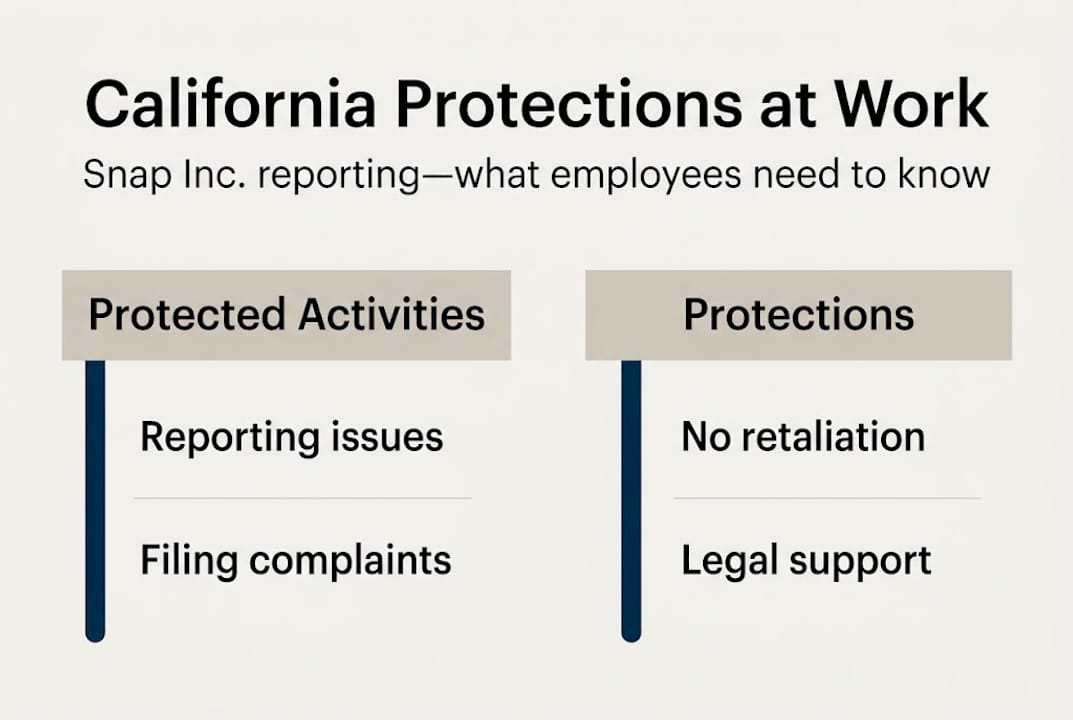
What the Snap settlement tells us:
Snap settled $15 million in 2024 with the California Civil Rights Department for gender discrimination, harassment, and retaliation claims brought by women who raised pay concerns. This is significant. It confirms that retaliation for raising pay-related concerns is a real and documented issue at the company, and that California regulators take it seriously.
The settlement also signals that employees who speak up and document their experiences have real legal recourse. This is not a theoretical protection. It has produced concrete results.

Pro Tip: Start a private log the moment you decide to report an issue. Record every relevant conversation, email, and interaction. This documentation becomes your strongest evidence if retaliation follows. Learn more about reporting safety violations and how documentation supports your case.
Practical steps: How to report issues and what to do if you suspect retaliation
Knowing your rights is one thing. Acting on them effectively is another. Here is a clear, practical framework for Snap Inc. employees who need to report a concern or respond to suspected retaliation.
Reporting a concern internally or externally:
- Internally: Submit a written complaint to HR or your direct supervisor. Use email so there is a record.
- Externally: File a complaint with the California Civil Rights Department (formerly DFEH), the Labor Commissioner’s Office, or Cal/OSHA depending on the nature of the issue.
- For harassment: Review what qualifies as workplace harassment in California before filing to make sure your claim is well-supported.
- For FEHA-based claims (harassment and discrimination): Filing a complaint with the California Civil Rights Department is a required prerequisite before you can file a civil lawsuit under the Fair Employment and Housing Act. An employment attorney can help you navigate this process and ensure you preserve all available remedies.
Steps to protect yourself when reporting:
- Put every report in writing, even if you spoke verbally first.
- Save copies of all relevant emails, texts, and documents in a personal location outside of company systems.
- Note any witnesses who were present during incidents.
- Track any changes in your treatment after you file your report.
- Consult an employment attorney before signing any agreements offered by your employer after you report.
Know Your Deadlines
Acting promptly is not just good practice — it is legally necessary. Different claims carry different filing deadlines. For claims filed directly with the California Labor Commissioner under Labor Code section 98.7 based on a Lab. Code § 1102.5 violation, a complaint must generally be filed within one year of the alleged violation. For harassment and discrimination claims under the Fair Employment and Housing Act (FEHA), a complaint must be filed with the California Civil Rights Department (CRD) within three years of the unlawful act before you can file a civil lawsuit. Missing these deadlines can bar your claims entirely. If you believe you have experienced retaliation, consult an employment attorney as soon as possible.
One of the most important legal principles to understand is this:
“Under California law, protected whistleblowing activity need only be a contributing factor in an adverse employment action to trigger legal protection — the employer cannot escape liability simply by pointing to additional reasons for its decision.”
In Lawson v. PPG Architectural Finishes, Inc. (2022) 12 Cal.5th 703, the California Supreme Court confirmed that the burden-shifting framework under Labor Code section 1102.6 governs whistleblower retaliation claims: once the employee shows that protected activity was a contributing factor in an adverse employment decision, the burden shifts to the employer to demonstrate by clear and convincing evidence that it would have taken the same action for legitimate, independent reasons.
You do not need to have proof of a violation. You need a reasonable belief that one occurred. That standard protects employees who report in good faith, even if an investigation later finds no wrongdoing.
If you believe retaliation has already started, focus on proving workplace harassment or retaliation with a clear paper trail. The more specific and dated your records are, the stronger your position becomes.
A fresh perspective: The reality behind protection vs. fear in tech workplaces
Here is something most articles will not tell you directly: the fear of reporting is often more damaging than the act of reporting itself. The California Supreme Court has reinforced this point: in Yanowitz v. L’Oreal USA, Inc. (2005) 36 Cal.4th 1028, the court confirmed that “it is good faith and reasonableness, not the fact of discrimination, that is the critical inquiry in a retaliation case” — meaning the focus is on the employee’s honest belief, not on proving the employer’s wrongdoing to a legal certainty.
In our experience working with California tech employees, the most common outcome of staying silent is not safety. It is prolonged harm. Employees who do not report harassment or discrimination often find that the behavior escalates, their own performance suffers under the stress, and they eventually leave on terms that do not protect their legal rights.
Contrast that with employees who report and document carefully. They create a legal record. They put the employer on notice. And if retaliation follows, they have documentation that may support a legal claim.
California’s laws are among the strongest nationally, but subtle retaliation can still occur when employees are unaware of their rights. The Snap settlement is a useful example here. It took enforcement action to produce change. That enforcement was only possible because employees came forward.
The uncomfortable truth is that silence protects the employer, not you. Reporting, combined with smart documentation and awareness of your tech industry reporting protections, is the more effective path. Fear is understandable. Acting despite it is what actually moves the needle.
Connect with expert help for workplace retaliation concerns
If you are a Snap Inc. employee who has reported a concern and now feels that something has shifted at work, do not wait to get clarity on your rights. At California United Law Group, P.C., we represent California employees facing retaliation, wrongful termination, discrimination, and harassment. We know California labor law, and we know how to build a case.
👉 Learn more about wrongful termination in California and what your options are if you have been let go after reporting an issue.
We can walk you through the employment lawsuit process and help you understand whether your situation warrants legal action. Explore your rights under California employment law and take the first step toward protecting yourself.
The information provided in this article is for general educational purposes only and does not constitute legal advice. Every employment situation is unique, and outcomes depend on the specific facts of each case. Reading this article does not create an attorney-client relationship with California United Law Group, P.C.
Frequently asked questions
Can Snap Inc. legally fire an employee for reporting workplace violations?
No. California Labor Code section 1102.5 prohibits employers, including Snap Inc., from terminating or otherwise retaliating against an employee because of good-faith reporting of violations. If an employer does so, the employee may have a legal claim for retaliation. That said, employers may argue that a termination was based on legitimate, non-retaliatory reasons — which is why documentation and timely legal advice are critical.
What should Snap Inc. employees document if they suspect retaliation?
Document dates, written communications, and specific interactions related to your report and any changes in treatment that followed. Detailed, timestamped records are your strongest evidence.
Has Snap Inc. faced penalties for retaliation or discrimination?
Yes. Snap settled $15 million in 2024 with the California Civil Rights Department for gender discrimination, harassment, and retaliation claims brought by female employees.
Where can Snap Inc. employees seek legal help for retaliation?
California United Law Group, P.C. provides employment law services and guides employees through retaliation and discrimination claims from pre-litigation through full litigation.
Recommended
- Understanding Gender Discrimination Class Action Challenges: Lessons from Tech Industry Lawsuits – California United Law Group
- Culver City Tech Workers Reporting Violations: Legal Protections – California United Law Group
- Los Angeles Employee Rights After Reporting Misconduct – California United Law Group
- Legal Insights – California United Law Group