
TL;DR:
- Current lawsuits focus on wage and hour violations, not worker misclassification at Warner Bros Discovery.
- In California, misclassification requires meeting three legal criteria; many employees are correctly classified.
- Employees should document pay issues, consult legal experts, and know their rights under California labor law.
If you work at Warner Bros Discovery in Burbank, you may have heard unsettling talk about worker misclassification and wondered whether your job is legally protected. That anxiety is understandable, especially in an entertainment industry where the line between employee and independent contractor has historically been blurry. But here’s what you need to know upfront: current lawsuits against Warner Bros Discovery focus on wage and hour violations for employees, not on misclassifying workers as independent contractors. This article explains what misclassification actually means under California law, what the legal record shows for Warner Bros Discovery workers, and what steps you should take if your pay or working conditions feel wrong.
Table of Contents
- What does worker misclassification mean in California?
- What does the law say about Warner Bros Discovery workers in Burbank?
- Common misunderstandings about worker status at Warner Bros Discovery
- What should you do if you think you’re misclassified or missing wages?
- Why most Warner Bros Discovery workers are better protected than they realize
- How California United Law Group can help with wage and hour issues
- Frequently asked questions
Key Takeaways
| Point | Details |
|---|---|
| No mass misclassification | Current lawsuits show Warner Bros Discovery Burbank workers are generally employees, not contractors. |
| Focus is on wage issues | The main legal challenges concern overtime, breaks, and wage law compliance for employees. |
| Protect your rights | You can seek legal help for wage violations, even if you are classified as an employee. |
What does worker misclassification mean in California?
To understand the Warner Bros Discovery situation, let’s clarify what misclassification actually means.
Misclassification happens when a company labels a worker as an independent contractor instead of an employee to avoid paying overtime, providing benefits, or following California labor protections. It is one of the most common wage abuses in the entertainment industry.
In California, worker misclassification is determined primarily by the ABC test, which was first established by the California Supreme Court in Dynamex Operations West, Inc. v. Sup.Ct. (Lee) (2018) 4 Cal.5th 903 and subsequently codified into statute under Assembly Bill 5 (AB5). The California ABC test requires that a worker be treated as an employee unless the hiring company can prove all three of the following:
- The worker is free from the company’s control and direction in connection with the performance of the work—both under the contract for the performance of the work and in actual practice.
- The work performed is outside the usual course of the company’s business.
- The worker is customarily engaged in an independently established trade, occupation, or business of the same nature as the work performed for the hiring entity.
In Dynamex Operations West, Inc. v. Sup.Ct. (Lee) (2018) 4 Cal.5th 903, the California Supreme Court placed the burden squarely on the hiring entity to prove all three prongs. The Court held that a hiring entity’s failure to satisfy even a single prong is sufficient on its own to establish that the worker is an employee for purposes of California’s wage orders. Importantly, the label a company places on the relationship—or what a contract says—does not override the legal test.
If a company cannot satisfy all three conditions, the worker is legally an employee, regardless of what the contract says. Note: California law expressly excludes certain occupations from the ABC test; workers in those roles are evaluated under a separate multi-factor standard. If you are uncertain which standard applies to your specific role, an employment attorney can advise you. That distinction matters enormously. Employees in California are entitled to overtime pay, meal and rest breaks, minimum wage protections, workers’ compensation, and unemployment insurance. Independent contractors receive none of those protections.
Why does this matter for you? Because misclassification is not just a paperwork issue. It can cost you thousands of dollars in unpaid wages and benefits over the course of your employment.
Pro Tip: Many workers assume that if they feel like a contractor, they must be one. That’s not how California law works. Your classification is determined by a legal test, not by what your employer calls you or what your contract says.
What does the law say about Warner Bros Discovery workers in Burbank?
Now that we’re clear on misclassification, let’s look at what’s actually happening with Warner Bros Discovery Burbank.
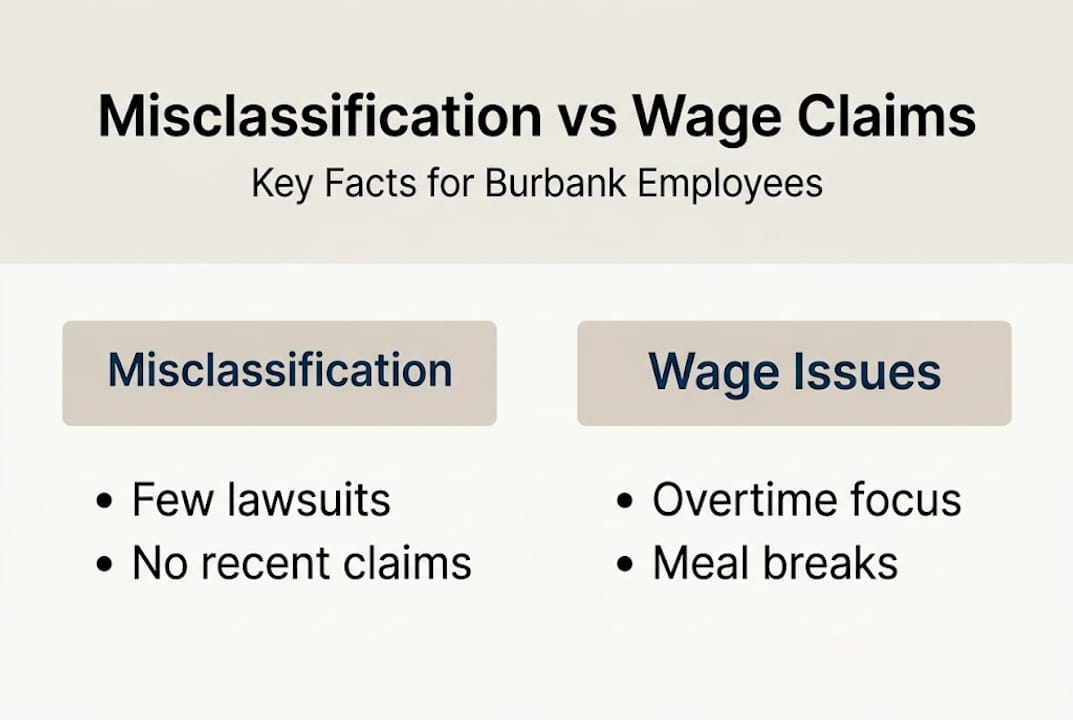
The most important fact for Burbank workers to understand is this: no misclassification lawsuits have been filed against Warner Bros Discovery for treating Burbank employees as independent contractors. The lawsuits that exist treat workers as employees and focus on whether those employees were paid correctly.
The 2025 Padilla v. Warner Bros Discovery case is a clear example. That lawsuit focuses on wage and hour issues at the Burbank facility, including unpaid overtime and missed meal breaks, not on whether workers were misclassified. Warner Bros Discovery has also faced National Labor Relations Board (NLRB) proceedings that confirmed Production Assistants are employees, further cementing that the company recognizes its workforce as employees.
| Case or proceeding | Claim type | Status or outcome |
|---|---|---|
| Padilla v. Warner Bros Discovery (2025) | Wage and hour violations | Active, arbitration sought |
| NLRB Production Assistant ruling | Employee status confirmation | Workers confirmed as employees |
| Warner Bros Studio Operations lawsuit | Wage and hour violations | Reported, ongoing |
What this tells you is that wage and hour claims are the real legal battleground here, not contractor misclassification. If you’re a Burbank employee and something feels off about your paycheck, overtime, or break schedule, that concern is valid and legally actionable.
For more context specific to your workplace, speaking with an employment lawyer in Burbank can help you understand how these cases may affect your situation. You can also review information on pay gaps at Warner Bros Discovery to see how compensation issues have played out across the company.
Common misunderstandings about worker status at Warner Bros Discovery
Despite the facts, many workers still feel anxious. Let’s sort out what people get wrong.
One of the most persistent misunderstandings is this: if you’re not getting overtime or timely meal breaks, you must be misclassified. That is not accurate. You can be correctly classified as an employee and still be the victim of wage theft. Those are two separate legal problems.

According to recent lawsuits, no misclassification claims have been brought against Warner Bros Discovery Burbank. The legal actions address wage and hour violations among workers who are already recognized as employees. That’s an important distinction.
Here’s a side-by-side comparison to help clarify the difference:
| Factor | Employee | Independent contractor |
|---|---|---|
| Who controls how work is done | Employer | Worker |
| Overtime eligibility | Yes, under California law | No |
| Meal and rest break rights | Yes | No |
| Workers’ compensation | Yes | No |
| Work is core to company’s business | Yes | No |
Common points of confusion among entertainment workers include:
- Being paid on a project basis does not automatically make you a contractor.
- Signing a contract that says “independent contractor” does not override California law.
- Working irregular hours or from multiple locations does not change your legal status.
- Not receiving a W-2 form does not mean you are legally a contractor.
For broader legal insights for entertainment workers, it helps to look at how similar cases have unfolded elsewhere in the industry. The Disney wage lawsuit in Burbank offers a useful parallel: like the Warner Bros Discovery cases, it centers on wage and hour enforcement for employees, not misclassification.
What should you do if you think you’re misclassified or missing wages?
So what should you do if your pay or status doesn’t seem right?
Start with these immediate steps:
- Check your classification. Review your offer letter, pay stubs, and any contracts you signed. Are you receiving a W-2 or a 1099? Are you getting overtime and break pay?
- Gather records. Save copies of timesheets, schedules, pay stubs, and any communications about your hours or pay. Documentation is your strongest asset.
- Talk to HR. Raise your concern internally first. This creates a record and may resolve the issue quickly.
- Consult an employment attorney. If HR does not resolve the issue, or if you face retaliation for raising it, speak with a labor lawyer.
Signs that may indicate misclassification:
- You are called a contractor but your employer controls your schedule and methods
- You perform core work for the company but are not offered employee benefits
- You were told to sign a contractor agreement but work full-time hours
Signs of wage theft (even for correctly classified employees):
- Unpaid overtime when you work more than 8 hours in a single workday or more than 40 hours in a workweek—and double-time pay when you work more than 12 hours in a single workday, or more than 8 hours on the seventh consecutive day of a workweek
- Missed or shortened meal and rest breaks without premium pay
- Off-the-clock work that is not compensated
Under Brinker Restaurant Corp. v. Superior Court (2012) 53 Cal.4th 1004, the California Supreme Court established that an employer fulfills its meal period obligation only by actually relieving employees of all duties, relinquishing control over their activities, and providing a genuine opportunity for an uninterrupted 30-minute break. An employer who fails to meet this standard owes the employee one hour of premium pay for each missed or noncompliant meal period.
Workers may have wage claims even if they’re correctly classified as employees. If you’ve experienced any of the above, reviewing your situation with a lawyer is a smart move. Issues involving broken employment contracts or unclear California employment contracts can also affect your rights in ways that aren’t immediately obvious.
Pro Tip: Depending on the nature of your claim, California law may allow employees to recover significantly more than unpaid wages alone. In overtime and minimum wage cases, a prevailing employee may recover attorney’s fees and costs under the California Labor Code. Where an employer willfully fails to pay an employee’s full final wages upon discharge or resignation, waiting time penalties of up to 30 additional days of wages may apply. However, attorney’s fees are not available for every type of wage claim—for example, they are generally not recoverable on stand-alone claims for missed meal or rest break premium pay. The remedies available depend on the specific facts of your situation, which is why consulting an attorney matters.
One practical advantage workers have: under Donohue v. AMN Services, LLC (2021) 11 Cal.5th 58, when an employer’s own timekeeping records show that a meal period was missed, cut short, or delayed past the fifth hour of work, California law raises a rebuttable presumption that the employer failed to provide a compliant meal break. Your employer’s records can become your evidence.
Why most Warner Bros Discovery workers are better protected than they realize
With these action steps in mind, it’s important to see why the real issue is wage enforcement, not classification.
Here’s a perspective that often surprises workers: being confirmed as an employee is actually a strong legal position. It means you have the full weight of California labor law behind you. The problem is not your status. The problem is whether your employer is honoring the obligations that come with that status.
Recent class action lawsuits against Warner Bros Discovery focus on enforcing employee rights, not misclassification. That tells us something important: the legal system already recognizes you as an employee. What it’s still working out is whether you’ve been paid what you’re owed.
In our observation, workers at large entertainment companies often spend energy worrying about the wrong thing. Every case is different, and the legal outcome in any situation depends on the specific facts involved. Misclassification fear can actually distract you from the more actionable question: are your wage rights being enforced? Focusing on pay gaps and wage rights gives you a clearer path to real remedies. The California Labor Code gives employees powerful tools. Use them.
How California United Law Group can help with wage and hour issues
If you’re looking for personalized support, here’s how professional help can make the difference.
At California United Law Group, P.C., we work with employees at major entertainment companies, including those in Burbank, who are dealing with unpaid overtime, missed breaks, and other wage violations. If you’re unsure whether your situation involves misclassification or a wage and hour issue, we can help you assess your situation.
👉 Get help with wage and hour claims from attorneys who know California labor law. We also offer broader California employment law guidance for workers navigating complex workplace situations. You don’t have to sort this out alone. Reach out to our team for a confidential consultation.
Disclaimer: The information in this article is provided for general educational and informational purposes only and does not constitute legal advice. It does not create an attorney-client relationship. California employment law is complex, and the rights and remedies available to any individual depend entirely on the specific facts of their situation. If you believe your wage rights have been violated, consult a qualified employment attorney for advice tailored to your circumstances.
Frequently asked questions
Has Warner Bros Discovery ever misclassified its Burbank workers as independent contractors?
No public evidence exists of Warner Bros Discovery misclassifying Burbank workers as contractors. Filed lawsuits treat workers as employees and address wage and hour violations instead.
What rights do Warner Bros Discovery employees have if classified correctly?
Employees are entitled to overtime, meal and rest breaks, minimum wage, and other protections under California law. Class action lawsuits confirm that these rights are actively being enforced through the courts.
What should I do if I think I’m missing overtime or meal breaks?
Document your hours and breaks carefully, report your concerns to HR, and consult an employment attorney if the issue is not resolved. Employees can pursue wage claims for overtime or missed breaks even without any misclassification issue.
Recommended
- Pay gaps at Disney and Warner Bros. in Burbank: What California employees need to know in 2026 – California United Law Group
- How Disney’s Wage Lawsuit Changed Overtime Compliance in Southern California: Lessons from Grace v. Disney – California United Law Group
- How Dynamex Reshaped Los Angeles Misclassification Lawsuits – California United Law Group
- California Worker Misclassification: Understanding Your Rights Under the ABC Test – California United Law Group