
Burbank, CA sits at a crossroads that most California cities never reach. It is home to major entertainment studios, a genuinely walkable downtown, and tight-knit residential neighborhoods that feel far removed from the chaos of Los Angeles just a few miles south. With a population of approximately 101,793 and a median household income of $97,082, this city punches well above its weight in terms of amenities, community engagement, and quality of life. Whether you have lived here for decades or just moved in, there is more happening in Burbank right now than most residents realize.
Table of Contents
- Key Takeaways
- Burbank neighborhoods and what they actually feel like
- Things to do in Burbank and where to eat
- Transportation and urban planning changes to watch
- City services, community events, and what your local government is doing
- My honest take on living and working in Burbank in 2026
- Working in Burbank? Know your employment rights
- FAQ
Key Takeaways
| Point | Details |
|---|---|
| Burbank has two distinct districts | Downtown and Magnolia Park offer very different lifestyles, so choosing the right neighborhood matters. |
| Local events are thriving in 2026 | Major events like the Hollywood Show and Parafencing Championships make Burbank a cultural destination. |
| Infrastructure changes are coming | The Olive Avenue BRT project and SB 79 zoning changes will affect daily life and housing options. |
| City services are active and evolving | Environmental mandates and community programs reflect an engaged local government with real impact on residents. |
| Employment rights matter here | Workers at Burbank’s major studios and businesses should understand their California labor protections. |
Burbank Neighborhoods And What They Actually Feel Like
Burbank is often described as one city, but its neighborhoods tell two very different stories. Understanding those differences can shape where you choose to live, shop, and spend your time.
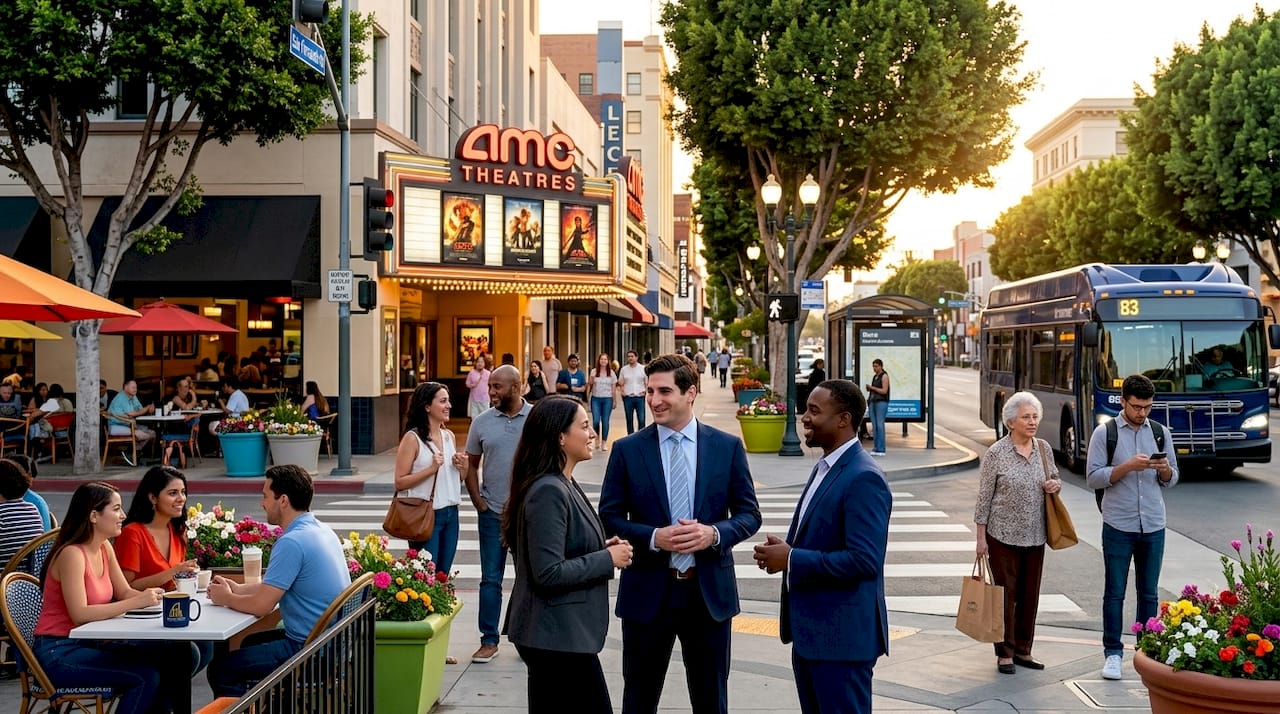
Downtown Burbank is media-centric and walkable, built around the San Fernando Boulevard corridor. You will find AMC theaters, chain restaurants, independent shops, and a steady stream of foot traffic from nearby studio workers. It has the energy of a small urban center without the density of Los Angeles. If you work in entertainment or prefer having dining and retail within walking distance of your front door, Downtown is the obvious choice.
Magnolia Park, on the other hand, is a different kind of neighborhood entirely. Centered along Magnolia Boulevard between Hollywood Way and Screenland Drive, it draws residents who prefer vintage shops, local cafes, and a quieter, more curated atmosphere. It is the kind of place where you recognize the person behind the counter at your coffee shop. For residents who want character over convenience, Magnolia Park consistently delivers.
Beyond these two anchors, Burbank’s residential streets offer solid housing stock, good schools, and a suburban feel that remains rare this close to Los Angeles.
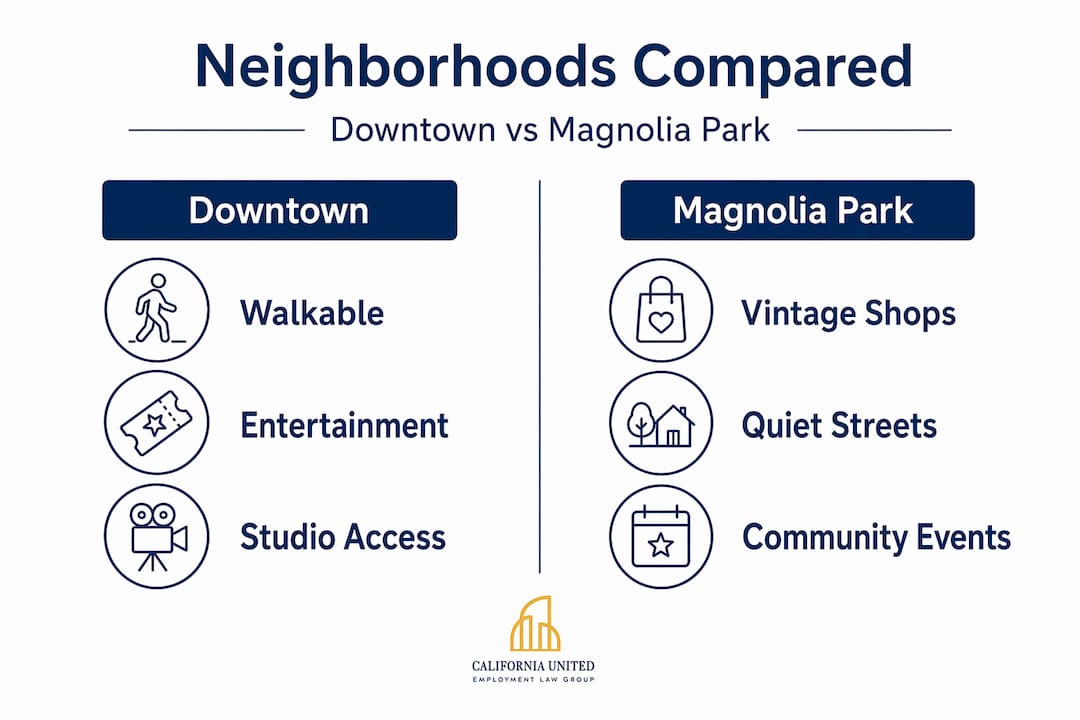
Here is what distinguishes the two main districts at a glance:
- Downtown Burbank: High walkability, entertainment venues, studio proximity, chain and independent dining, active nightlife
- Magnolia Park: Boutique retail, vintage stores, local dining, quieter streets, strong neighborhood identity
- Residential corridors: Single-family homes, tree-lined streets, proximity to Burbank parks and recreation facilities like Johnny Carson Park and Stough Canyon Nature Center
Pro Tip: If you work in media and value a short commute, Downtown or the areas near Olive Avenue put you closest to Warner Bros., Disney, and NBC. If remote work is your reality, Magnolia Park gives you more neighborhood character per dollar.
Things To Do In Burbank And Where To Eat
Burbank’s local business scene has grown more interesting in 2026, and the event calendar reflects a city that takes community seriously.
On the dining side, Burbank CA restaurants range from long-standing local favorites to newer concepts that draw visitors from across the Los Angeles area. Porto’s Bakery remains a regional institution, with lines that form before the doors open on weekends. Smokehouse Restaurant, just outside the Warner Bros. lot, has been feeding studio workers and residents since 1946. For something newer, the food hall at the Empire Center and the growing collection of independent spots along San Fernando Boulevard give you plenty of options.
The most talked-about Burbank CA attraction opening in 2026 is Scum & Villainy Cantina, an immersive fan experience venue taking over 5,300 square feet at 346 N. First St. in Downtown Burbank. If you have been to the original Hollywood location, the Burbank outpost promises a larger, more theatrical experience built around pop culture fandoms. It is exactly the kind of venue that fits Burbank’s entertainment identity.
Top things to do in Burbank in 2026:
- Visit the Warner Bros. Studio Tour for a behind-the-scenes look at active production facilities
- Attend the Hollywood Show on May 30 at the Marriott Burbank Airport, featuring celebrity guests including William Shatner
- Explore Magnolia Park’s vintage shops and local cafes on a weekend morning
- Hike the trails at Stough Canyon Nature Center for views of the San Fernando Valley
- Experience Scum & Villainy Cantina when it opens at its new Downtown location
- Catch a show at the Colony Theatre or a screening at the AMC Burbank 16
- Browse the weekly Burbank Farmers Market for local produce and artisan goods
For workers at major studios, it is also worth knowing that pay equity issues at Disney and Warner Bros. have been a topic of active discussion in 2026. Being informed about your rights as an employee in this city matters as much as knowing where to eat.
Transportation And Urban Planning Changes To Watch
Burbank is not immune to the infrastructure debates reshaping Southern California cities, and two developments in particular deserve your attention right now.
The proposed Bus Rapid Transit line along Olive Avenue has generated significant community pushback. The concern is not just about bus lanes. BRT lane reductions would reduce vehicle capacity on one of Burbank’s main east-west corridors, affecting daily commutes and access for residents who depend on cars. Opponents argue the project prioritizes transit optics over practical traffic flow.
Separately, Senate Bill 79 (SB 79) is creating real tension around housing density. The bill allows higher-density residential development near transit corridors, which in Burbank means neighborhoods along Olive Avenue and other bus routes could see zoning changes that affect neighborhood character. Understanding SB 79’s impact is not just a policy exercise. It has direct implications for property values, parking, and the feel of residential streets.
What residents should know about these changes:
- The BRT project is still in planning stages, but community input windows are open
- SB 79 overrides some local zoning authority, limiting what city councils can do independently
- Hollywood Burbank Airport remains a key transit asset, offering convenient access for residents who travel frequently for work
- City planning meetings are public and your participation has real weight
Pro Tip: Sign up for the City of Burbank’s email updates at burbankca.gov to receive notices about planning meetings, public comment periods, and zoning changes before they become final decisions.
City Services, Community Events, And What Your Local Government Is Doing
Burbank’s city government is more active than residents in many comparable cities experience, and the results show up in both positive programs and, occasionally, aggressive enforcement.
On the positive side, community engagement in 2026 has been strong. A record 2,000 residents attended the Burbank Fire and Police Service Day on May 9, reflecting genuine public trust in local emergency services. The city also hosted the California Parafencing Championships on May 23 and 24, positioning Burbank as a hub for adaptive sports and Paralympic programming. These are not small gestures. They reflect a city that invests in community identity.
Key city services and programs worth knowing:
- Environmental compliance: Burbank has banned gas-powered leaf blowers and actively encourages zero-emission alternatives. Residents who hire landscaping services should confirm their contractors are compliant to avoid liability.
- Code enforcement: The city enforces property codes with real financial consequences. Reports of fines up to $10,000 for violations like unauthorized tree pruning have circulated among residents. Know your property’s rules before you act.
- Adaptive sports and recreation: Burbank parks and recreation programming now includes dedicated adaptive sports events, making the city more accessible for residents with disabilities.
- Online engagement: The city maintains active social media channels and a well-organized website at burbankca.gov where you can track permits, report issues, and follow Burbank CA events in real time.
The city’s approach to governance is hands-on. That is mostly a good thing, but it requires residents to stay informed and proactive.
My Honest Take On Living And Working In Burbank In 2026
I have spent considerable time working with residents and employees across the Los Angeles area, and Burbank consistently stands out. Not because it is perfect, but because it is genuinely trying to be something specific.
What I find most interesting about Burbank right now is the tension between its entertainment industry identity and its residential character. The studios bring money, jobs, and cultural energy. They also bring employment contract disputes, wage questions, and workplace dynamics that are unique to the media industry. Workers here often assume that because their employer is a major studio, the rules are different. They are not. California labor law applies fully, and Burbank workers have the same protections as anyone else in the state.
The BRT and SB 79 debates also tell me something important: Burbank residents are paying attention. The turnout at planning meetings and the organized pushback on the Olive Avenue project show a community that understands its own interests. That kind of civic engagement is rare, and it is worth protecting.
My honest advice is to treat Burbank as a city that rewards participation. Show up to the planning meetings. Read the city notices. Understand your rights as a tenant, a homeowner, and an employee. The city is changing, and the residents who stay informed will be the ones who shape what it becomes.
Working In Burbank? Know Your Employment Rights
Burbank is one of California’s most employer-dense cities, with major studios, tech companies, and small businesses all operating within a few square miles. That concentration of employers also means a concentration of workplace disputes, from wage and hour violations to wrongful termination.
If you work in Burbank and have questions about your rights, California United Law Group’s employment law team represents employees across a full range of California Labor Code and FEHA claims. The firm handles wrongful termination, discrimination, harassment, retaliation, and wage disputes at all stages, from early consultation through litigation.
California courts have built some of the nation’s strongest employee protections over the past several decades. In Tameny v. Atlantic Richfield Co. (1980) 27 Cal.3d 167, the California Supreme Court recognized that employees may bring tort claims when a termination violates a fundamental public policy — a doctrine that applies squarely to workers at Burbank’s studios and businesses. The California Supreme Court further expanded employee rights in Foley v. Interactive Data Corp. (1988) 47 Cal.3d 654, holding that implied employment contracts can protect workers from termination without good cause even in the absence of a written agreement. On wage and hour issues, the Supreme Court’s decision in Brinker Restaurant Corp. v. Superior Court (2012) 53 Cal.4th 1004 established the standard for an employer’s obligation to provide compliant meal and rest periods, and Donohue v. AMN Services, LLC (2021) 11 Cal.5th 58 held that an employer’s own records showing missed or shortened meal periods create a rebuttable presumption that required breaks were not provided — giving employees significant evidentiary leverage. In the discrimination and harassment context, Roby v. McKesson Corp. (2009) 47 Cal.4th 686 confirmed that the same workplace conduct can simultaneously support both a FEHA discrimination and harassment claim, and that those claims may be proven through overlapping evidence.
Whether you are dealing with a denied rest break or a more serious workplace dispute, understanding your options is the first step. California United Law Group offers consultations for Burbank workers who want to understand their rights before making any decisions.
FAQ
What is the population of Burbank, CA?
Burbank’s population is approximately 101,793 in 2026, with a median household income of $97,082 and a median resident age of 40.1 years.
What are the best neighborhoods in Burbank?
Downtown Burbank suits residents who prefer walkability and entertainment access, while Magnolia Park appeals to those who want a boutique, locally focused atmosphere with strong neighborhood character.
How do I get to Burbank from Los Angeles?
Hollywood Burbank Airport serves the city directly, and the Metro Ventura Highway corridor connects Burbank to central Los Angeles by car or public transit in roughly 20 to 30 minutes depending on traffic.
What major events happen in Burbank, CA?
Burbank hosts the Hollywood Show convention, the California Parafencing Championships, the Fire and Police Service Day, and a regular Farmers Market, among other Burbank CA events throughout the year.
What should Burbank workers know about employment law?
California labor law applies fully to all Burbank employers, including major studios. Workers have rights around wages and rest breaks under the California Labor Code, which generally applies to all California employers. Separate and additional protections against discrimination, harassment, and retaliation are provided by the California Fair Employment and Housing Act (FEHA), which covers employers with five or more employees. Because California law is more expansive than federal law in this area, most Burbank workers — including those at major entertainment studios — are covered.