
TL;DR:
- California law mandates that all non-exempt Burbank employees receive paid rest breaks of 10 minutes for every four hours worked, with no local ordinances overriding these rights. Rest breaks must be duty-free, scheduled near the midpoint of shifts, and cannot be voluntarily skipped without penalty, with violations resulting in premium pay. Misclassification of workers and subtle workplace pressures can unlawfully deny these protections, but employees have legal recourse and remedies through documentation and consultation with employment attorneys.
Many Burbank employees assume that rest break rules vary by city or that their employer has the final say on when and whether breaks happen. That assumption is wrong. California state law sets uniform rest break standards that apply to every qualifying worker in the state, including those in Burbank, with no local ordinances overriding these protections. This article walks you through exactly what you are owed, who qualifies, how denial happens in subtle ways, and what remedies are available when your employer falls short.
Table of Contents
- What the law requires: Statewide rest break rights in Burbank
- Who is—and isn’t—entitled to rest breaks?
- What counts as denial—direct and indirect violations
- Remedies and penalties for denied rest breaks
- Real-world scenarios and best practices
- What most employees and employers miss about rest break laws
- Get help with rest break violations in Burbank
- Frequently asked questions
Key Takeaways
| Point | Details |
|---|---|
| State law governs | Burbank employers must follow California state rest break laws—no local override exists. |
| Eligibility matters | Only non-exempt employees are guaranteed rest breaks; exempt and contractors are not. |
| Denial takes many forms | Interrupting, discouraging, or requiring duty during breaks qualifies as denial, not just overt refusal. |
| Penalty pay for violations | Employers must pay one additional hour at the employee’s regular rate of pay for each workday on which one or more rest breaks were denied — not per individual break. |
| Document violations | Keep records of any missed or interrupted breaks to protect your rights and support claims. |
What The Law Requires: Statewide Rest Break Rights In Burbank
With confusion out of the way, let’s clarify what Burbank workers are actually owed under the law.
California rest break rights come from state law, specifically the California Labor Code and Industrial Welfare Commission (IWC) wage orders. Burbank does not have its own competing local ordinance that changes or limits these rights. This means every non-exempt employee working in Burbank is protected by the same rules that apply in Los Angeles, San Francisco, or any other California city.
Our California labor law insights page covers a range of wage and hour topics that connect to these statewide protections, and understanding the basics is the first step to knowing whether your rights are being respected.
The Core Requirements At A Glance
Here is what state law actually guarantees:
- Paid rest breaks. Rest breaks are compensated time. Your employer cannot dock your pay or require you to clock out during a rest break.
- 10 minutes per 4 hours worked. Non-exempt employees are entitled to a paid 10-minute rest break for every four hours worked, or major fraction thereof (meaning more than two hours).
- Scheduled near the middle. Breaks should be scheduled as close to the midpoint of each four-hour work period as is practical.
- No task assignments during breaks. You cannot be required to perform any work duties during your rest period.
The law is clear: Burbank employers cannot legally deny non-exempt employees their required rest breaks under California state law, which applies uniformly across the entire state. There are no local exceptions that allow Burbank employers to reduce or eliminate this obligation.
A straightforward example: if you work an eight-hour shift, you are entitled to two 10-minute paid rest breaks. If you work a shift of more than six hours but less than eight, you are still entitled to two breaks because your shift includes a “major fraction” of the second four-hour block. This is because any shift exceeding six hours crosses into a second four-hour work period by more than half, thus triggering the second required break. Understanding this math matters, because employers sometimes miscalculate or ignore the “major fraction” rule entirely.
You can also explore how these protections relate to Burbank contract rights to get a broader picture of your legal standing in the workplace.

Who Is—And Isn’t—Entitled To Rest Breaks?
Knowing that Burbank employees have these rights, it’s important to determine exactly who they apply to.
Not every worker in Burbank automatically qualifies for rest break protections. The law draws clear distinctions based on employment classification. Getting this wrong, on either side, creates real legal risk.
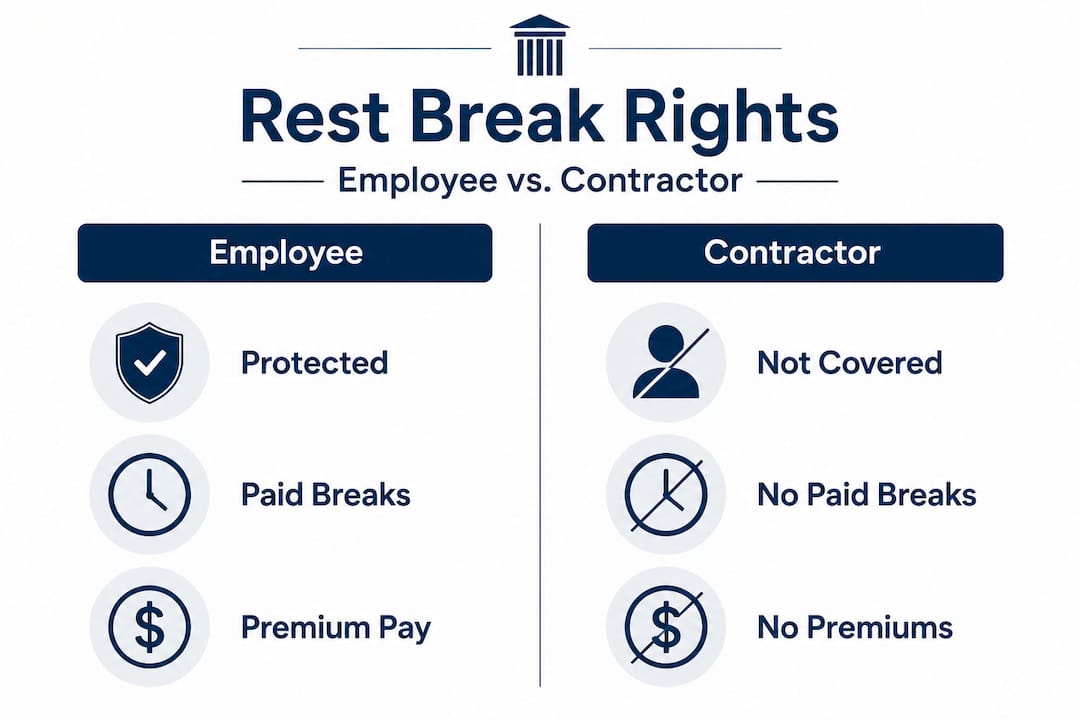
Classification Comparison
| Worker Type | Rest Break Entitlement | Key Factor |
|---|---|---|
| Non-exempt (hourly) employee | Yes, fully protected | Paid by the hour or doesn’t meet exemption test |
| Exempt (salaried) employee | No | Must meet salary threshold and duties test |
| True independent contractor | No | Genuine business-to-business relationship |
| Misclassified worker | Yes (if non-exempt in reality) | Classification may be disputed and corrected |
The rest break eligibility rules turn on whether you are genuinely classified and whether that classification is lawful.
The “Major Fraction” Rule, Explained
“Major fraction” of four hours means more than two hours of the remaining block. So if you work a shift that exceeds six hours — say, six hours and thirty minutes — your day includes one full four-hour block and a major fraction of a second block (two and a half hours, which is greater than half of four). That entitles you to two rest breaks. A shift of exactly six hours, by contrast, entitles you to only one rest break under Brinker Restaurant Corp. v. Superior Court (2012) 53 Cal.4th 1004, 1029. Many employers apply this incorrectly by giving only one break to employees who work moderately beyond the six-hour mark. That practice violates California law.
Common Misclassification Traps
Exempt employees and independent contractors are not entitled to rest breaks, but misclassification is common. Employers sometimes label workers as exempt or as independent contractors even when the actual working relationship does not meet the legal standard.
Watch for these warning signs:
- You are paid a salary, but your actual duties are largely routine or supervised rather than managerial or professional
- You are called an “independent contractor” but work set hours, use employer equipment, and have no other clients
- Your employer controls how, when, and where you perform your work
Pro Tip: If your job title says “manager” but you spend the majority of your time doing the same tasks as hourly employees you supervise, you may not actually meet the duties test for an exempt classification. Speak with a Burbank employment law attorney to evaluate your specific situation.
What Counts As Denial—Direct And Indirect Violations
Understanding who’s covered means looking closer at exactly how denial happens, in both obvious and subtle ways.
Most employees think of rest break denial as a supervisor saying, “No, you can’t take a break today.” But the law reaches much further than outright refusal. Subtle pressure, workplace culture, and operational structures can all constitute illegal denial.
Forms Of Rest Break Denial
- Direct refusal. Your supervisor explicitly tells you that breaks are not available during a shift, or that operational demands take priority. This is a clear violation.
- Scheduling that makes breaks impossible. Shifts are structured so that work tasks or customer service obligations leave no practical window for a 10-minute break. Even without a verbal refusal, this is a violation.
- On-call requirements during break time. On-call or workstation monitoring during breaks constitutes denial. You must be fully relieved of all duties.
- Subtle discouragement. A manager who sighs, comments on work volume, or questions the timing every time you try to take a break is creating an environment where employees feel they cannot legally exercise their rights.
- Requiring employees to remain on-site and available. If you must stay within earshot, monitor equipment, or respond to calls, you are not truly on a duty-free break.
The legal standard is clear: Employers must provide, authorize, and permit rest breaks, but they do not need to ensure employees take them when employees voluntarily choose to skip. However, employers cannot impede, discourage, or require work during breaks. That crosses the line into unlawful denial.
This distinction is important. If you voluntarily choose to skip a break on your own initiative, the law does not automatically penalize your employer. But if your work environment, your supervisor’s behavior, or your operational setup makes taking a break feel impossible or risky, that is a different matter legally.
Pro Tip: If you feel pressured not to take breaks, start keeping a personal log with dates, times, and a brief note about what happened. This documentation can be critical if you later need to show a pattern of rest break denial.
Remedies And Penalties For Denied Rest Breaks
If your rights have been violated, here’s what the law says you and your employer should expect next.
California law does not leave employees without recourse. When an employer fails to provide rest breaks, the financial consequences are real and structured.
Premium Pay: The Penalty For Non-Compliance
The law is specific about what you are owed. Under Ferra v. Loews Hollywood Hotel, LLC (2021) 11 Cal.5th 858, your “regular rate” is not simply your hourly pay rate — it includes all nondiscretionary compensation you earn during the pay period, such as production bonuses, commissions, and shift differentials. This means your premium pay entitlement may be higher than your base hourly wage alone. Denial of rest breaks triggers premium pay: one additional hour of pay at your regular rate for each workday a rest break was denied. If both a meal break and a rest break were denied in the same day, you can receive up to two hours of premium pay, one for each type of violation.
This premium pay, while separate from your base hourly wages, is itself a wage under California law — not merely a penalty. The California Supreme Court confirmed in Murphy v. Kenneth Cole Productions, Inc. (2007) 40 Cal.4th 1094 that the additional hour of pay is a premium wage owed as compensation to the employee. Because it is a wage, employees generally have three years to bring a claim for unpaid premium pay. Additionally, as the California Supreme Court held in Naranjo v. Spectrum Security Services, Inc. (2022) 13 Cal.5th 93, an employer’s failure to pay premium wages can also trigger wage statement penalties and waiting time penalties on top of the premium pay itself.
How long do you have to file a claim?
Employees generally have three years from the date of each violation to bring a claim for unpaid rest break premium pay under California’s statute of limitations for statutory wage liability. Because premium pay is a wage — not a penalty — the three-year period under Code of Civil Procedure § 338(a) applies, as the California Supreme Court confirmed in Murphy v. Kenneth Cole Productions, Inc. (2007) 40 Cal.4th 1094. Additionally, employees may join an unfair competition claim under Business and Professions Code § 17200, which carries a four-year limitations period, potentially extending the recovery window. If you have experienced years of systematic rest break violations, the exposure for your employer compounds significantly over time.
Comparing The Remedies
| Violation type | Premium pay owed | Daily maximum |
|---|---|---|
| Missed or denied rest break | 1 hour at regular rate | 1 hour per workday (regardless of how many rest breaks were missed that day) |
| Missed or denied meal break | 1 hour at regular rate | 1 hour per workday (regardless of how many meal breaks were missed that day) |
| Both violated same day | Up to 2 hours total | 2 hours combined |
Steps To Take If Your Breaks Are Being Denied
- Document each incident. Write down the date, the shift length, which break was missed, and any relevant context such as a supervisor’s comment or a scheduling conflict that made the break impossible.
- Review your pay stubs. If your employer owes premium pay, it should appear on your pay statement. Failure to reflect premium pay on your pay stub is itself a wage statement violation under California law, which can trigger additional statutory penalties separate from the unpaid premium wages.
- Report internally if safe to do so. Some employees find it useful to notify HR in writing. This creates a paper trail, though it is not required before seeking outside help.
- Consult an employment attorney. Statewide break claims are frequent and have proven costly for non-compliant employers. An attorney can evaluate your situation and help you understand your options.
For context on how related wage violations are addressed, the off-the-clock work issues handled in other California cities reflect how seriously courts take wage and hour violations broadly.
Real-World Scenarios And Best Practices
Bringing all these rules down to earth, here’s what they look like in real Burbank workplaces.
Legal principles become clearer with real examples. Consider the following situations that commonly arise in Burbank workplaces across industries such as entertainment, retail, healthcare support, and food service.
Scenario 1: The “just finish this first” pressure. A retail supervisor consistently asks employees to “just finish one more thing” before their break. By the time the task is done, the break window is lost. Even though no one said “no breaks allowed,” this pattern likely constitutes a rest break violation.
Scenario 2: The on-call break. A hospital support worker is told she can take a break but must keep her radio on and respond immediately if called. Under California law, rest breaks must be uninterrupted and duty-free. That arrangement is not a compliant break.
Scenario 3: The voluntary skip. A warehouse worker chooses to skip breaks to finish earlier. As long as the employer genuinely offered the break opportunity, the employer’s legal obligation is met. The California Supreme Court in Brinker Restaurant Corp. v. Superior Court_ (2012) 53 Cal.4th 1004 confirmed that employers must provide the opportunity for rest breaks, but they are not required to stand over employees to ensure the break is taken.
Best Practices For Burbank Employees
- Keep personal records of your daily schedule and breaks taken or missed
- Note any verbal or written communications from supervisors about break policies
- Understand your classification so you know whether rest break laws apply to you
- Do not assume that because a coworker skips breaks you are also required to do so
- Ask questions if your employer’s break policy is unclear or inconsistently applied
Pro Tip: Rest breaks cannot be waived by employees the way certain meal breaks can under specific conditions. Your employer cannot ask you to sign away your rest break rights. If you have been asked to do this, that document is unenforceable. Under Franco v. Athens Disposal Co., Inc. (2009) 171 Cal.App.4th 1277, rest break rights are a generally applicable labor standard that cannot be waived by employee agreement.
Lessons from cases like the Disney wage lawsuit illustrate how wage and hour violations can accumulate across large numbers of employees and result in significant liability for employers who do not take compliance seriously.
What Most Employees And Employers Miss About Rest Break Laws
In our experience handling wage and hour claims across California, the most common mistake is focusing on permission while ignoring environment. An employer might have a written break policy that looks fully compliant on paper. But if the actual workplace culture involves pressure, understaffing, or operational demands that make taking a break feel professionally risky, the written policy means very little.
True compliance is not just about whether a break is technically “offered.” It is about whether the conditions in your workplace make it genuinely possible for you to take that break without fear, inconvenience, or retaliation. That gap between policy and reality is exactly where meal break violations and rest break violations quietly accumulate.
What litigation repeatedly reveals is that gray areas are expensive. Employers who believed their informal practices were compliant have faced class actions when hundreds of employees experienced the same pattern of interrupted or pressured breaks. The cost of those cases far exceeds what it would have taken to properly schedule and enforce break policies from the start.
For Burbank employees, the takeaway is this: your rights exist regardless of what your employer’s culture normalizes. If taking a break at your job feels unusual, risky, or like something that requires an apology, that workplace environment deserves closer attention. Our legal insights cover a range of related topics that may help you understand the full picture of your rights.
Get Help With Rest Break Violations In Burbank
If you believe your employer has denied, interrupted, or discouraged your rest breaks, understanding your rights is the first step. Taking action is the next one.
At California United Law Group, P.C., we represent Burbank employees in wage and hour disputes, including rest break and meal break violations. We handle matters involving California wage and hour violations and broader California employment rights at every stage, from early evaluation through litigation.
👉 If you are a Burbank worker who has been denied rest breaks, contact a local Burbank employment lawyer at our firm for a confidential consultation. We can help you understand whether you have a claim and what your options are, without pressure or obligation.
Frequently Asked Questions
Can my Burbank employer ask me to stay on-call during rest breaks?
No. Rest breaks must be completely duty-free, and being on-call during a break or monitoring a workstation counts as unlawful denial under California law.
What should I do if my employer regularly interrupts or skips my breaks?
Document each incident carefully with dates and details, and consult a labor attorney. A consistent pattern of denied breaks can entitle you to premium pay per violation and other legal remedies.
Are all Burbank workers covered by rest break laws?
No. Only non-exempt employees are covered. Exempt employees and independent contractors are not entitled to rest breaks, though misclassification is common and worth reviewing with an attorney.
If I voluntarily skip a break, does my employer still owe me premium pay?
Generally no, if your employer genuinely offered the break opportunity. The premium pay obligation arises when the employer fails to provide, authorize, or permit the break, not when an employee makes a free choice to skip one.