
TL;DR:
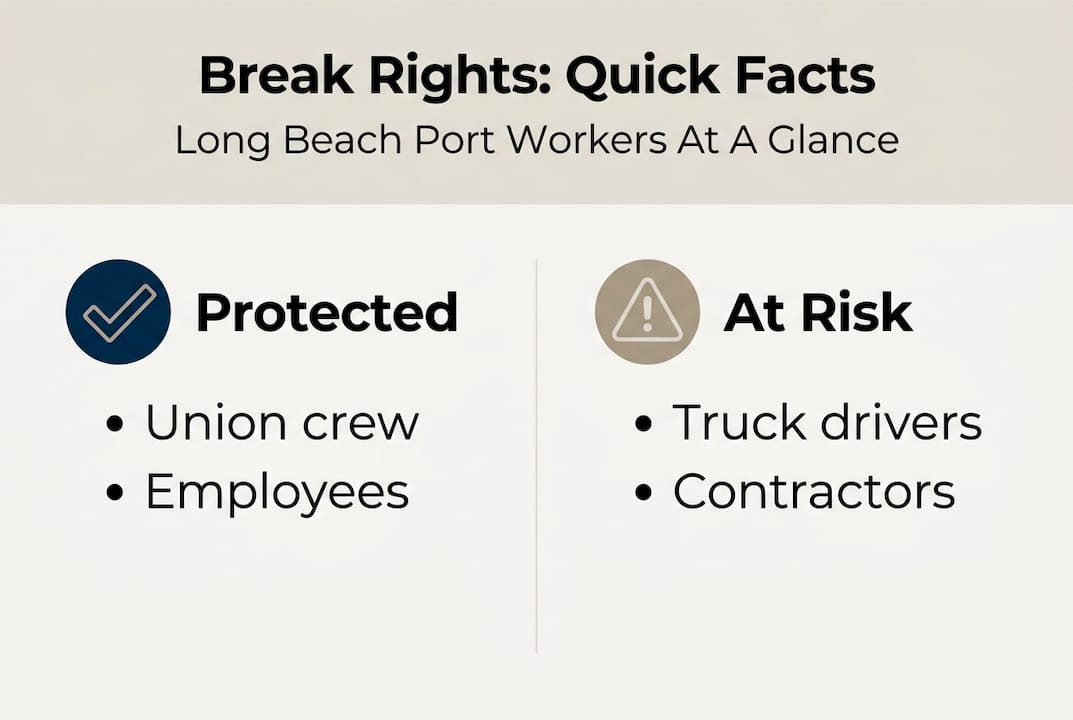
- Union longshore workers generally have strong protections against break violations, unlike non-union truckers.
- California law guarantees meal and rest breaks for employees, but misclassification as contractors often excludes port workers.
- Workers should document violations, seek legal advice, and report issues anonymously, as retaliation is illegal.
- Federal preemption may apply to some truckers. Commercial truck drivers who are subject to Federal Motor Carrier Safety Administration (FMCSA) regulations may face a federal preemption issue that limits the availability of California’s meal and rest break protections. Consult an attorney to evaluate your specific situation.
If you work at the Port of Long Beach and worry about denied meal and rest breaks, you’re not alone. But here’s something most workers don’t realize: the risk depends heavily on who you are and how you’re classified. Union longshore workers covered by ILWU contracts rarely face systematic break denials. Non-union port truckers and drayage drivers, however, deal with this problem regularly, often because of misclassification as independent contractors. This guide breaks down who is most at risk, what California law requires, and exactly what you can do if your rights are being violated.
Table Of Contents
- Who is really at risk for break denials at Long Beach port?
- California labor laws protecting port workers’ break rights
- Why misclassification leaves some port workers unprotected
- What to do if your meal and rest breaks are denied
- The uncomfortable truth: Why most Long Beach workers don’t know their break rights
- Get help with workplace break and wage issues
- Frequently asked questions
Key Takeaways
| Point | Details |
|---|---|
| Break denials mainly impact truckers | Non-union port truckers in Long Beach are most affected by denied meal and rest breaks. |
| Union longshoremen usually protected | ILWU longshore workers have strong contract protections and rarely face break violations. |
| Misclassification is the root issue | Many break violations stem from wrongly treating workers as independent contractors. |
| Workers can file claims safely | California law allows anonymous complaints and protects employees from retaliation. |
Who is really at risk for break denials at Long Beach port?
With the basics laid out, let’s break down exactly who is affected by denied meal and rest breaks at the port.
Not every port worker faces the same reality. The Port of Long Beach is a massive operation with thousands of workers across very different job categories, and your break rights depend largely on your employment classification and whether you have union representation.
Union Longshore Workers (ILWU Members)
Workers represented by the International Longshore and Warehouse Union (ILWU) operate under some of the strongest labor protections in the country. Their collective bargaining agreements include detailed provisions for meal periods, rest breaks, and overtime. The California Department of Industrial Relations has found no direct evidence of widespread or current denial of meal and rest breaks specifically for core longshore workers covered by ILWU contracts. If a break violation does occur for a union member, there is a formal grievance process available.
Non-union Port Truckers And Drayage Drivers
This is where real, documented violations happen. Port trucking and drayage workers at Long Beach frequently face meal and rest break denials, often connected to misclassification as independent contractors and pressure from dispatchers or trucking companies. These workers often have no union to file a grievance through and may not even realize they qualify as employees under California law.
| Worker Type | Union Coverage | Break Protection Level | Violation Risk |
|---|---|---|---|
| ILWU longshore worker | Yes (ILWU) | Very strong | Low |
| Non-union port trucker | No | Moderate to low | High |
| Drayage contractor | Rarely | Depends on classification | Very high |
| Warehouse/logistics staff | Varies | Standard California law | Moderate |
Common signs that your breaks may be at risk:
- You’re classified as an independent contractor but controlled by a company
- Dispatchers pressure you to skip lunch to complete hauls faster
- You’re paid per load, not by the hour, removing any incentive to take breaks
- You feel afraid of losing work if you push back on break denials
Know this: Large settlements and class action lawsuits in Long Beach port trucking have involved hundreds of drivers, not longshore crews. If you’re a trucker, the threat is real and legally actionable.
Understanding your rest break rights for Long Beach workers is the first step toward protecting yourself. You can also learn more about reporting safety violations as a related protection available to you.
California Labor Laws Protecting Port Workers’ Break Rights
Understanding who is affected sets up why and how California’s labor law enters the picture.
California has some of the strongest worker protections in the country. These rules apply to employees, not independent contractors, which is exactly why classification matters so much at the port.
What California law requires:
- Meal break: You are entitled to one unpaid, uninterrupted 30-minute meal period if you work more than five hours in a day. If you work more than ten hours in a day, you are entitled to a second meal period. If you work more than ten hours in a day, you get a second meal break. Waiver exception: By mutual consent of both you and your employer, you may waive the meal period if your total workday does not exceed six hours. You may also waive the second meal period by mutual consent on shifts longer than ten hours but shorter than twelve hours, provided you did not waive the first meal period.
- Rest break: You are entitled to a paid 10-minute rest break for every four hours worked (or major fraction thereof).
- Premium pay for violations: If your employer fails to provide a required meal or rest break, they owe you one additional hour of pay at your regular rate of compensation for each workday that type of violation occurs — up to one hour per day for meal period violations and one additional hour per day for rest period violations. “Regular rate of compensation” means not just your base hourly wage, but all nondiscretionary pay you earn, including performance bonuses, piece-rate pay, and commissions. This is called a “premium pay” penalty.
- No waiver under pressure: Rest break rights cannot be waived by agreement at all — not by a contract, a dispatcher’s policy, or company pressure. Meal break rights may only be waived voluntarily and by mutual consent in the narrow circumstances described above. Any employer policy, dispatch instruction, or scheduling practice that systematically pressures workers to skip breaks or deters them from taking breaks remains unlawful, even where a formal waiver could otherwise apply.
| Break Type | Trigger | Duration | Paid? | Penalty For Violation |
|---|---|---|---|---|
| Meal break | Shifts over 5 hours | 30 minutes | No (unpaid) | 1 hour premium pay (per workday) |
| Rest break | Every 4 hours | 10 minutes | Yes | 1 hour premium pay (per workday) |
| Second meal break | Over 10 hours worked | 30 minutes | No (unpaid) | 1 hour premium pay (per workday) |
What courts have decided. California’s Supreme Court has confirmed and sharpened these protections through landmark decisions. In Brinker Restaurant Corp. v. Superior Court (2012) 53 Cal.4th 1004, the Court held that employers must provide the opportunity for a genuine, uninterrupted 30-minute meal break — not merely make one technically available — and that employers who fail to authorize required rest breaks are automatically liable regardless of whether the employee personally took a break. In Ferra v. Loews Hollywood Hotel, LLC (2021) 11 Cal.5th 858, the Court ruled that premium pay must be calculated at the full regular rate of compensation, including bonuses and performance incentives, not just base hourly wages. And in Naranjo v. Spectrum Security Services, Inc. (2022) 13 Cal.5th 93, the Court held that unpaid premium pay for missed breaks constitutes wages — meaning employers who fail to pay it can also owe wage statement penalties and waiting-time penalties on top of the break premium itself.
How union contracts interact with state law:
For ILWU members, collective bargaining agreements may provide additional break protections on top of California law. However, state minimums always apply. No contract can strip you of rights the state guarantees.
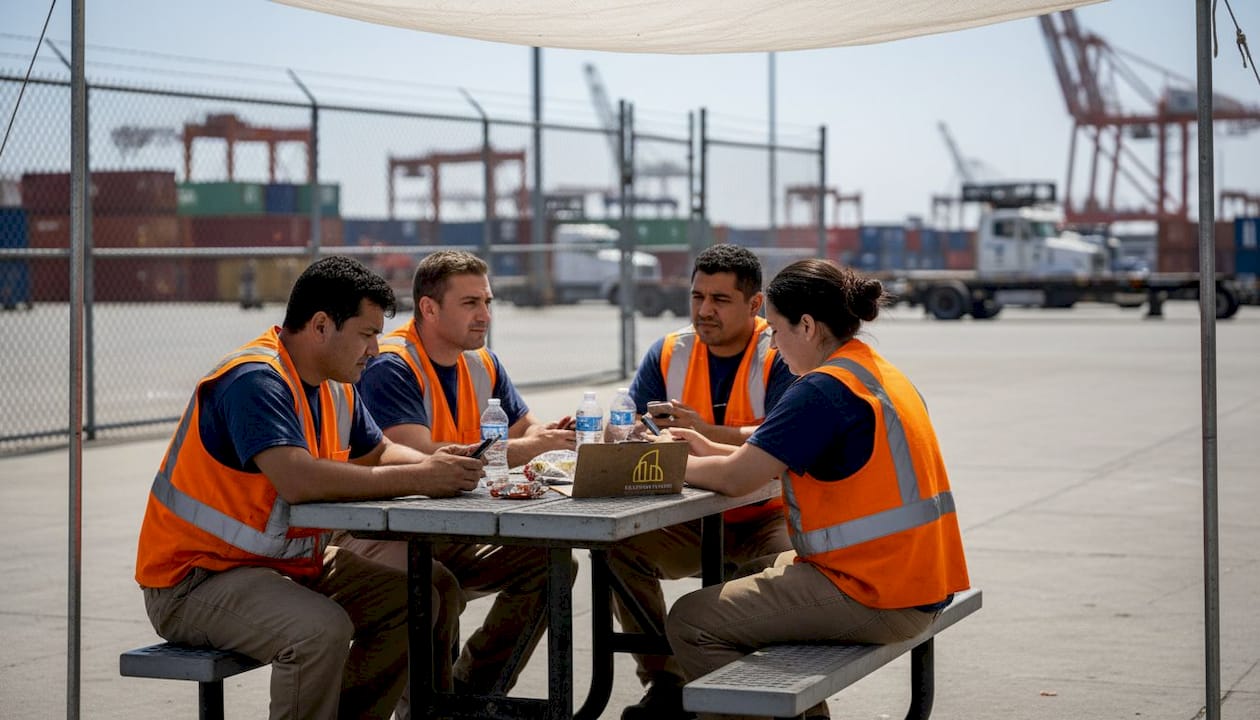
Retaliation is illegal. The California Department of Industrial Relations makes clear that retaliation for claiming or reporting break violations is prohibited, and workers can file claims anonymously. You don’t need to risk your job to assert your rights.
If violations are systemic, meaning they affect many workers at the same company, affected employees can pursue class actions or claims under the Private Attorneys General Act (PAGA). PAGA allows an aggrieved employee to sue on behalf of other workers and recover civil penalties — 75 percent of which are paid to the California Labor and Workforce Development Agency, with the remaining 25 percent distributed among the affected employees. PAGA claims do not require class certification, making them a particularly effective enforcement tool when many workers are affected by the same unlawful policy.
Learn more about your reporting safety rights or review examples of meal break violations to see how similar cases have played out.
Why Misclassification Leaves Some Port Workers Unprotected
But why do some port workers fall through the cracks? That comes down to misclassification and loopholes.
Misclassification is not a technicality. It is the central reason why thousands of Long Beach port truckers have been denied basic labor rights, including meal and rest breaks, for years. When a company labels you an “independent contractor” instead of an employee, they avoid paying for overtime, breaks, benefits, and employer taxes. That saves them money. It costs you your rights.
The ABC Test: How California defines employees
California uses a strict three-part test, called the ABC Test, to determine whether a worker is an employee or a contractor. To be a legitimate contractor, ALL three conditions must be true:
- A: You are free from the company’s control in how you perform your work
- B: Your work is outside the usual course of the company’s business
- C: You are customarily engaged in an independently established trade or business
Most port truckers fail at least one part of this test, meaning they legally qualify as employees, even if their paperwork says otherwise.
This test originated with the California Supreme Court’s decision in Dynamex Operations West, Inc. v. Superior Court (2018) 4 Cal.5th 903, and was later codified in California Labor Code section 2775. A critical point: the burden of proof falls entirely on the company, not the worker. The company must establish all three prongs to classify someone as a contractor. If it fails to prove even one, you are legally an employee — regardless of what your contract says.
Key laws and lawsuits targeting this practice:
- SB 1402 (California law) holds shipping companies jointly liable for labor violations by their trucking contractors, making it harder for large corporations to offload responsibility onto smaller carriers.
- A 2013 lawsuit involving port truck drivers resulted in significant settlements after drivers were found to be misclassified, denying them break rights and other protections. Similar cases continue to be filed in 2026.
Federal Preemption: A Critical Limitation For Commercial Truck Drivers
Before pursuing a California meal or rest break claim, port truckers must understand one significant legal hurdle: federal preemption. In 2018, the Federal Motor Carrier Safety Administration (FMCSA) determined that California’s meal and rest break rules are preempted by federal hours-of-service regulations for drivers of property-carrying commercial motor vehicles. California courts have since confirmed that this preemption applies — including to short-haul drivers. (Espinoza v. Hepta Run, Inc. (2022) 74 Cal.App.5th 44.) This means that if you drive a commercial vehicle subject to FMCSA regulation, federal hours-of-service rules — not California’s meal and rest break law — may govern your situation. Whether this preemption applies to your specific circumstances depends on your vehicle type, haul distance, and FMCSA coverage, and is a nuanced legal question. This is one of many reasons why consulting an attorney before drawing conclusions about your rights is essential.
Pro Tip: Keep a log of every load you haul, every time a dispatcher tells you to skip lunch, and any communications pressuring you to work through breaks. This documentation is often the strongest evidence in a misclassification case.
You can learn more about worker misclassification in California and related off-the-clock work violations to understand the full picture of how these issues connect.
What To Do If Your Meal And Rest Breaks Are Denied
So, what if you’re affected? Here’s how to protect your rights and get the help you need.
Knowing the law is one thing. Taking action is another. If you believe your break rights have been violated, there is a clear path forward. Here’s what to do:
Document everything immediately. Write down the date, time, and details of every denied break. Note whether a supervisor, dispatcher, or company policy was involved. Save any texts, emails, or app messages that show pressure to skip breaks.
Do not confront your employer alone. Raising the issue without legal guidance can backfire, especially if you’re worried about retaliation. Get advice first.
File a claim with the California Labor Commissioner (DLSE). The Division of Labor Standards Enforcement (DLSE) handles wage and break violation claims. You can file anonymously, and retaliation for filing is illegal under California law. The DLSE can investigate, hold hearings, and order your employer to pay owed wages and penalties.
Contact a labor attorney. An attorney experienced in California employment law can evaluate whether your situation qualifies for a class action or PAGA claim. If many coworkers are affected, a group claim may be far more powerful and efficient than individual filings.
Reach out to your union if applicable. If you’re a union member, your shop steward or union rep can file a grievance on your behalf. This is often the fastest resolution path for ILWU members.
Pro Tip: Even if you’re unsure whether you qualify as an employee, consult with an attorney before assuming you have no rights. Many workers who believed they were contractors have successfully recovered unpaid wages and break penalties after legal review.
Understanding your protections against retaliation is critical before you take any of these steps. Knowing you are protected makes it easier to act.
The Uncomfortable Truth: Why Most Long Beach Workers Don’t Know Their Break Rights
Looking beyond the step-by-step advice, there’s a bigger picture every port worker needs to consider.
Here’s what we’ve observed after working with California port and logistics workers: the law is only as powerful as the workers who know it exists. Most break rights violations at the Port of Long Beach persist not because California’s laws are weak, but because workers don’t realize the laws apply to them.
Union longshoremen are rarely the ones losing break rights. But they sometimes assume non-union truckers have the same protections they do. They don’t. And non-union truckers? Many assume that because their paperwork says “contractor,” they have no rights at all. That assumption costs them real money every single day.
Cultural pressure plays a role too. In port trucking, there is an unspoken rule that pushes workers to move fast and not ask questions. Raising a break concern can feel like you’re risking your next load, your relationship with dispatch, or your livelihood. That fear is real, but it is also exactly what companies rely on to avoid accountability.
Real change starts with workers knowing not just that there are laws, but which laws apply to them personally. Accessing legal insights from experienced California employment attorneys can make that difference, turning confusion into informed, confident action.
Get Help With Workplace Break And Wage Issues
If you’ve experienced denied meal or rest breaks, pressure to skip lunch, or suspect you’ve been misclassified as an independent contractor, you don’t have to sort it out alone. At California United Law Group, P.C., we represent employees across California in wage and hour disputes, including those involving port trucking and drayage work.
👉 Explore your options with our wage and hour legal help resources, or connect directly with a Long Beach employment lawyer who understands the specific challenges port workers face. Acting promptly matters. California’s statute of limitations for wage and hour claims is generally three years for statutory violations — and four years for claims brought under California’s Unfair Competition Law. Delay can also affect the preservation of critical evidence such as dispatch logs, load records, and communications. California’s statute of limitations means waiting too long can affect your ability to recover what you’re owed.
Frequently Asked Questions
Which Long Beach port workers are most likely to have their meal and rest breaks denied?
Non-union port truckers and drayage drivers are most at risk, especially when misclassified as independent contractors, while union longshore workers generally have strong contract protections that shield them from systematic violations.
What does California law say about meal and rest breaks for port workers?
California law guarantees meal and rest breaks for all employees. Port truckers face two separate legal obstacles to those protections: first, misclassification as independent contractors; and second, potential federal preemption under FMCSA hours-of-service regulations, which may override California’s rules for commercial motor vehicle drivers. Both issues require individual legal evaluation.California law guarantees meal and rest breaks for all employees, but many port truckers lose these protections when companies misclassify them as independent contractors, effectively removing their legal standing as employees.
How can I report denied meal or rest breaks if I fear retaliation?
You can file a claim anonymously with the California Labor Commissioner, and retaliation is illegal under California law, meaning your employer cannot legally punish you for reporting a break violation.
What is the main reason some Long Beach port workers lose their break rights?
The primary cause is misclassification as contractors rather than employees, which excludes workers from California’s meal and rest break protections, premium pay requirements, and other core labor rights. For commercial truck drivers, federal preemption under FMCSA hours-of-service regulations is a separate legal barrier that can apply even to workers who qualify as employees under California law. An attorney should evaluate which legal framework applies to your situation.