
TL;DR:
- A hostile work environment under California law requires unwelcome conduct tied to a protected trait that is severe or pervasive enough to alter conditions. Courts assess all relevant facts collectively, considering factors like frequency, severity, and power dynamics, to determine if the environment is legally hostile. Early documentation and consulting an attorney can meaningfully strengthen your position and help you understand whether you have a viable claim.
Many employees in West Hollywood assume that a hostile work environment only exists when a boss threatens them, or when something so extreme happens that it’s impossible to ignore. That assumption is wrong, and it’s one of the most costly mistakes workers make. Under California’s Fair Employment and Housing Act (FEHA), unlawful harassment requires unwelcome conduct tied to a protected characteristic that is severe or pervasive enough to alter your working conditions. Everyday conduct you’ve been told to simply “brush off” may actually cross a legal threshold. This article breaks down the legal standards, real examples, and practical steps that matter most.
Table Of Contents
- Defining a hostile work environment in West Hollywood
- Protected characteristics and examples of hostile conduct
- Severity, pervasiveness, and the “totality of circumstances” test
- Retaliation: Related but legally distinct
- What to do if you think you’re facing a hostile work environment
- The truth about proving your case: Why documentation and early action matter most
- How California United Law Group can help you
- Frequently asked questions
Key Takeaways
| Point | Details |
|---|---|
| Legal definition matters most | A hostile work environment in West Hollywood must meet strict legal criteria under California law. |
| Protected characteristics are crucial | Unwelcome conduct must be linked to a trait like race, gender, or sexual orientation. |
| Severity or pervasiveness required | Under California law, even a single incident can be legally sufficient if it created an intimidating or offensive work environment. An ongoing pattern of conduct can strengthen a claim further. |
| Retaliation is a separate claim | If you face negative treatment after reporting, that’s retaliation, which California law also prohibits. |
| Documentation strengthens your case | Carefully recording each incident and seeking early legal advice can maximize your legal protection. |
Defining A Hostile Work Environment In West Hollywood
The term “hostile work environment” gets used loosely in everyday conversation, often to describe any unpleasant workplace. Courts mean something far more specific. Understanding that distinction is important if you want to protect yourself.
Under California law, FEHA provides broad workplace protections that go beyond what federal law requires. At the federal level, the EEOC defines hostile environment harassment as unwelcome conduct that is sufficiently severe or creates a harmful or offensive work environment, even when the conduct does not cause tangible economic injury. California’s FEHA largely mirrors this standard but is often interpreted more broadly and is more protective of employees.
To establish a hostile work environment claim, three core legal elements must be present:
- Unwelcome conduct — The behavior must be something you did not invite, encourage, or welcome.
- Connection to a protected characteristic — The conduct must be tied to a trait that the law protects, such as your race, gender, religion, or sexual orientation.
- Severity or pervasiveness — The conduct must be serious enough, or frequent enough, to alter the conditions of your employment and create a work environment that a reasonable person would find hostile or abusive—and that you yourself actually perceived as hostile or abusive.
“Unlawful harassment under FEHA requires unwelcome conduct based on a protected characteristic that is severe or pervasive enough to alter the conditions of employment and create an abusive working environment.” — Cal. Gov. Code § 12923; Hughes v. Pair (2009) 46 Cal.4th 1035, 1043
Courts do not look at any single incident in isolation. Instead, they apply what is called the totality of circumstances test, which weighs all relevant facts together. This matters because a series of smaller incidents, each of which might seem minor on its own, can combine into a legally actionable pattern.
Here is a quick comparison of what counts and what does not:
| Situation | Likely qualifies? | Why |
|---|---|---|
| Supervisor makes repeated racial slurs | Yes | Tied to race; severe and/or pervasive |
| Co-worker is rude about your work performance | No | Not tied to a protected characteristic |
| Manager consistently excludes you from meetings due to your disability | Yes | Tied to disability; alters work conditions |
| Boss plays loud music you dislike | No | Not tied to a protected characteristic |
| Ongoing sexually explicit jokes targeting your gender | Yes | Tied to gender; pervasive and unwelcome |
| General workplace conflict unrelated to identity | No | Lacks protected characteristic connection |
Reviewing local hostile work environment standards and connecting with legal support in West Hollywood can help you assess where your situation falls.
Protected Characteristics And Examples Of Hostile Conduct
With the legal framework in mind, it’s crucial to recognize which characteristics are protected and what specific actions can meet these legal standards.
Under FEHA, the protected characteristics that trigger legal protection include, but are not limited to:
- Race and national origin
- Sex and gender identity
- Sexual orientation
- Religion
- Disability (physical or mental)
- Age (for workers 40 and older)
- Marital status
- Pregnancy and related conditions
- Military and veteran status
West Hollywood has a notably diverse workforce, and some of these categories, particularly sexual orientation and gender identity, are especially relevant to employees there. California law explicitly protects workers from harassment based on these characteristics. You can learn more about workplace harassment in California and your rights against sexual orientation discrimination to understand the full scope of these protections.
Conduct that may meet the legal threshold includes:
- Slurs, derogatory comments, or offensive jokes tied to a protected trait
- Unwanted touching or physical interference based on gender or another protected characteristic
- Threats or intimidation connected to a protected characteristic
- Displaying offensive images, symbols, or materials tied to race, religion, or other protected categories
- Persistent, unwanted sexual advances or commentary
- Mimicking, mocking, or demeaning behavior rooted in someone’s disability or national origin
Conduct that is unpleasant but likely does not meet the legal threshold:
- A manager who is generally harsh or short-tempered with everyone
- A co-worker who takes credit for your work without any connection to your identity
- Unfair workload distribution unrelated to any protected characteristic
- Routine criticism of your job performance delivered professionally
Unlawful harassment under FEHA requires the conduct to be tied to a protected characteristic. Without that connection, even genuinely unpleasant behavior may not rise to the legal definition.
Pro Tip: Start a written log as soon as you notice a pattern. Record the date, time, location, exactly what was said or done, and the names of anyone who witnessed it. This record is your strongest foundation if you ever need to support a claim. Even a simple notes app on your phone works. Consistency matters more than format.
Severity, Pervasiveness, And The “Totality Of Circumstances” Test
Understanding what is protected and hostile, let’s talk about how much is “enough” to count in court.
This is where many employees get discouraged. They feel what happened to them was serious, but worry it wasn’t “bad enough.” Courts do not require you to endure extreme or violent behavior before the law applies. The standard has two paths: severity or pervasiveness. You do not need both.
Severity refers to how serious a single act is. One incident of physical assault, an explicit sexual threat, or a particularly egregious slur may, on its own, qualify as severe enough to establish a hostile work environment.

Pervasiveness refers to how often and how consistently unwelcome conduct occurs. A steady stream of offensive comments that individually might seem minor can collectively create an environment that alters your working conditions.
Courts evaluating whether conduct is sufficiently severe or pervasive under the totality of circumstances typically consider:
- Frequency — How often does the conduct occur? Weekly? Daily? Sporadically over months?
- Severity — How serious is each incident on its own?
- Physical vs. verbal — Physical conduct tends to carry more legal weight than verbal conduct alone.
- Humiliation — Did the conduct humiliate you in front of others?
- Effect on work performance — Did the conduct interfere with your ability to do your job or make it harder to perform? Note: Under California law, you are not required to show your productivity actually declined or that you suffered psychological injury.
- Power dynamics — Conduct from a supervisor generally carries more weight than conduct from a peer, because supervisors have authority over your employment. Note: This distinction carries significant legal weight. Under California’s FEHA, an employer is strictly liable for harassment by a supervisor, regardless of whether the employer knew about it. For harassment by co-workers or non-employees, liability attaches only if the employer knew or should have known of the conduct and failed to take immediate and appropriate corrective action.
- Pattern vs. isolated act — An ongoing pattern strengthens a claim significantly.
When reviewing hostile work environment claims, the courts assess these factors together, not as a checklist where every box must be checked. California courts have applied this framework in ways that directly benefit employees. In Hughes v. Pair (2009) 46 Cal.4th 1035, 1043, the California Supreme Court confirmed that a FEHA hostile work environment claim requires conduct ‘severe enough or sufficiently pervasive to alter the conditions of employment and create a work environment that qualifies as hostile or abusive.’ In Miller v. Department of Corrections (2005) 36 Cal.4th 446, 462, the court emphasized that this determination requires looking at ‘all the circumstances’—including the frequency and severity of the discriminatory conduct, whether it was physically threatening or merely offensive, and whether it interfered with the employee’s ability to work. More recently, Beltran v. Hard Rock Hotel Licensing, Inc. (2023) 97 Cal.App.5th 865, 881 reaffirmed that under Government Code section 12923, a single incident can be sufficient to create a triable issue on a hostile work environment claim if it created an intimidating, hostile, or offensive work environment—reflecting California’s deliberately stronger standard compared to federal law. And proving harassment in California does not require you to have a perfect set of facts before speaking to a lawyer.
Pro Tip: If you are unsure whether your experience meets the legal standard, consult a California employment attorney before deciding not to pursue it. Many employees have strong potential claims they never explore because they assume what happened to them isn’t serious enough. An attorney can give you an informed assessment based on your specific facts.
Retaliation: Related But Legally Distinct
Sometimes, standing up to a hostile work environment leads to other issues. Let’s demystify retaliation and what makes it different.
Retaliation occurs when your employer takes an adverse action against you because you reported harassment, discrimination, or another protected activity. It is a separate legal claim from a hostile work environment, though the two can exist at the same time.
Under California law, retaliation is unlawful when an employer takes a negative employment action in response to protected conduct. Retaliation and hostile work environment claims can both arise from the same set of workplace events.
Common signs of retaliation after reporting harassment include:
- Being demoted or having your responsibilities reduced
- Receiving sudden negative performance reviews that didn’t exist before your report
- Being excluded from meetings, projects, or team activities
- Being transferred to a less desirable position or location
- Facing termination or being pushed out through a hostile environment
- Increased scrutiny or micromanagement that began after you raised concerns
- Being isolated from colleagues who previously included you
California courts have recognized that retaliation need not take the form of a single dramatic act. In Yanowitz v. L’Oreal USA, Inc. (2005) 36 Cal.4th 1028, 1055–1056, the California Supreme Court held that a series of individually minor retaliatory acts can collectively constitute actionable adverse employment action under FEHA. This means that even if no single incident after your complaint seems severe on its own, a documented pattern of adverse treatment can still support a retaliation claim.
It is important to understand that retaliation has its own legal elements separate from the hostile work environment definition. Just because one claim exists does not automatically create the other. However, if both are present, both can be pursued.
If you believe you are being retaliated against, document the sequence of events carefully. Note when you made your complaint, who received it, and when the adverse actions began. That timeline is often a central piece of evidence in a retaliation claim.
What To Do If You Think You’re Facing A Hostile Work Environment
Knowing the law is a start. Here’s what to do right now if you believe you’re affected.
Taking action can feel intimidating, especially if your employer has not been responsive. But there are concrete steps you can take to protect yourself and preserve your options.
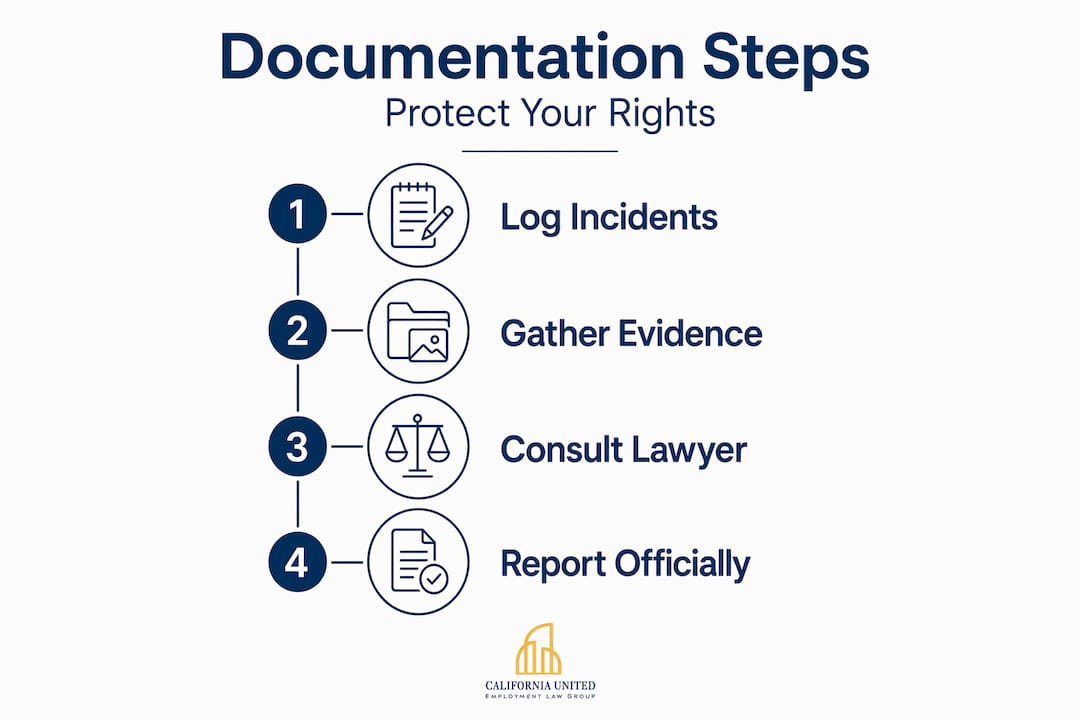
- Document every incident. Write down what happened, when it happened, where it took place, who was involved, and whether anyone witnessed it. Keep this record somewhere private, ideally outside of work systems.
- Save relevant communications. Keep copies of emails, texts, or messages that relate to the harassment or to any complaints you have made. Store these somewhere your employer cannot access.
- Report internally when it is safe to do so. Most employers have HR departments or written complaint procedures. Reporting through those channels creates a formal record and may trigger your employer’s legal obligation to investigate and address the issue.
- Follow up in writing. After making a verbal complaint, send a follow-up email summarizing what you reported and to whom. This creates a paper trail that can be invaluable later.
- File a complaint with a government agency. If your employer fails to address the problem, you have the right to file a complaint with the California Civil Rights Department (formerly DFEH) or with the EEOC. Important note: Deadlines apply to administrative filings, and they vary depending on the specific facts of your situation. Speak with a qualified employment attorney to understand applicable timelines before you miss a filing window.
- Consult a California employment attorney. An attorney familiar with FEHA and steps for proving harassment can help you understand whether your situation meets the legal standard and advise you on next steps tailored to your circumstances.
The EEOC guidance makes clear that a hostile work environment violation does not depend on economic injury. You do not need to have been fired, demoted, or financially harmed to have a valid claim.
Pro Tip: Early documentation is your most reliable protection. The more detailed and consistent your records are from the beginning, the stronger your position becomes if you later decide to pursue a legal claim or file a complaint.
The Truth About Proving Your Case: Why Documentation And Early Action Matter Most
With the practical steps outlined, here is our candid take on what really helps employees protect themselves in these situations.
Conventional wisdom tells employees to wait until they have “clear evidence” before doing anything. In our experience, waiting is one of the most damaging choices an employee can make.
Here is why. Evidence fades. Witnesses forget details. Emails get deleted. The longer you wait, the harder it becomes to reconstruct what happened. Courts rely on contemporaneous records, meaning notes and documentation created at the time of the events, far more heavily than reconstructed timelines put together months later.
There is also a psychological dimension. Employees who wait often spend that time minimizing what happened to them. They convince themselves it wasn’t serious enough. They worry about being believed. That internal doubt, while understandable, often leads to inaction that cannot be undone.
We have seen employees with genuinely strong facts walk away from potential claims because they didn’t start documenting early, didn’t report in writing, or waited too long to seek advice. We have also seen employees with more borderline situations achieve meaningful outcomes because they had thorough, consistent records and consulted an attorney before the situation escalated beyond recovery. The outcome of any matter depends on its own specific facts and circumstances.
The truth is this: you do not need a perfect case to consult a lawyer. You need enough concern to pick up the phone. A conversation about employee evidence strategies costs you nothing but time, and it can clarify whether you have a claim worth pursuing before critical evidence disappears.
Do not let uncertainty become your reason for inaction. If something feels wrong at work and it is tied to who you are, talk to someone who knows California employment law.
How California United Law Group Can Help You
If you are ready to take action or need expert guidance tailored to your situation, here is how to connect with specialized legal support.
At California United Law Group, P.C., we represent employees across California, including those working in West Hollywood, who are facing harassment, discrimination, and hostile work environments. We understand FEHA claims thoroughly and know how California courts evaluate these cases.
👉 We offer confidential consultations where you can discuss your situation without pressure. We will listen, ask questions, and help you understand what your options look like under California law.
Our team handles matters involving California employment law guidance across all stages, from early documentation strategies through formal litigation. If you are unsure whether what you’re experiencing qualifies as California workplace harassment, we can help you assess it.
👉 Reach out today to schedule a confidential consultation. You deserve to understand your rights, and we are here to help you do exactly that.
Frequently Asked Questions
Is one incident enough to prove a hostile work environment in California?
Under California’s FEHA, even a single incident can be legally sufficient to support a hostile work environment claim—without requiring a pattern of behavior or extreme conduct like a physical assault. California Government Code section 12923 establishes this more employee-protective standard, specifically rejecting the stricter federal approach. If a single incident unreasonably interfered with your work performance or created an intimidating, hostile, or offensive working environment, it can be enough to create a viable claim. An ongoing pattern of conduct can certainly strengthen your case, but it is not required under California law.
Does my harasser need to be my boss for the law to protect me?
No. California’s FEHA expressly provides that your employer can be held liable for harassment by co-workers, clients, or even non-employees, provided the employer knew or should have known about the conduct and failed to take immediate and appropriate corrective action. This protection is established by California Government Code section 12940(j)(1) and applies independently of federal guidance.
What if my employer retaliates after I report harassment?
Retaliation is unlawful under California law. Retaliation has its own legal elements separate from harassment, and you may be entitled to damages if your employer punishes you for making a protected complaint.
Can I sue for a hostile work environment if I didn’t lose money or get fired?
Yes. The EEOC confirms that economic harm is not required for a hostile work environment claim. If the conduct was severe or pervasive enough to create an abusive or offensive environment based on your protected status, you may have a valid claim regardless of whether you suffered a financial loss.
Recommended
- What Creates a Hostile Work Environment in West Hollywood? – California United Law Group
- Hostile Work Environment Claims Under California Law: A Guide for Culver City Workers – California United Law Group
- Can LGBTQ workers in West Hollywood sue for discrimination? – California United Law Group
- Sexual Orientation Discrimination: West Hollywood Employee Rights – California United Law Group