
TL;DR:
- Many California workers experience delayed final paychecks, which can lead to serious financial consequences. California law requires employers to pay all owed wages immediately upon termination or resignation with proper notice, and penalties may apply for willful delays. Workers can pursue administrative claims or court lawsuits to recover unpaid wages and penalties, with documented evidence strengthening their case.
Even in 2026, many California workers finish their last day, hand in their badge, and then wait. And wait. The paycheck doesn’t come on time, and suddenly you’re wondering whether you have any real power to do something about it. The short answer is yes. California has some of the strongest wage protection laws in the country, and a delayed final paycheck is not just frustrating. It is a potential legal violation that can carry serious financial consequences for your employer. This guide walks you through exactly what the law requires, what you can do, and what you stand to recover.
Table Of Contents
- Understanding your right to a timely final paycheck
- Can you sue for a late final paycheck? Options explained
- What penalties can Torrance employers face for late pay?
- Defenses employers might claim—and what you can do
- The real reason late paychecks persist—and what most workers miss
- Need help? Get support for your California wage claim
- Frequently asked questions
Key Takeaways
| Point | Details |
|---|---|
| Immediate final pay required | California law demands that final paychecks are issued immediately or within 72 hours, depending on how the job ends. |
| You can file a claim or sue | Torrance workers have the right to seek unpaid wages and penalties through a state claim or by going to court. |
| Penalties for late payment | Employers can be required to pay waiting time penalties up to 30 days of your daily wage for late final paychecks. |
| Employer ‘good faith’ defense | If the employer honestly disputes your pay, penalties may be avoided—but you should document everything. |
| Legal help makes a difference | Getting advice from an employment law professional boosts your chance of recovering all that you’re owed. |
Understanding Your Right To A Timely Final Paycheck
California does not leave final paycheck timing up to the employer’s convenience. The rules are specific, and they are strict.
When you are fired or laid off, your employer must pay you all wages you are owed immediately at the time of termination. There is no grace period. No “we’ll mail it next payday.” If you quit and gave at least 72 hours of notice, you are also entitled to your final pay on your last day. If you quit without that 72-hour notice, your employer has up to 72 hours to get your final wages to you.
These deadlines cover all wages you earned, including:
- Regular and overtime pay
- Accrued and unused vacation time (which California treats as earned wages)
- Any commissions that have been fully earned
- Bonuses that were already owed to you
A delayed final paycheck is not a minor administrative slip. For most workers, losing even one paycheck for a few days can mean missed rent, overdue bills, or scrambling to borrow money. Employers sometimes claim payroll scheduling issues or paperwork confusion as the reason for delay. But California law does not accept those as valid excuses for a late final check. As the California Court of Appeal held in Kao v. Holiday (2017) 12 Cal.App.5th 947, an employer may not delay final payment for even a few days until the next regular pay period, and this requirement “may not be ‘undercut’ by company payroll practices or any industry habit or custom to the contrary.”

It’s worth knowing that California law provides two distinct paths to recover unpaid final wages and related waiting time penalties: an administrative wage claim through the Labor Commissioner’s Office, or a civil lawsuit in court. Both options are available to workers whose employers miss the required payment deadlines. You have two real paths forward, not just the option to complain informally.
Understanding your termination rights for California employees is the starting point. Once you know what you are owed and when, you are in a much stronger position to act.
Pro Tip: Even if you are not sure whether your employer owes you vacation pay or commissions, write down everything you believe was earned before your last day. These notes can become important evidence.
Can you sue for a late final paycheck? Options Explained
Now that you know your right to timely final pay, here’s exactly how you can enforce it if your employer pays late.
You have two main paths under California law. Each has distinct advantages depending on your situation.
Path 1: File A Claim With The California Labor Commissioner
The Labor Commissioner’s Office (also called the Division of Labor Standards Enforcement) handles wage claims. This is an administrative process that does not require you to file a lawsuit in court. It tends to move faster and involves less complexity for straightforward cases.
Path 2: File A Civil Lawsuit In California Court
A lawsuit gives you access to the full range of legal remedies and may be better suited for larger or more complicated claims. It also allows you to seek attorney’s fees if you prevail, which can make a significant difference.
Here is a comparison to help you think through both options:
| Factor | Labor Commissioner Claim | Civil Lawsuit |
|---|---|---|
| Cost to file | Generally low or no filing fee | Court filing fees apply |
| Timeline | Often faster resolution | Can take longer depending on case |
| Attorney required? | Not required but helpful | Strongly recommended |
| Damages available | Wages plus waiting time penalties | Wages, penalties, attorney’s fees |
| Good for | Simpler cases, smaller amounts | Complex cases, larger amounts |
| Discovery process | Limited | Full discovery available |
To get a clearer picture of what each route involves, here is a simplified overview of how a formal claim typically proceeds:
- Gather your evidence. Collect pay stubs, your employment contract, any written communications about your final pay, and records of hours worked.
- Send a written demand. A formal written demand to your employer creates a paper trail and sometimes resolves the issue without escalation.
- Choose your filing path. Decide between a Labor Commissioner claim or a civil lawsuit based on the factors above.
- Submit your claim or complaint. Follow the proper procedures for whichever path you choose.
- Attend hearings or proceedings. Be prepared to present your evidence and explain your situation clearly.
- Receive your award. If you prevail, the decision will specify what you are owed, including any penalties.
Understanding the lawsuit process for California workers can make this less intimidating. And if you are in the area, connecting with legal help for Torrance workers can help you figure out which path fits your case.
Pro Tip: If your case also involves unreimbursed work expenses, check out additional wage claim topics because you may have grounds to include those in your claim as well.
What Penalties Can Torrance Employers Face For Late Pay?
But what happens to the employer who doesn’t pay on time? Let’s see what California law does to enforce your rights.
California’s waiting time penalties (sometimes called continuation wages) are one of the most powerful tools in your arsenal. Under California Labor Code Section 203, if your employer willfully fails to pay your final wages on time, you may be entitled to penalty pay equal to your daily wage for every day the payment is late. This continues for up to 30 days.
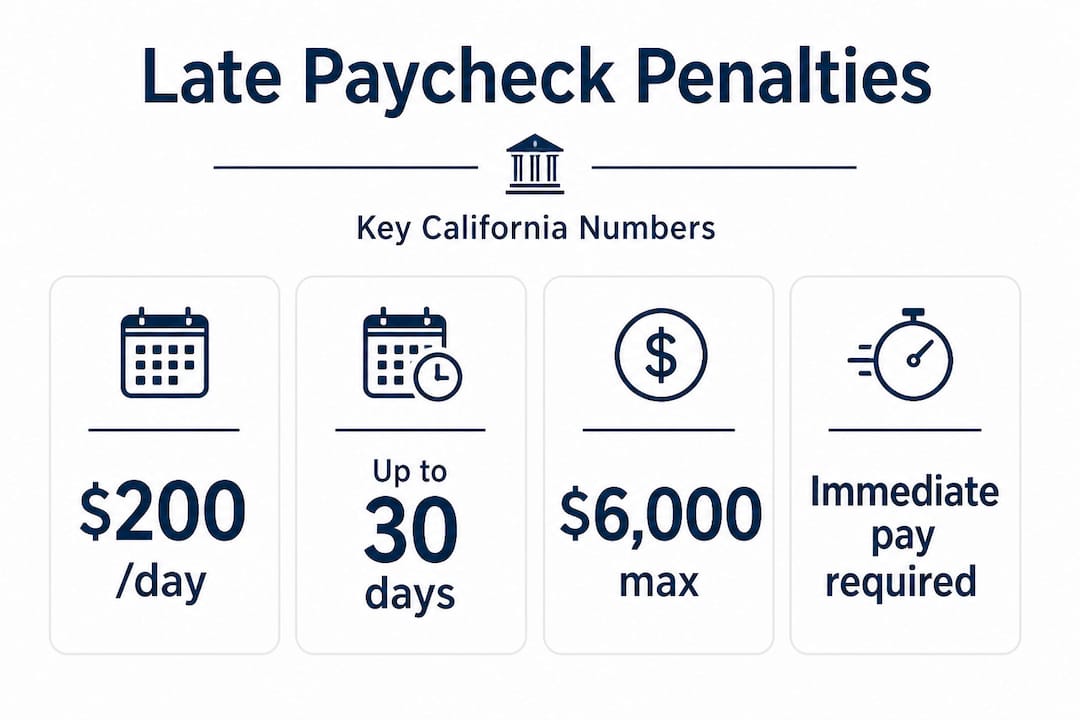
The figures shown above are provided as an illustrative example only based on a $200 daily wage. Your actual maximum recovery depends on your own daily straight-time wage rate — not a fixed dollar amount. Under California law, waiting time penalties accrue for each day your final wages remain unpaid, up to a maximum of 30 days. As established by the California Court of Appeal in Mamika v. Barca (1998) 68 Cal.App.4th 487, the penalty is calculated using your daily straight-time rate, not overtime. Workers earning more than $200 per day may be entitled to significantly higher penalties than the example above reflects.
Here is how the math works in practice:
| Daily wage | Days late | Penalty |
|---|---|---|
| $200/day | 10 days | $2,000 |
| $200/day | 20 days | $4,000 |
| $200/day | 30 days or more | $6,000 (maximum for this example) |
As the California Labor Code makes clear, workers can recover both the unpaid wages themselves and these waiting time penalties through either administrative or court processes.
Beyond waiting time penalties, consider these additional potential damages:
- Actual unpaid wages still owed to you
- Interest on unpaid amounts
- Attorney’s fees and costs if you win in court
- Civil penalties under the Private Attorneys General Act (PAGA) if your employer also committed other related Labor Code violations — such as wage statement violations — that are separate from the waiting time penalty itself. Note that PAGA does not apply to the waiting time penalty under Labor Code Section 203, which employees recover directly. Under PAGA, the aggrieved employee retains 25% of any civil penalty recovery, with 75% going to the state.
California’s waiting time penalty structure exists specifically to give employers a financial reason to pay on time. The law is designed to make late payment more costly than timely payment.
Employers who have a pattern of late paycheck penalties or who commit illegal pay practices may face even greater exposure when all wage violations are considered together. It is worth noting that even broader workplace compliance issues may intersect with your final pay rights, just as California employment regulations in related areas show how state law shapes employer obligations across many contexts.
The “willful” standard matters a great deal here. If your employer simply made an honest, good-faith mistake, penalties may not apply. But if they delayed payment on purpose, knew the rules and ignored them, or had no reasonable basis for the delay, courts and the Labor Commissioner typically find the violation willful. That distinction can mean thousands of dollars in your favor.
It is important to understand that “willful” under California law does not require your employer to have acted with malice or an evil motive. As the California Court of Appeal explained in Gonzalez v. Downtown LA Motors, LP (2013) 215 Cal.App.4th 36, “willful” simply means that the employer intentionally failed or refused to perform an act that was required to be done. An employer who knew the rules and failed to follow them — even without a deliberate intent to defraud — may still be found to have acted willfully.
Defenses Employers Might Claim—And What You Can Do
Even when the law is on your side, some employers push back. Here’s how defenses work and what you can do.
The most common defense you will encounter is the “good faith dispute” defense. This argument says that the employer delayed final wages not out of bad intent, but because there was a genuine, reasonable dispute about how much was owed. Maybe the employer believed you owed money back, or there was a real disagreement about whether commissions had been fully earned.
As noted in California’s legal framework, “willful” is the key threshold for waiting time penalties. A genuine good-faith dispute about the amount owed can matter, so cases where the employer withholds only a disputed portion may have different outcomes than total nonpayment.
What does this mean for you practically? If your employer can show they had a reasonable, honest basis for the delay or dispute, the waiting time penalties may be reduced or eliminated, even if you still recover the underlying wages.
Here are the most common employer defenses and what they mean for your case:
- Good faith dispute over amount owed. Employer claims it wasn’t clear how much you were owed, particularly for commissions or bonuses.
- Administrative error. Employer argues a payroll processing mistake caused the delay, not intentional conduct.
- Employee failed to provide forwarding address. California law requires you to keep your employer updated with where to send payment. Failure to do so can affect your claim.
- Disputed employment status. Employer argues you were an independent contractor, not an employee, so the final paycheck rules don’t apply.
The law on paystub law violations underscores why documentation matters so much. Every document you keep is a potential piece of evidence that counters your employer’s narrative.
Your best response to any of these defenses is strong, clear documentation. Here is what to preserve:
- Written communications about your final pay, including emails, texts, and letters
- Pay stubs from your final pay period and earlier periods for comparison
- Timesheets or work logs showing hours you worked
- Your employment contract or offer letter detailing your wage rate, bonuses, or commission structure
- Any dispute letters or responses exchanged between you and your employer
Pro Tip: Send a written demand for your final pay by email so you have a timestamped record. If your employer responds with a reason for the delay, that response itself can be evidence of whether their conduct was willful or good-faith.
The Real Reason Late Paychecks Persist—And What Most Workers Miss
Here is what we see in real-world cases that most legal guides won’t tell you directly.
California’s wage laws are strong on paper. The penalties are real, and what a lawsuit really takes is something we understand from actual experience with these cases. But despite all of that, late final paychecks remain stubbornly common. Why?
The honest answer is that many employers calculate the risk and figure that most employees won’t follow through. They know that workers dealing with job loss are also dealing with stress, uncertainty, and financial pressure. The assumption is that many people will just absorb the loss rather than pursue a formal claim.
That calculation changes when employees act quickly and document everything from day one. We’ve helped clients who came to us with solid paper trails recover significantly more than those who waited weeks before gathering their records. The difference wasn’t the strength of the law. It was the evidence. Past results in individual cases do not guarantee or predict similar outcomes in future matters, as each case depends on its own facts, evidence, and legal circumstances.
Here’s the other thing most workers miss: understanding your burden of proof is as critical as knowing your rights. You can’t simply assert that you weren’t paid on time. You need to show what you were owed, when it was due, and when (if ever) it was actually paid. That evidence comes from records you build while the events are still fresh.
Some Torrance employers genuinely don’t understand the rules. Others know them and test whether employees will push back. Either way, informed employees who document their situation and connect with qualified counsel are the ones who see real outcomes. Knowing your rights is only half of it. The other half is being ready to demonstrate them.
One critical factor many workers overlook is the deadline to file. Claims for waiting time penalties under California Labor Code Section 203 are subject to a three-year statute of limitations. If you wait too long after your final paycheck was due, you risk losing your right to recover entirely — regardless of how strong your evidence may be. If you believe your employer violated your final pay rights, you should act promptly.
Need Help? Get Support For Your California Wage Claim
👉 If your final paycheck was late or is still missing, you don’t have to sort this out alone.
At California United Law Group, P.C., we represent California employees in wage and hour claims, including disputes over final pay, waiting time penalties, and related violations. Our team understands the specific pressures that come with losing a job and then fighting to get paid what you earned.
California courts have consistently reinforced that the prompt payment of earned wages upon termination is a fundamental public policy of this state. In Pineda v. Bank of America, N.A. (2010) 50 Cal.4th 1389, the California Supreme Court emphasized that “the public policy in favor of full and prompt payment of an employee’s earned wages is fundamental and well established,” and that the failure to timely pay wages injures not only the employee but the public at large. More recently, in Diaz v. Grill Concepts Services, Inc. (2018) 23 Cal.App.5th 859, the Court of Appeal reaffirmed that waiting time penalties exist specifically to protect workers who are made to wait for the wages they have already earned. These are not obscure legal technicalities — they are well-established rights that California courts actively enforce.
Whether you are dealing with a straightforward late paycheck or a situation that also involves wrongful termination, we are here to help you understand your options clearly and without pressure. Our Torrance employment lawyers offer case reviews so you can learn where you stand before making any decisions. Knowing your rights is the first step. Taking action is what makes the difference.
Frequently Asked Questions
How long does my employer have to give my final paycheck in Torrance?
California law requires immediate payment upon termination or within 72 hours if you resign without notice. California law provides workers with both administrative and court options when these deadlines are missed. You may file a wage claim with the Labor Commissioner’s Office or pursue a civil lawsuit in court.
What damages can I recover if my last paycheck is late?
You can recover your unpaid wages plus waiting time penalties, which can equal up to 30 days of your daily wage depending on how long the payment was delayed.
Does my employer owe penalties if they had a good-faith dispute?
Maybe not. The law distinguishes between willful nonpayment and cases where there is an honest, reasonable dispute about the exact amount owed, which can affect whether waiting time penalties apply.
Should I use a wage claim or file a lawsuit for a late paycheck?
Filing a Labor Commissioner claim is often faster and simpler for straightforward cases, but larger or more complex disputes may call for a civil lawsuit. Either way, both options are available under California law.
Can I get attorney’s fees if I win?
Yes. In a civil lawsuit, winning employees may be entitled to recover attorney’s fees and costs under California law — an important factor that can make legal representation more accessible even when the dollar amount of the underlying claim seems modest. Whether fees are awarded depends on the specific outcome and procedural posture of your case.
Recommended
- Do Torrance employers have to reimburse work expenses? – California United Law Group
- Legal Insights – California United Law Group
- Toyota Torrance layoffs age biased? Know your rights – California United Law Group
- Off-the-clock work in El Monte warehouses: Know your rights – California United Law Group