
TL;DR:
- California law prohibits retaliation but employers can still fire workers for valid reasons.
- Protected activity includes reporting wage, safety, harassment, or discrimination violations, not personal grievances.
- Gathering timely evidence and consulting an attorney are crucial for proving retaliatory firing.
Many California workers believe that speaking up about workplace violations automatically shields them from being fired. That belief, while understandable, isn’t always accurate. California law strongly prohibits retaliation, but employers can still terminate workers for valid, non-retaliatory reasons. The line between legal and illegal firing isn’t always obvious, and employers often blur it deliberately. If you work in Glendale or anywhere else in California and you’ve been fired after reporting a problem at work, understanding how the law actually works, what qualifies as protected activity, and what evidence you need can make all the difference.
Table Of Contents
- What counts as protected activity under California law
- Can Glendale workers be fired after reporting violations?
- How to tell if your firing was retaliation
- What workers can do next: Practical steps and resources
- Why proving retaliation is harder than workers expect
- Get help defending your rights after workplace retaliation
- Frequently asked questions
Key Takeaways
| Point | Details |
|---|---|
| Protected activities explained | Reporting workplace violations is protected, but only specific activities qualify under California law. |
| Firing after reporting | Employers can terminate workers for legal reasons but not as retaliation for reporting violations. |
| Evidence is critical | Proving retaliation requires clear documentation and a link between the report and adverse action. |
| Act quickly | California workers should take prompt steps if they suspect wrongful termination or retaliation. |
What Counts As Protected Activity Under California Law
With a foundation in the risks of reporting, let’s clarify what specifically counts as a protected action.
Under California law, not every complaint or grievance you make at work qualifies as “protected activity.” The term has a specific legal meaning. Protected activity refers to actions that employees take to report, oppose, or resist violations of state or federal law. California anti-retaliation law covers reporting violations, but protection depends on whether the activity is classified as protected under that framework.
Common examples of protected activity include:
- Reporting unpaid wages, missed meal breaks, or overtime violations to HR, a supervisor, or the California Labor Commissioner
- Filing a complaint about workplace safety hazards with Cal/OSHA
- Reporting sexual harassment, racial discrimination, or other FEHA (Fair Employment and Housing Act) violations internally or to a government agency
- Participating in a workplace investigation or supporting a coworker’s complaint
- Refusing to engage in activity you reasonably believe is illegal
- Reporting violations of environmental, financial, or public health laws
These are the kinds of actions your reporting misconduct rights are built to protect under California law.
What is NOT considered protected activity:
- Personal grievances that aren’t connected to a law violation (for example, complaining that your manager is rude without tying it to harassment or discrimination)
- General workplace disputes over schedules, office politics, or personal conflicts
- Complaints about company policies that don’t violate any law
The distinction matters enormously. If your complaint doesn’t tie to a recognized legal violation, your employer may argue that no protected activity occurred, and your retaliation claim could fail at the very first step. To fully understand how retaliation laws explained by California courts affect your specific situation, it helps to speak with an attorney early.
Documenting your report is critical. Put your complaints in writing whenever possible. Send an email to HR or a supervisor summarizing what you reported and when. If you made an oral complaint, follow up with a written record. This documentation creates a timestamp and a paper trail that can anchor your retaliation claim if you’re fired later.

Pro Tip: When you report a workplace violation, always end the interaction with a written summary. A simple email that says “As we discussed today, I reported [issue] to [name]” creates a dated record that is very difficult for an employer to dispute later.
Can Glendale workers be fired after reporting violations?
Now that you know what counts as protected activity, let’s address the heart of the issue: termination after reporting.
The direct answer is yes, you can be fired after reporting a workplace violation. But that doesn’t mean it’s legal. California prohibits workplace retaliation legal options being removed from workers simply because they exercised their rights. The key question courts ask is: why were you fired?
California is an at-will employment state. This means an employer can terminate you for almost any reason, or no reason at all, as long as the reason isn’t illegal. Retaliation for protected activity is an illegal reason. So the legal battle usually comes down to proving what actually motivated the employer’s decision.
Even when an employer has a legitimate non-retaliatory reason, timing and evidence that connect the protected report to the termination can be crucial.
This is where the nuance lives. Employers are sophisticated. They rarely say, “We’re firing you because you reported us.” Instead, they point to performance issues, budget cuts, restructuring, or policy violations. Courts must then weigh all available evidence to determine whether the stated reason is real or a pretext for retaliation.
Here’s a comparison of legal versus illegal termination scenarios:
| Scenario | Type Of Termination |
|---|---|
| Fired for consistent tardiness documented before the report | Likely legal |
| Fired two weeks after filing a wage complaint, with no prior performance issues | Red flag for retaliation |
| Laid off in a company-wide reduction in workforce | Likely legal |
| Demoted, then fired, after reporting safety violations | Strong retaliation indicators |
| Fired after a performance improvement plan (PIP) started before your report | May be legal depending on facts |
| Fired one month after testifying in a coworker’s harassment case | Strong retaliation indicators |
Legitimate reasons an employer might cite:
- Documented performance issues predating your report
- Genuine business necessity or budget reduction
- Violation of a known company policy
- Workforce restructuring applied equally to other employees
Red flags that suggest retaliation:
- Sudden negative performance reviews after your complaint
- Being fired shortly after your report with no prior disciplinary history
- Other employees who didn’t report were treated differently in the same situation
- Supervisors began excluding you from meetings or projects right after your report
Understanding employee termination protections available under California law can help you evaluate whether your firing crosses the line from legal to unlawful.
How To Tell If Your Firing Was Retaliation
Understanding the “why” behind your firing is essential. Here’s how you can spot retaliation.
Recognizing retaliation isn’t always easy. It often looks like a performance problem on paper, but feels completely disconnected from your actual work history. Proving retaliation requires showing a link between your protected activity and the adverse action taken against you, such as termination, demotion, or a significant reduction in responsibilities.
Common warning signs of retaliation:
- The timing is suspicious. You reported a violation, and within days, weeks, or a few months, your job situation changed dramatically.
- Your performance reviews were positive before the report but suddenly became critical afterward.
- You started being excluded from team meetings, projects, or communications.
- Your hours were reduced or your role was changed without explanation.
- Managers or coworkers who knew about your complaint began treating you differently.
- You were placed on a performance improvement plan with little or no prior warning.
Identifying these patterns early is key to building a strong case. The wrongful termination guide we’ve put together walks through how these scenarios typically unfold and what legal remedies may be available to you.
Here are the steps to gather proof your firing was retaliatory:
- Save every communication. Collect all emails, texts, Slack messages, and written notices related to your complaint and your termination. Screenshot anything stored digitally before your access is revoked.
- Write a detailed timeline. Record dates and events: when you reported the violation, who you told, what happened next, and when you were fired. Precision matters in court.
- Preserve performance records. Gather your prior reviews, commendations, raises, or positive feedback. These contrast sharply with sudden criticism after your report.
- Identify witnesses. Think about coworkers, managers, or HR staff who witnessed your report, the employer’s reaction, or the change in how you were treated.
- Request your personnel file. California law gives employees the right to access their personnel files. Reviewing it can reveal whether any new documents were added after your report.
- Note any verbal statements. If a supervisor made comments connecting your termination to your complaint, write them down immediately, including exact words, dates, and who was present.
Retaliation protections under California law are strong, but they don’t apply automatically. You have to build the case.
One real challenge is that employers rarely leave obvious evidence. They prepare documentation, cite policy reasons, and present a tidy story. That’s why gathering your own evidence immediately, before your employer can fill the record with alternative explanations, is so important.
Pro Tip: After you report a violation and before any disciplinary action is taken, start documenting every interaction with supervisors in writing. A daily log noting who you spoke with, what was said, and how your duties are changing creates a powerful personal record that supports your account later.
What Workers Can Do Next: Practical Steps And Resources
Once you’ve gathered evidence or suspect retaliation, knowing how to act quickly is crucial.
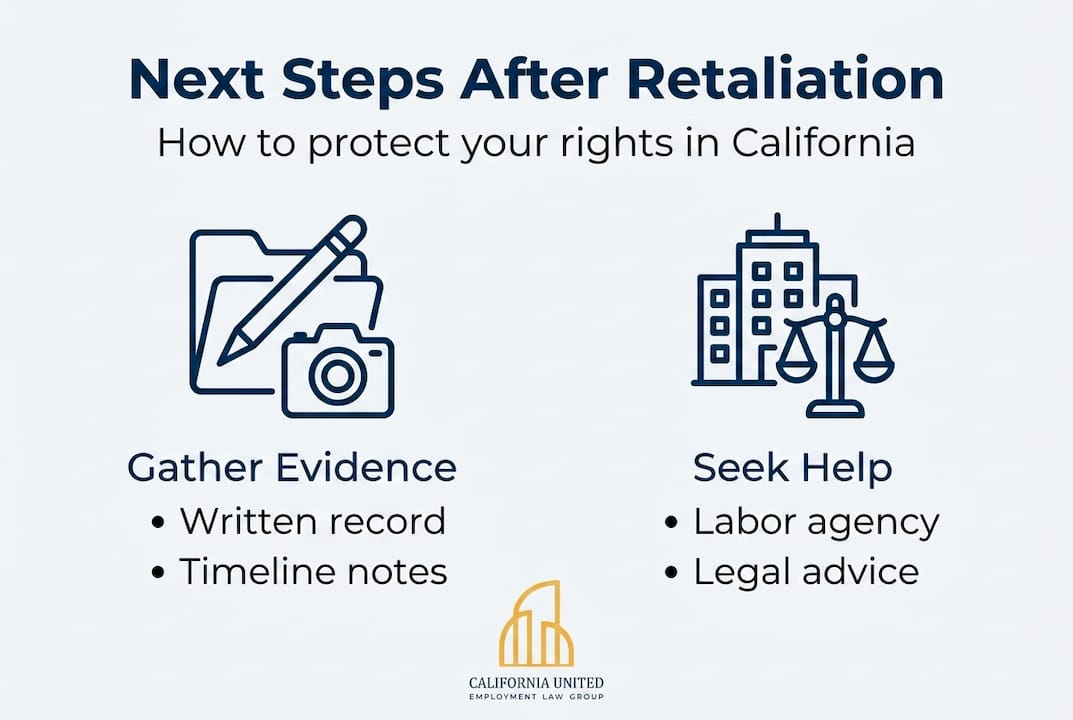
Retaliation claims in California have strict filing deadlines. Missing those deadlines can mean losing your right to pursue a claim entirely, regardless of how strong your case is. Acting fast protects your options.
Immediate actions to take if you suspect retaliation:
- Document everything now. Don’t wait. Start your timeline and save communications the same day you suspect retaliation.
- Contact an employment attorney. Many firms, including ours, offer free case evaluations. An attorney can help you understand whether your situation qualifies as a retaliation or wrongful termination claim.
- File a complaint with the appropriate agency. Depending on the nature of your complaint, you may file with the California Labor Commissioner, Cal/OSHA, or the Civil Rights Department (formerly DFEH).
- Talk to HR in writing. If you haven’t been fired yet, raise your concern in writing. This creates a record that you flagged the potential retaliation before it escalated.
- Review your employment contract or offer letter. Some employees have additional protections through arbitration agreements or company policies that may affect your options.
Legal options and agencies for Glendale workers:
| Agency Or Option | What They Handle | Contact Method |
|---|---|---|
| California Labor Commissioner | Wage theft, hours, retaliation for wage complaints | Online or in-person filing |
| Civil Rights Department (CRD) | Discrimination, harassment, FEHA retaliation | Online complaint portal |
| Cal/OSHA | Safety violations, retaliation for safety reports | Regional office filing |
| Private employment attorney | All types of retaliation and wrongful termination | Direct consultation |
| NLRB (National Labor Relations Board) | Retaliation for union or protected concerted activity | Online charge filing |
Retaliation claims focus on whether the protected activity contributed to the adverse action. Filing a complaint with the right agency preserves your administrative record and is often a required step before filing a lawsuit.
Understanding the full lawsuit process overview helps you see what’s ahead and set realistic expectations. Many retaliation cases settle before trial, but you need to initiate the process correctly to put yourself in the best position.
Deadlines you should know:
- For FEHA retaliation claims: you generally have three years from the retaliatory act to file an administrative complaint with the CRD. This is only the first step. After the CRD issues a right-to-sue notice, you have one year from that notice to file a civil lawsuit. Both deadlines must be met to protect your right to pursue your claim in court.
- For Labor Code retaliation claims: deadlines vary significantly depending on the statute and the type of employer. If your employer is a government entity, a Government Claims Act claim must typically be filed within six months of the retaliatory act. For claims against private employers under Labor Code § 1102.5, an administrative complaint with the Labor Commissioner must be filed within one year, though this step is not required before filing a civil lawsuit. Because the applicable deadline depends on the specific statute and the nature of your employer, consulting an attorney early is essential.
- Consulting an employment attorney promptly can help you identify which deadlines apply to your specific claim and take timely steps to preserve your legal options.
Why Proving Retaliation Is Harder Than Workers Expect
California courts have carefully defined the legal framework workers must navigate in retaliation cases. In Yanowitz v. L’Oreal USA, Inc. (2005) 36 Cal.4th 1028, 1042, the California Supreme Court confirmed that to establish a retaliation claim under the FEHA, an employee must show: (1) engagement in a protected activity; (2) an adverse employment action by the employer; and (3) a causal link between the two. Once that showing is made, the burden shifts to the employer to articulate a legitimate, non-retaliatory reason; the employee must then prove that reason is a pretext. In Nazir v. United Airlines, Inc. (2009) 178 Cal.App.4th 243, 272, the Court of Appeal held that pretext “may be inferred from the timing of the company’s termination decision, by the identity of the person making the decision, and by the terminated employee’s job performance before termination”—directly reflecting how circumstantial evidence carries most retaliation cases. For claims under Labor Code § 1102.5, California’s Supreme Court held in Lawson v. PPG Architectural Finishes, Inc. (2022) 12 Cal.5th 703, 712, that “section 1102.6, and not McDonnell Douglas, supplies the applicable framework,” requiring only that the employee show protected whistleblowing was a “contributing factor” in the adverse action; the employer must then prove by clear and convincing evidence that it would have made the same decision regardless. As the Court of Appeal observed in McCoy v. Pacific Maritime Assn. (2013) 216 Cal.App.4th 283, 299, retaliation claims are “inherently fact-driven”; it is the jury, not the court, that is charged with determining the facts—which underscores why building your own evidence record, rather than relying on the apparent unfairness of your firing, is what ultimately matters.
After reviewing specific actions, it’s important to understand the real-world challenges workers face beyond theory.
Many workers come to us expecting a clear-cut case. They reported a violation, they were fired, and the conclusion feels obvious. But courtrooms don’t run on feelings. They run on documented facts, and that’s where many retaliation cases become complicated.
Employers almost always have a prepared explanation ready before the termination notice is even handed to the employee. They’ve documented performance issues, cited policy violations, or tied the termination to a business restructuring. These explanations don’t have to be completely true to create doubt, and doubt is the employer’s most powerful legal tool.
What we’ve observed in working on these cases is that the workers who prevail are the ones who built their own paper trail before the termination. They sent emails, kept logs, and preserved records while still employed. Workers who start gathering evidence only after being fired often find that access to emails, systems, and witnesses has already been cut off.
There’s also a common mistake of focusing only on what feels unfair rather than what can be concretely proven. Retaliation is about connecting specific dots: your protected report, the employer’s knowledge of it, and a change in your employment status that followed. When even one link in that chain is missing or unclear, the case becomes harder to win.
Visit our page on workplace retaliation realities to understand the full picture of what building a winning case actually requires.
The most powerful thing you can do is act early, document thoroughly, and get legal guidance before the employer shapes the entire narrative.
Get Help Defending Your Rights After Workplace Retaliation
If you suspect retaliation or wrongful firing, you don’t have to navigate the process alone.
California United Law Group, P.C. represents employees across California, including Glendale, who have been fired or punished after reporting workplace violations. We understand how employers frame these situations, and we know how to build the evidence-based case you need. Whether you’re still employed and facing escalating pressure or you’ve already been terminated, we can evaluate your situation and help you understand your options.
👉 Because retaliation claims are subject to strict filing deadlines, contacting an employment attorney early is the most effective way to understand your options, preserve critical evidence, and avoid losing your right to pursue a claim. The sooner you reach out, the better protected your legal rights will be.
Frequently Asked Questions
Is it legal for my employer to fire me for reporting violations in Glendale?
No. California law prohibits employers from terminating—or taking any other adverse employment action against—an employee because of protected activity. Under the California Fair Employment and Housing Act, a plaintiff need only show that the protected conduct was a “substantial motivating factor” in the adverse employment decision, not the sole reason. Under Labor Code § 1102.5—California’s primary whistleblower protection statute—the standard is a “contributing factor,” meaning the protected report need only have played a role in the employer’s decision, even if the employer also had other stated reasons. Because employers rarely admit retaliatory intent, courts look to circumstantial evidence such as the timing of the termination, sudden changes in performance evaluations, and differential treatment of other employees. An attorney can help you evaluate whether the evidence in your situation meets this standard.
What evidence do I need to prove retaliation after being fired?
Key evidence includes a written record of your complaint, a timeline of events surrounding your termination, employer communications, and any changes in performance reviews or treatment. Proving a link between your protected activity and the termination is the core of any retaliation claim.
How soon after reporting a violation can I be fired?
If your employer fires you shortly after you report a workplace violation, it can be a strong indicator of retaliation, but timing alone does not guarantee a successful legal claim. Your employer may still argue a legitimate performance or business reason for the decision.
Who can I contact for help if I think I was wrongfully terminated?
You can contact a California employment attorney for a case evaluation or file a complaint with the California Labor Commissioner or the Civil Rights Department to begin the administrative process and preserve your legal rights.
Recommended
- Los Angeles Employee Rights After Reporting Misconduct – California United Law Group
- California Employee Termination Rights: Your Legal Protections – California United Law Group
- Long Beach Workers Reporting Safety Violations: Your Rights – California United Law Group
- Culver City Workplace Retaliation After Reporting Violations – California United Law Group