
TL;DR:
- California law protects employees who work for employers with five or more employees from national origin discrimination.
- Workers can sue for a variety of misconduct including disparate treatment, harassment, and retaliation.
- Many cases resolve through mediation within 12 to 24 months; outcomes depend on the strength of the evidence and the specific facts of each case.
If you work in Monterey Park and your employer is treating you differently because of where you’re from, your accent, or your cultural background, you may have stronger legal protections than you realize. Many workers assume only large corporations or federal law can hold employers accountable. The truth is that California’s Fair Employment and Housing Act, known as FEHA, covers employers with as few as five employees and goes significantly further than federal law in what it protects and what you can recover. This guide walks you through what national origin bias looks like, who can sue, how the legal process works, and what outcomes are realistic for Monterey Park workers.
Table Of Contents
- Understanding national origin bias and Monterey Park’s legal landscape
- Who can sue and what counts as actionable national origin discrimination
- The step-by-step process to sue for national origin bias
- Settlement benchmarks, remedies, and how long cases take
- The reality of pursuing a national origin bias case in Monterey Park
- How Monterey Park employees can get trusted legal help
- Frequently asked questions
Key Takeaways
| Point | Details |
|---|---|
| Broad protections under FEHA | California’s statute covers employers with only five or more employees, providing strong national origin bias safeguards. |
| Clear lawsuit requirements | Employees must file a CRD complaint within three years and a lawsuit within one year after receiving the right-to-sue notice. |
| Generous remedies available | Successful cases may result in uncapped emotional distress damages, punitive awards, and attorney fees. |
| Most cases resolve via mediation | Many California employment discrimination lawsuits resolve through mediation or early settlement; timelines vary based on case complexity and employer response. |
| Monterey Park follows state law | No special local ordinances exist—California’s FEHA is the primary source of protection for workers. |
Understanding National Origin Bias And Monterey Park’s Legal Landscape
National origin bias in the workplace is more common than most people recognize, and it takes many forms. Some are obvious. Others are subtle and harder to name.
What is national origin bias?
National origin bias means an employer treats you unfairly because of your country of origin, your ethnicity, your cultural background, or your accent. It is not limited to where you were born. It also covers your ancestry, your association with a national group, or even your appearance if it is connected to a perceived national or ethnic background.
Here are examples of what national origin bias can look like in practice:
- A supervisor assigns the least desirable shifts to employees who speak with a foreign accent
- A manager makes mocking comments about an employee’s cultural food or clothing
- A company refuses to promote employees of a specific ethnic background despite strong performance reviews
- An employer applies stricter English-only rules to workers from certain countries but not others
- A coworker makes repeated derogatory comments about someone’s home country and management ignores complaints
“FEHA prohibits national origin discrimination by employers with 5+ employees, broader than federal Title VII which requires at least 15 employees. It covers accent, ethnicity, and cultural background.”
This distinction matters enormously for Monterey Park workers. If your employer has between 5 and 14 employees, federal law offers you no protection at all. California law does.
Does Monterey Park have its own employment discrimination ordinance?
This is a question we hear often. Monterey Park does not have a separate employment discrimination ordinance beyond what California state law already provides. The city may offer local resources, language assistance, or reporting guidance through its departments, but FEHA is the governing law for discrimination claims. That is actually good news, because FEHA is one of the most employee-friendly laws in the country.
Understanding these national origin laws at the state level is the foundation for every discrimination claim in Monterey Park. If you have experienced bias related to your ancestry or national background, ancestry discrimination lawsuits under FEHA are the primary vehicle for seeking justice.
Who Can Sue And What Counts As Actionable National Origin Discrimination
Now that you know the legal landscape, let’s dig into the specifics about who can sue and what kinds of conduct are actually covered.
Who qualifies to file a claim?
You can file a national origin discrimination claim under FEHA if:
- You work for an employer with five or more employees in California
- You experienced an adverse employment action or hostile work environment tied to your national origin
- You are an employee or job applicant. Independent contractors are generally not covered for discrimination claims under FEHA, though they may have limited protections against harassment in certain circumstances — a distinction that depends on how courts assess the true nature of the working relationship.
Federal Title VII requires employers to have at least 15 employees before protections kick in. FEHA’s lower 5-employee threshold means that most Monterey Park businesses are covered, including small family-owned shops and local service providers.
Types of conduct that qualify as national origin discrimination
Not every difficult workplace experience rises to the level of a legal claim. To be actionable, the conduct must be tied to your national origin and meet a certain threshold. Here is a breakdown:
| Type Of Discrimination | What It Looks Like | Covered Under FEHA? |
|---|---|---|
| Disparate treatment | Denied promotion because of your ethnicity | Yes |
| Hostile work environment | Repeated ethnic slurs or mocking accent | Yes |
| Harassment by a supervisor | Supervisor makes daily demeaning comments | Yes |
| Retaliation | Fired after complaining about discrimination | Yes |
| Wrongful termination | Let go specifically due to national origin | Yes |
| English-only policies | Applied selectively to certain nationalities | Yes |
California courts have consistently reinforced broad FEHA protections for workers facing national origin discrimination. In Aguilar v. Avis Rent A Car System, Inc., the California Supreme Court upheld an injunction prohibiting an employer from using racial and ethnic slurs in the workplace, affirming that FEHA reaches pervasive workplace harassment tied to national origin and ethnicity. On the issue of supervisor liability, Fiol v. Doellstedt established that supervisors who personally engage in harassment may be held individually liable under FEHA — separate and apart from the employer’s liability — a principle that continues to carry significant weight in settlement negotiations today. And in Yanowitz v. L’Oreal USA, Inc., the California Supreme Court broadly defined what constitutes protected activity under FEHA’s anti-retaliation provisions, making clear that an employee who refuses to carry out a discriminatory order is protected from retaliation. Together, these decisions confirm that California’s protections for Monterey Park workers go well beyond the floor set by federal law.
Can supervisors be held personally liable?
This is one of the most powerful aspects of California law. Under FEHA, supervisors can face personal liability for harassment. This means the individual who harassed you may be named as a defendant in your lawsuit, not just the company. That changes the dynamic considerably during settlement negotiations.

What remedies are available?
California law offers significantly stronger remedies than federal law. Here is what you may be entitled to recover:
- Lost wages and benefits covering the period you were harmed
- Emotional distress damages with no statutory cap, unlike federal law
- Punitive damages to punish particularly egregious employer conduct
- Attorney fees and litigation costs, which California law allows a prevailing plaintiff to recover from the employer — a significant advantage that makes pursuing a valid claim more financially accessible.
- Reinstatement to your job if you were wrongfully terminated
Understanding what counts as workplace harassment under California law will help you assess whether your situation meets the threshold for a claim. If you are unsure whether your experience qualifies, a consultation focused on proving harassment in detail can clarify whether you have a strong foundation to move forward.
Pro Tip: Document every incident of national origin bias in writing, even if it seems minor. Dates, exact words used, witnesses present, and any written communications like emails or texts are all valuable evidence. Courts and mediators respond to specific, documented timelines.
The Step-By-Step Process To Sue For National Origin Bias
With eligibility clear, let’s walk through the practical steps and deadlines workers must know to file a lawsuit.
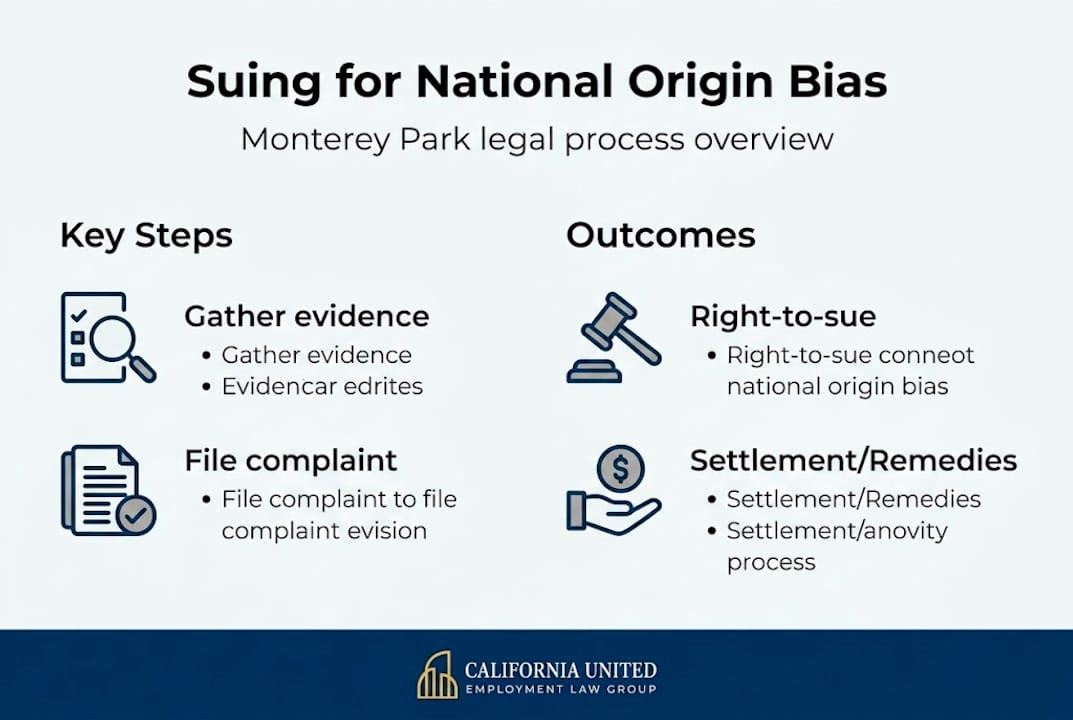
Step 1: Gather your evidence
Before you file anything, build your record. Save emails, text messages, performance reviews, and any written communications that show discriminatory treatment. Write down specific incidents with dates and witnesses while your memory is fresh.
Step 2: File a complaint with the Civil Rights Department
In California, you must file a CRD complaint within three years of the discriminatory act before you can sue in civil court. The Civil Rights Department, or CRD, was formerly known as the Department of Fair Employment and Housing. Filing this complaint is called “exhausting administrative remedies,” and it is a required step before you can bring a lawsuit in Superior Court.
Step 3: Obtain a right-to-sue notice
After filing your CRD complaint, you will need to request a right-to-sue notice. Once issued, you have one year to file your lawsuit in California Superior Court.
Step 4: Decide whether to dual-file with the EEOC
For some workers, it makes strategic sense to dual-file with both the CRD and the EEOC (Equal Employment Opportunity Commission). California generally prefers the CRD route because FEHA offers broader protections and covers smaller employers. But dual filing preserves your rights under federal law at the same time, which can be useful depending on your situation.
Step 5: File your lawsuit in Superior Court
Once you have your right-to-sue notice, your attorney files the lawsuit in Superior Court. The case then proceeds through discovery, mediation, and potentially trial.
Here is a simplified timeline overview:
| Stage | Deadline Or Typical Timeframe |
|---|---|
| File CRD complaint | Within 3 years of discriminatory act |
| CRD investigation | Several months to over one year |
| Right-to-sue notice | Requested after filing; issued by CRD |
| File civil lawsuit | Within 1 year of right-to-sue notice |
| Discovery and litigation | 12 to 24 months or more |
| Mediation or trial | Varies; many cases settle before trial |
Why The Three-Year Deadline Is Critical
Missing the CRD filing deadline means losing your right to sue under FEHA entirely. Many workers wait too long, hoping the situation improves or feeling uncertain about whether their experience “counts.” If you suspect discrimination, do not wait. The clock starts running from the date each harmful act occurred.
Pro Tip: If you are still employed at the company where the bias occurred, getting legal advice before you file is especially important. Your attorney can help you understand the lawsuit process overview and protect your termination rights so that filing a complaint does not inadvertently put your job at greater risk.
Settlement Benchmarks, Remedies, And How Long Cases Take
Finally, now that you understand the legal process and your options, let’s explore what workers can realistically expect in terms of outcomes and timelines.
What do national origin discrimination cases actually settle for?
Real numbers help set realistic expectations. In one notable example, HCL America agreed to a $495,000 settlement to resolve claims involving age and national origin discrimination. Cases vary widely depending on the severity of the conduct, the number of workers affected, and the strength of the evidence. But this benchmark shows that strong discrimination claims carry real financial weight.
Typical Timeline For Resolution
Most California national origin discrimination cases resolve within 12 to 24 months. Many settle before trial, often through mediation. Mediation is a structured negotiation process where both sides meet with a neutral third party to reach a resolution. It avoids the unpredictability of trial and often results in faster, private outcomes.
What damages can you recover?
Under FEHA, uncapped emotional distress damages are one of the most significant advantages California workers have over their counterparts in other states. Here is a breakdown of what successful plaintiffs often recover:
- Back pay and front pay representing lost earnings during and after the discrimination
- Emotional distress damages which can be substantial and are not capped under California law
- Punitive damages available when an employer’s conduct was particularly malicious or oppressive
- Attorney fees and litigation costs meaning you keep more of your recovery
- Non-monetary relief such as policy changes at the company or reinstatement to your position
Why Early Action Increases Your Recovery
Workers who document incidents from the beginning, report internally when safe to do so, and consult an attorney before the situation escalates tend to build stronger cases. Every email you save, every incident you write down, and every complaint you formally submit creates a paper trail that directly supports your damages claim.
For Monterey Park employees specifically, working with a firm that understands both the local workforce dynamics and the full scope of FEHA protections can make a measurable difference. A consultation with experienced Monterey Park employment lawyers gives you an honest assessment of what your case is worth and what realistic next steps look like.
The Reality Of Pursuing A National Origin Bias Case In Monterey Park
After years of helping employees navigate discrimination claims, we want to share something that legal guides often skip over: most national origin bias cases never reach a courtroom. They resolve in mediation or through early settlement negotiations. This is actually good news for most workers, because settlement means faster resolution, lower stress, and guaranteed outcomes rather than the risk of a trial verdict.
What we see consistently is that workers underestimate the power of FEHA’s tools. Uncapped emotional distress damages and individual supervisor liability are not just legal provisions on paper. They change how employers and their insurers calculate the cost of defending a case. That calculation often tips toward settlement.
The most common mistake? Waiting too long to act. Many Monterey Park workers absorb bias for months or years before reaching out for help, believing it will stop on its own or fearing retaliation. California’s retaliation protections are robust, and filing a complaint does not strip you of your job protections. In fact, any retaliation after a complaint becomes its own separate claim.
Local resources in Monterey Park may offer translation help or community guidance, but they cannot replace the legal protection FEHA provides. Do not mistake community support for legal recourse. They serve different purposes.
How Monterey Park Employees Can Get Trusted Legal Help
If you are facing national origin bias at work, the most important step you can take right now is speaking with an attorney who understands California employment law deeply. At California United Law Group, P.C., we represent Monterey Park employees at every stage of the discrimination process, from the initial CRD filing through litigation.
👉 We can walk you through the full lawsuit process so you understand exactly what to expect at each stage.
Our team handles national origin discrimination, harassment, retaliation, and wrongful termination claims. We work on a contingency basis for many discrimination cases, which means you pay nothing unless we recover for you.
👉 Contact our Monterey Park employment lawyer team today for a confidential consultation.
Frequently Asked Questions
What is considered national origin bias under California law?
Any workplace unfair treatment based on ethnicity, accent, cultural background, or birthplace can count as national origin bias. FEHA covers employers with five or more employees, which is far broader than what federal law requires.
Is there a deadline to file a national origin discrimination claim in Monterey Park?
Yes. You must file a CRD complaint within three years of the discriminatory incident, then submit your lawsuit in Superior Court within one year of receiving your right-to-sue notice.
Do Monterey Park workers have extra protections beyond California law?
Monterey Park does not have its own anti-discrimination ordinance. The city relies on California’s state law for employment protection, though local offices may provide language resources or reporting guidance.
What damages can I recover if successful in a national origin bias suit?
California law allows uncapped emotional distress compensation, punitive damages, attorney fees, and personal liability for supervisors who engaged in harassment, giving you significantly stronger remedies than federal law provides.
Disclaimer: The information on this page is provided for general educational purposes only and does not constitute legal advice. Reading this article does not create an attorney-client relationship between you and California United Law Group, P.C. Every case is different, and the outcome of your case will depend on the specific facts and circumstances involved. If you believe you have experienced national origin discrimination, contact a licensed California employment attorney to discuss your individual situation.