
TL;DR:
- Off-the-clock unpaid work remains widespread in California warehouses despite strict laws.
- California law mandates payment for all work time, rejecting federal de minimis rules.
- Workers should document unpaid tasks, understand their legal rights, and seek legal support to recover wages.
California’s labor laws are among the strongest in the nation, yet unpaid off-the-clock work remains a daily reality for thousands of warehouse workers right now. If you work in an El Monte warehouse, you may already know what it feels like to clock out and then spend another 10 or 15 minutes finishing tasks your employer never pays you for. That is not a gray area under California law. It is wage theft. This guide explains how common the problem still is in 2026, what the law says, what recent enforcement cases show, and exactly what steps you can take to protect your wages and your rights.
Table Of Contents
- How common is off-the-clock work in El Monte warehouses?
- California labor laws: What counts as off-the-clock work?
- Recent cases and enforcement: What’s happening in 2026?
- What El Monte warehouse workers can do: Claims, documentation, and legal rights
- Why off-the-clock work persists—and what most employees miss
- Get help: Legal support for El Monte warehouse workers
- Frequently asked questions
Key Takeaways
| Point | Details |
|---|---|
| Widespread problem | Off-the-clock work continues in El Monte warehouses, impacting thousands in 2026. |
| CA labor laws protect pay | California requires payment for all employer-required tasks, even brief ones. The California Supreme Court has rejected the federal de minimis defense for regularly required off-the-clock work. |
| Major recoveries show risk | Recent multi-million dollar settlements highlight that wage theft remains a major enforcement focus. |
| Document everything | Accurate, daily records are critical for wage claims and legal protection. |
| Help is available | Workers can seek legal help to recover unpaid wages and prevent retaliation. |
How common is off-the-clock work in El Monte warehouses?
The short answer: very common. Off-the-clock work affects thousands of warehouse and manufacturing employees in El Monte and across California, and that number has not dropped in any meaningful way heading into 2026. Workers report unpaid time at the start of shifts, during security screenings, and after shifts when finishing up production floors.
Why does it keep happening despite strict state law? Several factors drive it:
- Production quotas push workers to start early or stay late without recording time
- Employer scheduling gaps leave no buffer for required end-of-shift tasks
- Fear of retaliation stops many workers from reporting unpaid minutes to supervisors
- Normalized culture in some facilities where off-the-clock work is treated as standard
The numbers behind the problem are striking. DOL wage violation recoveries show that warehouse and manufacturing workers lose millions in unpaid wages every year, with federal investigators recovering those wages only after formal complaints are filed.
Off-the-clock work remains a recognized ongoing issue for warehouse and manufacturing workers in El Monte, California, as of 2026, with thousands affected statewide.
Local organizations that track worker conditions, including the LA Worker Center Network, document persistent wage violations across the San Gabriel Valley, particularly in logistics and warehousing. El Monte sits at the center of a major distribution corridor, which means high volumes of workers and, unfortunately, high rates of wage abuse.
For workers in California off-the-clock manufacturing roles, the problem is even more acute because production demands rarely align with what employers record as paid time. The gap between what you actually work and what you get paid adds up fast. Even 10 unpaid minutes per shift totals over 40 hours a year in lost wages.
California labor laws: What counts as off-the-clock work?
California law is clear and strict: you must be paid for every minute you work. Full stop. Under the California Labor Code, there is no such thing as “minor” unpaid work time. This is where California goes further than federal law.

Under federal law, the ‘de minimis’ rule permitted employers to avoid compensating employees for very short, irregular tasks, based on factors such as the total time involved, its regularity, and the practical difficulty of tracking it. California courts have rejected applying that federal rule to California wage and hour claims. In Troester v. Starbucks Corp. (2018) 5 Cal.5th 829, the California Supreme Court held that ‘[a]n employer that requires its employees to work minutes off the clock on a regular basis or as a regular feature of the job may not evade the obligation to compensate the employee for that time by invoking the de minimis doctrine.’ The Ninth Circuit reaffirmed this principle in Rodriguez v. Nike Retail Services, Inc. (9th Cir. 2019) 928 F.3d 810, 815, confirming that the federal de minimis doctrine does not apply to California wage and hour claims.
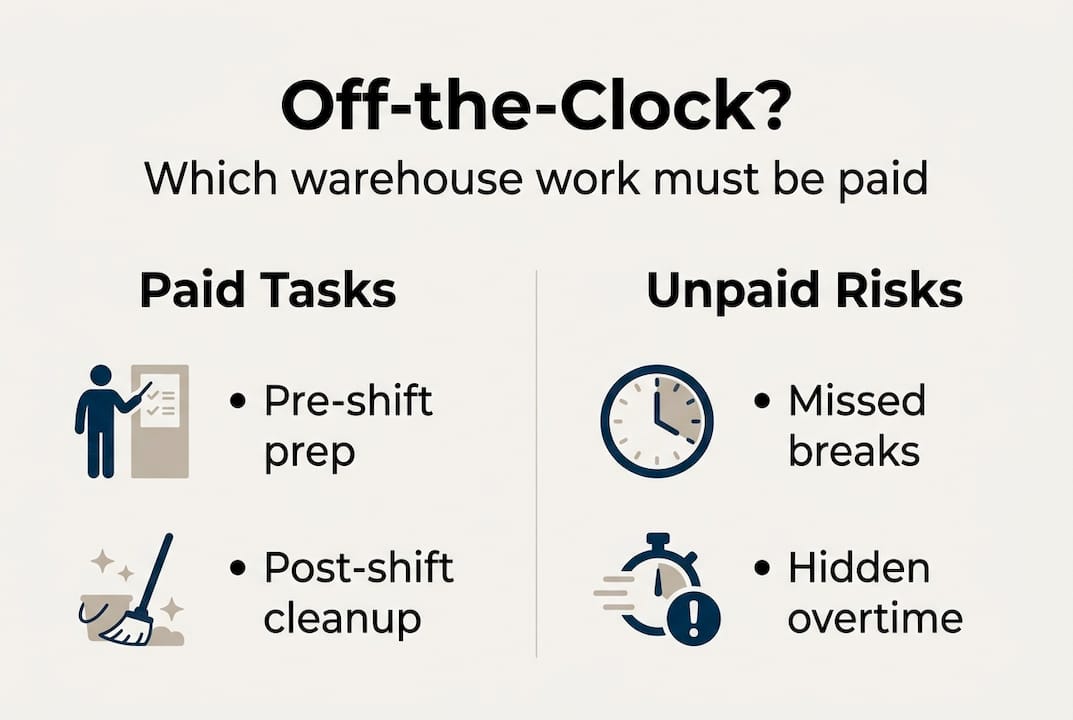
So what tasks must be paid in a warehouse setting? Here are common examples that often go uncompensated:
- Waiting in line for or going through security screenings before and after shifts
- Donning and doffing PPE (personal protective equipment) like gloves, helmets, or protective gear
- Pre-shift equipment checks or safety briefings
- End-of-shift cleanup, machine shutdown, or logging work completed
- Walking from a time clock to your actual work station when the walk takes several minutes
- Brief post-shift meetings required by a supervisor
Under California Wage Orders, the guiding legal standard is whether the employee was ‘suffered or permitted to work’—meaning the employer knew or should have known the employee was performing work. This standard includes time the employee is working but not under direct supervision, such as unauthorized overtime, provided the employer had knowledge of it. A central factor courts also examine is whether the activity was primarily for the employer’s benefit.
California courts have applied these principles to real-world warehouse and manufacturing settings. In Troester, the employee was required to transmit sales data, activate the alarm, and lock up after clocking out—tasks taking several minutes nightly. The Supreme Court held that the employer could not escape liability for this time. The Ninth Circuit’s decision in Rodriguez v. Nike Retail Services, Inc. (9th Cir. 2019) 928 F.3d 810 extended this principle statewide, affirming that California workers are protected against off-the-clock time that federal law might have excused. And in Murphy v. Kenneth Cole Productions, Inc. (2007) 40 Cal.4th 1094, 1109, the California Supreme Court confirmed that claims for unpaid overtime and minimum wages are governed by the three-year statute of limitations for statutory liabilities—not the shorter federal period—giving California workers a broader window to seek recovery.
Understanding your full warehouse worker rights in California also means knowing the overtime rules. Time worked beyond eight hours in a day (not just 40 hours a week) qualifies for overtime pay at one and one-half times your regular rate. Hours worked beyond 12 in a single workday are paid at double your regular rate under California law. Off-the-clock time that pushes you past either of those thresholds means you may be owed significantly more than just base wages. Off-the-clock time that pushes you past those thresholds means you are owed even more than just base wages.
Pro Tip: Keep a daily log of every task you perform before and after your scheduled shift, even if it takes just five minutes. Note the time, the task, and your supervisor’s name. This habit can make or break a wage claim.
Recent cases and enforcement: What’s happening in 2026?
Enforcement actions show that the law has real teeth, but gaps still exist. Here is a snapshot of recent activity:
| Case | Recovery | Workers Affected |
|---|---|---|
| DOL California warehouse investigation | $1M+ in back wages | 24 workers |
| Costco driver wage theft fine (2025) | $870K+ | Delivery drivers |
| Statewide DLSE warehouse settlements | Ongoing | Thousands annually |
The Costco wage fine and the DOL recovery case are significant for one key reason: they show that even large employers with legal departments get caught and fined. But both cases required workers or investigators to push hard before anything happened.
So what actually happens after you file a wage complaint? Here is the general process:
- File your complaint with the California Division of Labor Standards Enforcement (DLSE), also called the Labor Commissioner’s Office
- Within 30 days of filing, the Labor Commissioner notifies both parties whether the office will schedule a hearing, pursue a civil action on your behalf, or take no further action on the claim.
- Conference scheduled where both sides present their positions
- Hearing held if no settlement is reached at the conference stage
- Award issued if you prevail; employer must pay back wages, penalties, and interest
- Private lawsuit option available if agency action is too slow or insufficient
Understanding the full employment lawsuit process helps you set realistic expectations. Agency timelines can stretch 12 to 18 months, which is why some workers choose private litigation with an attorney to move faster and recover more.
What El Monte Warehouse Workers Can Do: Claims, Documentation, And Legal Rights
Knowing the law matters, but taking action is what changes your situation. Here is a step-by-step approach to protecting yourself.
Step 1: Document Everything Now
- Write down every unpaid task you perform, with start time, end time, and a description
- Note whether a supervisor was present or directed the task
- Save any texts, emails, or written instructions telling you to work before or after clocking in
- If coworkers share the same experience, note that too without putting them at risk
Step 2: Understand your options
You have three main paths for recovering unpaid wages:
- DLSE complaint: Free to file, government-investigated, but can be slow
- Small claims court: Available for smaller amounts; no attorney required
- Private lawsuit: Can recover more, including penalties and attorney fees; faster in many cases
Key rights you should know:
- California’s statute of limitations allows wage claims going back three years for most statutory violations, and four years for claims based on a written employment contract.
- Retaliation protections are strong: your employer cannot cut your hours, demote you, or fire you for filing a wage complaint
- You have rights against retaliation under California Labor Code Section 98.6 and Section 1102.5
- Evidence that matters most: personal time logs, pay stubs, and witness statements from coworkers
Pro Tip: Keep your documentation separate from your workplace, such as in a personal email or a notebook at home. Employers sometimes delete electronic records. Your personal log is your strongest evidence.
One honest note: state agencies are often understaffed, and timelines for resolution can be long. A private wage and hour lawsuit with an experienced attorney may deliver results faster and may recover additional penalties that agency claims cannot.
Why Off-The-Clock Work Persists—And What Most Employees Miss
Here is something that rarely gets said plainly: California’s labor laws are excellent on paper, but they depend almost entirely on workers taking action. Employers who benefit from unpaid labor have little incentive to self-correct. Enforcement agencies do solid work, but they are stretched thin across millions of workers.
The real drivers of off-the-clock work in El Monte warehouses are systemic. Tight production quotas and understaffed shifts create pressure to work beyond scheduled hours. Supervisors sometimes pressure workers indirectly, without ever saying the words “work off the clock.”
Most workers underestimate two things. First, how quickly small unpaid increments add up to real money over months or years. Second, how important it is to document early, before the details blur.
The contrarian truth is this: don’t wait for enforcement trends to protect you. Agencies, headlines, and fines help, but they rarely help you specifically unless you have already built a solid personal record. In California’s at-will employment landscape, employers sometimes use scheduling changes or termination to silence workers before wage claims can be filed—actions that may themselves constitute illegal retaliation under California law.
Solidarity with coworkers matters too. Claims with multiple workers involved carry more weight and are harder for employers to dismiss or retaliate against quietly.
Get Help: Legal Support For El Monte Warehouse Workers
👉 If you believe you have been working off the clock without pay, you do not have to figure this out alone.
At California United Law Group, P.C., we represent warehouse employees in El Monte and across California in wage and hour disputes, including off-the-clock work claims. We understand how enforcement delays work, and we know how to build evidence-backed claims on behalf of our clients.
Our employment law services cover everything from initial claim review to full litigation. If your wages have been stolen through unpaid off-the-clock time, you may be entitled to back wages, overtime penalties, and more.
👉 Explore your options through our wage and hour claims page, or contact us today for a confidential consultation. The sooner you act, the more of your available claim period you can preserve.
Results in any legal matter depend on the specific facts, evidence, and circumstances of each individual case. No representation is made that the quality of legal services to be performed is greater than the quality of legal services performed by other lawyers. Prior results do not guarantee a similar outcome.
Frequently Asked Questions
What kinds of warehouse tasks must be paid under California law?
Under California law, the federal de minimis rule has been rejected for regularly required off-the-clock work. The California Supreme Court has held that employers cannot use any minimum-time threshold to avoid paying for work that is a regular feature of the job. If your employer regularly requires you to perform tasks off the clock, those minutes must be compensated regardless of their length.
How far back can I claim unpaid off-the-clock wages?
You can generally claim unpaid wages going back three to four years based on a written employment contract. Filing a DLSE wage complaint promptly preserves your ability to recover the most wages possible.
Is it retaliation if my boss cuts my hours after I file a wage claim?
Yes. Reducing your hours specifically because you filed a wage complaint is illegal retaliation under California law. You have strong anti-retaliation protections and can file a separate retaliation claim in addition to your wage claim.
What should I do if I’m still being asked to work off-the-clock?
Document every incident with dates, times, tasks, and any instructions from supervisors. Then consult a legal expert about your options, because private legal action is often faster than waiting for agency enforcement when violations are ongoing.
Recommended
- Off-the-clock work in El Monte warehouses: Know your rights – California United Law Group
- Off-the-Clock Work in CA Manufacturing: 100% Pay Required – California United Law Group
- Employment Lawyer El Monte – California United Law Group
- Salaried Employees and Overtime Pay in Alhambra – California United Law Group