
Religious discrimination at work is illegal in Santa Monica, and California’s Fair Employment and Housing Act (FEHA) requires employers to provide reasonable accommodations for employees’ sincerely held religious beliefs and practices. The California Civil Rights Department (CRD) enforces FEHA protections against covered employers across the state, including covered workplaces in Santa Monica. Whether your employer has refused to adjust your schedule for a religious observance, penalized you for wearing a hijab or turban, or pressured you to participate in religious activities, you have legal rights worth understanding. This article explains those rights clearly, without legal jargon, so you can make informed decisions about your situation.
This article provides general legal information, not legal advice, and reading it does not create an attorney-client relationship. Outcomes depend on the specific facts and law applicable to each case.
What rights do Santa Monica employees have against religious discrimination?
Religious discrimination at work is defined as adverse treatment of an employee because of their religion, perceived religion, or lack of religious belief. FEHA covers a broad range of protected characteristics, and California law extends these protections not only to traditional religions but also to sincerely held belief systems. That scope matters because it means your employer cannot treat you differently based on assumptions about your faith, even if those assumptions are wrong.

Santa Monica employees are protected from discrimination in every phase of employment. California law prohibits adverse employment actions based on religious beliefs or practices in hiring, promotions, benefits, and termination decisions. These protections can apply to employees, applicants, unpaid interns, and other covered workplace roles, depending on the facts.
The specific conduct FEHA prohibits includes:
- Termination or discipline because of religious beliefs, practices, or dress
- Denial of promotions or raises motivated by an employee’s religion
- Forced participation in religious activities or employer-sponsored religious programs
- Harassment based on religion, including slurs, mockery, or unwanted religious pressure
- Refusal to accommodate religious dress, grooming, holidays, or observances without justification
California jury instructions recognize religious accommodation claims under FEHA, including claims for failure to accommodate religious creed and the employer’s undue-hardship defense. CACI lists “Religious Creed Discrimination-Failure to Accommodate-Essential Factual Elements” and “Religious Creed Discrimination-Reasonable Accommodation-Affirmative Defense-Undue Hardship.” Federal law, specifically Title VII of the Civil Rights Act of 1964, also prohibits religious discrimination. California’s FEHA generally provides broader protections and covers employers with five or more employees, compared to Title VII’s threshold of 15. For many Santa Monica workers, FEHA may provide broader protection because it applies to smaller covered employers than Title VII.
How does religious accommodation work in Santa Monica workplaces?
A reasonable accommodation is any adjustment to a job, work environment, or workplace policy that allows an employee to practice their religion without causing the employer significant difficulty or expense. Whether a requested accommodation creates undue hardship is evaluated case by case. FEHA explicitly protects religious dress and grooming practices such as hijabs, beards, turbans, and religious jewelry. Employers generally cannot require employees to remove or conceal religious dress or grooming items as a condition of employment unless a legally recognized exception applies.
Common examples of reasonable accommodations include:
- Schedule adjustments to allow attendance at religious services or observance of holy days
- Dress code exceptions for religious attire or grooming requirements
- Shift swaps arranged with willing coworkers
- Reassignment to a different role or shift that does not conflict with religious practice
When you request a religious accommodation, your employer should engage in a good-faith dialogue and explore available reasonable alternatives. This means a genuine back-and-forth conversation to identify workable solutions, not a one-sided denial. The interactive process should be a meaningful dialogue, not just a formality. Employers should seriously consider accommodation options, and if they deny a request, they should be prepared to explain the factual basis for the denial.
One critical limit applies to how accommodations are structured. Employers cannot isolate or segregate employees as a form of accommodation for religious attire or practices. Moving a hijab-wearing employee to a back office away from customers, for example, is not a lawful accommodation. FEHA specifically treats segregation from other employees or the public as unreasonable when used to accommodate religious dress or grooming practices. Rutter states that an accommodation of religious dress or grooming is not reasonable if it requires segregating the employee from other employees or the public. It violates the employee’s right to inclusion and visibility in the workplace.
Pro Tip: Document every accommodation request you make in writing, including the date, what you asked for, and how your employer responded. Written records are your strongest defense if a dispute arises later.
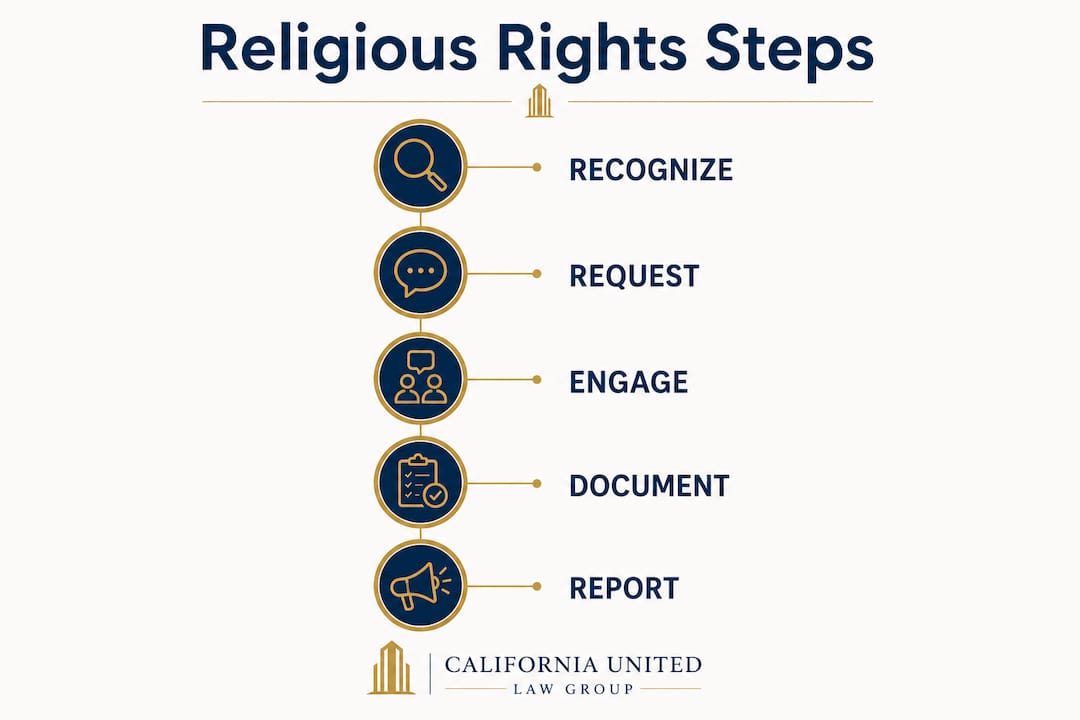
What steps can you take if you face religious discrimination or denial of accommodation?
If your employer has denied a religious accommodation request or taken adverse action against you because of your faith, you have clear procedural options under California law. Acting promptly protects your rights.
Document everything. Save emails, texts, written requests, and any employer responses. Note dates, times, and the names of anyone involved in relevant conversations. Keep copies of performance reviews and disciplinary records that may show a pattern.
File a complaint with the California Civil Rights Department (CRD). The CRD is the state agency that enforces FEHA. California employees generally have a 3-year deadline from the date of the discriminatory act to file an administrative complaint. Missing this deadline can jeopardize or bar state-law claims.
Understand your options after filing. Once you file with the CRD, the agency may investigate your complaint, offer mediation, or issue a right-to-sue notice. You can also request an immediate right-to-sue notice from the CRD, which may allow you to proceed to court without waiting for a full agency investigation. Whether to request an immediate right-to-sue notice is a strategic decision that depends on the facts, evidence, deadlines, and litigation goals.
Know the federal timeline. If you also want to file a complaint with the Equal Employment Opportunity Commission (EEOC) under Title VII, the deadline is generally 300 days from the discriminatory act in California. State and federal complaints can run concurrently.
Report retaliation immediately. If your employer retaliates against you for requesting an accommodation or filing a complaint, that retaliation is itself a separate legal violation. Report it to the CRD and document it the same way you documented the original discrimination.
Pro Tip: Consult with an employment attorney before filing to understand which agency and timeline best fits your situation. The choice between a CRD complaint and an immediate right-to-sue notice can significantly affect your case. An attorney can help evaluate that choice based on the facts of your situation.
What employer defenses to accommodation requests are valid under California law?
Employers in Santa Monica can deny a religious accommodation request only if a legally recognized basis applies, such as undue hardship or a conflict with civil-rights laws. The undue hardship standard requires the employer to show significant difficulty or expense relative to the size and operations of the business. Minor scheduling inconveniences or modest costs usually will not meet this threshold. That distinction is important because many employers claim undue hardship without meeting the legal bar.
California courts have recognized that religious accommodation claims require a fact-specific analysis. In Soldinger v. Northwest Airlines, Inc., the court explained that once an employee establishes a prima facie religious accommodation case, the employer must show it made good-faith accommodation efforts or that no accommodation was possible without undue hardship. CACI cites Soldinger v. Northwest Airlines, Inc. for the rule that once the employee establishes a prima facie case, the employer must establish it initiated good-faith efforts to accommodate or that no accommodation was possible without undue hardship. In California Fair Employment & Housing Commission v. Gemini Aluminum Corp., the employer violated FEHA by refusing time off for a Jehovah’s Witness convention without initiating a good-faith effort to accommodate. Rutter cites California Fair Employment & Housing Comm’n v. Gemini Aluminum Corp. for the proposition that an employer violated FEHA by refusing time off to attend a Jehovah’s Witness convention without initiating a good-faith effort to accommodate.
Examples that may or may not qualify as undue hardship:
- Usually does not qualify: minor disruption to a work schedule, customer preference for a certain appearance, or the cost of a simple policy adjustment.
- May qualify: A safety-critical role where religious attire creates a genuine and documented hazard, or a staffing situation where no alternative scheduling is feasible
- Usually does not qualify: coworker discomfort, customer preference, or general inconvenience.
- May qualify: Substantial financial cost that is disproportionate to the employer’s resources
A limited defense called the ministerial exception applies to religious organizations. It allows churches, synagogues, mosques, and similar institutions to make employment decisions about ministers and clergy based on religious criteria. This defense is narrow and generally does not apply to secular workplaces.
California law places the burden on the employer to prove undue hardship with real evidence, not assumptions. An employer that denies a request without a good-faith accommodation analysis may face difficulty proving that no reasonable accommodation was available without undue hardship.
Documentation of the interactive process matters on both sides. Employers who refuse to consider alternatives may increase their litigation risk. Your documentation of a good-faith request, paired with an employer’s inadequate response, builds a strong factual record.
How does California law protect Santa Monica employees from religious harassment and retaliation?
Religious harassment at work is a form of discrimination that creates a hostile work environment based on an employee’s religion. Examples include:
- Slurs or mockery directed at an employee’s religious beliefs or practices
- Unwanted proselytizing or pressure to adopt the employer’s or coworkers’ religious views
- Repeated offensive comments about religious attire, holidays, or observances
- Exclusion from meetings or opportunities because of religious identity
A single severe incident can constitute harassment under California law, while repeated less severe conduct may also qualify if it creates a hostile work environment. California jury instructions evaluate whether harassment is “severe or pervasive,” and CACI includes separate instructions explaining harassing conduct and the severe-or-pervasive standard. CACI lists “Harassing Conduct Explained” and “‘Severe or Pervasive’ Explained” for FEHA harassment claims. Repeated, less severe conduct that creates a hostile environment also qualifies. You do not need to wait until the harassment becomes unbearable to report it.
FEHA prohibits retaliation against employees who request religious accommodations or file discrimination complaints. Retaliation can take the form of demotion, termination, reduction in hours, negative performance reviews, or a sudden hostile shift in how supervisors treat you. Depending on the facts, these actions may support a retaliation claim under California law.
Reporting harassment or retaliation internally, through HR or a supervisor, can help create a record that your employer was on notice. That record matters if you later file a complaint with the CRD or pursue litigation. Santa Monica employees can also review California United Law Group’s resources on rights after reporting discrimination.
Key Takeaways
California’s FEHA gives covered Santa Monica employees enforceable rights against religious discrimination, including protections for religious accommodation requests and retaliation.
| Point | Details |
|---|---|
| FEHA covers broad beliefs | Protections extend to sincerely held belief systems, not just traditional religions, including perceived religion. |
| Accommodation is required | Employers must consider reasonable accommodation options and generally cannot deny requests based on minor inconvenience. |
| Religious dress segregation is not a reasonable accommodation | Moving an employee out of public view because of religious dress or grooming is not a reasonable accommodation under FEHA. |
| Three-year filing deadline | You have 3 years from the discriminatory act to file a complaint with the California Civil Rights Department. |
| Retaliation is separately prohibited | Adverse action taken because an employee requested accommodation or filed a complaint may support a retaliation claim under FEHA. |
My Perspective On Religious Discrimination Cases In Santa Monica
Religious discrimination claims are often misunderstood in employment law, and that misunderstanding can hurt employees and employers alike. The most common mistake employees make is waiting too long to document what is happening to them. By the time they seek legal guidance, key emails have been deleted, conversations are unrecorded, and the timeline is blurry.
The second mistake is assuming that a verbal accommodation request is enough. Employers have a legal duty to engage in the interactive process, but that duty is easier to enforce when your request exists in writing. A simple email stating your religious practice and what adjustment you need creates a paper trail that is hard to dispute.
Some employers deny accommodation requests with a form letter and no meaningful analysis. California law requires more than a reflexive denial when reasonable alternatives may be available. The undue hardship defense requires actual evidence, not a reflexive “no.” Employers who refuse to consider reasonable alternatives may increase their liability risk.
The legal standards in California are genuinely protective. FEHA provides broad employment discrimination protections compared with federal law in several important respects. But those protections only work if you know they exist and act on them. Understanding your rights is not just reassuring. It is the first step toward doing something about what is happening to you.
— California United Law Group
How California United Law Group Can Help With Your Religious Discrimination Claim
California United Law Group represents Santa Monica employees in religious discrimination and accommodation disputes under FEHA. The firm handles cases from the earliest stages, including reviewing accommodation requests and employer responses, through administrative filings with the CRD and litigation when necessary. If you believe your employer has denied a lawful accommodation, retaliated against you for asserting your rights, or subjected you to religious harassment, a case assessment can help you understand possible options based on your facts. California United Law Group offers an initial consultation to discuss how California law may apply to the facts of your situation. To speak with an employment attorney, contact the firm directly. You can also learn more about Santa Monica employment law representation on the firm’s website.
FAQ
What is religious discrimination under California law?
Religious discrimination generally means adverse treatment of an employee or applicant because of religion, perceived religion, religious practice, or lack of religious belief. California’s FEHA covers sincerely held belief systems, not just traditional organized religions.
How long do I have to file a religious discrimination complaint in California?
California employees generally have 3 years from the date of the discriminatory act to file a complaint with the California Civil Rights Department. Missing a filing deadline can jeopardize or bar state-law claims, so prompt legal advice is important.
Can my employer deny my request for a religious accommodation?
An employer can deny a religious accommodation if a legally recognized basis applies, such as undue hardship. Undue hardship generally means significant difficulty or expense, evaluated in light of the employer’s resources, operations, and the requested accommodation.
What counts as religious harassment at work in Santa Monica?
Religious harassment includes slurs, repeated offensive comments about religious practices, unwanted pressure to adopt religious beliefs, and exclusion from opportunities based on religious identity. A single severe incident may qualify, and repeated conduct may also qualify if it is sufficiently severe or pervasive.
What should I do if my employer retaliates against me for requesting an accommodation?
Document the retaliatory action immediately, including dates, names, and what changed after your request. FEHA prohibits retaliation for requesting accommodation or filing a discrimination complaint, and retaliation may be reported to the CRD as a separate issue or as part of an existing complaint.