
Employee misclassification is defined as the practice of labeling a worker as an independent contractor when California law requires that person to be treated as an employee. For workers in Monterey Park, this distinction carries serious consequences. Misclassification strips you of minimum wage protections, overtime pay, meal and rest breaks, workers’ compensation, and unemployment insurance. California law generally presumes that a person providing labor or services for pay is an employee unless the hiring entity proves independent-contractor status under the applicable test. The burden falls on the hiring entity to prove otherwise using the ABC test. If your employer cannot meet that burden, you may be a misclassified employee with the right to recover wages and penalties. California United Law Group represents Monterey Park employees navigating exactly these situations.
What is the ABC test and how does it determine worker classification in California?
The ABC test is the legal standard California uses to classify workers under Labor Code § 2775. It presumes every worker is an employee unless the hiring entity proves all three prongs. Some occupations and business relationships are subject to exceptions, and in those situations California courts may apply the multi-factor Borello test rather than the ABC test. For claims governed by the ABC test, failing any one prong is enough to treat the worker as an employee for purposes of the applicable wage order, Labor Code, or Unemployment Insurance Code protections, regardless of the label used in a contract.
The three prongs work as follows:
- Prong A: Freedom from control. The worker must be free from the hiring entity’s control and direction in performing the work, both under the contract and in actual practice. If the hiring entity sets your schedule, dictates your methods, or supervises your daily tasks, those facts may weigh against independent-contractor status.
- Prong B: Work outside the usual course of business. The work you perform must fall outside the hiring entity’s normal business operations. For example, in Dynamex, delivery drivers working for a package-delivery company were treated as employees because the company failed to satisfy the ABC test’s B and C prongs. Courts examine the actual role the work plays in the hiring entity’s business, not just how the company describes it.
- Prong C: Independently established trade. You must be customarily engaged in an independently established trade, occupation, or business of the same nature as the work you perform. This means you operate your own business, serve multiple clients, and hold yourself out to the public as a contractor.
California courts have repeatedly emphasized that classification depends on the governing legal test and the actual working relationship. In Dynamex Operations West, Inc. v. Superior Court, the California Supreme Court adopted the ABC test for wage-order claims and explained that a hiring entity must satisfy each prong to treat a worker as an independent contractor. In S.G. Borello & Sons, Inc. v. Department of Industrial Relations, the court applied a multi-factor approach focused on control and other factors, which still applies to certain occupations and contexts excluded from the ABC test.
When the ABC test applies, the burden rests on the hiring entity to establish independent-contractor status. Workers still need evidence about the actual working relationship, but the hiring entity must satisfy the legal test.
Pro Tip: The B prong is often important because it asks whether the work falls outside the hiring entity’s usual course of business. Employers in Monterey Park’s retail, food service, and logistics industries often claim that workers perform tasks “outside” their core business. Courts and the Labor Commissioner regularly reject this argument when the work is central to daily operations.
What legal rights do Monterey Park employees have when misclassified?
Misclassification denies workers a broad set of legal protections that California law guarantees to employees. The good news is that California’s state labor laws provide more comprehensive protections than federal law, giving misclassified workers stronger remedies in state courts and administrative proceedings.
Depending on the facts and claims, misclassified workers in Monterey Park may be able to recover the following:
- Unpaid minimum wage and overtime. California’s minimum wage and overtime rules apply to employees. If you were paid a flat rate that fell below minimum wage, or if you worked more than 8 hours in a day without overtime pay, you can recover the difference.
- Meal and rest break premium pay. California employees generally have meal and rest break rights, including meal periods and rest periods that depend on hours worked and applicable wage-order rules. Employers who denied these breaks owe one additional hour of pay per missed break.
- Business expense reimbursement. Labor Code § 2802 generally requires employers to reimburse necessary expenditures or losses incurred because of the employee’s work. If you paid for your own tools, vehicle use, phone, or supplies, you can recover those costs.
- Workers’ compensation and unemployment insurance. Misclassification affects eligibility for both programs. Workers who were injured on the job or lost work may have been denied access to benefits that depend on proper employee classification.
- Wage statement penalties. If your employer failed to provide accurate wage statements, additional penalties apply under the California Labor Code.
Potential remedies may include unpaid wages, overtime, meal or rest break premiums, reimbursable business expenses, wage-statement penalties, waiting-time penalties, and other relief depending on the facts. These remedies are enforced through Labor Commissioner claims or court actions.
How can Monterey Park employees identify signs of misclassification?

Your job title does not determine your legal classification. What matters is the reality of your working relationship. Many workers in Monterey Park are labeled “contractors” on paper while their day-to-day work looks exactly like that of a regular employee.
Watch for these common signs that you may be misclassified. No single factor automatically decides classification. The legal analysis depends on the applicable test and the full working relationship.
- No payroll taxes are withheld from your pay, and you receive a 1099 form instead of a W-2
- You are required to work set hours or report to a specific location chosen by the company
- The company controls how you perform your work, not just the final result
- You are not allowed to work for other clients or competitors
- You use equipment, tools, or software provided by the company
- You have no independent business presence, no separate business license, and no other clients
- You receive no benefits such as health insurance, paid time off, or retirement contributions, although lack of benefits alone does not decide classification.
The difference between a freelancer and an employee is not what you are called. It is how you actually work. A contract that labels you a contractor does not control if the applicable legal test and actual working relationship point to employee status. California courts look at the substance of the relationship, not the label.
The Labor Commissioner’s Office may handle wage claims and retaliation complaints, and some workers can pursue administrative options without filing a court lawsuit first. Workers in Monterey Park can file a wage claim or a retaliation complaint directly with that office.
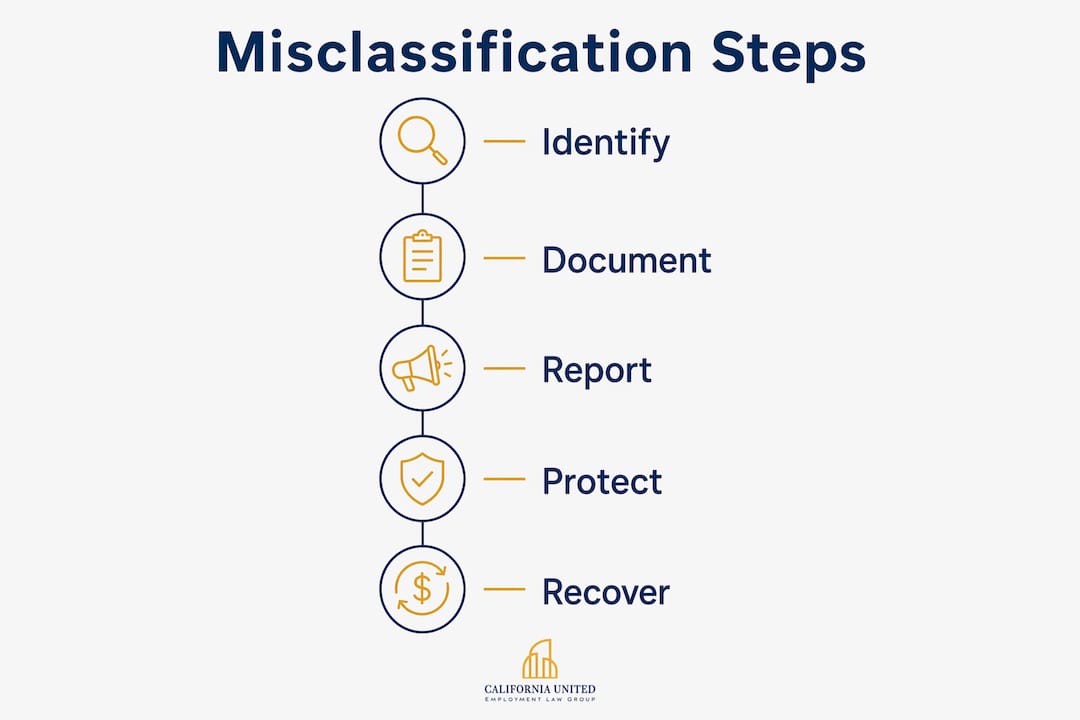
Pro Tip: Keep records of your work schedule, communications with your employer, expenses you paid out of pocket, and any instructions you received about how to perform your work. This documentation supports a misclassification claim significantly.
California law also protects you from retaliation. Firing, demotion, or reduced hours in response to a classification dispute are illegal. If your employer retaliates after you raise a classification or wage concern, you may be able to file a retaliation complaint with the Labor Commissioner or pursue other available remedies.
What are the consequences for employers who misclassify workers in Monterey Park?
Employers who misclassify workers face serious financial and legal exposure under California law. The California Department of Industrial Relations and the Labor and Workforce Development Agency may be involved in enforcing worker-classification and wage-and-hour laws.
The penalties are substantial. Willful misclassification carries civil penalties between $5,000 and $25,000 per violation under Labor Code § 226.8. Penalties may be assessed per violation, and the amount depends on the statute, facts, and enforcement posture.
| Consequence | Details |
|---|---|
| Civil penalties | $5,000–$25,000 per willful misclassification violation under Labor Code § 226.8 |
| Back wages and overtime | Full restitution of unpaid minimum wage, overtime, and premium pay owed to each worker |
| Payroll tax liability | Unpaid employer payroll taxes plus interest and penalties assessed by tax authorities |
| Business expense reimbursement | 100% of worker expenses paid out of pocket that the employer should have covered |
| Mandatory reclassification | Potential reclassification as employees, triggering ongoing compliance obligations |
Employers failing the ABC test also risk audits, back tax assessments, and mandatory reclassification orders. Misclassification can also create tax exposure involving federal and California tax authorities. The financial exposure from a single misclassification audit can far exceed the cost of proper classification from the start.
The ABC test is not optional. Employers in Monterey Park who rely on contractor arrangements for work that is central to their business operations carry significant legal risk.
Key Takeaways
Misclassified workers in Monterey Park may have wage, reimbursement, penalty, retaliation, and benefit-related rights under California law, and hiring entities that fail the applicable classification test may face significant exposure.
| Point | Details |
|---|---|
| ABC test governs classification | When the ABC test applies, the hiring entity must satisfy all three prongs; failing one prong can establish employee status for covered claims. |
| Misclassification denies core rights | Workers lose minimum wage, overtime, breaks, expense reimbursement, and insurance eligibility. |
| Employers face serious penalties | Willful misclassification carries civil penalties of $5,000–$25,000 per violation under Labor Code § 226.8. |
| Retaliation is illegal | California law protects workers who challenge their classification or file complaints. |
| Documentation matters | Records of schedules, instructions, and expenses significantly strengthen a misclassification claim. |
What I’ve Seen Working With Misclassified Workers In Monterey Park
Workers who come to me after years of being labeled contractors are often surprised by one thing: they already knew something was wrong. They just didn’t have a name for it. They were told when to show up, given a company email address, trained by a supervisor, and then handed a 1099 at tax time. Those facts may indicate an employment relationship, not a true independent-contractor relationship, and they warrant legal review.
The most common misconception I encounter is that signing a contractor agreement settles the question. It does not. California courts and the Labor Commissioner look past the paperwork and examine the actual working relationship. A contract that calls you a contractor is not determinative if the actual working relationship shows employee status under the applicable test.
Monterey Park has a large and economically active workforce across retail, food service, logistics, and healthcare support. These are industries where misclassification concerns can arise, and the financial impact on workers can be significant. Workers in these sectors often lack the resources to absorb the loss of overtime pay, expense reimbursements, and workers’ compensation coverage.
My strong advice is this: if the signs of misclassification are present in your situation, get a legal consultation before assuming nothing can be done. California provides enforcement mechanisms that may help misclassified workers pursue unpaid wages, penalties, and other remedies. You do not need to file a lawsuit to start the process.
— California United Law Group
California United Law Group Serves Monterey Park Employees Facing Misclassification
California United Law Group, the public-facing brand of California United Law Group, P.C., represents employees in Monterey Park who believe they may have been misclassified as independent contractors. The firm handles wage and hour violations, Labor Code § 2775 claims, and related employment disputes at every stage, from pre-litigation through trial. If you believe your employer has denied you wages, benefits, or legal protections by treating you as a contractor, a consultation can help clarify your options.
Contact California United Law Group to speak with an employment attorney about your situation in Monterey Park. The firm’s California employment lawyers are available to review Monterey Park workers’ circumstances and explain what California law may provide
FAQ
What is employee misclassification under California law?
Employee misclassification occurs when a hiring entity labels a worker as an independent contractor instead of an employee, in violation of California Labor Code § 2775. For many California wage-and-hour claims, California presumes a person providing labor or services for pay is an employee unless the hiring entity satisfies the ABC test. Some occupations and relationships are exceptions and may be analyzed under Borello instead.
How does the ABC test work in California?
The ABC test requires the hiring entity to prove the worker is free from control, performs work outside the company’s usual business, and operates an independently established trade. When the ABC test applies, failing any single prong can establish employee status for covered California wage-and-hour protections.
What can a misclassified worker recover in Monterey Park?
A misclassified worker may be able to recover unpaid minimum wages, overtime, meal and rest break premiums, reimbursable business expenses, and wage-statement penalties, depending on the facts and applicable claims. Claims are filed with the California Labor Commissioner or through a court action.
Can my employer retaliate if I report misclassification?
Retaliation is illegal under California law. Employers who fire, demote, or reduce hours in response to a classification dispute face separate discrimination complaints and additional liability.
Does a contractor agreement mean I am not an employee?
A contractor agreement does not override the ABC test. California courts examine the actual working relationship, not the label in the contract. If the substance of the relationship meets the employee standard, you are legally an employee regardless of what the agreement says.
Recommended
- Monterey Park Wage Complaint Rights: Understanding California’s Strong Retaliation Protections in 2026 – California United Law Group
- Monterey Park Pregnancy Discrimination: Know Your Rights – California United Law Group –
- National Origin Discrimination: Monterey Park Workplace Laws – California United Law Group
- California Worker Misclassification: Understanding Your Rights Under the ABC Test – California United Law Group