
Unpaid wages for all hours worked is defined as compensation an employer owes but has not paid for time an employee actually spent working, including regular hours, overtime, and legally required break premiums. California law guarantees every worker in Torrance the right to full pay for all labor provided. Recovering unpaid wages — the recognized process under California and federal law — involves formal wage claims, civil lawsuits, or direct employer resolution. This article explains the common causes of wage violations, how to document your hours, the legal processes available, and the penalties you may recover beyond base wages.
What causes unpaid wages for all hours worked in Torrance?
Wage violations in California follow predictable patterns. Employers in Torrance and across the Greater Los Angeles area most often underpay workers through these specific practices:
- Off-the-clock work. Employees start early, finish late, or complete tasks during unpaid breaks without recorded time. Retail workers at South Bay shopping centers and warehouse staff near the Port of Los Angeles frequently report this violation.
- Unpaid overtime. California labor law requires overtime pay at 1.5 times the regular rate after 8 hours in a single day or 40 hours in a week. Employees who work more than 12 hours in a single day, or more than 8 hours on the seventh consecutive day of the same workweek, are entitled to double their regular rate of pay for those additional hours. Many employers calculate overtime only on weekly totals, which shortchanges workers who put in long daily shifts.
- Missed meal and rest break premiums. When an employer fails to provide a compliant 30-minute meal break or a 10-minute rest break, California law requires one additional hour of pay at the employee’s regular rate for each type of missed break per workday. If both a meal break and a rest break are missed on the same day, an employer can owe up to two additional hours of pay for that day. Importantly, “regular rate” includes not just the base hourly wage but also nondiscretionary bonuses and commissions. (Ferra v. Loews Hollywood Hotel, LLC (2021) 11 Cal.5th 858.) These premiums add up quickly across a full year of employment.
- Illegal paycheck deductions. Employers sometimes deduct for uniforms, tools, or cash register shortages. California law prohibits most of these deductions.
- Unreimbursed work expenses. Employees who use personal vehicles or phones for work are entitled to reimbursement. Denying those reimbursements is a form of wage theft.
Pro Tip: Keep a separate note on your phone each day recording your actual start time, end time, and any missed breaks. This personal log becomes powerful evidence if your employer’s records are incomplete or inaccurate.
California courts have consistently reinforced worker protections in these areas. The California Supreme Court held in Naranjo v. Spectrum Security Services, Inc. (2022) 13 Cal.5th 93 that missed-break premium pay constitutes wages — meaning that if an employer fails to pay those premiums, waiting time penalties and wage statement penalties can also apply. In Ferra v. Loews Hollywood Hotel, LLC (2021) 11 Cal.5th 858, the Court confirmed that break premiums must be calculated at the employee’s full “regular rate of pay,” including nondiscretionary bonuses and commissions, not just the base hourly rate. And in Donohue v. AMN Services, LLC (2021) 11 Cal.5th 58, the Court ruled that employers cannot use time-rounding practices to shorten or delay meal periods. Together, these decisions significantly expand the potential recovery available to workers in Torrance and across California.
How can Torrance employees document and calculate missing wages?
Accurate documentation is your strongest foundation for any unpaid wages claim. Detailed records of hours worked, pay received, and employer communications significantly improve your chances of recovery. Gather the following before filing any claim:
- Pay stubs for every pay period in question
- Bank statements showing actual deposits
- Work schedules, shift assignments, or manager texts confirming your hours
- Emails or written messages where supervisors acknowledged extra hours
- Your own daily time log with start times, end times, and break records
Once you have those records, reconcile your actual hours against what you were paid. A simple worksheet helps clarify the gap:
| Week | Hours worked | Hours paid | Difference | Estimated amount owed |
|---|---|---|---|---|
| Week 1 | 48 | 40 | 8 overtime hours | Calculated at 1.5x rate |
| Week 2 | 46 | 40 | 6 overtime hours | Calculated at 1.5x rate |
| Week 3 | 50 | 40 | 10 overtime hours | Calculated at 1.5x rate |

Separate regular hours from overtime hours in your calculation. California applies overtime at the daily level, not just weekly, so an employee who works 10 hours on Monday is owed 2 hours of overtime pay for that day alone, regardless of the rest of the week. For any day on which an employee works more than 12 hours, all hours beyond 12 must be paid at double the regular rate.
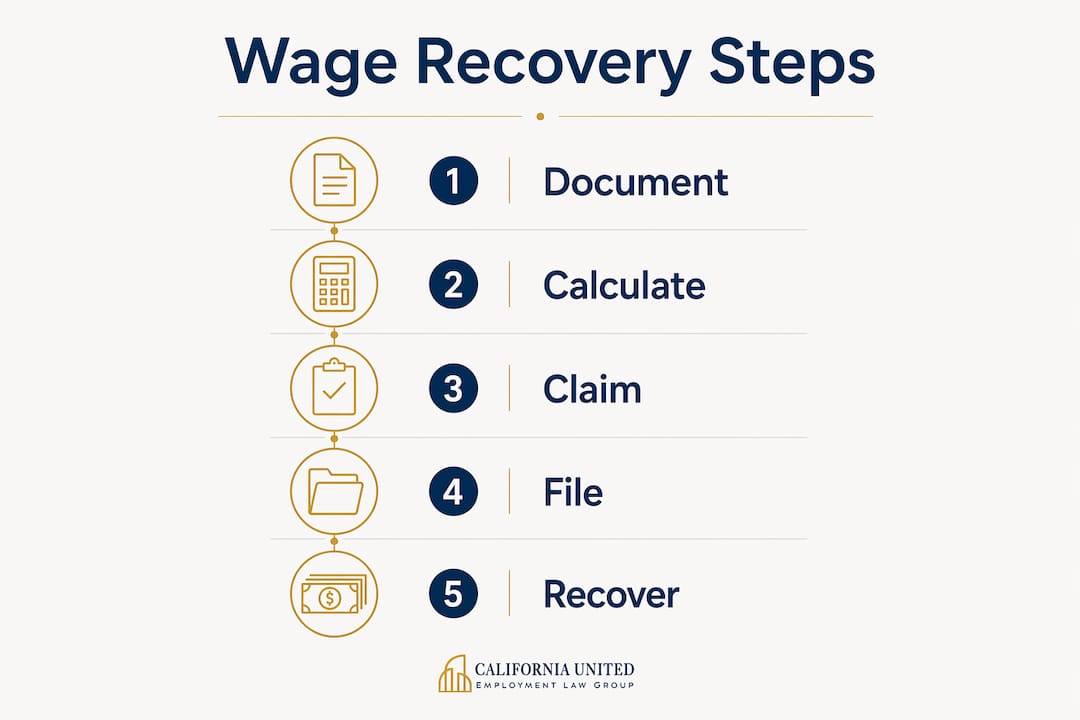
Pro Tip: Preserve screenshots of any scheduling app, time-tracking software, or group chat where your hours or assignments are discussed. Employers sometimes delete digital records once a dispute arises.
What legal processes are available to recover unpaid wages in Torrance?
Torrance employees have two main formal routes to recover compensation for unpaid hours: filing an administrative wage claim or pursuing a civil lawsuit.
Option 1: Filing A Wage Claim With A Government Agency
- California Labor Commissioner (DLSE). File a wage claim with the Division of Labor Standards Enforcement online or at a local office. The process is free and does not require an attorney. The Labor Commissioner investigates the claim, holds a conference, and can order your employer to pay back wages and penalties.
- U.S. Department of Labor Wage and Hour Division. The WHD investigates complaints confidentially, at no cost to you. A successful investigation can recover back pay plus liquidated damages. The agency can also refer cases for litigation when employers refuse to comply.
Administrative claims are cost-free and accessible. The tradeoff is time. Government investigations can take several months to resolve, which matters if you need compensation quickly.
Option 2: Filing A Civil Lawsuit
A civil lawsuit gives you more direct control over the timeline and potential recovery. Legal professionals recommend lawsuits for urgent or complex cases, particularly when the amount owed is large or multiple employees are affected. California courts can award unpaid wages, interest, statutory penalties, and attorney fees.
| Factor | Administrative claim | Civil lawsuit |
|---|---|---|
| Cost to file | Free | Filing fees apply; attorney may work on contingency |
| Timeline | Several months | Varies; can be faster with experienced counsel |
| Potential recovery | Back wages, liquidated damages | Back wages, penalties, interest, attorney fees |
| Best for | Straightforward, smaller claims | Complex, large, or multi-employee cases |
Timing matters. The statute of limitations for wage claims in California depends on the legal basis of the claim. Statutory claims under the Labor Code — such as unpaid overtime and break premiums — are subject to a three-year limitations period. Claims based on a written employment contract may have a four-year period; claims based solely on an oral agreement may have a two-year period. Under federal law (FLSA), the period is generally two years, extended to three for willful violations. Because multiple deadlines may apply to the same set of facts, filing sooner preserves more evidence, more options, and potentially a longer recovery period.
What penalties can Torrance employees recover beyond base wages?
California law builds significant financial penalties into wage violation cases. These penalties exist to compensate workers fully and to discourage employers from underpaying in the first place.
- Waiting time penalties. If your employer willfully fails to pay your final paycheck on time after termination, California Labor Code section 203 allows you to recover up to 30 additional days of wages as a penalty. “Willfully” means the employer intentionally failed to pay — but courts have held that an employer does not need a bad purpose; failing to pay wages the employer knew were owed is sufficient. (Gonzalez v. Downtown LA Motors, LP (2013) 215 Cal.App.4th 36, 54.) This applies to Torrance workers who were discharged, laid off, or who resigned after giving at least 72 hours’ notice. A good-faith dispute over the wages owed may be a defense to this penalty.
- Liquidated damages. Under federal law (the FLSA), workers who are underpaid in violation of minimum wage or overtime requirements may recover their unpaid wages plus an equal amount in liquidated damages — effectively doubling the recovery — unless the employer proves it acted in good faith. Under California law, liquidated damages equal to the unpaid amount are available specifically when an employer pays below the minimum wage (Lab. Code § 1194.2). Employers can avoid California liquidated damages by demonstrating good faith, though courts have discretion in awarding or reducing them.
- Per-paycheck statutory penalties. California law imposes penalties for each pay period in which a wage statement is inaccurate or incomplete. These penalties accumulate across every affected pay period.
- Interest on unpaid wages. Courts can award interest on the unpaid amount from the date the wages were due.
- Attorney fees and court costs. California law allows employees who win wage claims to recover attorney fees from the employer. This provision makes it practical to pursue claims even when the individual amount owed is modest.
These additional remedies mean your total recovery can be substantially higher than the raw unpaid wage amount. Depending on the specific facts, applicable laws, and penalties in a given case, a worker’s total recovery can exceed the raw unpaid wage amount — sometimes significantly — once penalties, interest, and attorney fees are factored in. Every case is different, and outcomes depend on the facts and legal claims available to each employee.
How should Torrance employees protect their rights during a wage dispute?
Taking the right steps early protects both your claim and your job. California labor code rights give you clear protections against retaliation when you assert a wage claim.
- Document discrepancies immediately. Write down the specific dates, hours, and amounts in question as soon as you notice a problem. Memory fades and records disappear.
- Communicate in writing. Send your employer a written request for the wages you believe you are owed. An email creates a record and gives the employer a chance to correct the error before a formal claim is necessary.
- Know the retaliation rules. California law prohibits employers from firing, demoting, or threatening employees who file wage claims or cooperate with labor investigations. If your employer retaliates, that creates a separate legal claim.
- Consult an employment attorney for complex cases. Complex or multi-employee claims benefit significantly from legal counsel. An attorney can calculate your full damages, identify all applicable penalties, and choose the most effective legal route.
- Act within the statute of limitations. The three-year window sounds long, but evidence degrades and witnesses move on. Filing promptly strengthens your case.
Pro Tip: If you suspect your employer will dispute your hours, request a copy of your personnel file and time records in writing. California law gives employees the right to inspect these records, and the request itself signals that you are serious about your claim.
Key Takeaways
California employees in Torrance can recover unpaid wages, liquidated damages, waiting time penalties, and attorney fees by filing a wage claim or civil lawsuit within three years of the violation.
| Point | Details |
|---|---|
| Right to full pay | California law requires payment for all hours worked, including daily overtime and break premiums. |
| Document everything | Pay stubs, time logs, and written communications are the foundation of any successful wage claim. |
| Two formal routes | Administrative wage claims are free; civil lawsuits offer faster and larger recovery in complex cases. |
| Penalties multiply recovery | Liquidated damages and waiting time penalties can double or triple the base unpaid wage amount. |
| Three-year deadline | California Labor Code claims for unpaid overtime and break premiums carry a three-year limitations period; other bases may carry two or four years. Acting early preserves evidence and keeps all legal options open. |
What I’ve Seen Working Wage Cases In Torrance
The most common mistake I see Torrance employees make is waiting too long before doing anything. They assume the error will be corrected on the next paycheck. It rarely is. By the time they come to us, months of records are gone and the employer’s version of events has hardened.
The second mistake is underestimating the full value of a claim. Workers often focus only on the raw unpaid hours. They do not realize that waiting time penalties, liquidated damages, and per-paycheck penalties can make the total recovery significantly larger than the original shortfall. That changes the calculus on whether to pursue a claim at all.
Administrative claims through the California Labor Commissioner work well for straightforward cases with clear records. When the employer disputes the hours, when multiple employees are affected, or when the amounts are large, a civil lawsuit with experienced counsel is usually the more direct path. The government process is free but slow. A lawsuit with a contingency attorney means no attorney fees upfront — the attorney is paid only from a recovery. Clients should discuss with counsel at the outset whether litigation costs (such as filing fees and deposition expenses) are also advanced by the firm or may be the client’s responsibility.
My honest advice: start documenting today, send a written request to your employer, and consult an attorney before the three-year window closes. You do not need to commit to litigation on day one. You just need to preserve your options.
How California United Law Group Helps Torrance Employees Recover What They Are Owed
California United Law Group, P.C. represents employees in Torrance and across the Greater Los Angeles area in wage and hour disputes. The firm handles unpaid overtime, missed break premiums, illegal deductions, and final paycheck violations under the California Labor Code. Whether your situation calls for a Labor Commissioner claim or a civil lawsuit, the team at California United Law Group can assess your options and guide you through the process. Schedule a consultation with Jared R. Sohn to discuss your specific situation. There are no upfront attorney fees for an initial review. The firm handles wage and hour cases on contingency, meaning legal fees are paid only from a recovery — schedule a consultation with Jared R. Sohn to discuss the specific terms and any cost arrangements that apply to your situation.
FAQ
What counts as unpaid wages under California law?
California law requires payment for all hours worked, including regular time, daily overtime, and meal or rest break premiums when an employer fails to provide those breaks.
How long do I have to file an unpaid wages claim in Torrance?
California allows three years from the date of each violation to file a wage theft claim for unpaid wages or overtime.
Can I recover more than just the wages I was not paid?
Yes. California law allows recovery of liquidated damages equal to the unpaid amount, waiting time penalties of up to 30 days of wages for late final paychecks, interest, and attorney fees in successful lawsuits.
Do I need an attorney to file a wage claim in Torrance?
An attorney is not required for an administrative claim with the California Labor Commissioner, but complex or multi-employee claims benefit significantly from legal counsel, particularly when large amounts or employer disputes are involved.
Can my employer fire me for filing a wage claim?
No. California law prohibits retaliation against employees who file wage claims or participate in labor investigations. Retaliation creates a separate legal claim against the employer.
The information in this article is for general educational purposes only and does not constitute legal advice. Every wage claim is different. Prior outcomes described or referenced on this website do not guarantee or predict results in any future matter. Consult an attorney about the specific facts of your situation.
Recommended
- Can Long Beach Workers Claim Unpaid Wages? Your Rights Explained – California United Law Group
- Culver City Wage and Hour Attorneys: Unpaid Overtime Rights – California United Law Group –
- Employment Lawyer Torrance – California United Law Group
- Do Torrance employers have to reimburse work expenses? – California United Law Group