
Glendale employees who report conduct they reasonably believe violates a state or federal statute, rule, or regulation are generally protected from retaliation under California law, including Labor Code §1102.5., which prohibits employers from retaliating against workers who disclose information they reasonably believe reflects a legal violation. If you have already made a report, or are considering one, three actions matter most right now:
- Preserve documentation. Save copies of any written reports, emails, or texts related to your complaint — stored somewhere your employer cannot access. Do not remove confidential, privileged, trade secret, or proprietary employer materials without legal advice.
- Record dates and witnesses. Write down when you made the report, who received it, and who else was present. Do this today, while details are fresh.
- Avoid employer devices for personal backups. Storing private copies on a company laptop or phone creates access and ownership complications.
This article is general educational information about California whistleblower protections. It is not legal advice. Employment law claims are fact-specific, and outcomes vary. For guidance on your specific situation, consult a qualified California employment attorney.
Table of Contents
- What counts as whistleblowing under California law?
- How California defines retaliation — and what it looks like in practice
- California and federal laws that protect Glendale whistleblowers
- Where you can report misconduct — and the trade-offs of each path
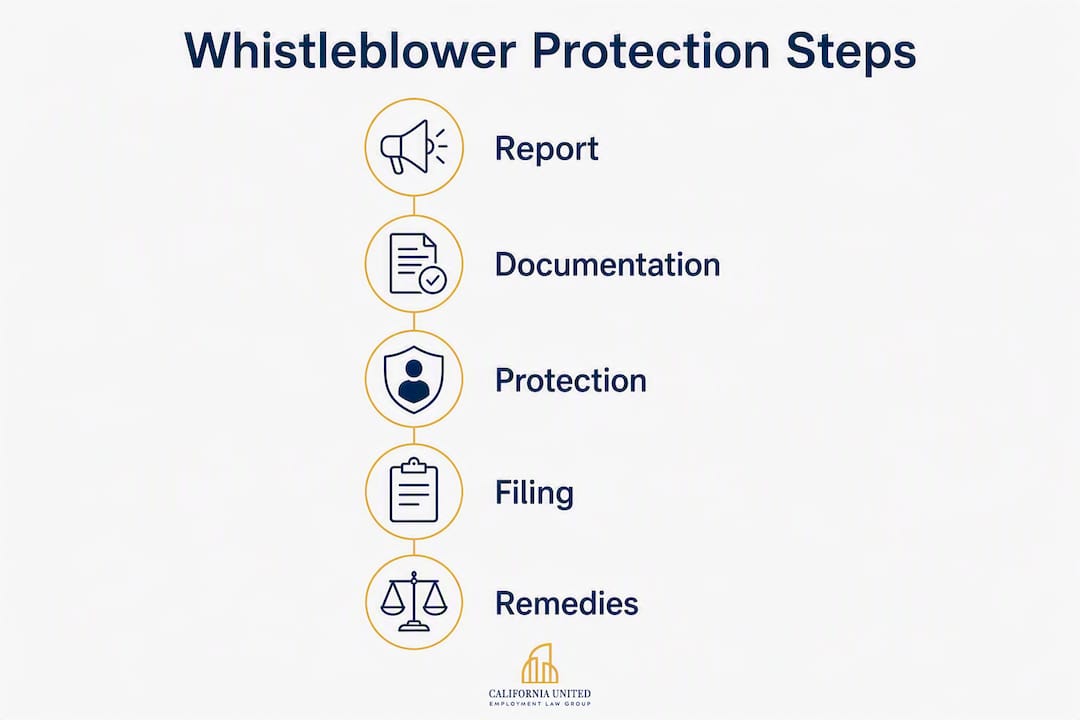
- What to do after you report: a documentation checklist
- How to file a formal complaint: your options and what happens next
- What remedies are available to Glendale employees?
- How employers disguise retaliation — and what to watch for
- Key Takeaways
- A perspective on whistleblower claims from California United Law Group
- How California United Law Group can help you after reporting misconduct
- Authoritative California resources for whistleblower and retaliation claims
What counts as whistleblowing under California law?
Whistleblowing, in the legal sense, usually refers to a protected disclosure, testimony, or refusal to participate in conduct where the employee has reasonable cause to believe the conduct involves a violation of a state or federal statute, or a violation of or noncompliance with a local, state, or federal rule or regulation. Under Labor Code §1102.5, California’s primary whistleblower statute, protected activities include:
- Reporting a suspected legal violation to a supervisor, manager, or anyone inside the organization with authority to investigate or correct it
- Disclosing information to a government or law enforcement agency
- Refusing to participate in an activity you reasonably believe is unlawful
- Providing information to, or testifying before, a public body conducting an investigation
- Examples may include reporting workplace safety violations, wage-law violations, health-code violations, billing fraud, or other suspected legal noncompliance
The “reasonable belief” standard is important. You generally do not need to prove, at the reporting stage, that your employer actually broke the law. The key question is whether you had reasonable cause to believe the information disclosed a legal violation or noncompliance. California courts have interpreted these protections broadly. In Ross v. County of Riverside, the court explained that an employee does not have to expressly identify the specific law being violated, so long as the employee discloses information and reasonably believes it reveals unlawful activity. In People ex rel. Garcia-Brower v. Kolla’s Inc., the California Supreme Court also confirmed that a disclosure can be protected even if the employer or agency already knew about the reported violation.
For Glendale employees, this covers a wide range of real-world situations: reporting unpaid overtime or off-the-clock work to HR, flagging unsafe conditions at a warehouse or restaurant, alerting a manager to billing fraud, or notifying a government agency about a health-code breach.
Pro Tip: The recipient of your report matters. California law protects internal reports made to any person inside your organization who has the authority to investigate, discover, or correct the problem — not only formal HR channels. A report to your direct supervisor can qualify as protected activity.
How California Defines Retaliation — And What It Looks Like In Practice
Retaliation usually means an adverse employment action connected to protected activity. In practical terms, this can include conduct that materially affects the terms, conditions, or privileges of employment, not just termination. California law defines this broadly, and the range of covered actions goes well beyond termination.
Common forms of retaliation include:
- Termination or constructive discharge
- Demotion or reduction in job responsibilities
- Pay cuts or denial of raises
- Involuntary transfers to less desirable positions
- Reduced hours or schedule changes
- Negative performance reviews that appear after a report
- Sudden hostile treatment from supervisors or coworkers
Subtle retaliation is often harder to recognize but just as legally significant. The table below shows how overt and disguised retaliation can look in a Glendale workplace:
| Type | Overt Example | Subtle Example |
|---|---|---|
| Performance | Immediate termination after a complaint | Sudden critical performance reviews after years of positive ones |
| Scheduling | Cutting hours the week after a report | Shifting to undesirable shifts without explanation |
| Duties | Formal demotion | Quietly removing responsibilities or excluding the employee from key meetings |
| Discipline | Written warning citing the complaint | Selective enforcement of minor policy violations not applied to others |
| Environment | Direct threats or hostile statements | Social exclusion, ignored communications, or altered team dynamics |

Consider this pattern: an employee at a Glendale business reports a wage violation to their manager in January. In February, they receive their first-ever written warning for a minor attendance issue that colleagues routinely commit without consequence. Timing and inconsistent treatment are the kinds of facts courts and agencies may consider when evaluating whether retaliation occurred. Documenting both the report and the subsequent treatment is what makes that pattern visible.
California And Federal Laws That Protect Glendale Whistleblowers
Several statutes work together to protect employees who report misconduct. Understanding which law applies to your situation helps determine where to file and what remedies are available.
Labor Code §1102.5 is California’s broadest whistleblower protection statute. It prohibits employers from retaliating against employees who disclose information they reasonably believe reflects a violation of state or federal law. Potential remedies may include reinstatement with back pay and benefits, actual damages, a civil penalty of $10,000 per employee for each violation, reasonable attorney’s fees for a successful plaintiff, and, in some cases, punitive damages.
Labor Code §98.6 provides additional retaliation protections and includes a significant procedural advantage: if an employer takes an adverse action within 90 days of a protected activity, the law creates a rebuttable presumption that the action was retaliatory. Labor Code §98.6 provides additional retaliation protections. If an employer takes prohibited action within 90 days of protected activity covered by that statute, the law creates a rebuttable presumption in favor of the employee’s retaliation claim.
FEHA (Fair Employment and Housing Act) overlaps with whistleblower claims when the reported misconduct involves discrimination or harassment based on a protected characteristic. FEHA administrative complaints are filed with the California Civil Rights Department (CRD, formerly DFEH), and many FEHA lawsuits require a right-to-sue notice before filing in court.
Federal statutes add another layer. The EEOC processes discrimination and retaliation claims under Title VII, the ADA, and the ADEA when the employer meets federal size thresholds. OSHA handles retaliation complaints tied to workplace safety reports.
The agencies Glendale employees will most commonly interact with:
- DLSE / Labor Commissioner — wage claims, retaliation under the Labor Code, and general labor violations
- California Civil Rights Department (CRD/DFEH) — FEHA-based discrimination, harassment, and retaliation claims
- EEOC — federal discrimination and retaliation claims
- Cal/OSHA / Labor Commissioner resources – workplace safety issues and related retaliation complaint information
Pro Tip: Filing windows differ by agency and claim type. Some deadlines are as short as one year; others extend to three years for certain FEHA claims. Confirm the correct window for your specific claim directly with the agency or with an employment attorney before assuming you have time.
Where You Can Report Misconduct — And The Trade-offs Of Each Path
Glendale employees have several reporting options, and the right choice depends on the nature of the misconduct, your risk tolerance, and how quickly you need the situation addressed.
Reporting channels available to you include:
- Direct manager or supervisor — appropriate when the violation does not involve that person
- HR department or internal compliance channel — standard first step in many organizations
- Any person with authority to investigate — California law protects this, even if they are not in HR
- State agencies — DLSE for labor/wage issues, CRD for FEHA claims
- Federal agencies — EEOC for federal discrimination, OSHA for safety violations
- Anonymous hotlines — some employers maintain these; protection levels vary
- Union representative or grievance process — for unionized Glendale employees, a separate procedural path exists
| Reporting Path | Protection Level | Confidentiality | Investigative Scope | Speed |
|---|---|---|---|---|
| Internal (HR/manager) | Protected under §1102.5 | Moderate — employer controls process | Limited to employer’s investigation | Fastest initial response |
| External (state/federal agency) | Statutory protection may apply, depending on the claim and agency | Higher — agency-controlled | Broader; agency can compel records | Slower; formal process |
| Anonymous hotline | Varies; harder to enforce if identity unknown | Potentially higher, but not guaranteed | Depends on employer’s process | Variable |
| Union grievance | Protected under collective bargaining | Moderate | Governed by CBA terms | Varies by contract |
One point worth emphasizing: California law protects internal reports to anyone with authority to investigate or correct the violation — you do not need to go to a government agency to be covered. That said, external filings with agencies like the DLSE or CRD trigger formal investigative processes that internal reports do not.
For unionized employees in Glendale, collective bargaining agreements may provide additional procedural protections and grievance mechanisms. A union representative can explain what the contract provides, though the statutory protections under California law apply independently of union membership.
What To Do After You Report: A Documentation Checklist
The period immediately after making a report is when your documentation habits matter most. Courts and agencies rely heavily on contemporaneous records — notes and copies created at the time events occurred, not reconstructed later.
Documentation checklist:
- Save your written report. Keep a copy of any complaint you submitted in writing — email, online form, or letter. Store it outside your employer’s systems.
- Record the date, time, and recipient. Note exactly when you made the report, who received it (name and title), and the method (in person, email, HR portal).
- Save related communications. Preserve emails, texts, or voicemails connected to the report or to any changes in your treatment afterward. If the material includes confidential employer information, trade secrets, privileged communications, or private information about others, speak with an attorney before copying or distributing it.
- Keep your personnel file current. Request a copy of your personnel file before any adverse action is taken, if possible. California law generally gives employees the right to inspect and receive copies of certain personnel records, subject to statutory procedures and limits.
- Note any changes in treatment. Write down schedule changes, new assignments, exclusions from meetings, or altered supervisory behavior — with dates.
- Preserve pay records. Keep copies of pay stubs, timesheets, and any records showing changes in hours or compensation.
- Identify witnesses. Note the names of coworkers who observed the report, the retaliation, or both.
Pro Tip: Store personal copies on a personal device or personal cloud account — never on employer-issued equipment. Employers may have access to company devices and accounts, which can complicate your ability to retrieve records later.
What to avoid:
- Deleting messages or communications, even ones that seem unrelated
- Discussing the specifics of your complaint publicly on social media
- Signing any waiver, release, or settlement document without first consulting an attorney
- Assuming that because nothing has happened yet, nothing will
Timing is also evidence. For protected activity covered by Labor Code §98.6, certain adverse actions within 90 days may trigger a rebuttable presumption in favor of the employee’s retaliation claim. Sudden performance write-ups, policy enforcement that was never applied before, or inconsistent disciplinary treatment in that window are all worth documenting carefully.
How To File A Formal Complaint: Your Options And What Happens Next
When internal reporting does not resolve the problem, or when retaliation has already occurred, formal filing becomes the next consideration. Two main routes exist: administrative filings with a state or federal agency, or a private civil lawsuit.

Administrative filings are handled by agencies like the DLSE, CRD, or EEOC. They are generally lower-cost to initiate and can result in agency investigations, conciliation, and sometimes civil penalties. A right-to-sue notice from the CRD or EEOC is typically required before filing a civil lawsuit on FEHA or federal discrimination claims.
Private civil lawsuits under Labor Code §1102.5 and related statutes can be filed directly in California court without an administrative prerequisite in some cases, though confirming the correct path with counsel is important.
Typical stages after filing:
- Intake and charge filing — you submit a complaint or intake form to the relevant agency (DLSE, CRD, or EEOC).
- Agency review and investigation — the agency reviews the complaint, may contact your employer, and gathers information.
- Conciliation or mediation — many agencies attempt to resolve complaints through negotiation before proceeding further.
- Right-to-sue notice — for FEHA and federal claims, the agency issues a notice that allows you to file a private lawsuit if the agency does not resolve the matter.
- Private litigation or settlement — cases proceed to court or resolve through settlement at various stages.
Filing deadlines vary significantly:
- DLSE retaliation claims: confirm the current window directly with the agency
- CRD/FEHA employment claims: generally, you must submit an intake form within three years of the last harmful act
- EEOC federal claims: typically 180 or 300 days depending on whether a state agency also covers the claim
These windows can be shorter than they appear, especially when multiple claims or agencies are involved. Confirm your specific deadline with the CRD complaint process page, the DLSE, or an employment attorney before taking any action.
What remedies are available to Glendale employees?
California law provides several categories of relief for employees whose whistleblower rights were violated. The specific remedies available depend on which statute applies, which agency or court handles the claim, and the facts of the case.
Common remedies include:
- Reinstatement — returning to your former position or an equivalent one
- Back pay and lost benefits — compensation for wages and benefits lost due to retaliation
- Actual damages — compensation for legally recoverable losses caused by retaliation
- Punitive damages — available in some cases where the facts and legal standard support them
- Front pay — compensation for future lost earnings when reinstatement is not feasible
- Civil penalties — under Labor Code §1102.5, employers may face a civil penalty of $10,000 per employee for each violation
- Attorney’s fees — successful plaintiffs under §1102.5 may recover reasonable attorney’s fees from the employer
- Injunctive relief — court orders requiring the employer to stop retaliatory conduct or implement corrective measures
Outcomes vary considerably. A wage retaliation claim resolved through the DLSE may result in back pay and reinstatement. A discrimination-related retaliation claim under FEHA may involve additional damages. There is no reliable “average” payout — results depend on the strength of the evidence, the nature of the harm, the employer’s conduct, and the applicable statute.
Settlement and mediation resolve many whistleblower claims before trial. If your employer proposes a settlement, review the terms carefully with an attorney before signing. Confidential settlement agreements often include broad release language that affects future claims.
How Employers Disguise Retaliation — And What To Watch For
Employers rarely announce that an adverse action is connected to a complaint. More often, retaliation is framed as a performance issue, a business decision, or a policy enforcement matter. Recognizing these patterns early gives you time to document them.
Common employer tactics include:
- Sudden performance write-ups that appear shortly after a report, with no prior history of documented concerns
- Shifting attendance records or retroactive changes to timekeeping entries
- Altered job descriptions that reduce responsibilities without a formal demotion
- Selective enforcement of minor policies that were never applied to other employees
- Disciplinary records that appear inconsistent with prior evaluations, policies, or how other employees were treated
The most effective counter to these tactics is a paper trail that predates them. Prior performance appraisals showing positive ratings, date-stamped emails from supervisors praising your work, and records of colleagues receiving different treatment for the same conduct all help establish that a new negative narrative is inconsistent with your actual history.
Red flags that suggest faster action may be warranted:
- Adverse actions occurring within 90 days of protected activity covered by Labor Code §98.6
- Disciplinary patterns that apply only to you and not to similarly situated coworkers
- Coercive statements or implied threats from management
- Sudden changes to your role, team, or reporting structure without business justification
Reviewing signs of employer retaliation can help you identify patterns that warrant legal consultation sooner rather than later.
Pro Tip: Save copies of any new policy memos, employee handbook updates, or procedural changes issued after your report. If an employer later claims you violated a policy, having the version in effect at the time of your report can be important context.
Key Takeaways
California employees in Glendale who report suspected legal violations or refuse to participate in unlawful activity may be protected under Labor Code §1102.5 and related statutes. Documentation created close in time to the report can be important evidence in a retaliation claim.
| Point | Details |
|---|---|
| Protection is broad | Labor Code §1102.5 can cover internal and external reports when the employee has reasonable cause to believe the information discloses legal violations or noncompliance. |
| The 90-day window matters | For protected activity covered by Labor Code §98.6, certain adverse actions within 90 days may trigger a rebuttable presumption in favor of the employee’s claim. |
| Document immediately | Save copies of reports, emails, pay records, and witness names off employer systems as soon as possible. |
| Filing deadlines vary | CRD/FEHA employment claims generally require an intake form within three years; other agency windows may be shorter — confirm with counsel. |
| California United Law Group | The firm represents Glendale employees in whistleblower and retaliation matters under California Labor Code and FEHA, with free consultations available. |
This article is general educational information about California employment law. It is not legal advice, and no attorney-client relationship is formed by reading it. Employment law matters are fact-specific — consult a qualified California employment attorney for guidance on your situation.
A Perspective On Whistleblower Claims From California United Law Group
What often surprises employees is how quickly the evidentiary window closes after a report. Many employees focus first on whether their report may be legally protected. That question depends on what was reported, who received the report, what the employee reasonably believed, and what happened afterward. California law gives employees meaningful tools, including a reasonable-cause standard under Labor Code §1102.5, potential fee-shifting for successful plaintiffs, agency filing options, and, for protected activity covered by Labor Code §98.6, a possible 90-day rebuttable presumption. Those tools only work if there is a contemporaneous record to support them.
Some retaliation cases become harder to evaluate when key documents, dates, and witness information are missing. They are the ones where an employee waited weeks or months before writing anything down, or signed a document they did not fully understand, or assumed the situation would resolve on its own. Glendale employees who report misconduct and then experience changes in their treatment deserve to know their options early — before evidence fades and deadlines approach.
California United Law Group works with employees in the Glendale area on whistleblower and retaliation claims under California Labor Code and FEHA. We offer consultations to help employees understand what their documentation shows and what options may be available. This perspective is informational and does not constitute legal advice for any individual situation.
How California United Law Group Can Help You After Reporting Misconduct
If you are a Glendale employee who has reported workplace misconduct and is now facing changes in your treatment, California United Law Group offers a free consultation to review your documentation, discuss the facts, and identify legal options that may be available.
The firm handles whistleblower and retaliation matters under California Labor Code §1102.5, Labor Code §98.6, and FEHA, including administrative complaint filings with the DLSE and CRD, and civil litigation when the facts support it. In many employment matters, California United Law Group may offer contingency-fee representation, meaning attorney’s fees are typically paid from a settlement or judgment if the case succeeds. Any fee and cost responsibilities will depend on the written fee agreement.
What to bring to your consultation:
- Copies of any written reports or complaints you submitted
- Dates and names of anyone who received your report
- Records of any changes in your treatment, schedule, pay, or duties after reporting
- Copies of relevant emails, texts, or performance reviews
- Names of any witnesses
Contact California United Law Group to request a free consultation with a Glendale employment attorney. You can also learn more about local representation on the firm’s Glendale retaliation attorneys page.
Authoritative California Resources For Whistleblower And Retaliation Claims
Use these official sources to confirm current filing procedures, deadlines, and forms before taking action. Deadlines and procedures can change; always verify directly with the agency or with qualified legal counsel.
- California Civil Rights Department (CRD) — How to File a Complaint — Online intake portal for FEHA-based retaliation, discrimination, and harassment claims; employment cases generally require intake within three years of the last harmful act.
- CRD Complaint Process Overview — Explains investigation stages, conciliation, and right-to-sue procedures.
- CRD Retaliation Fact Sheet — Plain-language summary of retaliation protections for California employees.
- DLSE Whistleblowers Are Protected Notice — Official DLSE notice outlining who is covered and what remedies are available under California labor law.
- DLSE Retaliation Complaint Procedure — Step-by-step agency guidance for filing a retaliation complaint with the Labor Commissioner.
- California Labor Code §1102.5 (Justia) — Full text of California’s primary whistleblower protection statute.
- California Labor Code §98.6 (Legislature) — Full text of the retaliation protection statute that includes the 90-day rebuttable presumption.
- U.S. Department of Labor — Whistleblower Protections — Federal overview of whistleblower programs across multiple industries and agencies.
- California United Law Group — Glendale Employment Attorney — Local Glendale resource for employees seeking a consultation on whistleblower or retaliation matters.
Verify all filing windows directly with the relevant agency or with a California employment attorney before submitting any complaint. Deadlines are strictly enforced, and missing one can affect your ability to pursue a claim.
Recommended
- Fired After Reporting Violations? Know Your Rights – California United Law Group
- Glendale Off-the-Clock Work Violations: Know Your Rights – California United Law Group –
- Glendale Workplace Retaliation Attorneys on Employer Signs – California United Law Group –
- Los Angeles Whistleblower Claims: Your 2026 Rights Guide – California United Law Group –