
Los Angeles whistleblower claims are formal legal actions that protect employees who report suspected workplace violations from retaliation by their employers. Under California Labor Code Section 1102.5, the state’s primary whistleblower protection statute, you do not need to prove that an actual violation occurred. You only need reasonable cause to believe a violation happened. That distinction matters enormously for Los Angeles workers. Senate Bill 497, effective since 2024, added a powerful procedural tool: if your employer takes adverse action against you within 90 days of your protected disclosure, California law presumes retaliation occurred. Once an employee demonstrates that the protected disclosure was a contributing factor in the adverse action, the burden shifts to the employer to prove by clear and convincing evidence that it would have taken the same action regardless of the disclosure. These protections apply to workers across Los Angeles, from downtown office employees to public sector workers in agencies like the Los Angeles Unified School District and the Department of Water and Power.
What rights do Los Angeles employees have under whistleblower protections?
California Labor Code Section 1102.5 is the foundation of whistleblower protections in Los Angeles. It prohibits employers from retaliating against employees who disclose information about suspected violations of state or federal law, local ordinances, or regulations. Disclosures can be made to a government agency, law enforcement, or even an internal supervisor. You have flexibility in where you report.
The 90-day retaliation presumption under SB 497 is one of the most significant recent changes to California whistleblower law. If your employer fires, demotes, or otherwise punishes you within 90 days of your protected activity, the law presumes that action was retaliatory. To invoke the full protection of the law, an employee must first demonstrate by a preponderance of the evidence that the protected disclosure was a ‘contributing factor’ in the employer’s adverse action. This standard does not require proof that retaliation was the sole or even the primary reason—only that it played a role. The California Supreme Court, in Lawson v. PPG Architectural Finishes, Inc. (2022) 12 Cal.5th 703, confirmed that once the employee meets this threshold, the burden shifts to the employer to prove by clear and convincing evidence that the adverse action would have occurred regardless of the disclosure. Your employer must then prove by clear and convincing evidence that it would have taken the same action regardless of your disclosure.
Protected forms of retaliation under California law include:
- Termination or constructive dismissal
- Demotion or reduction in pay
- Suspension or unpaid leave
- Negative performance reviews tied to the disclosure
- Harassment, intimidation, or hostile work environment
- Reassignment to less desirable duties or locations
California’s protections are broader than federal whistleblower statutes in several ways. Federal laws like the Sarbanes-Oxley Act or the False Claims Act cover specific industries or types of fraud. California Labor Code Section 1102.5 applies across virtually all private and public sector workplaces in Los Angeles, regardless of employer size or industry.
Pro Tip: Document every adverse action your employer takes after your disclosure, including dates, names of supervisors involved, and any written communications. This record becomes critical if you pursue a claim.
The LA County Office of Labor Equity also provides worker protection resources and enforcement functions, reachable at (800) 593-8222. This office can be a useful starting point for employees in Los Angeles County who need guidance before pursuing formal legal action.
How does the legal process for whistleblower claims work in LA?
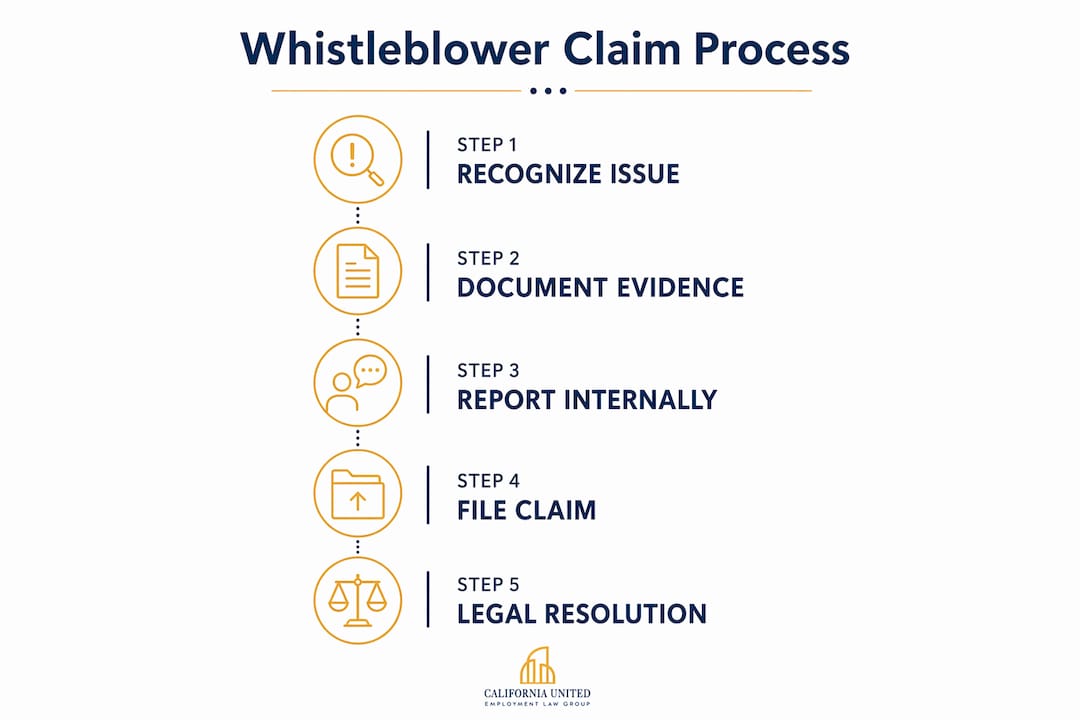
Understanding the procedural steps in a whistleblower claim helps you protect your rights from the start. Here is how the process generally unfolds for Los Angeles employees:
- Protected disclosure occurs. You report a suspected violation to a government agency, law enforcement, or an internal supervisor. The disclosure triggers your legal protections immediately.
- Adverse action follows. Your employer takes a negative employment action against you, such as termination, demotion, or harassment.
- The 90-day window activates. If the adverse action occurs within 90 days of your disclosure, a rebuttable presumption of retaliation arises under SB 497, which helps establish that your disclosure was a contributing factor in the employer’s decision.
- Employer responds. Your employer must present clear and convincing evidence that the adverse action was taken for legitimate, independent reasons unrelated to your disclosure.
- Claim is filed. You file a civil lawsuit in the appropriate Los Angeles area court, such as the Los Angeles Superior Court.
- Discovery and litigation. Both sides gather evidence, take depositions, and prepare for trial or settlement.
California courts have refined the legal framework for these claims in important ways. In Lawson v. PPG Architectural Finishes, Inc. (2022) 12 Cal.5th 703, the California Supreme Court clarified that Labor Code Section 1102.6—not the federal McDonnell Douglas burden-shifting test—governs whistleblower retaliation claims under Section 1102.5. This means an employee needs only to show that the protected disclosure was a ‘contributing factor’ in the adverse action, a lower bar than prior frameworks required. Separately, in Ross v. County of Riverside (2019) 36 Cal.App.5th 580, the Court of Appeal held that an employee does not need to expressly identify a specific law being violated in their disclosure—reasonable belief that unlawful activity occurred is sufficient. And in Whitehall v. County of San Bernardino (2017) 17 Cal.App.5th 352, the court confirmed that whistleblower claims against public agencies are not barred by governmental immunity, an important protection for public sector employees in Los Angeles.
Evidence that strengthens a whistleblower claim includes:
| Evidence Type | Why It Matters |
|---|---|
| Written disclosure records | Establishes the date and content of your protected activity |
| Timeline of adverse actions | Shows proximity to the disclosure, supporting the presumption |
| Performance reviews before and after | Demonstrates a shift in employer treatment |
| Witness statements | Corroborates your account of retaliation |
| Internal communications | May reveal employer awareness of your disclosure |
Timing is the most common pitfall in these cases. Missing the statute of limitations or failing to document the sequence of events can weaken an otherwise strong claim. Employers frequently present legitimate, nonretaliatory reasons for adverse actions, and courts require substantial evidence linking the retaliation to your protected activity.

If you prevail, recoverable remedies under Labor Code Section 1102.5 and related provisions include reinstatement with back pay and benefits, front pay, emotional distress damages, civil penalties up to $10,000 per violation, punitive damages, and reasonable attorney’s fees awarded to a successful plaintiff. That range of remedies reflects how seriously California treats employer retaliation.
Pro Tip: Keep a private log outside of work systems, such as a personal email or notebook, recording every incident of potential retaliation with dates and details. Courts treat contemporaneous records as highly credible.
What do recent Los Angeles cases reveal about whistleblower outcomes?
Recent cases from Los Angeles illustrate both the potential rewards and the real risks of pursuing a whistleblower claim. These outcomes offer concrete lessons for any employee considering this path.
The LAUSD structural engineer case is one of the most striking recent examples. A Los Angeles structural engineer won $2 million in emotional distress damages in 2025 after reporting structural safety concerns in Los Angeles Unified School District buildings. In 2026, the engineer sought nearly $7 million in attorney’s fees. The litigation spanned eight years. That timeline underscores a critical reality: even a successful whistleblower case demands sustained commitment.
“Whistleblower lawsuits can span multiple years and require sustained legal effort, with potential for significant awards in damages and attorney’s fees for successful plaintiffs.” — Recent Los Angeles case analysis
The DWP auditor case tells a different story. In 2026, a Los Angeles jury rejected a whistleblower claim brought by a city auditor against the Department of Water and Power. The jury sided with the employer, which successfully demonstrated legitimate, nonretaliatory reasons for the adverse actions taken. This outcome highlights that strong California laws do not guarantee a favorable verdict.
Key lessons from these two cases:
- A large damages award is possible, but the path is long and uncertain.
- Employers invest heavily in building alternative explanations for adverse actions.
- Credible, well-documented evidence is the difference between winning and losing.
- Emotional distress damages can be substantial when retaliation is proven.
- Attorney’s fees awards can exceed the underlying damages in complex cases.
These cases also reflect the broader Los Angeles labor environment, where both private employers and large public agencies like LAUSD and DWP have legal teams prepared to contest retaliation claims. Knowing this going in shapes how you prepare your case and what to expect from the process.
How do whistleblower protections relate to retaliation laws in Los Angeles?
Whistleblower protections and general workplace retaliation laws overlap significantly in California, but they are not identical. Understanding the difference helps you identify all the legal tools available to you.
| Protection Type | Trigger | Key Statute | Burden Shift |
|---|---|---|---|
| Whistleblower protection | Reporting suspected legal violations | Labor Code § 1102.5 | Yes, within 90 days under SB 497 |
| General retaliation protection | Exercising any protected legal right | FEHA, Labor Code § 98.6 | Depends on claim type |
| Wrongful termination | Termination violating public policy | Common law / FEHA | No automatic presumption |
California’s Labor Code also protects employees from retaliation beyond whistleblowing, including wrongful termination and harassment claims, with overlapping remedies. This broader safety net means that if your employer fires you after you report misconduct, you may have claims under multiple statutes simultaneously.
Common retaliation types covered across these overlapping laws include:
- Firing an employee for reporting wage theft or safety violations
- Demoting a worker after they file a complaint with the California Labor Commissioner
- Harassing an employee who reported discrimination to the California Civil Rights Department
- Cutting hours or reassigning duties after an internal complaint about illegal conduct
The relationship between retaliation and whistleblowing claims matters practically because each statute carries its own procedural requirements, deadlines, and remedies. Filing under multiple statutes, where appropriate, can strengthen your overall legal position. An experienced employment attorney can assess which claims apply to your specific situation in Los Angeles.
What I’ve Learned About Whistleblower Cases In Los Angeles
The LAUSD engineer case and the DWP auditor case, both from 2025 and 2026, tell you everything you need to know about the practical reality of whistleblower litigation in Los Angeles. The law is genuinely protective. California’s 90-day presumption under SB 497 is a real procedural advantage that shifts meaningful pressure onto employers. But the law does not win cases by itself.
What I have seen repeatedly is that employees underestimate the documentation burden. They report a violation, face retaliation, and then struggle to reconstruct a clear timeline months later when litigation begins. The employers who successfully defend these cases almost always do so by presenting a paper trail of their own, performance issues, budget cuts, restructuring plans, that predates the disclosure. Your strongest defense against that strategy is a contemporaneous record that you built before any dispute arose.
The eight-year duration of the LAUSD case is not an outlier. Whistleblower litigation in Los Angeles regularly runs three to five years. That is not a reason to avoid filing a legitimate claim. It is a reason to go in with clear expectations and solid legal support from the start. California’s laws are among the strongest in the country for employees in this situation. Using them well requires preparation, patience, and professional guidance.
For employees in areas like Pasadena, Long Beach, or anywhere across Los Angeles County, the process for filing and preserving a whistleblower claim follows the same California framework. Local context matters, but the legal foundation is statewide.
How California United Law Group Can Help With Your Whistleblower Claim
If you believe you have faced retaliation for reporting workplace misconduct in Los Angeles, California United Law Group is ready to help.
California United Law Group, P.C. represents employees across Los Angeles in whistleblower and retaliation claims, wrongful termination, discrimination, and wage and hour disputes. The firm handles California Labor Code and FEHA claims at every stage, from pre-litigation through trial. Timing matters in these cases. The 90-day presumption window and statute of limitations mean that delays can cost you critical legal protections. Contact California United Law Group for a case evaluation and get a clear picture of your rights before making any decisions.
Key Takeaways
Whistleblower retaliation claims in Los Angeles require timely action, strong documentation, and a clear understanding of California’s protective legal framework.
| Point | Details |
|---|---|
| Reasonable cause is enough | You do not need to prove a violation occurred, only that you had reasonable cause to believe one did. |
| 90-day presumption is powerful | Adverse action within 90 days of your disclosure triggers a legal presumption of retaliation under SB 497. |
| Outcomes are not guaranteed | Recent LA cases show both $2 million verdicts and jury rejections, depending on evidence quality. |
| Multiple claims may apply | Whistleblower, retaliation, and wrongful termination claims can overlap and strengthen your legal position. |
| Documentation is your foundation | A contemporaneous record of events, dates, and communications is the most critical asset in any claim. |
FAQ
What is a whistleblower claim under California law?
A whistleblower claim is a legal action filed by an employee who faced retaliation for reporting a suspected violation of law to a government agency, law enforcement, or an internal supervisor. California Labor Code Section 1102.5 governs these claims and protects employees even if the reported violation is never proven.
How long do I have to file a whistleblower claim in Los Angeles?
The statute of limitations for whistleblower retaliation claims under Labor Code Section 1102.5 is generally three years from the date of the retaliatory act. However, claims limited to the civil penalty under Labor Code Section 1102.5(f) may be subject to a shorter one-year limitations period. Because the applicable deadline depends on the specific relief sought, you should consult an attorney promptly after any retaliatory act. Acting quickly preserves your rights and protects the 90-day presumption window created by SB 497.
What counts as retaliation in a whistleblower case?
Retaliation includes any adverse employment action taken because of your protected disclosure, such as termination, demotion, pay cuts, harassment, or reassignment. California law covers a broad range of employer responses, not just termination.
Can I file a whistleblower claim against a public agency in Los Angeles?
Yes. Recent cases involving the Los Angeles Unified School District and the Department of Water and Power confirm that public sector employees in Los Angeles have the same whistleblower protections as private sector workers under California law.
Do I need a lawyer to file a whistleblower claim?
You are not legally required to have an attorney, but whistleblower cases involve complex evidentiary standards and employer defenses. An experienced employment law attorney can help you preserve evidence, meet deadlines, and build the strongest possible case.