
A promotion barrier can be unlawful under California law when a protected characteristic such as sex, race, age, or gender identity is a substantial motivating factor in the decision. If you work in Inglewood and believe invisible barriers are limiting your career advancement, here are three immediate steps to take right now:
- Document everything. Write down dates, names, and specific incidents while details are fresh. Note who was promoted, when, and under what stated criteria.
- Preserve evidence lawfully. Keep copies of documents you are authorized to access, save your own performance reviews and communications when permitted, and avoid taking confidential, proprietary, or privileged company materials without legal advice.
- Know your filing window. Under California’s Fair Employment and Housing Act (FEHA), you generally have up to three years from the discriminatory act to file an administrative complaint with the California Civil Rights Department (CRD).
Inglewood employees have access to both state protections under FEHA and federal protections under Title VII of the Civil Rights Act. California’s state law is often broader in important respects, including coverage of smaller employers and additional protected categories, although the specific rights and deadlines depend on the facts.
Table of Contents
- What is the glass ceiling and why does it persist?
- How glass ceiling discrimination shows up in the workplace
- The legal framework that protects Inglewood employees
- How to collect evidence that supports your claim
- What to do next if you believe you’ve been discriminated against
- Practical strategies for breaking through promotion barriers
- Key Takeaways
- California United Law Group’s perspective on glass ceiling claims
- How California United Law Group can help Inglewood employees
- Useful sources and further reading
What is the glass ceiling and why does it persist?
The “glass ceiling” describes an invisible barrier that prevents qualified employees, particularly women and people of color, from advancing to senior or leadership roles despite their qualifications and performance. The term is informal, not a standalone legal claim. But when promotion barriers are tied to a protected characteristic, the facts may support claims such as disparate treatment or disparate impact under California or federal employment law.

Two related concepts are worth knowing. The sticky floor refers to barriers that keep workers in low-wage or entry-level roles, preventing upward movement from the start. The frozen middle describes the phenomenon where employees advance to mid-level management but then stall, unable to break into executive or senior leadership tiers. All three patterns can reflect systemic discrimination when protected characteristics drive the outcome.
Research published in PMC describes the glass ceiling as often connected to structural and cultural organizational practices rather than a single isolated decision. Statistical patterns in promotion rates and leadership representation can demonstrate systemic exclusion, which is why aggregated data often plays a central role in these claims.
Structural drivers of the glass ceiling include:
- Vague or inconsistently applied promotion criteria
- Restricted access to high-visibility projects and stretch assignments
- Sponsorship gaps (senior leaders who advocate for advancement tend to favor people similar to themselves)
- Informal networks that exclude certain employees from key conversations
Cultural drivers include:
- Gender and racial stereotypes about leadership ability
- Affinity bias, where decision-makers favor candidates who remind them of themselves
- Microaggressions that signal certain employees are not seen as leadership material
- Performance reviews that use subjective language applied differently across demographic groups
Pro Tip: Ask your HR department for the written promotion criteria for any role you are interested in. If no written criteria exist, that absence may be relevant, especially if promotion decisions appear inconsistent or favor employees outside the protected group.
How glass ceiling discrimination shows up in the workplace
Recognizing the pattern matters. A single passed-over promotion may reflect any number of factors. A repeated pattern, especially one that tracks protected characteristics and affects advancement, may help support a claim when it connects the adverse decision to unlawful bias.
Common workplace signals include:
- Being passed over for promotion repeatedly while less-qualified colleagues in a different demographic group advance
- Receiving late or no notice about open leadership positions
- Being excluded from high-profile projects, client-facing work, or assignments that typically lead to promotion
- Performance reviews that use vague, subjective language compared to more specific, positive reviews given to similarly situated colleagues
- Pay gaps between employees with comparable roles, tenure, and performance records
- Being steered toward support roles rather than leadership tracks
Comparator analysis is one of the most practical tools for identifying disparate treatment. A comparator is a similarly situated employee outside your protected group who was treated more favorably. To be useful, a comparator should share comparable job duties, tenure, performance history, and objective qualifications. The comparison does not need to be perfect, but the more closely matched, the stronger the evidence.
| Factor | What to compare |
|---|---|
| Job duties | Same or substantially similar responsibilities |
| Tenure | Comparable time with the employer |
| Performance record | Similar ratings, no greater disciplinary history |
| Qualifications | Education, certifications, relevant experience |
| Promotion outcome | Comparator advanced; you did not |

Intersectionality is especially relevant in Inglewood, a city with a diverse workforce. A woman of color may face compounded barriers that neither a race-only nor a gender-only analysis fully captures. Discrimination may involve more than one protected characteristic, and employees should document all protected bases that appear connected to the promotion barrier. FEHA’s broad list of protected characteristics, including race, sex, gender identity, national origin, and age (40+), means that intersectional claims are cognizable under state law.
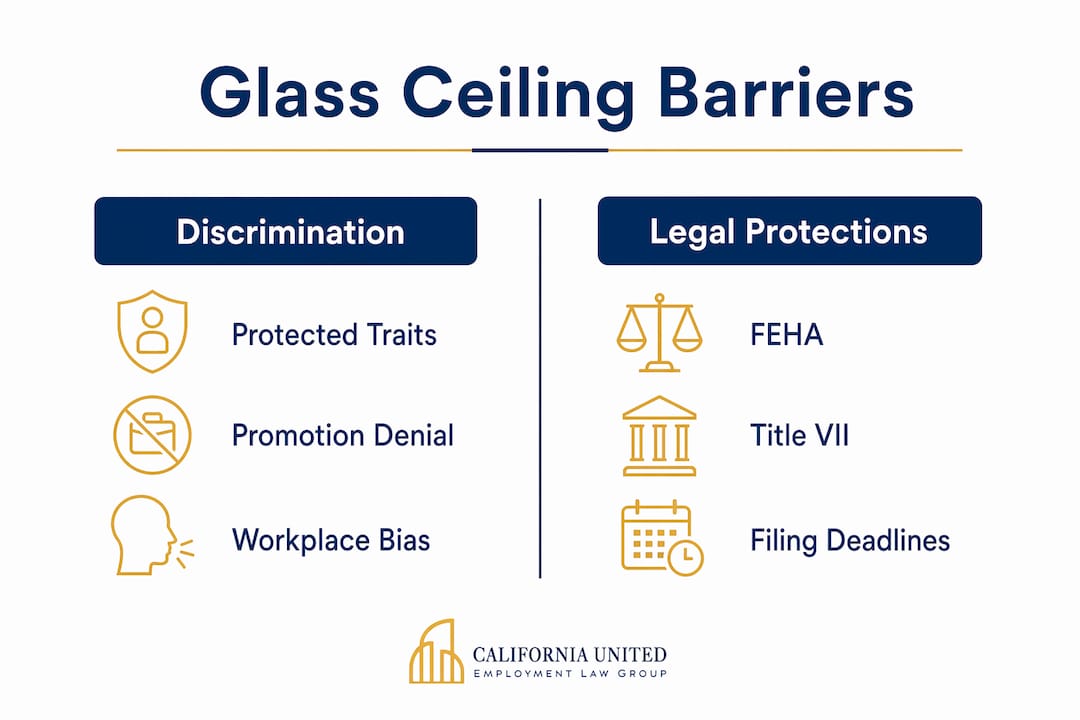
Proving promotion discrimination often relies on circumstantial evidence and comparators because employers rarely state discriminatory motives directly.
The legal framework that protects Inglewood employees
When a promotion barrier in Inglewood is tied to a protected characteristic, several overlapping legal frameworks may apply.
California’s Fair Employment and Housing Act (FEHA)
FEHA, including Government Code section 12940, prohibits covered employers from discriminating in employment because of protected characteristics such as sex, gender, race, age 40 and older, disability, sexual orientation, gender identity, national origin, and other protected categories. In promotion cases, FEHA may apply when a protected characteristic is a substantial motivating reason for an adverse employment decision. FEHA also prohibits restricting information about promotion and transfer opportunities in ways that discriminate on a protected basis, and it covers access to training programs that lead to advancement.
Selection policies that disproportionately screen out a protected group may create disparate-impact liability unless the employer can show the policy is job-related and consistent with business necessity, subject to the facts and available defenses.
California courts have emphasized that FEHA discrimination claims focus on whether a protected characteristic was a substantial motivating reason for the adverse employment decision. In Harris v. City of Santa Monica, the California Supreme Court explained that FEHA liability may arise when discrimination is a substantial factor in the decision, even if other factors also played a role. In Yanowitz v. L’Oreal USA, Inc., the court addressed adverse employment action under FEHA and explained that the challenged conduct must materially affect the terms, conditions, or privileges of employment. These cases are useful reminders that promotion-discrimination claims require both an adverse workplace consequence and evidence connecting that consequence to a protected characteristic.
Title VII of the Civil Rights Act
Title VII is the federal counterpart, prohibiting employment discrimination based on race, color, religion, sex, and national origin. It applies to employers with 15 or more employees. For Inglewood workers, FEHA typically offers broader coverage because it applies to smaller employers and protects more categories.
Filing timelines and administrative prerequisites
Before filing a civil lawsuit under FEHA, you must exhaust administrative remedies by filing with the CRD and obtaining a Right-to-Sue notice. Missing this step can bar a court case entirely.
| Agency | Statute | Filing window | Right-to-Sue required? |
|---|---|---|---|
| California CRD | FEHA | Generally up to 3 years from the discriminatory act | Yes, before filing in state court |
| EEOC | Title VII | Usually 300 days in California for Title VII claims, but confirm the current deadline before filing | Yes, before filing in federal court |
CRD and EEOC filings are separate processes. Inglewood employees often consider filing with the CRD because FEHA may provide broader coverage and a longer state-law filing window, but employees should confirm whether a separate or cross-filed EEOC charge is needed to preserve federal claims. The two agencies have a work-sharing agreement, so a CRD filing can be cross-filed with the EEOC when both statutes apply.
Available remedies
FEHA remedies for proven promotion discrimination can include:
- Back pay: wages and benefits lost due to the discriminatory denial of promotion
- Front pay: future earnings if reinstatement is not feasible
- Promotion or reinstatement: placement into the role that was wrongfully denied
- Emotional distress damages: compensation for psychological harm
- Punitive damages: potentially available in some cases involving malice, oppression, or fraud, depending on the defendant and the proof
- Attorneys’ fees and costs: recoverable under FEHA, which is significant for employees who could not otherwise afford litigation
The employment lawsuit process in California involves multiple stages, from administrative complaint through potential litigation, and outcomes vary based on the specific facts of each case.
This section is general educational information, not legal advice. Employment law claims are fact-specific, and you should consult a qualified attorney about your individual situation.
How to collect evidence that supports your claim
Building a glass ceiling claim requires more than a feeling that something is unfair. Courts and the CRD look for documented patterns, comparator data, and evidence that the employer’s stated reasons for not promoting you do not hold up under scrutiny.
Step-by-step evidence checklist:
- Preserve emails and written communications. Preserve relevant communications in a lawful way, such as saving your own non-confidential records where permitted, noting dates and participants, and asking an attorney before copying confidential, proprietary, privileged, or third-party information.
- Log incidents with dates and details. Keep a running record of every relevant event: when you applied for a promotion, who was selected, what reasons were given, and who witnessed the decision.
- Collect your performance records. Gather annual reviews, goal-setting documents, commendations, and any written feedback. These records may help show your qualifications and may be relevant if the employer later cites performance as the reason for the promotion decision.
- Identify comparators. List colleagues in similar roles who were promoted. Note their tenure, qualifications, and performance records as best you can from publicly available or workplace-shared information.
- Request promotion criteria in writing. Ask HR or your manager to provide the written criteria used to evaluate candidates for the role you sought. If criteria are applied inconsistently or changed after the fact, that inconsistency may support an argument that the stated reason was not the real reason, especially when combined with evidence of bias or unequal treatment.
- Gather witness information. Note the names of colleagues who observed relevant incidents or who may have heard discriminatory comments. You do not need to approach them yet, but having names documented is valuable.
- Track statistical patterns. If your workplace has published diversity data or if you can observe promotion patterns over time, note the demographic breakdown of who advances into leadership roles.
Comparator documentation table:
| Element | Your record | Comparator’s record |
|---|---|---|
| Job title and duties | [Your role] | [Comparator’s role] |
| Tenure | [Your years] | [Comparator’s years] |
| Most recent performance rating | [Your rating] | [Comparator’s rating] |
| Promotion outcome | Denied | Promoted |
| Stated reason for outcome | [Employer’s stated reason] | Not applicable |
Employers commonly defend promotion decisions by citing lack of qualifications, performance issues, or insufficient experience. Anticipating these defenses and documenting the facts that respond to them can help an attorney evaluate the claim.
Pro Tip: Time-stamp your evidence. When you save screenshots or forward emails, the metadata showing when you preserved the document can matter if the employer later claims records were altered. Use cloud storage with automatic date-logging when possible.
What to do next if you believe you’ve been discriminated against
Deciding how to respond to a potential glass ceiling situation involves weighing several options. Here is a practical decision flow for Inglewood employees:
- Step 1: Consider an internal complaint. Report the concern to HR or a supervisor above the decision-maker. Document that you made the report, including the date, who you spoke with, and what response you received. Internal complaints create a record and may trigger the employer’s own investigation process.
- Step 2: Preserve all records after reporting. Internal complaints sometimes lead to retaliation. California law prohibits employers from retaliating against employees who report discrimination or file complaints. If you experience adverse action after reporting, document it immediately. Retaliation protections under FEHA are broad and cover a wide range of adverse employment actions.
- Step 3: File with the CRD if the internal process does not resolve the issue. The California Civil Rights Department accepts complaints from employees at covered employers (five or more employees). Filing with the CRD preserves your right to sue in state court and starts the administrative process.
- Step 4: Understand the CRD vs. EEOC choice. For most Inglewood employees, filing with the CRD is the priority because FEHA covers more protected categories and applies to smaller employers than Title VII. The CRD and EEOC have a work-sharing agreement, so a CRD filing can also be cross-filed federally when relevant.
- Step 5: Consult an attorney before filing suit. An attorney can review your evidence, assess the strength of your claim, and advise on timing. Many employment attorneys in California handle these cases on a contingency-fee basis, but fee agreements vary and should explain whether the client may be responsible for litigation costs.
On confidentiality: The CRD process is not the same as a private attorney consultation. If an agency complaint proceeds, the employer may receive notice and have an opportunity to respond. Before filing, consider speaking with an attorney about timing, confidentiality, and retaliation concerns.
On case timelines: Administrative complaints can take months to resolve, and litigation, if it proceeds, typically extends the timeline further. Outcomes vary significantly based on the facts, the employer’s response, and the strength of the evidence. No attorney can guarantee a specific result.
Practical strategies for breaking through promotion barriers
Both employers and employees can take concrete steps to reduce the structural and cultural conditions that create glass ceiling effects. These strategies do not replace legal remedies, but they can shift workplace dynamics over time.
Employer actions:
From a prevention standpoint, employers often reduce risk by adopting transparent promotion practices. For employees, these practices also provide useful reference points when evaluating whether advancement decisions are being applied consistently.
- Publish written promotion criteria for every leadership role and apply them consistently
- Create formal sponsorship programs that pair high-potential employees from underrepresented groups with senior advocates
- Audit promotion rates by demographic group annually and investigate significant disparities
- Assign high-visibility projects through a transparent process rather than informal networks
- Train managers on affinity bias and how it affects performance evaluations and promotion decisions
Individual actions:
- Seek a sponsor, not just a mentor. A mentor gives advice; a sponsor actively advocates for your advancement in rooms you are not in. Identify a senior leader who has visibility into promotion decisions and build a relationship based on demonstrated results.
- Document your impact in writing. Keep a running record of projects completed, revenue generated, problems solved, and recognition received. When promotion cycles open, you have a ready summary of your contributions.
- Ask for written promotion criteria. Request the specific benchmarks for the next role in writing. This creates accountability and gives you a clear target to document against.
- Negotiate for stretch assignments. Ask directly for high-profile projects that build the skills and visibility associated with leadership roles. Frame the request around business value.
- Track patterns in your workplace. Note who gets promoted, who gets the high-visibility work, and whether those patterns correlate with demographic characteristics. This awareness helps you identify whether barriers are personal or systemic.
Pro Tip: The distinction between mentorship and sponsorship is significant in glass ceiling research. Mentors help you develop skills; sponsors use their own political capital to advocate for your promotion. Women and employees of color are often over-mentored and under-sponsored, which is one reason the glass ceiling persists even when individual qualifications are strong.
If employer efforts stall or retaliation occurs, resources such as the CRD, community legal aid organizations in the Los Angeles area, and employment law firms with FEHA experience can provide support. If biased comments, harassment, or a hostile work environment are part of the same promotion pattern, those facts may support additional or related FEHA theories depending on the evidence.
Key Takeaways
Glass ceiling discrimination in Inglewood can be unlawful under FEHA when a protected characteristic is a substantial motivating factor in a promotion denial, and acting quickly to preserve evidence and meet filing deadlines is the most important thing you can do to protect your rights.
| Point | Details |
|---|---|
| Promotion barriers can be illegal | FEHA and Title VII prohibit promotion denials driven by sex, race, age, gender identity, and other protected characteristics. |
| CRD filing window | You generally have up to three years from the discriminatory act to file an administrative complaint with the CRD under FEHA. |
| Administrative exhaustion is required | You must obtain a Right-to-Sue notice from the CRD before filing a civil lawsuit in California state court. |
| Comparators and patterns are key | Documenting similarly situated employees who were treated more favorably is one of the strongest forms of evidence in these claims. |
| California United Law Group | California United Law Group offers free case evaluations for qualifying matters. If representation is offered on a contingency-fee basis, the written agreement should explain how fees and costs are handled. |
This article is general educational information only, not legal advice. Employment law outcomes are fact-specific and vary. Consult a qualified California employment attorney about your individual situation.
California United Law Group’s Perspective On Glass Ceiling Claims
Glass ceiling cases are among the most nuanced matters in California employment law, and that complexity is something we take seriously at California United Law Group. Employees who raise these concerns are often strong performers who believe their qualifications and results are not being weighed consistently against those of colleagues who advance. That pattern is not always random, and it is not always legal.
In our experience, documented patterns are often more useful for evaluating potential claims than isolated incidents. A single promotion denial, standing alone, is difficult to pursue. A pattern of denials, combined with comparator data, inconsistent application of promotion criteria, and a demographic skew in who advances, tells a different story. Inglewood’s workforce is diverse, and intersectional claims involving both race and gender are not uncommon. FEHA’s broad protections are well-suited to address those compounded barriers.
We also want to be direct about what this process involves. Administrative complaints take time. Litigation takes longer. Outcomes are never guaranteed, and every case turns on its specific facts. What we can offer is a clear-eyed assessment of your situation, guidance on evidence preservation, and representation at every stage if the facts support moving forward.
How California United Law Group can help Inglewood employees
If you work in Inglewood and believe a promotion barrier may be tied to your sex, race, age, or another protected characteristic, California United Law Group offers free case evaluations for employees in exactly this situation. The firm handles FEHA promotion-discrimination matters from the initial consultation through administrative filings with the CRD and, where appropriate, litigation in California courts.
Representation may be available on a contingency-fee basis for qualifying matters. The written fee agreement will explain how attorneys’ fees and litigation costs are handled, including whether any costs could be owed depending on the outcome. For qualifying matters, there may be no upfront attorneys’ fees, but costs and fee terms depend on the written agreement.
Ready to understand your options? Request a case evaluation with California United Law Group to receive a preliminary assessment of your options under California law.
Useful sources and further reading
The following sources are provided for educational reference only and do not constitute legal advice.
- FEHA statute: California Government Code §12940 — the primary state law prohibiting promotion discrimination
- California Civil Rights Department: CRD Employment pages — agency jurisdiction, complaint process, and employer obligations
- CRD Employment FAQ: CRD FAQ — filing timelines, remedies, and covered employers
- California Civil Jury Instructions: CACI FEHA instructions on disparate treatment, disparate impact, retaliation, adverse employment action, and substantial motivating reason
- California appellate authority: cases discussing FEHA causation, adverse employment action, and proof of discrimination
- Academic research: PMC — Breaking the Glass Ceiling — peer-reviewed research on structural and cultural causes
- Cal. Code Regs. Tit. 2, § 11017: LII / Legal Information Institute — California regulations on employee selection and promotion
These links are for informational purposes. Always verify current law with a qualified California employment attorney.