
Religious discrimination at work is defined as unfavorable treatment of an employee based on their religious beliefs, practices, or observance. In Glendale, California, this conduct is prohibited under the California Fair Employment and Housing Act (FEHA), which covers employers with five or more employees and applies to every stage of employment. Glendale employees are legally protected from religious discrimination in hiring, assignments, discipline, promotions, and benefits. The 2023 U.S. Supreme Court ruling in Groff v. DeJoy also raised the legal bar for denying religious accommodations, making these protections stronger than they were just a few years ago. Employers must now show that granting an accommodation would result in substantial increased costs in relation to the conduct of their particular business — a context-specific standard. Notably, inconvenience to coworkers alone does not qualify as undue hardship unless it rises to the level of meaningfully affecting business operations. [Groff v. DeJoy (2023) 600 US 447]. Understanding your rights under FEHA and federal Title VII is the first step toward protecting yourself at work.
The information in this article is provided for general educational purposes and does not constitute legal advice or create an attorney-client relationship. Employment situations vary, and you should consult a qualified California employment attorney about the specific facts of your case.
What does religious discrimination at work mean under Glendale and California law?
Religious discrimination at work covers a wide range of conduct, not just outright refusals to hire. Under California FEHA and federal Title VII protections, employers may not treat employees unfavorably based on religious beliefs in any employment aspect, including hiring, assignments, discipline, promotion, or benefits. Harassment based on religion is also prohibited.
In Glendale workplaces, religious discrimination can take many forms. Recognizing these behaviors is the first step to addressing them:
- Hiring refusals based on a job applicant’s religion, religious dress, or observance schedule
- Demotions or unequal pay tied to an employee’s religious identity or practices
- Hostile work environment created through offensive comments, mockery, or exclusion related to religion
- Denial of schedule changes needed for religious observance when granting the change would not cause the employer substantial hardship
- Discipline or termination that would not have occurred but for the employee’s religion
FEHA protects a broad range of beliefs. It covers traditional organized religions such as Christianity, Islam, Judaism, Hinduism, and Buddhism. It also covers sincerely held personal religious beliefs that may not belong to a formal institution. Under FEHA, the belief must be sincerely held and must occupy a place in the employee’s life parallel to traditionally recognized religious beliefs — it need not belong to a formal institution or be widely shared, but it must be genuinely and consistently held.
Glendale’s workforce is one of the most religiously diverse in Los Angeles County. That diversity makes clear, enforceable religious discrimination policies at the employer level both a legal requirement and a practical necessity. Employees who experience any of the conduct listed above have the right to seek relief under California law.
How do Glendale employers handle religious accommodation requests?
A reasonable accommodation is any adjustment to a job, work environment, or workplace policy that allows an employee to practice their religion without causing the employer substantial hardship. The Groff v. DeJoy ruling in 2023 replaced the previous low “de minimis” cost standard with a higher threshold. Employers must now show that granting an accommodation would cause substantial increased costs or business hardship before they can legally deny it. That shift gives Glendale employees significantly stronger standing when requesting accommodations.
Common forms of reasonable accommodation include:
- Flexible scheduling to allow attendance at religious services or observance of holy days
- Voluntary shift swaps arranged between willing coworkers
- Modified dress codes to permit religious attire such as headscarves, turbans, or yarmulkes
- Reassignment to a different role or shift that does not conflict with religious obligations
The protections extend even to situations where the employee never explicitly mentions religion. In EEOC v. Abercrombie & Fitch Stores, Inc. (2015) 575 US 768, the U.S. Supreme Court held that an employer violated Title VII by refusing to hire a Muslim applicant because her headscarf conflicted with its dress policy — even though religion was never discussed during the interview. The Court held that an employer may not make a religious practice a motivating factor in an employment decision, regardless of whether the employer had actual confirmed knowledge of the religious motivation. This means Glendale employees do not necessarily need to announce their religion to trigger these protections.
Employers in Glendale are required to make a good-faith effort to explore all reasonable alternatives when an accommodation request is made. Under FEHA, an employer cannot simply deny a request without first investigating workable solutions. Employers who refuse to engage in that good-faith exploration — as where a court found an employer violated FEHA by refusing an employee time off for a religious convention without any effort to find an accommodation — risk liability regardless of whether an accommodation ultimately proves feasible. [California Fair Employment & Housing Comm’n v. Gemini Aluminum Corp. (2004) 122 CA4th 1004]
Employees often fail by submitting vague accommodation requests. Explicitly linking religious conflicts with specific job duties leads to better employer responses. The more clearly you describe the conflict between your religious practice and your work schedule or policy, the harder it is for an employer to dismiss the request.

Pro Tip: When submitting a religious accommodation request, put it in writing. Describe the specific religious practice, the exact workplace policy or schedule that conflicts with it, and what change you are requesting. Written requests create a clear record and signal to your employer that you understand your rights.
The Groff v. DeJoy decision marks one of the most significant shifts in religious accommodation law. Glendale employers who previously denied requests under the old standard may now need to revisit those decisions.
What steps can Glendale employees take to report religious discrimination?
Reporting religious discrimination requires attention to deadlines. Missing a filing window can eliminate your legal options entirely. Here is the process for Glendale employees:
Document the discrimination. Record every incident with dates, the names of witnesses, exact language used, and the context. Contemporaneous documentation is far more reliable than memory alone and is your strongest evidence in any claim. Keep these records privately, not on company devices.
File with the California Civil Rights Department (CRD). California employees must submit a complaint to the CRD within three years of the last act of discrimination. The CRD aims to complete its initial investigation within 100 days, with a maximum of one year in complex matters, and may file a civil action on the employee’s behalf if the evidence warrants it.
File with the EEOC if pursuing federal claims. Federal Equal Employment Opportunity Commission (EEOC) complaints carry shorter deadlines. You must file an EEOC complaint within 180 days of the discriminatory act, or within 300 days if a state agency like the CRD is also handling the matter. Missing these windows forfeits your federal claim.
Preserve all related communications. Save emails, texts, performance reviews, and any written policies that relate to the discrimination. These documents support your complaint and help investigators understand the full picture.
Be aware of retaliation protections. Filing a complaint does not expose you to lawful retaliation. Any adverse action taken against you after you report discrimination, such as a demotion, schedule change, or termination, may itself be an additional legal violation.
The three-year window under California law is notably longer than the federal EEOC deadline. That difference matters for Glendale employees who may not realize they still have options under state law even if a federal deadline has passed. Consulting an employment attorney familiar with California employment claims can help you understand which avenue applies to your situation.
What legal protections exist for Glendale employees facing harassment or retaliation?
Harassment and retaliation protections extend beyond the initial act of discrimination. Under both FEHA and Title VII, retaliation against employees who report religious discrimination is illegal. These protections apply whether you reported internally to HR or externally to the CRD or EEOC.
Prohibited retaliatory actions include:
- Termination or demotion following a discrimination complaint
- Reduction in hours or pay after an accommodation request
- Hostile treatment from supervisors or coworkers after you assert your rights
- Negative performance reviews that appear after a complaint but were not an issue before
- Exclusion from meetings, projects, or opportunities tied to your complaint
Workplace harassment based on religion is also independently prohibited under California law. A hostile work environment exists when religious mockery, offensive comments, or unwanted religious pressure is severe or pervasive enough to interfere with your ability to do your job — a standard applied in courts throughout California and consistent with FEHA’s prohibition on harassment based on religion. [See Gov.C. § 12940(j)]. A single isolated comment may not meet that threshold, but a pattern of conduct almost certainly does.
California’s enforcement mechanisms are meaningful. Employees who prevail in religious discrimination or retaliation claims may recover lost wages, emotional distress damages, attorney’s fees, and — where the employer’s conduct was malicious, oppressive, or fraudulent — punitive damages. The CRD can also pursue civil action on behalf of employees in serious cases. These remedies exist to make employees whole and to deter employers from violating the law.
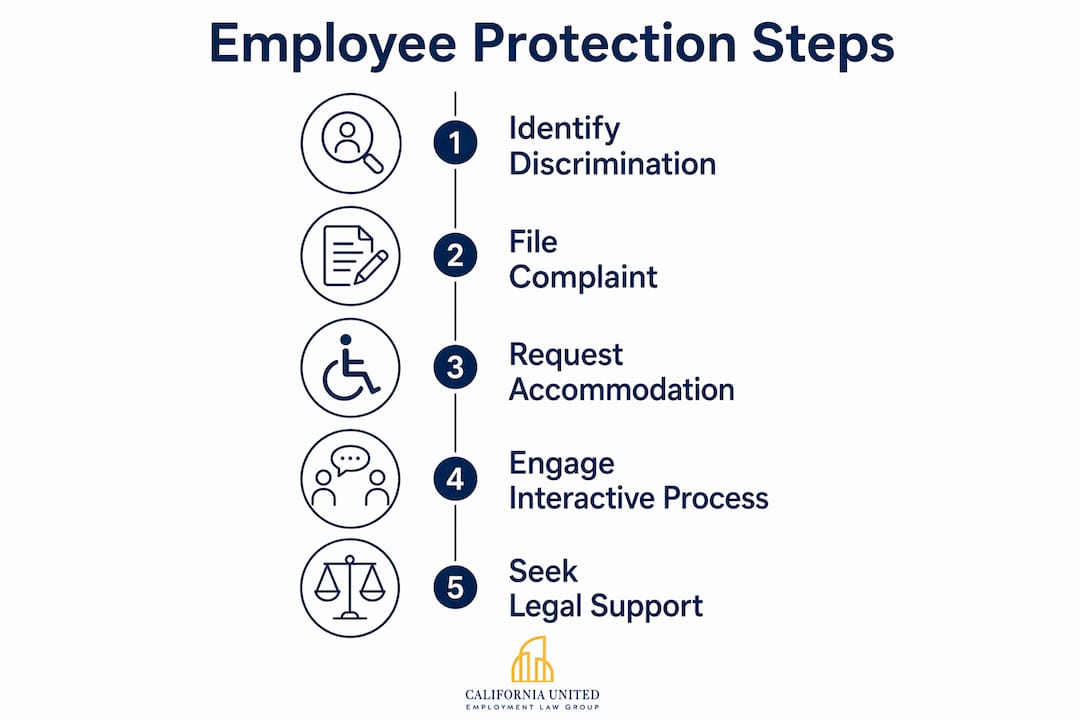
Glendale employees should also know that employee termination rights under California law include protections against being fired for asserting religious rights. If your termination followed a discrimination complaint or accommodation request, the timing alone may support a retaliation claim.
Key Takeaways
Glendale employees are protected from religious discrimination, harassment, and retaliation under California FEHA and federal Title VII, with the 2023 Groff v. DeJoy ruling now requiring employers to show substantial hardship before denying any accommodation request.
| Point | Details |
|---|---|
| FEHA covers all employment stages | Protections apply to hiring, assignments, discipline, promotions, benefits, and termination. |
| Groff v. DeJoy raised the bar | Employers must now prove substantial hardship, not just minor inconvenience, to deny accommodations. |
| California CRD deadline is three years | State complaints must be filed within three years of the last discriminatory act. |
| EEOC deadlines are shorter | Federal complaints must be filed within 180 to 300 days depending on state agency coordination. |
| Retaliation is independently illegal | Any adverse action after a complaint or accommodation request may constitute a separate legal violation. |
What I’ve Learned About Religious Discrimination Cases In Glendale
Most employees who come to me with religious discrimination concerns share one thing in common. They waited too long to document what was happening. By the time they sought help, key details were fuzzy, witnesses had moved on, and the paper trail was thin. The law gives you real protections, but those protections depend heavily on what you can prove.
The Groff v. DeJoy ruling is genuinely important, and most employees do not know about it. Before 2023, employers could deny accommodation requests by pointing to almost any cost or inconvenience. That standard is gone. If your employer denied a religious accommodation request in the last few years, that denial may now be legally questionable under the new substantial hardship standard.
Clear communication matters more than most people realize. Employees who describe their accommodation needs in vague terms, such as “I need some flexibility,” rarely get what they need. Employees who write a specific request that names the religious practice, the exact scheduling conflict, and the proposed solution get taken seriously. That difference is not about being aggressive. It is about being clear.
Glendale’s religious diversity is real, and so is the discrimination that sometimes follows from it. You do not need to accept a hostile work environment or an unexplained denial of your accommodation request. The law is on your side. Use it.
How California United Law Group Supports Glendale Employees With Religious Discrimination Concerns
California United Law Group represents employees in Glendale and across California in workplace discrimination matters, including religious discrimination, harassment, and retaliation claims under FEHA and Title VII. The firm handles cases at every stage, from pre-litigation through full litigation, and focuses exclusively on California employment law.
If you believe your employer has treated you unfairly because of your religion, denied a reasonable accommodation request, or retaliated against you for speaking up, getting a professional case evaluation is a practical first step. Contact California United Law Group to speak with an employment attorney about your situation. You can also learn more about Glendale employer obligations regarding religious accommodations before your consultation.
FAQ
What is religious discrimination under California FEHA?
Religious discrimination under FEHA is defined as unfavorable treatment of an employee based on their religious beliefs, practices, or observance. It covers all aspects of employment, including hiring, pay, assignments, and termination.
How long do I have to file a religious discrimination complaint in Glendale?
California employees have three years from the last discriminatory act to file with the CRD. Federal EEOC complaints must be filed within 180 to 300 days depending on whether a state agency is also involved.
Can my Glendale employer deny my religious accommodation request?
An employer can deny a request only if granting it would result in substantial increased costs in relation to the conduct of that employer’s particular business. The 2023 Groff v. DeJoy ruling made this a context-specific, fact-intensive standard — general inconvenience or minor costs are not enough.
What counts as retaliation after reporting religious discrimination?
Retaliation includes any adverse employment action taken because you reported discrimination or requested an accommodation. Demotions, terminations, pay cuts, and hostile treatment after a complaint all qualify as prohibited retaliation under FEHA and Title VII.
Do I need an attorney to file a religious discrimination complaint?
You do not need an attorney to file with the CRD or EEOC, but an employment attorney familiar with California law can help you meet deadlines, build your documentation, and understand your full range of legal options.