
If you were recently fired in Alhambra, California, you may have legal rights worth understanding before you do anything else. Many terminations in California are lawful under the state’s at-will employment rule, but your firing could be unlawful if it violated the Fair Employment and Housing Act (FEHA), an express or implied employment agreement, a statute protecting workplace rights, or a recognized public-policy principle. The agencies that matter most are the California Civil Rights Department (CRD, formerly DFEH), the California Labor Commissioner’s Office (DLSE), and the U.S. Equal Employment Opportunity Commission (EEOC).
Your first priority is to act quickly. Filing windows are strict, and evidence can disappear fast.
Common reasons a termination may be unlawful:
- Discrimination based on a protected characteristic (race, sex, age, disability, national origin, religion, pregnancy, and more)
- Retaliation for reporting workplace violations, filing a wage complaint, or cooperating with an investigation
- Termination because an employee requested, took, or opposed interference with protected leave, including qualifying FMLA, CFRA, or pregnancy disability leave.
- Being fired for refusing to participate in illegal activity
Pro Tip: Write down everything you remember about your termination within 24–48 hours: dates, names, what was said, and who was present. That contemporaneous record can be critical later.
Table of Contents
- What qualifies as wrongful termination for Alhambra workers?
- How California law limits the at-will employment presumption
- Which filing path fits your claim, and what are the deadlines?
- What remedies can you recover in a California wrongful termination case?
- What to document and preserve immediately after your Alhambra termination
- CRD, DLSE, or civil court: how do you choose the right path?
- How California United Law Group can help Alhambra employees now
- What the conventional advice on wrongful termination gets wrong
- Key takeaways for Alhambra employees after a termination
- Sources
What qualifies as wrongful termination for Alhambra workers?
“Wrongful termination” is not a single statute. It is a legal concept covering several distinct theories, each with its own requirements. Understanding which one applies to your situation is the first step toward knowing whether you have a viable wrongful termination claim.
The four main legal theories:
- FEHA discrimination or harassment: Your employer fired you because of a protected characteristic. FEHA covers race, color, religion, sex, gender identity, sexual orientation, national origin, disability, age (40+), pregnancy, marital status, and several other categories.
- Retaliation: You engaged in a protected activity (filed a complaint, reported safety violations, requested leave) and were fired as a result.
- Public-policy discharge (Tameny claim): Your employer fired you for a reason that violates a fundamental public policy, such as refusing to commit fraud or testifying in a legal proceeding.
- Breach of contract: Your employer made express or implied promises about job security that were violated by your termination.
Not every unfair firing is a wrongful one. Being passed over for a promotion unfairly, or being fired because a manager dislikes you personally, may feel unjust without crossing a legal line. The distinction matters.
California courts have recognized several important limits on at-will employment. In Tameny v. Atlantic Richfield Co., the California Supreme Court recognized tort remedies for discharge contrary to fundamental public policy. In Foley v. Interactive Data Corp., the court addressed implied-contract limits on termination. Later cases also recognize that public-policy wrongful termination claims may arise from discrimination, protected leave, unsafe workplace complaints, testifying in legal proceedings, or refusing to engage in unlawful conduct, depending on the facts.
The key question is not whether your firing felt wrong, but whether it violated a specific legal protection. A termination that feels deeply unfair may still be lawful under California law — and one that seems routine may actually cross a protected line. Identifying the difference early is what shapes the entire claim.
Scenario examples Alhambra employees commonly face:
| Scenario | Likely legal theory | Relevant law |
|---|---|---|
| Fired two weeks after announcing pregnancy | FEHA discrimination | FEHA |
| Terminated after reporting unpaid overtime to HR | Retaliation | Labor Code retaliation / wage-and-hour protections; FEHA only if the report also involved discrimination, harassment, or another FEHA-protected activity. |
| Let go after requesting CFRA medical leave | Retaliation / FEHA | CFRA; FEHA |
| Fired for refusing to falsify safety records | Public-policy discharge | Tameny doctrine |
| Dismissed despite verbal promise of long-term employment | Implied contract breach | Labor Code §2922 exceptions |
How California law limits the at-will employment presumption
Labor Code §2922 states that employment with no specified term may be terminated at the will of either party. That presumption is real, but it is not absolute. California courts and the Legislature have carved out significant exceptions that protect many Alhambra employees.
The main exceptions to at-will employment:
Tameny public-policy tort. In Tameny v. Atlantic Richfield Co., the California Supreme Court held that an employer who fires a worker for a reason that violates a fundamental public policy commits a tort. This opens the door to tort-style damages, including emotional distress and punitive damages in appropriate cases.
Implied contract. Courts distinguish express written at-will language from implied-in-fact promises. Oral assurances from a manager, a progressive discipline policy in an employee handbook, or a long-standing company practice of terminating only “for cause” can all create an implied limitation on termination. The Guz and Foley lines of cases address when such promises are enforceable.
FEHA and other statutes. Statutory protections effectively override the at-will rule for protected reasons. An employer cannot invoke at-will employment to justify firing someone because of their disability or in retaliation for a protected complaint.
California’s protections are materially stronger than federal law in several respects, as shown below.
FEHA often provides California workers broader protections or remedies than federal law, so many Alhambra employees should evaluate state-law options before deciding where and how to file.
Which filing path fits your claim, and what are the deadlines?
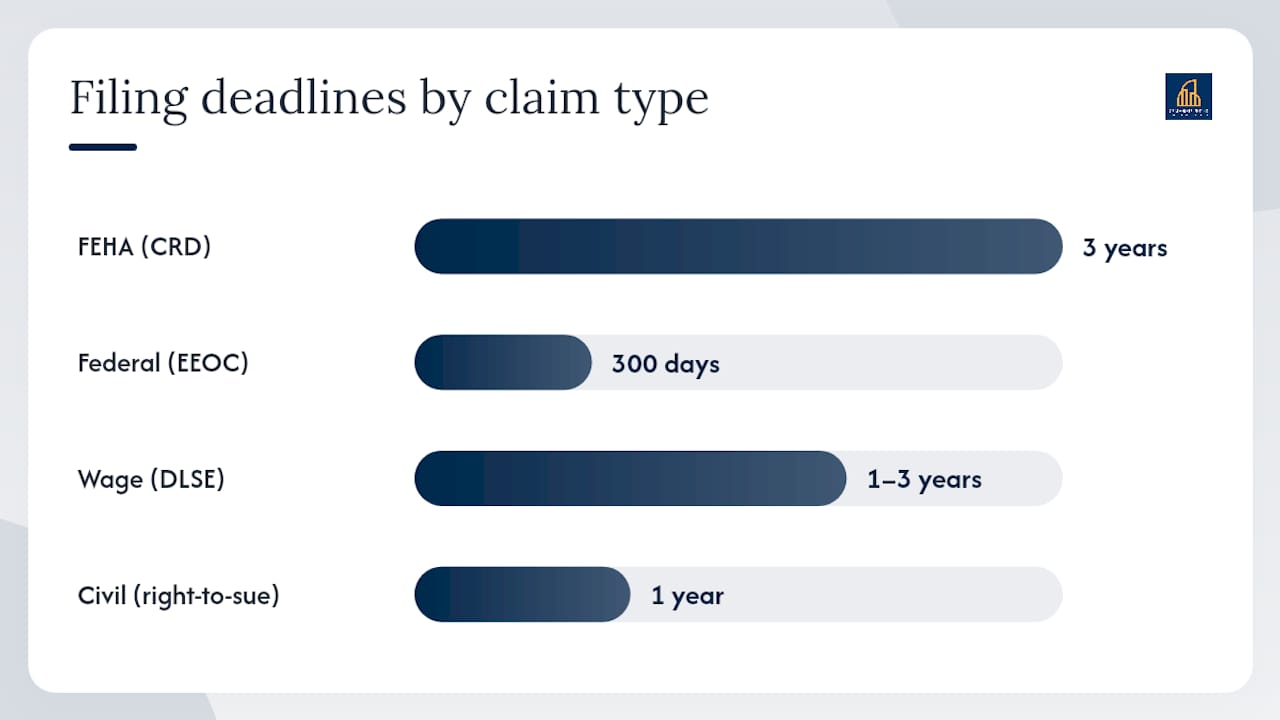
Choosing the right forum depends on the type of claim you have. Deadlines can change based on the claim, agency procedure, tolling, prior filings, and the facts of the case, so employees should confirm the applicable deadline before relying on a general rule. Filing in the wrong place, or missing a deadline, can permanently bar your recovery.
| Claim type | Primary forum | Typical deadline |
|---|---|---|
| FEHA discrimination / retaliation | California CRD | Generally 3 years from violation |
| Federal discrimination (Title VII, ADA, ADEA) | EEOC | Generally 300 days from violation |
| Unpaid wages / wage theft | DLSE (Labor Commissioner) | 1–3 years depending on claim type |
| Civil lawsuit (after right-to-sue) | Los Angeles Superior Court | Depends on underlying claim |
How the process typically flows:
- Identify your claim type (discrimination, retaliation, wage violation, or contract breach).
- File with the appropriate administrative agency (CRD for FEHA claims, EEOC for federal claims, DLSE for wage claims).
- Request a right-to-sue notice if you want to proceed in civil court rather than wait for the agency investigation.
- File your civil lawsuit within the time the right-to-sue notice allows (typically one year from issuance for FEHA claims).
For a more detailed procedural overview, California United Law Group’s step-by-step wrongful termination guide walks through each stage.
Pro Tip: You can file simultaneously with both the CRD and the EEOC through a “dual filing” arrangement. This preserves both state and federal options without requiring two separate submissions. Missing the state CRD deadline can seriously limit or bar FEHA remedies, so employees should verify the applicable deadline as early as possible.
What remedies can you recover in a California wrongful termination case?
California law offers a meaningful range of remedies for employees who prove a wrongful termination claim. The specific damages available depend on the legal theory and the forum.
Core remedies available in California:
- Back pay: Wages and benefits lost from the date of termination to the date of judgment or settlement
- Front pay: Compensation for future lost earnings when reinstatement is not practical
- Reinstatement: Return to your former position (available but not always sought)
- Compensatory damages: Emotional distress, loss of reputation, and related harms
- Punitive damages: Punitive damages: Potentially available in FEHA or tort-based wrongful termination cases if the legal standard is met, including proof of malice, oppression, or fraud and any required employer-level showing.
- Attorneys’ fees: Recoverable by a prevailing employee under FEHA and certain other statutes
- Injunctive relief: Court orders requiring the employer to change policies or practices
FEHA claims filed in California state court can carry compensatory and punitive damages that are not subject to statutory caps. Federal Title VII claims, by contrast, cap combined compensatory and punitive damages based on employer size. That difference materially affects settlement dynamics and is one reason many Alhambra employees prefer the state court route.
Many cases resolve through settlement before trial. Settlements commonly include some combination of lost wages, interest, and attorneys’ fees. Outcomes vary significantly based on the facts of each case, and no result can be predicted or guaranteed.
What to document and preserve immediately after your Alhambra termination
The immediate post-termination window is critical. Employers can deactivate accounts, archive records, and otherwise limit your access to evidence within days. Acting quickly protects your options.
Prioritized evidence checklist:
- Save all emails and texts you are lawfully permitted to access and retain. Do not take confidential, privileged, trade-secret, or proprietary employer materials without legal advice. Screenshot relevant text messages and preserve communications about your performance, the stated reason for termination, and any complaints you made.
- Collect pay stubs and benefit notices. Gather your last several pay stubs, any bonus or commission records, and written benefit summaries.
- Write a dated summary of events. Record the sequence of events leading to your termination: dates, what was said, who was present, and any witnesses. Do this now, while details are fresh.
- Request your personnel file. Under Labor Code §1198.5, you have a statutory right to inspect or receive a copy of your personnel file. Submit a written request promptly.
- Preserve electronic evidence. Save calendar entries, performance reviews, disciplinary notices, and any screenshots of relevant workplace communications.
- Note witness contact information. Write down the names and contact details of coworkers who witnessed relevant events before you lose access to the company directory.
Sample personnel file request (adapt as needed):
Send this request in writing and keep a copy. A written personnel-file request helps document that you invoked your statutory inspection or copy rights after employment ends.
For more guidance on recognizing early indicators that your termination may be unlawful, California United Law Group’s resource on how to recognize wrongful termination covers the key warning signs.
CRD, DLSE, or civil court: how do you choose the right path?
The right forum depends on what you want to achieve, how quickly you need to act, and what your claim is based on. There is no single answer that fits every situation.
Administrative exhaustion is required for FEHA claims before you can file a civil lawsuit. You must first file with the CRD and obtain a right-to-sue notice. For wage claims, the DLSE provides an administrative route that can be faster and less expensive than civil litigation for straightforward unpaid-wage disputes.
Practical factors that often guide the choice:
- Reinstatement or policy change: Administrative agencies can order reinstatement and injunctive relief; civil courts can too, but the process is longer.
- Speed: DLSE wage claims can resolve faster than civil litigation. CRD investigations can take time, but requesting an immediate right-to-sue bypasses the investigation.
- Damages: Civil court may allow broader FEHA remedies, including emotional-distress damages and, in appropriate cases, punitive damages. DLSE wage claims generally focus on wage recovery and related statutory remedies.
- Cost: Administrative filings have no filing fee. Civil litigation involves court costs and, typically, attorney time.
Pro Tip: If your claim involves both a wage violation and discrimination or retaliation, you may need to pursue two separate administrative paths simultaneously — one with the DLSE and one with the CRD. An employment attorney can help you map the right combination before a deadline passes.
Missing the CRD’s filing window is one of the most common and avoidable errors in California employment cases. When deadlines or complex remedies are at issue, consulting an Alhambra employment attorney promptly can help protect your options. California United Law Group’s overview of how to fight wrongful termination explains what to expect from pre-litigation through resolution.
How California United Law Group can help Alhambra employees now
If you believe your termination may have violated California law, working with a local employment firm gives you practical support at every stage of the process.
What California United Law Group offers:
- Free, confidential case review to assess whether your termination may be unlawful
- Administrative complaint filings with the CRD and DLSE
- Right-to-sue requests and civil litigation in California courts
- Discovery and evidence preservation support from the earliest stage
- Negotiation and settlement handling throughout the process
The firm works on a contingency fee basis, meaning attorney fees are typically paid from any recovery. Case costs and expense responsibility depend on the written fee agreement, and the firm will explain those terms before representation begins. The initial consultation is confidential and carries no obligation.
Who commonly benefits from contacting a local firm:
- Employees fired after requesting or taking protected leave (FMLA, CFRA, pregnancy disability)
- Workers terminated after reporting wage violations, safety hazards, or discrimination
- Employees who received verbal or written assurances of job security before being let go
- Anyone facing a filing deadline within the next few weeks or months
Pro Tip: Even if you are unsure whether your termination was unlawful, a free confidential case review can help you better understand your options before a deadline passes, with no obligation to hire the firm.
👉 Contact California United Law Group for a free, confidential consultation about your Alhambra wrongful termination situation. The firm’s Alhambra employment law page provides additional information about local services.
What the conventional advice on wrongful termination gets wrong
The standard guidance tells employees to “document everything and consult a lawyer.” That is correct, but it misses the more important point: most employees wait too long, and by the time they seek help, key evidence is gone and filing windows are closing.
The at-will rule is frequently misunderstood in the other direction too. Many employees assume their firing was legal simply because their employer said it was “at-will.” That framing ignores the fact that at-will is a default, not a shield. An employer can fire you for any reason that is not an illegal one, but the exceptions to that rule are substantial. FEHA covers a wide range of protected characteristics and activities, and California courts have recognized public-policy wrongful termination claims in defined circumstances since Tameny.
The other underappreciated reality is that the state filing window is one of California’s most meaningful employee protections. The CRD’s generally three-year window for FEHA claims is far longer than the EEOC’s 300-day federal window. Employees who know this can take time to gather evidence and consult counsel without the panic of an imminent federal deadline. Employees who do not know it sometimes file only with the EEOC and inadvertently limit their remedies.
What actually matters most in the first days after termination is not deciding whether to sue. It is preserving your evidence, requesting your personnel file, and getting a clear-eyed assessment of what legal theories might apply to your specific facts. The rest follows from that foundation.
Key takeaways for Alhambra employees after a termination
California’s at-will rule has real exceptions, and Alhambra employees who were fired for a protected reason, in retaliation, or in violation of a contract may have a viable claim under FEHA, the Labor Code, or California public policy.
| Point | Details |
|---|---|
| At-will has exceptions | FEHA, public-policy (Tameny), and implied contracts all limit when an employer can legally fire you. |
| CRD filing window | FEHA claims generally allow up to three years to file with the CRD — longer than the federal 300-day EEOC window. |
| Preserve evidence now | Request your personnel file under Labor Code §1198.5 and save emails, pay stubs, and witness contacts immediately. |
| Multiple forums exist | CRD handles FEHA claims, DLSE handles wage claims, and civil court is available after a right-to-sue notice. |
| California United Law Group | Offers free confidential consultations and may offer contingency-fee representation for qualifying Alhambra wrongful termination claims, subject to case review and a written fee agreement. |
This article is for general educational purposes only and does not constitute legal advice. Employment law outcomes depend on the specific facts of each case. Consult a qualified California employment attorney to evaluate your individual situation.
Sources
These authoritative sources provide forms, statute text, and filing instructions directly from the relevant agencies.
- California Code, LAB 2922
- Employment | CRD
- California Workplace Discrimination Law: FEHA Rights & Protections (2026)
- Tameny v. Atlantic Richfield Co. (opinion)
- Foley v. Interactive Data Corp.
- Guz v. Bechtel National, Inc.
- Rojo v. Kliger
- Stevenson v. Superior Court”
- EEOC
This article is general information, not a substitute for advice from a qualified lawyer. Consult a qualified legal professional about your own circumstances before acting on anything here.
Recommended
- Alhambra Age Discrimination in the Workplace: Know Your Rights – California United Law Group –
- Wrongful Termination in Pasadena: Know Your Rights – California United Law Group –
- Alhambra Unpaid Overtime Wages: Recovering Lost Pay – California United Law Group –
- Employment Lawyer Alhambra – California United Law Group