
Losing your job is hard enough. But when something about the way it happened feels off, you deserve to know whether your rights under California law were violated. Knowing how to recognize wrongful termination is the first step toward making an informed decision about what to do next. California employees, from those working in Pasadena to Long Beach, often confuse an unfair firing with an illegal one. This article explains the legal distinction, the warning signs to watch for, how to gather supporting evidence, and why deadlines matter more than most people realize.
Table of Contents
- Key Takeaways
- How to recognize wrongful termination: the legal foundation
- Warning signs that your termination may be wrongful
- Gathering evidence to support your case
- Deadlines and timelines you cannot afford to ignore
- Common misconceptions about wrongful termination
- My perspective on recognizing wrongful termination
- How Calunitedlaw can help you understand your options
- FAQ
Key Takeaways
| Point | Details |
|---|---|
| Wrongful vs. unfair | A firing can feel deeply unfair without being legally wrongful under California law. |
| Timing is a red flag | Termination shortly after protected activity, like reporting misconduct, may indicate retaliation. |
| Documentation matters | Requesting your personnel file promptly after termination helps you identify inconsistencies in the employer’s stated reasons. |
| Deadlines are strict | California employees have 3 years to file a discrimination or retaliation complaint with the California Civil Rights Department (CRD) under FEHA. For federal claims, the deadline to file with the EEOC is 300 days from the adverse action. After the CRD issues a right-to-sue notice, you generally have one year to file a civil lawsuit. |
| Local legal support exists | Employees in Los Angeles, Glendale, Long Beach, and nearby cities have access to California employment law attorneys. |
How To Recognize Wrongful Termination: The Legal Foundation
California is an at-will employment state. That means your employer can generally terminate you for any reason, or no reason at all, as long as that reason is not illegal. This is where many employees get confused. A firing may feel wrong, unjust, or politically motivated inside your workplace, and still not cross the legal line of wrongful termination.
Wrongful termination is legally defined as a firing that violates a federal or state law, a written or implied employment contract, or established public policy. It is not simply unfair treatment or a manager’s personal dislike. Understanding this distinction matters before you decide how to proceed.
Under California law, terminations may be considered wrongful when they are based on one or more of the following:
- Discrimination based on a protected characteristic, such as race, gender, age, disability, religion, or national origin, under the Fair Employment and Housing Act (FEHA)
- Retaliation for engaging in a protected activity, such as reporting harassment, filing a wage complaint, or requesting medical leave
- Breach of contract, either a written employment agreement or an implied contract based on employer promises or policy manuals
- Violation of public policy, such as firing someone for serving on jury duty or refusing to participate in illegal activity
California courts have spent decades defining these protections through landmark decisions. In Tameny v. Atlantic Richfield Co. (1980) 27 Cal.3d 167, the California Supreme Court established that an employer who discharges an employee in violation of fundamental public policy is liable in tort — not merely for breach of contract — a principle that underpins public policy wrongful termination claims to this day. The implied contract exception was shaped by Foley v. Interactive Data Corp. (1988) 47 Cal.3d 654, which recognized that employer handbooks, policy manuals, and patterns of conduct can give rise to an implied-in-fact promise not to terminate without good cause, even without a written agreement. In Guz v. Bechtel National, Inc. (2000) 24 Cal.4th 317, the California Supreme Court confirmed that while the at-will presumption remains strong, it is rebuttable by evidence of an actual or implied agreement between employer and employee. Together, these decisions established that California employees have meaningful legal avenues even when no formal employment contract exists.
Employees in cities like Glendale, Torrance, and Burbank work under these same state protections. California’s employment laws are among the strongest in the country, and they apply regardless of where in the state you work. For a broader overview of how these protections apply to your situation, reviewing California wrongful termination law can clarify the legal framework significantly.
Warning Signs That Your Termination May Be Wrongful
Learning how to spot wrongful termination requires attention to patterns, not just the moment you were let go. The circumstances leading up to a termination often reveal more than the termination itself.
These are the wrongful termination warning signs that employment law practitioners most commonly flag:
- Suspicious timing. Were you fired shortly after reporting discrimination, requesting a medical leave of absence, filing a wage complaint, or participating in a workplace investigation? Adverse action within days or weeks of protected activity raises serious questions about motive.
- Shifting explanations. Did your employer initially cite budget cuts, then change the reason to performance? Inconsistent or shifting explanations undermine the stated reason and can signal that the real motive is something else entirely.
- Sudden negative evaluations. Did glowing performance reviews suddenly turn negative after you engaged in a protected activity? Abruptly negative reviews appearing after a protected event are often described by practitioners as an employer “building a file” to justify a predetermined outcome.
- Bypassed discipline procedures. Most employers have progressive discipline policies. If you were terminated without a warning, a performance improvement plan, or any prior documented discipline, that inconsistency is worth examining.
- Disparate treatment. Were similarly situated coworkers outside your protected class given second chances for the same conduct that got you fired? That gap in treatment is a meaningful sign of wrongful termination.
- Replacement by someone outside your protected class. If you were replaced by someone significantly younger, of a different race, or otherwise outside your protected class, that can support an inference of discrimination.
California’s SB 497, effective January 1, 2024, adds a particularly significant legal wrinkle for certain retaliation claims. Under Labor Code sections 98.6 and 1197.5, as amended by SB 497, adverse actions taken within 90 days of specific protected activities — such as filing a wage complaint with the Labor Commissioner or asserting equal pay rights — create a rebuttable presumption of retaliation. This shifts the burden to the employer to rebut the presumption. For other types of retaliation claims, including FEHA claims for reporting harassment or requesting medical leave, timing within that same window remains powerful circumstantial evidence of retaliatory motive, even without a statutory presumption. If you were fired within 90 days of any protected activity, that timing carries legal weight and should be documented immediately.
Pro Tip: Write down a timeline of key events as soon as possible after your termination. Include dates you made any complaints, requested leave, or participated in investigations. Specific dates are far more useful to an attorney than general recollections.
Gathering Evidence To Support Your Case
Once you suspect wrongful termination, the most useful thing you can do is organize evidence before memories fade and documents become harder to access. Here is a practical sequence for doing that:
Request your personnel file immediately. Under California Labor Code § 1198.5, your employer must provide your personnel file within 30 calendar days of a written request. Noncompliance can result in a $750 penalty. Make this request in writing so you have proof you asked. The file may contain performance reviews, disciplinary records, or written warnings, and gaps in that file can be just as revealing as its contents.
Gather your own records. Save copies of emails, text messages, performance evaluations, commendation letters, and any written communications related to your termination. If you have a company laptop or phone, be mindful that you should only collect materials you are authorized to access. When in doubt, consult an attorney before extracting documents.
Document conversations. Write down the substance of any verbal conversations about your termination as soon after they happened as you can. Include who said what, where the conversation took place, and who else was present.
Compare your treatment to that of coworkers. Comparing disciplinary records of similarly situated employees outside your protected class is one of the most effective ways to identify disparate treatment. Think about whether colleagues who engaged in the same conduct were treated differently.
Review your employment agreement and any offer letters. Check whether any written policies, handbooks, or agreements created expectations about how terminations would be handled. These documents can support a breach of contract claim.
Employees in areas like Pasadena and Los Angeles have access to employment attorneys who can review gathered evidence and help identify whether the documented patterns suggest illegal conduct. Organized documentation from the start puts you in a stronger position, whatever path you choose.
Pro Tip: Send your personnel file request via certified mail and keep the return receipt. This creates a clear record of the request date and starts the 30-day compliance clock.

Deadlines And Timelines You Cannot Afford To Ignore
One of the most consequential aspects of any wrongful termination case is timing, not just the timing of events at work, but the legal deadlines that govern when you can file a claim.
| Claim Type | Filing Agency | Deadline |
|---|---|---|
| Discrimination / Retaliation (FEHA — California state) | California Civil Rights Department (CRD) | 3 years from date of unlawful act |
| Discrimination / Retaliation (Federal — Title VII, ADEA, ADA) | EEOC | 300 days from date of adverse action |
| FEHA Civil Lawsuit (after right-to-sue notice) | California Superior Court | 1 year from CRD right-to-sue notice |
| Breach of contract | California Superior Court | 2 to 4 years depending on contract type |
| Public policy violation | California Superior Court | 2 years |
California FEHA claims must be filed with the CRD within three years of the date of the unlawful act. Separately, for federal discrimination and retaliation claims under Title VII, the ADEA, or the ADA, California employees have 300 days to file a charge with the EEOC — an extension from the standard federal 180-day period that applies because California has its own anti-discrimination agency. Charges filed with the CRD are constructively filed with the EEOC under a worksharing agreement. Once the CRD issues a right-to-sue notice, employees have one year from that date to file a civil lawsuit in court. Missing any of these deadlines can permanently bar the affected claim, which is why consulting an attorney promptly is critical regardless of which type of claim applies to your situation.
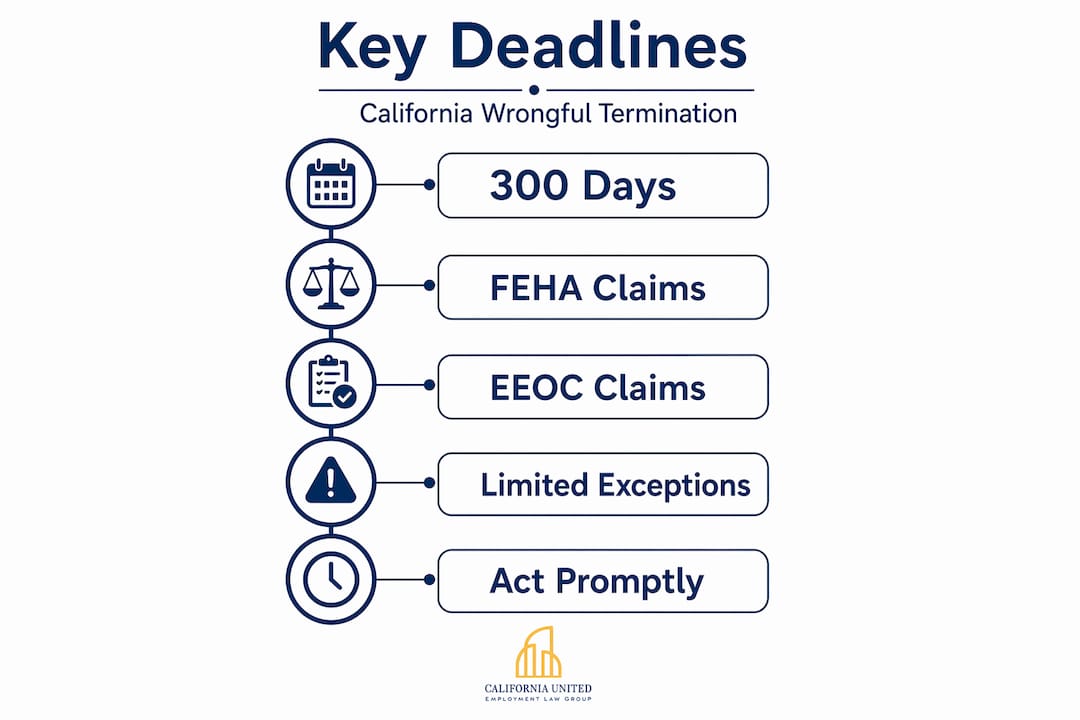
There are limited exceptions that can pause or extend these deadlines, but they are narrow and fact-specific. Do not assume a tolling exception applies to your situation without speaking with an attorney. Employees in cities like Long Beach, Burbank, and throughout the Los Angeles metro area can consult with local employment attorneys who are familiar with both the state and federal filing processes.
Acting promptly is the clearest way to protect your options. Even if you are uncertain whether your termination was wrongful, a free initial consultation costs you nothing compared to permanently losing the right to file.
Common Misconceptions About Wrongful Termination
Several misunderstandings lead employees to either overestimate or underestimate their legal position. Recognizing these can help you approach the situation with realistic expectations.
- “Unfair” is not the same as illegal. Many firings feel deeply unjust but do not meet the legal threshold for wrongful termination. A manager who simply dislikes you, or who fires you because of a personal conflict unrelated to a protected characteristic, may be behaving badly without breaking the law.
- At-will employment has real limits. While California’s at-will doctrine gives employers broad termination authority, that authority ends where anti-discrimination laws, retaliation protections, and public policy begin. The doctrine is not absolute.
- Proving motive is difficult. Employers rarely document discriminatory intent. The burden of proof falls on you, as the employee, to show the termination was for an illegal reason. That is why circumstantial evidence like timing, shifting explanations, and comparative treatment becomes so important.
- Outcomes vary widely. The same set of facts can lead to different outcomes depending on the strength of the evidence, the legal theories pursued, and the specific jurisdiction. This is not a process with guaranteed results.
- Location-based nuances matter. California metro areas operate under the same state law, but local practices, court timelines, and agency resources can differ. Employees in West Hollywood, Santa Monica, or El Monte may have different practical experiences even within the same legal framework.
My Perspective On Recognizing Wrongful Termination
I have seen one thing separate employees who successfully identify and document potential wrongful termination from those who struggle to do so: they move quickly and stay organized. Not urgently or anxiously. Just methodically.
In my experience observing cases across the Los Angeles area, the employees who fare best are those who write things down immediately, make their personnel file request within the first week after termination, and resist the urge to confront their employer before speaking with someone who understands California employment law. Confrontations rarely produce useful information and sometimes create new problems.
What I find underappreciated is the value of the personnel file itself. Employers build documentation when they plan a termination. Sometimes that documentation appears after the fact. When a personnel file is sparse or when negative reviews appear with dates that conflict with what you remember, that inconsistency tells a story. You just need to know what to look for.
The other thing worth saying directly: not every suspicious termination is a winning legal case. California employment law is genuinely protective, and SB 497’s retaliation presumption is a meaningful development for employees. But the law works best when the facts support it. My strongest recommendation is to consult with a qualified California employment attorney before drawing conclusions about your case.
How California United Law Group Can Help You Understand Your Options
👉 If you are asking questions about your termination and wondering whether something illegal happened, you do not have to figure it out alone.
California United Law Group, P.C. represents employees across the Los Angeles metro area, including Pasadena, Glendale, Long Beach, Burbank, and surrounding cities. The firm focuses on California employment law, including FEHA claims, retaliation, discrimination, and wrongful termination cases. If you are in the Pasadena area and want guidance specific to your location, the firm’s Pasadena employment attorneys are available to discuss your situation.
This article is for general educational purposes and does not constitute legal advice. Every situation is fact-specific, and speaking with an attorney is the best way to understand your rights.
FAQ
What makes a termination wrongful under California law?
A termination is legally wrongful when it violates a state or federal law, a contract, or public policy. Being fired unfairly or without good reason is not enough on its own to constitute wrongful termination.
How do I spot wrongful termination warning signs?
Key warning signs include suspicious timing after protected activity, shifting employer explanations, sudden negative performance reviews, and being treated differently from similarly situated coworkers.
How long do I have to file a wrongful termination claim in California?
For discrimination and retaliation claims under FEHA, California employees generally have 300 days from the termination date to file a charge with the EEOC or the California Civil Rights Department.
Can I be fired for reporting workplace misconduct in California?
Firing an employee in retaliation for reporting workplace misconduct is illegal under California law. Under Labor Code § 1102.5, employees who report reasonably suspected violations of law to a government agency or internally are protected from retaliation. Additionally, SB 497 (effective January 1, 2024) amended specific Labor Code sections — including § 98.6 governing wage complaints — so that adverse action within 90 days of those protected activities creates a rebuttable presumption of retaliation. For FEHA-based retaliation claims, including firing someone for reporting harassment or requesting medical leave, timing within that same window is powerful evidence even without a statutory presumption.
What evidence helps identify wrongful dismissal?
Useful evidence includes your personnel file, performance reviews, emails, records of complaints you filed, and documentation of how similar coworkers were treated under the same circumstances.