
You showed up, did the work, and then one day you were let go. Maybe the timing felt suspicious. Maybe your manager had been making comments about your age, your pregnancy, or a complaint you filed. Whatever happened, you are now asking whether what you experienced was actually illegal — and whether you can do something about it. Knowing how to fight wrongful termination in California starts with understanding that “unfair” and “illegal” are not the same thing, and that wrongful termination has a specific legal meaning rooted in illegal motive or violations of state law. This guide walks you through what you need to know, from the legal foundation to the practical steps, whether you are in Pasadena, Los Angeles, or anywhere else in California.
Table Of Contents
- Understanding wrongful termination and its legal context in California
- Preparing your case: key evidence and important deadlines
- Practical steps to respond after a suspected wrongful termination
- Common challenges and pitfalls when addressing wrongful termination in California
- Why understanding your wrongful termination rights in California goes beyond legal definitions
- Get expert help fighting wrongful termination in California
- Frequently asked questions
Understanding Wrongful Termination And Its Legal Context In California
Most people assume that if they were fired without good reason, they have a case. California’s at-will employment doctrine actually allows employers to end a working relationship for almost any reason, or no reason at all. But “almost any” is doing a lot of work in that sentence. The law draws a clear line.
Wrongful termination means firing for illegal reasons, not simply firing someone unfairly. The illegal motives that make a termination wrongful under California law include:
- Discrimination based on a protected characteristic such as race, gender, age, disability, religion, national origin, sexual orientation, or pregnancy
- Retaliation for reporting workplace violations, filing a workers’ compensation claim, or participating in a legal investigation
- Whistleblowing after reporting illegal activity by the employer to a government agency or internally
- Violations of public policy, such as firing someone for refusing to commit an illegal act or for exercising a constitutional right
California provides especially strong protection through what courts call the public policy exception. The California Supreme Court established in Tameny v. Atlantic Richfield Co. that there is no right to terminate an employee for a reason that contravenes fundamental public policy, even under at-will employment. California courts later clarified that to support a wrongful discharge claim, the violated public policy must meet a four-part test: it must be based on a constitutional or statutory provision, be ‘public’ in the sense that it inures to the benefit of the public, have been firmly established at the time of the discharge, and be fundamental and substantial. (Stevenson v. Superior Court (1997) 16 Cal.4th 880.) This means if an employer fires you for refusing to falsify safety records, for example, you may have a Tameny claim regardless of your at-will status.
The Fair Employment and Housing Act (FEHA) is California’s primary anti-discrimination law. It covers employers with five or more employees and goes further than federal law in several areas, including broader protections for disability and pregnancy-related conditions.

Pro Tip: If your employer gave you a reason for the termination, that reason is not automatically the whole story. Employers sometimes offer a stated reason that masks an illegal one. This is called “pretext,” and it is something an experienced employment attorney can help you evaluate.
Courts have held that an employer may discharge an employee for a good reason, a bad reason, or no reason at all — unless the actual reason is discriminatory. ‘The employer may fire an employee for a good reason, a bad reason, a reason based on erroneous facts, or for no reason at all, as long as its action is not for a discriminatory reason.‘ (See CACI No. 2513, Business Judgment for ‘At-Will’ Employment.)
Courts have recognized that ‘[t]he employer may fire an employee for a good reason, a bad reason, a reason based on erroneous facts, or for no reason at all, as long as its action is not for a discriminatory reason.‘ (Veronese v. Lucasfilm Ltd. (2012) 212 Cal.App.4th 1.) The question is always whether the stated reason was a cover for an illegal motive. Understanding which legal theory applies to your situation is the foundation of your California termination rights and shapes everything that follows, including which agency you file with and how much time you have to act.
Preparing Your Case: Key Evidence And Important Deadlines
Once you understand the legal framework, preparation becomes your most important task. Two things matter above everything else: what you can document and how quickly you move.
What to gather right away
- Your offer letter, employment contract, and any written policies in your employee handbook
- All termination-related documents, including your termination notice or any separation agreement you were asked to sign
- Emails, texts, or written communications that reflect the employer’s attitude toward your protected characteristic or your complaint
- Performance reviews, especially any positive ones that contradict the employer’s stated reason for firing you
- A written timeline of events, noting dates, names, and what was said during relevant conversations
- Records of any complaints you made to HR or a supervisor and the responses you received
Understanding your filing deadlines
California has at least seven different limitations clocks that may apply to a single termination, each running on a different schedule, starting on a different date. Missing even one can extinguish a claim entirely.
| Claim type | Filing deadline | Agency or court |
|---|---|---|
| FEHA discrimination/retaliation | 3 years from the violation | California CRD |
| EEOC federal discrimination charge | 180 days or 300 days (if state agency involved) | EEOC |
| Wage claims (Labor Commissioner) | 1 to 4 years depending on claim type (e.g., 4 years for written contract wage claims). | California Labor Commissioner |
| Common law wrongful termination (Tameny) | 2 years | Superior Court |
| WARN Act violation claim | No specific employee pre-filing deadline; employer must give 60 days’ advance written notice (If notice was not provided, your claim is not time-barred by a 60-day window — that period is the employer’s obligation, not yours.) | Superior Court |
The distinction between 180 and 300 days on a federal discrimination charge depends on whether a state or local agency has jurisdiction over the same claim. Because California’s CRD (Civil Rights Department) handles these claims, most California employees fall under the 300-day window. But do not assume you have time to spare.
Pro Tip: Even if you are not sure which claims apply to you, contacting an attorney early means you protect every potential avenue. Waiting to see “how things play out” is one of the most common reasons employees lose otherwise valid wrongful termination claims in California.
If retaliation is part of your situation, the same deadline urgency applies to workplace retaliation claims in California. Different laws, different clocks.
Practical Steps To Respond After A Suspected Wrongful Termination
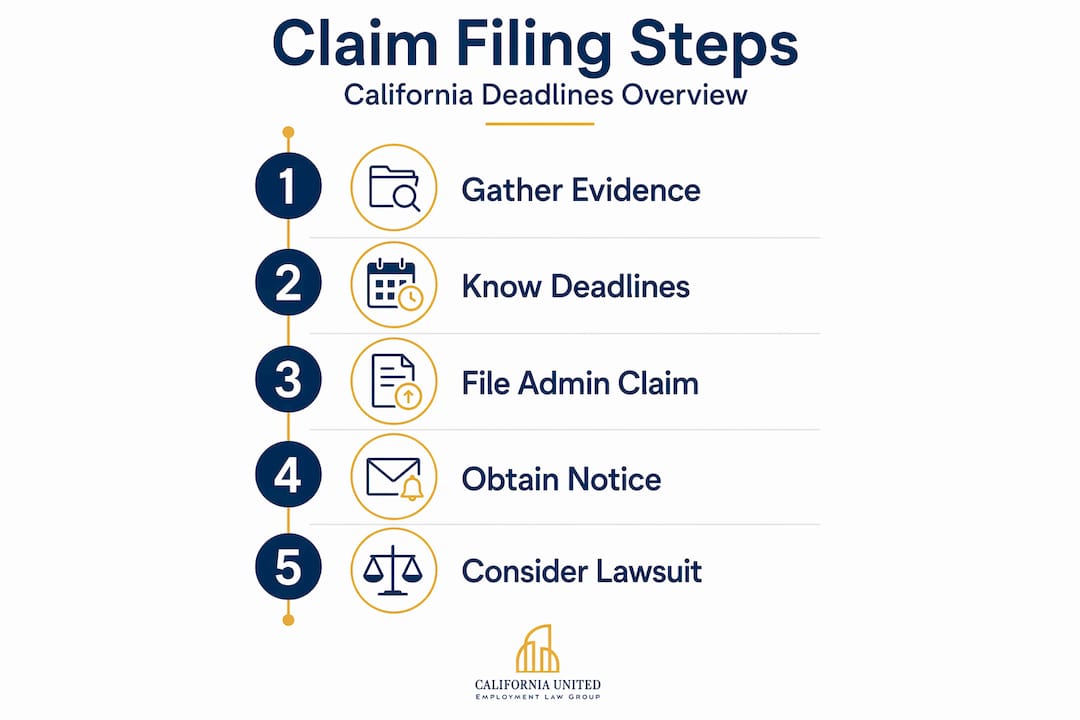
After gathering evidence and understanding your deadlines, here is a general overview of how California employees typically move through the process of disputing a firing and exploring their legal options.
Step-By-Step Overview
- Consult an employment attorney early. Before filing anything, a legal evaluation can help you identify which claims apply, which agencies to use, and which deadlines are most urgent for your situation.
- File a charge with the CRD or EEOC. For discrimination and retaliation claims under FEHA or federal law, you must file an administrative charge before you can sue in court. This is not optional.
- Request a right-to-sue notice promptly. Under FEHA, you can request a right-to-sue notice without waiting for the CRD to complete its investigation. Once it is issued, you have one year from the date of the notice — not the date you receive it — to file a civil lawsuit. Mail delays do not extend this deadline. Waiting for the investigation can use up valuable time.
- Evaluate your wage claims separately. If your employer failed to pay you correctly or on time, those claims proceed through a different channel.
- File a civil lawsuit if warranted. Once you have your right-to-sue notice and have completed the administrative process, your attorney can file suit in California Superior Court or federal court.
Other Claims Worth Checking
- Wage and hour violations: California requires that final wages be paid immediately upon termination. If your employer delayed that payment willfully, waiting-time penalties can accrue for up to 30 calendar days. This is a separate and often overlooked form of leverage that affects workers across El Monte, Monterey Park, and beyond.
- WARN Act violations: If you were part of a mass layoff, California’s WARN Act may require 60 days of advance written notice. Note: California’s WARN Act applies to employers with 75 or more employees; the federal WARN Act applies to employers with 100 or more employees. If you did not receive it, that is a separate legal claim.
- Public policy claims: These do not require an administrative filing before suit, which makes them a different path than FEHA claims.
| Claim type | Requires admin filing? | Right-to-sue notice needed? |
|---|---|---|
| FEHA discrimination/retaliation | Yes, through CRD | Yes |
| Federal Title VII discrimination | Yes, through EEOC | Yes |
| Tameny public policy claim | No | No |
| Wage claim (Labor Commissioner) | Optional (can sue directly) | No |
Pro Tip: Filing a wage and hour claim alongside a wrongful termination claim is not just about the money. It can strengthen your overall legal position by establishing a documented timeline of employer conduct.
Understanding the employment lawsuit process in California before you begin can reduce stress and help you make better decisions at each stage.
Common Challenges And Pitfalls When Addressing Wrongful Termination In California
Even employees with strong cases run into serious obstacles. Knowing what they are in advance helps you avoid them.
The Most Frequent Mistakes
- Confusing unfair with illegal. Your employer may have treated you terribly. That alone is not enough. You need to show an illegal motive tied to a protected characteristic or a protected activity. This distinction trips up many employees in Torrance, Santa Monica, and across California.
- Missing the filing deadline. The most common way to lose a meritorious California wrongful termination case is to miss the deadline. Courts do not routinely grant extensions because you did not know about the rule.
- Signing a separation agreement too quickly. Employers sometimes present a severance offer within days of termination, knowing that many employees will sign without understanding they may be waiving significant legal rights.
- Weak or incomplete documentation. Wrongful termination claims almost always involve a dispute over motive. Your employer will offer a different explanation. Without documentation that undermines that explanation, the case becomes much harder.
- Not preserving digital communications. Texts, emails, and internal messages are often critical evidence. Save copies outside of any employer-owned device or system immediately.
Employers in wrongful termination disputes almost always argue that the firing was for a legitimate business reason. Your strongest position is a documented record that tells a different story.
Pro Tip: Review any separation or severance agreement with an attorney before signing. In California, employees over 40 have at least 21 days to consider agreements that waive age discrimination claims under the Older Workers Benefit Protection Act, plus a 7-day revocation period after signing.
Failure to comply with these OWBPA requirements renders the waiver invalid. (See Oubre v. Entergy Operations, Inc. (1998) 522 U.S. 422.)” This is confirmed by: Employees at least 40 years of age may not waive any right or claim under the OWBPA unless the waiver is “knowing and voluntary.” Among other things, the employee must be given at least 21 days to consider the agreement, followed by at least seven days to revoke the agreement. Failure to comply with the OWBPA requirements renders the waiver invalid. [See Oubre v. Entergy Operations, Inc. (1998) 522 US 422, 427-428.]
Understanding the risks of wrongful termination claims in California, including how employer defenses work, is part of building a realistic strategy. And if your termination followed a complaint about workplace misconduct, you should also review your rights as someone fired after reporting misconduct, which involves specific retaliation protections.
Why Understanding Your Wrongful Termination Rights In California Goes Beyond Legal Definitions
Here is something most legal articles will not tell you directly: the employees who protect themselves best are not always the ones with the most obvious cases. They are the ones who move quickly, pursue every applicable legal theory at once, and do not wait for one claim to resolve before protecting the others.
California employees often pursue multiple legal theories simultaneously, including discrimination, retaliation, wage claims, and public policy violations. The reason is practical: deadlines and available remedies differ across theories. Leaning on only one claim can mean forfeiting others that might have been stronger or easier to prove.
Mass layoffs add another layer of complexity. If you were part of a reduction in force, California WARN Act requirements mandate at least 60 days of advance written notice for covered employers. Failure to provide that notice creates a separate legal claim entirely apart from any discrimination or retaliation analysis. Many employees never check WARN coverage because they assume the layoff was handled legally.
We have also seen, across cases from West Hollywood to Long Beach, that employees who wait for a “clear sign” that their case is strong before consulting an attorney often run out of time to act on the best claims. The legal system rewards people who prepare early and respond systematically, not those who wait for certainty.
California courts have consistently enforced these protections in real cases. In Tameny v. Atlantic Richfield Co. (1980) 27 Cal.3d 167, the California Supreme Court held that a wrongful termination suit is a tort action, allowing employees to recover damages beyond mere breach of contract. Courts have also recognized public policy claims based on discrimination under the FEHA — for example, Stevenson v. Superior Court (1997) 16 Cal.4th 880 established that age discrimination supports a public policy tort claim even when the FEHA’s administrative process is also available. And as early as 1959, California courts recognized the right to sue when an employer fired an employee for refusing to commit an illegal act. (Petermann v. International Brotherhood of Teamsters (1959) 174 Cal.App.2d 184 — employee fired for refusing to commit perjury.)
The broader point is this: California employment law is designed to protect you, but it does not enforce itself. The rights exist on paper. Protecting them requires action, documentation, and in most cases, someone who understands which laws apply to your specific facts and in what order to use them.
Get Expert Help Fighting Wrongful Termination In California
👉 You do not have to figure this out alone. California United Law Group, P.C. represents employees across California in wrongful termination claims, from initial evaluation through litigation. We handle discrimination, retaliation, whistleblower, public policy, and wage and hour claims under both the California Labor Code and FEHA.
Our team serves employees throughout the region, including those seeking an employment lawyer in Pasadena and workers looking for an employment lawyer in Long Beach. Whether you are in the early stages of evaluating your situation or ready to move forward, we can help you understand your rights and options with clarity and without pressure.
👉 Contact California United Law Group, P.C. today to schedule a confidential case evaluation. There is no obligation, and the conversation itself may give you the clarity you need to make an informed decision.
Frequently Asked Questions
What is considered wrongful termination under California law?
Wrongful termination in California occurs when an employee is fired for an illegal reason, such as discrimination, retaliation, or a violation of public policy, rather than simply being treated unfairly. The legal definition focuses on illegal motive or a termination that violates a specific law, not whether the firing seemed unjust.
How soon must I file a discrimination charge after wrongful termination in California?
You generally have 300 days to file a discrimination charge with a state or local agency, or 180 days if only federal law applies. Because California’s CRD covers most discrimination claims, the 300-day window typically applies, but acting quickly is always in your best interest.
Can I sue immediately after being wrongfully terminated in California?
No. Most California wrongful termination claims require you to file an administrative charge first and obtain a right-to-sue notice before you can file a lawsuit in court. You generally cannot go directly to court without completing this administrative step for discrimination and retaliation claims. However, common law wrongful termination claims based on public policy violations — sometimes called Tameny claims — do not require an administrative filing before suit. An attorney can help you determine which pathway applies to your specific claims.
What if my employer failed to pay my final wages on time after termination?
California law requires that final wages be paid immediately upon termination. If your employer willfully delays payment, you may be entitled to waiting-time penalties that can accrue for up to 30 calendar days, giving you a separate claim beyond wrongful termination itself.