
Yes, California law generally prohibits employers from taking adverse employment action against an employee because of marital status, including being married, unmarried, divorced, separated, widowed, annulled, or in another marital state. The California Fair Employment and Housing Act (FEHA), Government Code §12940, explicitly lists marital status as a protected characteristic, and that protection applies fully to Santa Monica employees. FEHA generally applies to California employers with five or more employees for discrimination claims, while harassment protections are broader.
Examples that may support a marital-status discrimination or harassment claim include:
- Paying a single employee less than a married colleague doing the same job
- Denying a promotion because a manager assumes a married employee has a spouse’s income to fall back on
- Harassment or hostile comments tied to someone’s marital status, if the conduct is legally sufficient under FEHA.
If you believe you have experienced this, consider these next steps:
- Preserve all relevant emails, pay records, and written policies
- File an internal HR complaint if your workplace has a reporting procedure
- File an administrative complaint with the California Civil Rights Department (CRD, formerly DFEH), and ask whether dual-filing with the EEOC makes sense based on the facts.
- Consult an employment attorney to evaluate your specific situation
Table of Contents
- How do you prove marital-status discrimination under FEHA?
- What remedies are available, and how does the filing process work?
- How should Santa Monica employees document and report marital-status concerns?
- When does it make sense to consult a Santa Monica employment attorney?
- Key Takeaways
- California United Law Group’s perspective on marital-status claims
- California United Law Group can help Santa Monica employees with marital-status claims
- Useful sources and further reading
How do you prove marital-status discrimination under FEHA?
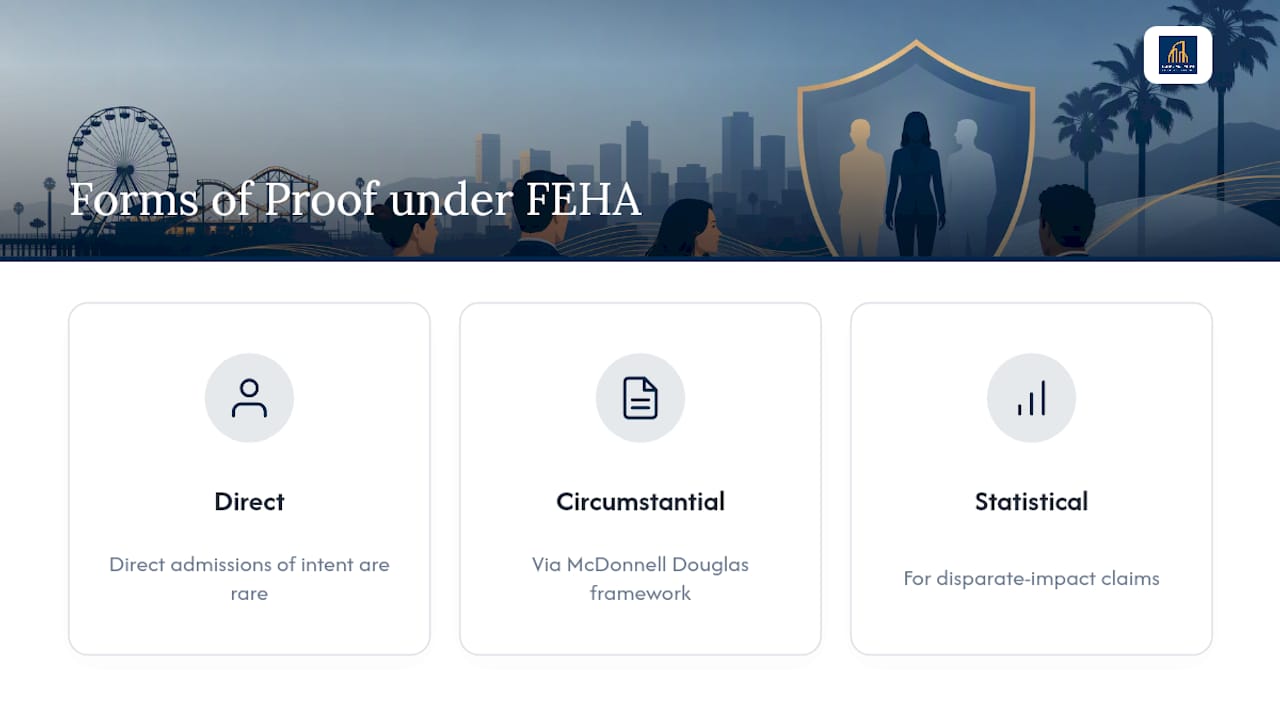
Proof comes in three forms: direct evidence, circumstantial evidence under the McDonnell Douglas framework, and statistical evidence for disparate-impact claims. Most cases rely on circumstantial evidence, because direct admissions of discriminatory intent are rare.
Direct Evidence
A written or recorded statement showing that a decision was made because of marital status is direct evidence. Think of an email where a manager explicitly says a single employee was passed over because “we need someone with a spouse’s support system.” This type of evidence is uncommon but powerful.
Circumstantial Evidence And The McDonnell Douglas Framework
California courts apply a burden-shifting approach adapted from the federal McDonnell Douglas framework. In many circumstantial-evidence cases, an employee may establish a prima facie case by showing they are in a protected marital-status category, were qualified or performing competently, suffered an adverse employment action, and circumstances suggest a discriminatory motive, such as more favorable treatment of similarly situated employees with a different marital status. The burden then shifts to the employer to articulate a legitimate, non-discriminatory reason. If the employer does so, you must show that reason is pretextual.
Under California’s standard, drawn from Harris v. City of Santa Monica and Guz v. Bechtel National, the employee must show that marital status was a substantial motivating factor in the adverse decision. CACI explains that a substantial motivating reason is one that actually contributed to the adverse employment action, was more than remote or trivial, and did not have to be the only reason. In mixed-motive cases, where the employer proves it would have made the same decision regardless, remedies may be limited but are not entirely barred.
Statistical And Adverse-Impact Evidence
| Evidence Type | What It Shows | Strength |
|---|---|---|
| Direct | Explicit discriminatory statement or document | Very strong, but rare |
| Circumstantial (McDonnell Douglas) | Disparate treatment of similarly situated employees | Most common in FEHA cases |
| Statistical / Adverse Impact | Patterns across a workforce showing one group is disproportionately harmed | Useful for systemic claims |
For disparate-impact claims, the EEOC’s four-fifths (80%) rule is often used as a screening tool, but it is not a substitute for legal analysis under FEHA and does not by itself prove liability. It calculates whether a selection rate for one group is less than 80% of the rate for the highest-selected group. A ratio below 0.80 flags a potential disparity worth investigating. As Duke Law scholarship on statistical proof in discrimination law notes, courts accept statistical comparisons to establish a prima facie disparate-impact case, but the numbers alone do not decide the outcome.
The 80% rule is a screening flag, not a verdict. A ratio below 0.80 signals that closer analysis is warranted. Small sample sizes can produce misleading results, and a flagged ratio must be followed by analysis of business necessity and whether less discriminatory alternatives exist.
Documents to preserve now:
- Emails, texts, and messages referencing your marital status or a decision tied to it
- Performance reviews and disciplinary records
- Pay stubs and compensation history
- Written job postings, offer letters, and promotion criteria
- Company policies on benefits, scheduling, or conduct
- Names, dates, and roles of witnesses to relevant conversations or decisions
What remedies are available, and how does the filing process work?
FEHA may provide remedies for employees who prevail, depending on the facts and proof. Potential remedies can include back pay, front pay, emotional distress damages, punitive damages where legally available, attorney’s fees and costs, and appropriate declaratory or injunctive relief.
In mixed-motive cases, if the employer proves it would have made the same decision for lawful reasons even without the discriminatory motive, damages, back pay, and reinstatement may be unavailable, but declaratory relief, injunctive relief, and attorney’s fees and costs may still be available where appropriate. Reinstatement and damages may be limited, though declaratory and injunctive relief can still be available.
The typical path from complaint to resolution follows this sequence:
- Documentation and evaluation – preserve evidence, identify witnesses, and evaluate whether the facts support a FEHA claim.
- Administrative filing — file a complaint with the CRD (formerly DFEH) or dual-file with the EEOC
Filing deadlines under FEHA are strict. Missing them can bar your claim entirely. Check the CRD’s current filing requirements and consider consulting an employment attorney early so no deadline is missed; if federal claims may be involved, ask whether EEOC filing or dual-filing is appropriate.
How should Santa Monica employees document and report marital-status concerns?
Acting promptly and carefully with documentation gives you the strongest foundation, whatever path you choose later.
Start with this checklist:
- Preserve relevant emails, texts, and voicemails in a lawful manner, and avoid taking confidential, privileged, proprietary, or trade-secret materials without legal advice.
- Print or export pay stubs, offer letters, and performance reviews
- Write down dates, times, locations, and the names of anyone present during relevant incidents
- Screenshot company policies, job postings, or benefit descriptions that may be relevant
- Note any witnesses who observed the conduct or have relevant knowledge
When filing an internal complaint, include: the specific conduct or decision you are reporting, the dates and locations it occurred, the names and roles of the individuals involved, any policy you believe was violated, and the names of any witnesses. Do not exaggerate, guess, or include facts you cannot support; inaccurate statements can undermine a claim.
Pro Tip: Keep personal copies of all documentation outside your work email and work devices. Employers may have document-retention policies that affect what you can access later, and your personal copies may be the only record you have. Avoid deleting any messages, even ones that seem minor.
After reporting internally, document the employer’s response, including any retaliation or changes in how you are treated. Santa Monica employees who make a good-faith complaint about suspected discrimination are generally protected from retaliation under FEHA.
When does it make sense to consult a Santa Monica employment attorney?
Not every workplace conflict requires legal representation, but certain circumstances make consulting an attorney a practical step worth taking.
Consider speaking with an employment lawyer if:
- You experienced a serious adverse action such as termination, demotion, or significant pay cut
- You have evidence, even circumstantial, suggesting your marital status played a role in the decision
- A filing deadline is approaching and you are unsure whether your claim qualifies
- Your situation involves mixed motives or overlapping protected categories
- Your employer has retaliated after you raised a concern internally
An employment attorney can evaluate the facts of your specific situation, advise on whether FEHA or other statutes apply, assist with administrative filings at the CRD or EEOC, negotiate with the employer, and represent you in litigation if the matter proceeds to court. Many California employment attorneys, including California United Law Group, may handle qualifying cases on a contingency-fee basis. Fee and cost obligations depend on the written fee agreement, including whether the client may be responsible for litigation costs.
This article is general educational information, not legal advice. Employment law outcomes are fact-specific and vary by situation. Consult a qualified employment attorney or contact the CRD or EEOC directly to understand your rights in your specific case.
Key Takeaways
Marital status is a protected characteristic under California FEHA, and Santa Monica employees who are treated differently for being married, single, divorced, separated, or widowed may have a legal claim worth evaluating.
| Point | Details |
|---|---|
| FEHA protects marital status | California Gov. Code §12940 covers married, single, divorced, separated, and widowed employees. |
| Unlawful conduct spans many areas | Discrimination in hiring, pay, promotion, benefits, scheduling, harassment, and termination can all violate FEHA. |
| Three proof types apply | Direct evidence, circumstantial evidence under McDonnell Douglas, and statistical adverse-impact evidence are all recognized. |
| File promptly with CRD | Administrative filing deadlines are strict; if federal claims may also be involved, ask whether EEOC filing or dual-filing is appropriate. |
| California United Law Group | The firm handles FEHA marital-status claims for Santa Monica employees and offers case evaluations. |
California United Law Group’s Perspective On Marital-Status Claims
What strikes us most about marital-status discrimination cases is how often they go unrecognized. Employees frequently sense that something is unfair but do not connect the treatment to a legally protected characteristic. A single worker who is consistently assigned the worst shifts, or a divorced employee who is quietly passed over for promotion, may assume the pattern is personal or coincidental. California law may treat that pattern differently when the facts show an adverse employment action or harassment tied to marital status.
FEHA’s protection of marital status is broader than most employees realize, and it sits alongside other protected categories in ways that can strengthen a claim when facts overlap.
California courts have recognized important limits and protections in marital-status cases. In Chen v. County of Orange, the court distinguished marital-status discrimination from an employer’s personal dislike of a particular spouse or romantic partner. In Hope International University v. Superior Court, the court explained that California marital-status law does not allow an employer to treat marriage between coworkers as an automatic reason to remove one spouse from employment, while also recognizing that discipline for an extramarital affair is not the same thing as marital-status discrimination. These distinctions matter because a viable claim usually depends on whether the employer acted because of marital status itself, not merely because of interpersonal conflict.
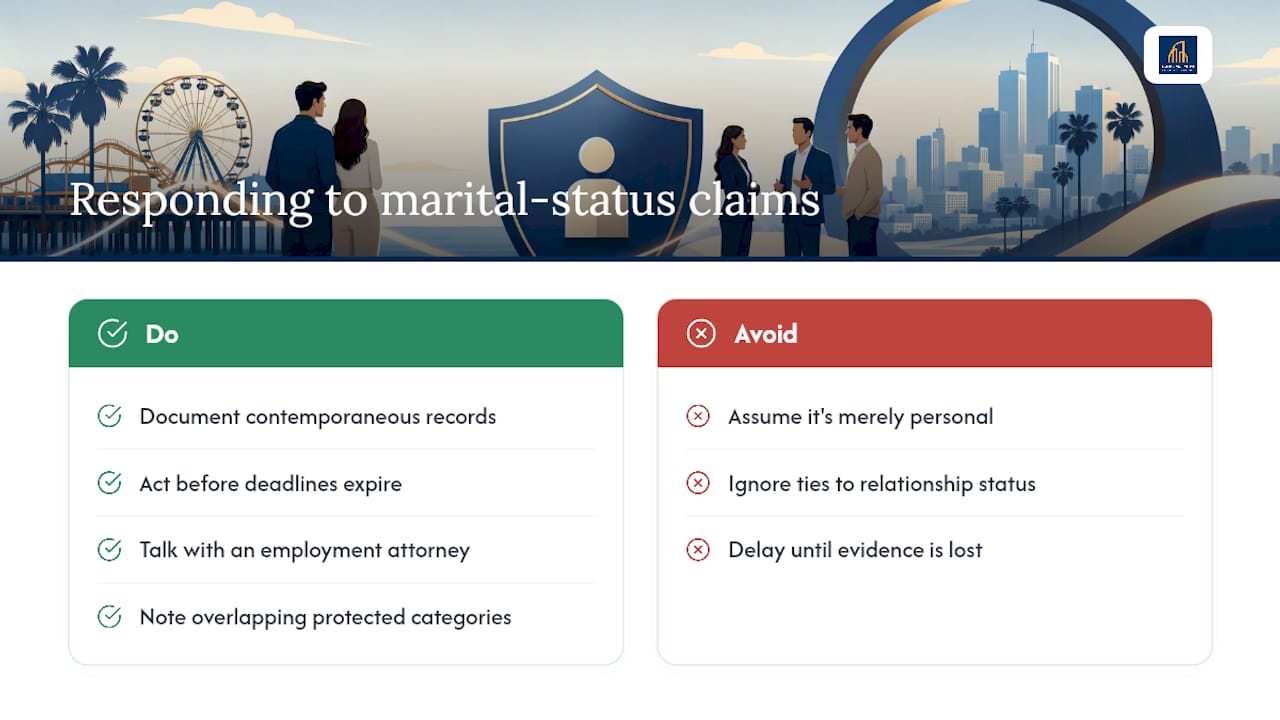
The evidence standards are demanding but workable, particularly when employees have preserved contemporaneous records. What we consistently see is that the employees who document carefully and act before deadlines expire are in a far better position than those who wait. If you are a Santa Monica employee and something about your treatment at work feels tied to your relationship status, the right first step is a candid conversation with an attorney who knows California employment law.
California United Law Group Can Help Santa Monica Employees With Marital-Status Claims
California United Law Group represents Santa Monica employees in FEHA discrimination claims, including those involving marital-status bias. The firm evaluates qualifying marital-status discrimination claims and may assist with CRD filings, negotiation, and litigation. Some matters may be handled on a contingency-fee basis, subject to a written fee agreement that explains fees and costs. You pay nothing unless the firm recovers for you.
👉 Schedule a case evaluation with California United Law Group today. Consultations are handled confidentially, and there is no obligation to proceed. This is educational content, not legal advice, and outcomes depend on the specific facts of your situation.
Useful Sources And Further Reading
- California Government Code §12940 — Discrimination Prohibited (FEHA)
- Employment | CRD
- Employment | CRD
- Questions and Answers to Clarify and Provide Common Interpretation of the Uniform Guidelines — EEOC
- Pre‑employment inquiries and marital status or number of children — EEOC
- The McDonnell Douglas Framework — How California Discrimination Cases Are Proven
- Scholarly analysis of statistical proof in discrimination law — Duke Law Scholarship
- Michelle Rapoport | Contact us — California United Law Group