
West Hollywood employees are legally protected against discrimination based on gender identity or gender expression under California’s Fair Employment and Housing Act (FEHA), regardless of whether that identity is actual or perceived. This protection applies to all employers with five or more employees, making it one of the broadest state-level shields in the country. West Hollywood, a city with deep roots in LGBTQ civil rights dating back to its 1985 establishment of same-gender domestic partnership benefits, sits within a legal framework that goes well beyond federal minimums. If you work in West Hollywood and believe you have faced discrimination based on who you are or how you express your gender, California law gives you real, enforceable rights.
This article is for general informational purposes only and does not constitute legal advice or create an attorney-client relationship. Employment law is fact-specific. If you believe your rights have been violated, consult a qualified California employment attorney about your individual situation.
What counts as West Hollywood gender identity or expression discrimination in California?
Gender identity or expression discrimination is the formal legal term for adverse treatment an employer directs at an employee because of their gender identity, gender expression, or the employer’s perception of either. Under California Government Code § 12940(a), FEHA prohibits this conduct across every stage of employment, from hiring through termination.
Discrimination does not always look like an outright firing. In West Hollywood workplaces, it can appear in subtler but equally unlawful forms:
- Refusal to use correct pronouns or name after being informed of an employee’s preference
- Wrongful termination tied to a transition or gender nonconforming presentation
- Denial of restroom access consistent with an employee’s gender identity
- Dress code enforcement that penalizes employees for presenting in a way that matches their gender identity
- Harassment that creates a hostile work environment based on gender expression
- Demotion or pay cuts following disclosure of a transgender or non-binary identity
Gender identity and gender expression are distinct protected categories under FEHA. That distinction matters. An employee can bring a claim based on gender identity, gender expression, or both, depending on the facts of their situation.
Sex stereotyping is another recognized form of this discrimination. “The U.S. Supreme Court established in Price Waterhouse v. Hopkins (1989) that penalizing an employee for failing to conform to gender norms is unlawful sex discrimination. California codified this principle directly into FEHA, making gender expression an independent protected category under Government Code § 12926(r)(2) — separate from, and in addition to, sex discrimination. California has codified that principle directly into FEHA, meaning dress code stereotyping is explicitly prohibited.

Pro Tip: Document every incident as it happens. Save emails, note dates and witnesses, and keep records outside of your work devices. This documentation becomes your strongest foundation if you later file a complaint.
How do California and federal laws compare on gender identity protections?
California’s FEHA and the federal Title VII of the Civil Rights Act of 1964 both prohibit gender identity discrimination, but they differ in meaningful ways that affect West Hollywood employees directly.
The U.S. Supreme Court’s 2020 ruling in Bostock v. Clayton County extended Title VII protections to gender identity and sexual orientation nationwide. That was a landmark shift. Before Bostock, federal protection was inconsistent and contested. Bostock resolved a longstanding circuit split and established that an employer who fires an employee merely for being transgender violates Title VII — even without any intent to discriminate against women or men as a class.
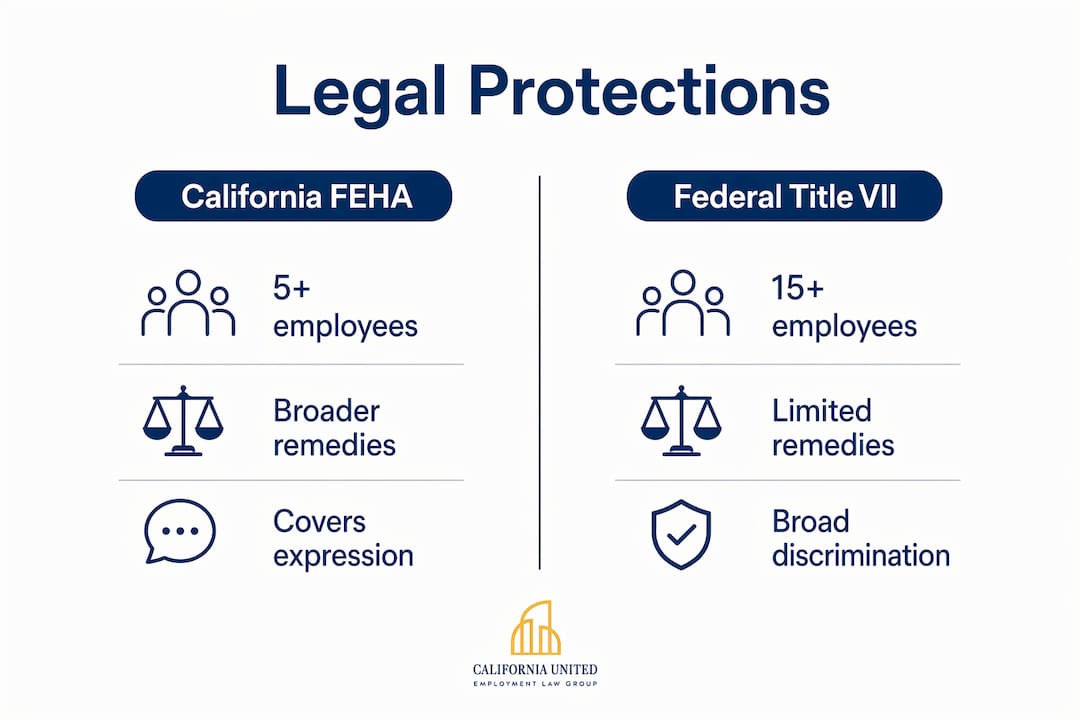
California did not wait for the federal courts to catch up. FEHA has explicitly covered gender identity and expression for years, and it applies to employers with five or more employees. Title VII applies only to employers with 15 or more employees. That gap matters significantly in West Hollywood, where many businesses are small or mid-sized.
| Feature | California FEHA | Federal Title VII |
|---|---|---|
| Employer size threshold | 5 or more employees | 15 or more employees |
| Gender identity coverage | Explicit, codified | Recognized via Bostock (2020) |
| Enforcement agency | California Civil Rights Department (CRD) | Equal Employment Opportunity Commission (EEOC) |
| Statute of limitations | 3 years from discriminatory act | 300 days from discriminatory act (California is a deferral state; timely CRD filing also satisfies Title VII exhaustion) |
| Remedies available | Broader, including emotional distress damages | More limited under federal caps |
California’s remedies are broader than federal ones. FEHA allows recovery for emotional distress, attorney’s fees, and punitive damages in appropriate cases. Federal Title VII caps compensatory and punitive damages based on employer size. For most West Hollywood employees, a FEHA claim filed with the California Civil Rights Department offers stronger practical protection than a federal EEOC complaint alone.
How do you file a gender identity discrimination complaint in California?
Filing a discrimination claim in California follows a specific procedural path. Missing a step can result in your case being dismissed before it is ever heard on the merits.
Here is the required process:
- File an administrative complaint with the California Civil Rights Department (CRD). This is a mandatory first step before you can sue in civil court. You cannot skip it.
- Wait for or request a Right to Sue letter. The CRD will investigate or issue a Right to Sue letter. You need this letter before filing a civil lawsuit.
- File your civil lawsuit within one year of the date the CRD issues the Right to Sue notice. The one-year period begins on the date of issuance — not the date you receive it — so act immediately upon receiving the notice.
- Meet the overall statute of limitations. Under California law, you must file your CRD complaint within 3 years of the discriminatory act. Waiting too long forfeits your rights entirely.
- Preserve all evidence before filing. Gather emails, performance reviews, witness names, and any written communications that document the discrimination.
The employment lawsuit process in California has strict procedural requirements that trip up many employees who try to navigate it without legal guidance. Missing the Right to Sue letter step is one of the most preventable procedural errors that leads to case dismissal in California gender discrimination cases.
Pro Tip: Request your Right to Sue letter from the CRD as soon as you file your complaint. You do not have to wait for the agency to complete its investigation before requesting it. Acting early preserves your options.
West Hollywood employees also have access to local resources. The City of West Hollywood has a Human Services Division and maintains relationships with LGBTQ advocacy organizations that can provide referrals and support during the complaint process.
What workplace protections apply to transgender and non-binary employees?
California law goes beyond simply prohibiting discrimination. It also requires employers to provide specific accommodations and maintain inclusive workplace conditions for transgender and non-binary employees.
These protections apply in West Hollywood workplaces and across California:
- Correct name and pronouns: Employers must use the name and pronouns an employee requests. Persistent refusal after being informed is prohibited under FEHA and can constitute harassment.
- Restroom access: Employees have the right to use facilities that correspond to their gender identity. Employers cannot require employees to use facilities inconsistent with their identity or to use separate, isolated facilities. Federal guidance supports this position as well. In Lusardi v. McHugh (EEOC 2015), the EEOC ruled that denying a transgender employee access to a bathroom consistent with her gender identity constitutes unlawful sex discrimination under Title VII.
- Dress code flexibility: Employers must allow employees to dress consistently with their gender identity. Policies that enforce gender-based appearance standards in a way that conflicts with an employee’s identity violate California law.
- Protection from hostile work environments: Repeated misgendering, derogatory comments, or exclusion based on gender identity can create a hostile work environment that is independently actionable under FEHA.
- Protection for perceived identity: Even if an employer is wrong about an employee’s gender identity, discrimination based on that perception is still unlawful.
West Hollywood’s cultural environment reflects these legal standards. The city has long been a hub for LGBTQ residents and workers, and many local employers have adopted inclusive policies that meet or exceed state requirements. Still, legal protections exist precisely because workplace culture does not always match legal obligations.
Non-binary employees are fully covered under these protections. California law does not require an employee to identify as transgender to receive gender identity protections. Any employee whose gender identity or expression differs from what their employer expects can assert these rights.
One nuance worth understanding: wage discrimination claims under California law use a ‘substantially similar work’ standard rather than a strict ‘equal work’ test. This applies to pay claims based on gender, race, or ethnicity — meaning employees facing pay disparities have a broader basis for claims than many assume, without needing to prove they perform identical work to a higher-paid colleague. Understanding this standard can make the difference between pursuing a valid claim and walking away from one.
Key Takeaways
California’s FEHA gives West Hollywood employees among the strongest gender identity and expression discrimination protections in the country, covering employers with as few as five employees and requiring specific procedural steps to enforce those rights.
| Point | Details |
|---|---|
| FEHA covers small employers | Protections apply to any employer with 5 or more employees, broader than federal law. |
| Both identity and expression are protected | Employees can claim discrimination based on gender identity, gender expression, or both. |
| Filing order is mandatory | You must file with the CRD and obtain a Right to Sue letter before suing in civil court. |
| The 3-year deadline is firm | Discrimination complaints must reach the CRD within 3 years of the unlawful act. |
| Perceived identity is also covered | Employers cannot discriminate based on what they believe an employee’s gender identity to be. |
What I’ve Learned About Gender Identity Protections In West Hollywood Workplaces
After working with California employees on discrimination claims, one pattern stands out clearly. Most people who contact us about gender identity discrimination waited too long before seeking information. They tolerated misgendering, hostile comments, or unfair treatment for months before realizing those experiences had legal names and legal remedies.
West Hollywood has a reputation as a progressive, affirming city, and that reputation is largely earned. But it can create a false sense of security. Employees sometimes assume that because their city is supportive, their employer will be too. That assumption does not always hold. Legal protections exist because workplace behavior does not automatically reflect community values.
The procedural requirements under California law are where I see the most preventable harm. The CRD filing requirement and the Right to Sue letter step are not formalities. Missing them ends cases that would otherwise have merit. If you are reading this because something at work has felt wrong, the most useful thing you can do right now is find out where you stand procedurally, not just whether you have a claim.
I also want to address a misconception that legal commentators have noted repeatedly: many employees believe they cannot pursue a wage discrimination claim unless they can prove they do identical work to a higher-paid colleague. California’s “substantially similar work” standard is more flexible than that. Do not assume you lack a claim before speaking with someone who knows the law.
West Hollywood’s LGBTQ employee rights are real and enforceable. Understanding them is not just reassuring. It is the foundation for doing something about it when those rights are violated.
How California United Law Group Can Help West Hollywood Employees
If you work in West Hollywood and believe you have experienced gender identity or expression discrimination, California United Law Group is here to help.
California United Law Group, P.C. represents employees in workplace discrimination disputes, including claims under FEHA involving gender identity, gender expression, and related protections. The firm handles cases from the initial complaint stage through litigation, including wrongful termination, harassment, and retaliation tied to gender identity.
West Hollywood employees can contact California United Law Group to discuss the facts of their situation with an attorney who understands California employment law and the local context that matters in these cases. The firm also handles sexual orientation discrimination claims, which often arise alongside gender identity claims.
Reach out today to understand your rights and your options.
FAQ
What is gender identity or expression discrimination under California law?
Gender identity or expression discrimination is adverse employment treatment based on an employee’s actual or perceived gender identity or gender expression. California’s FEHA prohibits this conduct for employers with five or more employees.
How long do I have to file a gender identity discrimination complaint in California?
You have 3 years from the discriminatory act to file a complaint with the California Civil Rights Department. Missing this deadline typically bars you from pursuing the claim.
Do I need a lawyer to file a gender identity discrimination complaint?
You are not required to have a lawyer to file with the CRD, but procedural errors are common and can result in dismissal. Legal guidance helps you meet deadlines and preserve your rights throughout the process.
Are non-binary employees protected under California gender identity laws?
Yes. California’s FEHA covers all employees regardless of whether they identify as transgender, non-binary, or gender nonconforming. Protection extends to any employee whose gender identity or expression differs from employer expectations.
Can my employer require me to use a restroom that does not match my gender identity?
No. California law requires employers to allow employees to use facilities consistent with their gender identity. Requiring otherwise is a form of prohibited discrimination under FEHA.