
Off-the-clock work violations occur when employees perform job duties without receiving pay for every hour worked, which is illegal under the California Labor Code. For Santa Monica employees and off-the-clock work violations, the stakes are real: the Department of Labor has recovered over $664,139 in back wages across 71 enforcement cases in Santa Monica alone, primarily in hospitality and retail. California law is stricter than federal standards on this issue, and local ordinances are expanding worker protections further. Understanding where the law stands gives you a clearer picture of your rights.
What counts as off-the-clock work in Santa Monica?
Off-the-clock work is the industry term for any compensable time an employer fails to record or pay. Under California law, compensable time is broadly defined to include all time an employer “suffers or permits” an employee to work. That standard is significantly wider than the federal Fair Labor Standards Act. In Morillion v. Royal Packing Co. (2000) 22 Cal.4th 575, the California Supreme Court confirmed that an employee subject to an employer’s control does not even need to be actively working during that time to be entitled to compensation—a far broader standard than federal law.
Common examples of off-the-clock work include:
- Pre-shift tasks: Setting up a workstation, loading equipment, or attending a brief team meeting before clocking in
- Post-shift duties: Cleaning up, completing paperwork, or waiting to be dismissed after clocking out
- Electronic communications: Responding to work texts, emails, or calls outside scheduled hours
- Off-site work: Completing reports or job-related tasks from home without logging the time
California courts reject the federal “de minimis” rule. In Troester v. Starbucks Corp. (2018) 5 Cal.5th 829, the California Supreme Court held that the federal de minimis doctrine does not apply to wage claims under California law—meaning employers generally cannot avoid paying for brief tasks by arguing they are too short to count. The Court did leave open the narrow question of whether activities so irregular or fleeting that they are practically impossible to track might still be non-compensable, but that exception is rarely applicable in routine off-the-clock scenarios. That rule allows employers to skip paying for very short tasks. California requires payment for nearly any work that benefits the employer, no matter how brief. A two-minute email reply after your shift ends is generally compensable time under California law. While California courts have left open a very narrow exception for activities so sporadic or fleeting as to be practically untrackable, routine off-hours communications requested by an employer fall squarely within compensable time.
Santa Monica’s hospitality and retail sectors see this pattern regularly. A hotel front desk worker clocking out and then handling a guest complaint for 15 minutes, or a retail associate staying to restock shelves after their shift ends, both may have valid wage claims under California law, depending on the specific facts and circumstances of their employment.
Pro Tip: Keep a personal log of every task you perform outside your scheduled hours, including the date, time, and a brief description. This record can become your strongest evidence in a wage dispute.

How do Santa Monica’s 2026 ordinances affect your wage protections?
Santa Monica has enacted local ordinances that directly raise the floor on worker compensation and job security, particularly in hospitality. These laws create a stronger baseline that makes off-the-clock violations more financially significant for both workers and employers.
The minimum wage for hotel workers rises to $25 per hour on July 1, 2026, with a planned increase to $30 per hour by 2030. That means every unpaid hour carries a higher dollar value, and the financial harm from off-the-clock violations grows accordingly.
| Ordinance | Key Requirement | Effective Date |
|---|---|---|
| Hotel Worker Minimum Wage | $25/hr minimum wage | July 1, 2026 |
| Planned Wage Increase | $30/hr minimum wage | By 2030 |
| Recall Obligation | Offer jobs to laid-off workers within 10 days | In effect |
| Retention Requirement | Retain existing staff for 90 days after ownership change | In effect |
Santa Monica also requires hotel and pier employers to offer positions to laid-off workers within 10 days and retain existing staff for 90 days following an ownership change. These recall and retention protections reduce the economic pressure that often pushes workers to accept unpaid tasks out of fear of losing their jobs. The city’s recall and retention laws also include penalties for violations and explicit retaliation protections, giving workers a safer path to assert their rights.
Together, these ordinances signal that Santa Monica takes worker compensation seriously. Higher wages and stronger job security protections reduce the leverage employers hold over hourly workers, making it harder to pressure employees into working off the clock.
California courts have reinforced these protections through landmark decisions. In Troester v. Starbucks Corp. (2018) 5 Cal.5th 829, the California Supreme Court rejected the federal “de minimis” doctrine as applied to California wage claims, holding that an employer who regularly requires employees to work even minutes off the clock cannot escape liability by calling the time trivial. Earlier, in Morillion v. Royal Packing Co. (2000) 22 Cal.4th 575, the Supreme Court held that compensable “hours worked” extends to any time an employee is subject to an employer’s control—even if no active task is being performed. Together, these decisions establish that California’s wage protections are among the most expansive in the country, and that even brief, routine off-the-clock tasks carry real legal consequences for employers.
What legal remedies exist for off-the-clock violations in Santa Monica?
Santa Monica employees have concrete legal options when an employer fails to pay for all hours worked. The process starts with understanding what you are owed and how to pursue it.
- Calculate your unpaid wages. Add up every unpaid hour or task, multiply by your hourly rate (including any applicable overtime premium), and document the total. California requires overtime pay at 1.5 times your regular rate for hours over 8 in a day or 40 in a week, and double time (2× your regular rate) for hours worked beyond 12 in a single day or beyond 8 hours on the seventh consecutive day of a workweek.
- Preserve your evidence. Employee-maintained time logs are critical evidence in off-the-clock claims, especially when employers lack detailed records. Save text messages, emails, and any written communications that show you were working outside your scheduled hours.
- File a wage claim. You can file a claim with the California Labor Commissioner’s Office (also called the Division of Labor Standards Enforcement) or pursue a civil lawsuit. Both paths can recover back wages, interest, and penalties.
- Understand your retaliation protections. California law prohibits employers from firing, demoting, or threatening employees who report wage violations. Santa Monica’s local ordinances add another layer of retaliation protection for hospitality workers.
- Explore legal representation. Small wage disputes in Santa Monica typically range from $2,000 to $8,000. Flat-fee or contingency-based legal services are often more accessible for claims in this range. Under a contingency arrangement, attorney fees are typically recovered only if your case succeeds; however, clients may still be responsible for certain litigation costs regardless of outcome. A consultation will clarify the specific fee structure applicable to your claim.
Statistic: The Department of Labor recovered over $664,139 across 71 Santa Monica wage enforcement cases. That average recovery per case reflects how quickly unpaid hours accumulate into meaningful dollar amounts.
Pro Tip: Contact an employment lawyer in Santa Monica for a case evaluation before filing. The right legal strategy depends on your specific facts, and a consultation can clarify your options without committing you to a course of action.
Common Employer Tactics That Lead To Off-the-clock Violations
Employers do not always demand unpaid work directly. Many off-the-clock violations result from subtle management practices that pressure employees to work without recording their time. Recognizing these patterns protects you.
Watch for these common tactics:
- Discouraging accurate time reporting: Managers who say “don’t worry about clocking in for that” or “it’ll only take a minute” are signaling that they expect uncompensated work. Management pressure to underreport hours is a recognized red flag under California wage law.
- Sending messages after hours: Texting or emailing employees about work tasks outside their scheduled shift creates compensable time, even if the employer never explicitly asks for a response.
- Requiring pre-shift preparation: Asking employees to arrive early to set up without paying for that time is a direct violation of California Labor Code requirements.
- Understaffing at shift end: When there are not enough workers to complete closing tasks, remaining employees often stay past their clocked-out time without additional pay.
- Informal “off the books” requests: Asking employees to handle a quick task “as a favor” or “just this once” creates a pattern that can add up to significant unpaid wages over time.
Your response to these situations matters. Document each incident with the date, time, what was asked, and how long it took. Raise concerns in writing when possible, so there is a record. If your employer retaliates after you raise a wage concern, that retaliation is itself a separate legal violation under California law. You can also review your rights after reporting workplace issues for additional context on retaliation protections.
How Off-the-clock Violations Hit Hospitality And Retail Workers Hardest
Santa Monica’s economy relies heavily on tourism, hotels, and retail. That concentration creates specific vulnerability for workers in those sectors. Hospitality and retail are the primary enforcement targets in Santa Monica’s wage dispute history, and the patterns are consistent.
| Sector | Common Violation Type | Typical Impact |
|---|---|---|
| Hotel and Hospitality | Pre-shift setup, post-shift guest handling | Daily unpaid minutes accumulate into weekly wage theft |
| Retail | Post-shift restocking, off-hours inventory tasks | Unpaid overtime and missed meal break premiums |
| Restaurant and Food Service | Cleaning after clock-out, tip pool irregularities | Combined wage and tip violations |
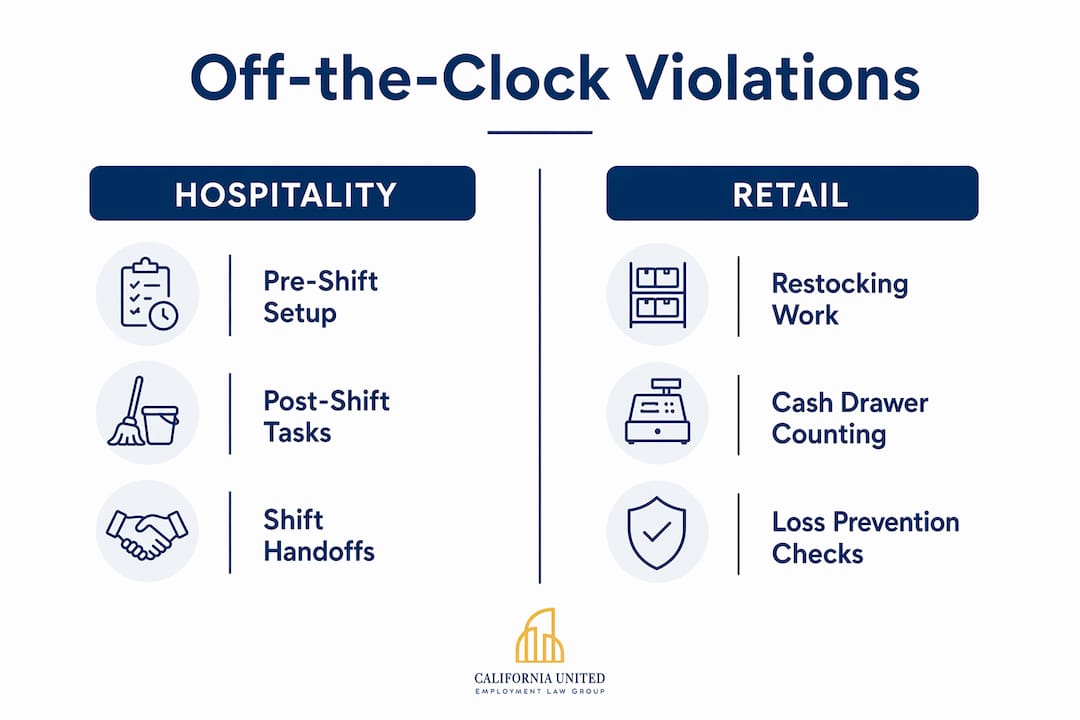
Hotel workers face particular pressure because their shifts often involve handoff tasks that blur the line between paid and unpaid time. A front desk employee briefing the incoming shift for 10 minutes after clocking out is performing compensable work. Santa Monica’s new wage floor of $25 per hour for hotel workers makes each of those unpaid minutes more valuable, and more worth pursuing legally.
Retail employees face a different pattern. Restocking shelves, counting a cash drawer, or completing a loss prevention check after the official shift ends are all compensable activities under California law. Workers in these roles often accept these tasks as “part of the job” without realizing they have a legal right to be paid. Understanding off-the-clock work rights in California can help you recognize when your employer has crossed a legal line.
My Take On Wage Theft Trends In Santa Monica
What I’ve Seen Working With Santa Monica Employees On Wage Claims
The pattern I observe most often is not dramatic. It is not an employer handing someone a time sheet and telling them to falsify it. It is quieter than that. A manager sends a text at 9 PM asking a question that requires a real answer. A worker stays 20 minutes after clocking out because the incoming shift is late. These moments feel minor in isolation. Over a month, they represent hours of unpaid labor.
What strikes me about Santa Monica specifically is that the local ordinances are genuinely strong. The recall protections, the rising wage floor, the retaliation prohibitions — these are not symbolic. They give workers real leverage. But leverage only works if you use it. The employees who recover wages are the ones who kept records, raised concerns in writing, and sought legal guidance before their claim window closed. California’s statute of limitations for wage claims depends on the nature of the claim. Most off-the-clock and overtime claims, which are based on statutory violations, carry a three-year limitations period. Claims based on a written employment contract may carry a four-year period, while claims based solely on an oral agreement may be limited to two years. That clock starts running from each separate violation—not from when you quit or were terminated. Do not wait.
Get Legal Support For Your Wage Claim In Santa Monica
If you believe your employer has required you to work without full pay, you have legal options worth exploring.
California United Law Group represents Santa Monica employees in wage and hour disputes, including off-the-clock claims in hospitality, retail, and other industries. The firm handles California Labor Code claims at all stages, from pre-litigation through full litigation. For smaller disputes in the $2,000–$8,000 range, flat-fee and contingency arrangements make legal representation more accessible. Under a contingency arrangement, attorney fees are typically tied to recovery; however, costs of litigation may still apply. We will explain the applicable fee structure clearly during your consultation.
Contact California United Law Group for a case evaluation. We will review your situation, explain your options clearly, and help you decide on the right path forward.
FAQ
What is off-the-clock work under California law?
Off-the-clock work is any task an employer allows or requires an employee to perform without recording or paying for that time. California law defines compensable time broadly, covering pre-shift setup, post-shift duties, and electronic communications outside scheduled hours.
Does California allow employers to skip paying for very short tasks?
No. In Troester v. Starbucks Corp. (2018) 5 Cal.5th 829, the California Supreme Court held that the federal “de minimis” rule does not apply to wage claims under California law. That rule allows employers to skip paying for very brief tasks; California rejects it. Under California law, nearly any work that benefits the employer must be compensated, regardless of how short it is. The Court preserved a narrow theoretical exception for activities so irregular and fleeting as to be practically impossible to record, but that exception does not apply to the routine pre-shift and post-shift tasks most workers encounter.
How much can Santa Monica employees recover in a wage dispute?
The Department of Labor has recovered over $664,139 across 71 Santa Monica wage cases. Individual disputes commonly range from $2,000 to $8,000, and employees may also recover interest and penalties on top of back wages.
Can my employer retaliate if I report an off-the-clock violation?
Retaliation for reporting wage violations is prohibited under California law. Santa Monica’s local ordinances add specific retaliation protections for hospitality workers, making it illegal to fire, demote, or threaten employees who assert their wage rights.
What evidence do I need to support an off-the-clock claim?
Employee-maintained contemporaneous time logs are the strongest evidence in off-the-clock disputes. Save text messages, emails, and any written records showing you worked outside your scheduled hours, and document each incident with the date, time, and task description.
Key takeaways
Santa Monica employees who work off the clock without pay have enforceable rights under California law, and local ordinances make those protections stronger than ever in 2026.
| Point | Details |
|---|---|
| California’s broad definition | Any employer-benefiting task, no matter how brief, is compensable time under California law. |
| Local wage increases | Santa Monica hotel workers earn a minimum of $25/hr starting July 1, 2026, raising the value of every unpaid hour. |
| Enforcement is real | The Department of Labor recovered over $664,139 across 71 Santa Monica wage cases, primarily in hospitality and retail. |
| Documentation is critical | Personal time logs and saved communications are the strongest evidence in off-the-clock wage claims. |
| Legal help is accessible | Flat-fee and contingency legal services make wage claim representation practical for disputes in the $2,000–$8,000 range. |