
Yes. Many Glendale employees can bring national origin discrimination claims under California’s Fair Employment and Housing Act, and some may also have claims under Title VII of the Civil Rights Act when the employer meets the federal 15-employee threshold. FEHA generally offers broader coverage and a longer filing window. A common next step is filing with the California Civil Rights Department or consulting an employment attorney before a deadline approaches.
TL;DR:
- Many Glendale employees may have FEHA protection because FEHA generally covers employers with five or more employees for discrimination claims and provides broader coverage than Title VII in several respects.
- Evidence such as discriminatory remarks, unfair policies, or suspicious timing can support a national origin discrimination claim, with documentation being crucial.
- California employees generally have three years to file a FEHA complaint with the Civil Rights Department, while federal EEOC deadlines are generally 180 days or, in states like California with a fair employment agency, 300 days.
- FEHA harassment protections can apply regardless of employer size, including small Glendale businesses with fewer than five employees. Employer liability may depend on whether the harasser was a supervisor, coworker, or other person involved in the workplace.
- Consulting an employment lawyer early can help clarify rights, preserve evidence, and avoid missing administrative filing deadlines.
Table of Contents
- Which Laws Apply: Title VII vs. FEHA for Glendale Workers
- Concrete Workplace Examples That Count as National Origin Discrimination
- What Evidence Matters: Proving a Discrimination Claim
- How to File: CRD and EEOC Deadlines Explained
- Remedies and Employer Liability Under FEHA and Title VII
- Retaliation: Protections When You Report or Oppose Discrimination
- Practitioner Perspective: When to Talk to an Employment Lawyer in Glendale
- Our Take: Why the California-First Approach Usually Serves Glendale Workers Better
- How California United Law Group Can Help Glendale Employees
- Sources
- FAQ
Which Laws Apply: Title VII vs. FEHA for Glendale Workers
The law protecting you may depend on your employer’s size, the type of conduct involved, and where you file. Both statutes ban discrimination based on where you or your ancestors are from, but they diverge in meaningful ways.
Title VII of the Civil Rights Act of 1964 applies to employers with 15 or more employees and is enforced by the Equal Employment Opportunity Commission. It covers workplace decisions and conduct tied to national origin, including hiring, firing, promotion, and harassment.
FEHA, California’s own anti-discrimination law, generally covers discrimination claims against employers with five or more employees, while its harassment protections can apply regardless of employer size. The California Civil Rights Department handles intake and issues right-to-sue notices.
For a Glendale worker at a smaller company, this distinction can affect which claims may be available. FEHA tends to provide stronger practical outcomes because it:
- Covers smaller employers than Title VII does
- Allows individual liability against a supervisor or coworker who personally engages in harassment
- Generally gives claimants more time to file than the federal process allows
Concrete Workplace Examples That Count as National Origin Discrimination
National origin discrimination shows up in patterns that are easy to miss until you see them named. Depending on the facts, these situations may support a claim.
- Hiring and promotion decisions. Being passed over for a job, a callback, or a promotion because of your accent, birthplace, or surname.
- Termination tied to ancestry. Getting fired after comments about your “foreign” background or after disclosing your heritage, especially when timing or other evidence suggests a discriminatory reason.
- Accent and language-based harassment. Mocking an accent, mandatory “English-only” rules with no real business justification, or demeaning jokes about how you speak.
- Association discrimination. Being treated worse because you’re married to, or friends with, someone of a particular national origin.
- Improper document re-verification. An employer that singles out employees of certain backgrounds for repeated or unnecessary work-authorization checks may violate national origin discrimination laws or separate immigration-related protections enforced by federal agencies.
What Evidence Matters: Proving a Discrimination Claim
Agencies and courts may consider direct and circumstantial evidence, and either type of evidence can be important depending on the facts.
Direct evidence can include a supervisor’s derogatory remark about your accent, an email instructing staff not to hire people from a certain country, or a written policy banning a language without a legitimate business reason.
Circumstantial evidence builds a pattern instead. This includes:
- How comparable coworkers of a different national origin were treated for the same conduct
- Suspicious timing, such as a demotion right after you disclosed your heritage
- A sudden policy change that coincides with a shift in your treatment
- Inconsistent explanations for a firing or discipline decision
Pro Tip: Start a simple written log the day something happens. Note the date, what was said or done, who was present, and how you responded. This kind of contemporaneous record can be more persuasive than memory reconstructed months later.
How to File: CRD and EEOC Deadlines Explained
Filing early can help preserve your rights. For many claims, the deadline runs from the date the discriminatory act occurred.
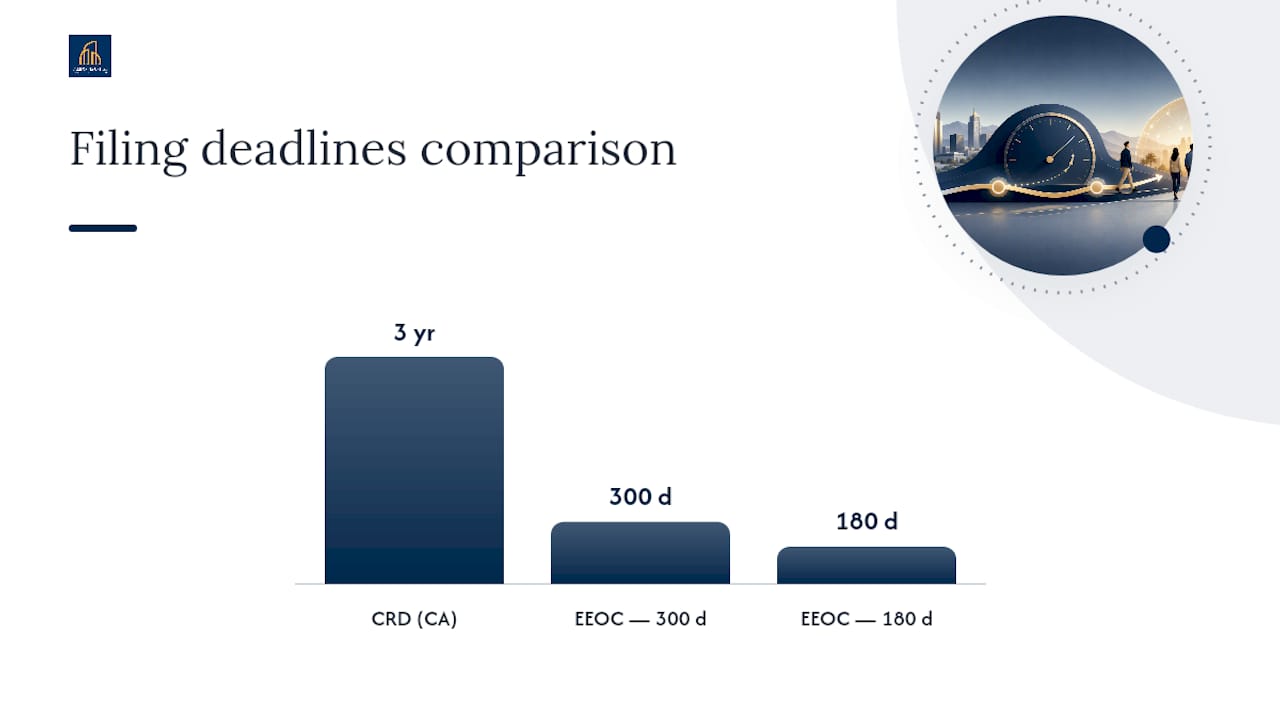
In California, employees generally have three years to file an intake with the CRD, one of the longer administrative windows in the country. Filing with the CRD is generally required before filing a FEHA lawsuit, and a right-to-sue notice is generally required before proceeding in court.
Federal law works differently. Under EEOC procedures, you typically have 180 days to file a charge, extended to 300 days in states like California that have their own fair employment agency.
California’s three-year CRD deadline is significantly longer than the EEOC’s federal window, which is one reason many California employees start with the state process.
Because California and federal agencies have work-sharing procedures, one filing may help preserve both state and federal claims in some situations, but employees should confirm that both FEHA and Title VII deadlines are satisfied. Key differences worth understanding:
- CRD deadline: generally three years from the discriminatory act
- EEOC deadline: generally 180 days, or 300 days in states with their own agency
- A right-to-sue notice opens a limited window to file in court, and the length of that window depends on the agency and claim involved
Remedies and Employer Liability Under FEHA and Title VII
Potential remedies depend on which law applies, the facts, available proof, and how the case resolves.
Available remedies can include:
- Back pay for wages lost due to the discrimination
- Front pay if reinstatement isn’t practical
- Emotional distress damages
- Punitive damages in some cases involving malice, oppression, or fraud, subject to the applicable legal standard
- Injunctive relief, such as requiring policy changes
FEHA allows individual liability against a supervisor or coworker who personally harassed you, something Title VII generally does not permit. California courts recognize that FEHA harassment liability differs depending on who engaged in the conduct. Employers are generally strictly liable for harassment by supervisors acting in a supervisory capacity, while coworker harassment generally requires proof that the employer knew or should have known about the conduct and failed to take appropriate corrective action. Courts have also recognized national-origin harassment based on conduct such as threats of deportation, derogatory comments about immigration status, or mockery of an accent or language. Under FEHA, employers are generally strictly liable for harassment by a supervisor, while employer liability for coworker harassment generally depends on whether the employer knew or should have known about the conduct and failed to take appropriate corrective action. FEHA does not impose the same compensatory and punitive damages caps that apply to Title VII claims, though every recovery still depends on the evidence, defenses, and applicable law. Every case turns on its specific facts, and no outcome is guaranteed.
Retaliation: Protections When You Report or Oppose Discrimination
Retaliation can occur when an employer takes a materially adverse action against an employee because the employee engaged in protected activity, such as filing a complaint, participating in an investigation, or opposing discriminatory treatment.
Both FEHA and Title VII treat retaliation as its own violation, separate from the underlying discrimination claim. Depending on timing and context, warning signs may include:
- A sudden negative performance review after you raised a concern
- Reduced hours, a demotion, or exclusion from meetings following a complaint
- Termination that closely follows a report to HR or a government agency
If you notice an adverse action after making a complaint, documenting the timeline matters. You can also learn more about how Glendale workplace retaliation claims may interact with discrimination cases and why the sequence of events often becomes central evidence.
Practitioner Perspective: When to Talk to an Employment Lawyer in Glendale
Not every workplace conflict requires a lawyer, but certain situations may warrant a professional evaluation before you act.
Consider speaking with counsel when your situation involves layered evidence, retaliation on top of discrimination, an intersection with wage-and-hour issues, or documents tied to immigration status. Significant potential damages or a pattern affecting multiple employees may also raise the stakes enough to warrant a second opinion.
When you request a consultation, having a few things ready helps the review move faster:
- A written timeline of key events
- Copies of relevant emails, texts, or performance reviews
- Names of coworkers who witnessed the conduct
Employees in California often start the CRD process online, and that intake step may be a practical first move before deciding whether litigation makes sense.
California’s FEHA protections may cover national origin issues involving language, accent, association, and name-based discrimination, which can make California law broader than federal law in some situations.
Our Take: Why the California-First Approach Usually Serves Glendale Workers Better
Most general guidance on national origin discrimination treats Title VII as the default framework and mentions state law as an afterthought. For many Glendale employees, that can put too much emphasis on federal law and too little on California law. FEHA is often the stronger starting point for California employees, not merely a fallback.
The three-year CRD filing window alone changes the calculus. Employees who assume they missed their chance because 180 or 300 federal days have passed may still have time under California law. Individual liability for a person who personally engages in harassment under FEHA is another point that gets buried in generic explanations, and it can matter when the alleged harasser is still your manager or coworker.
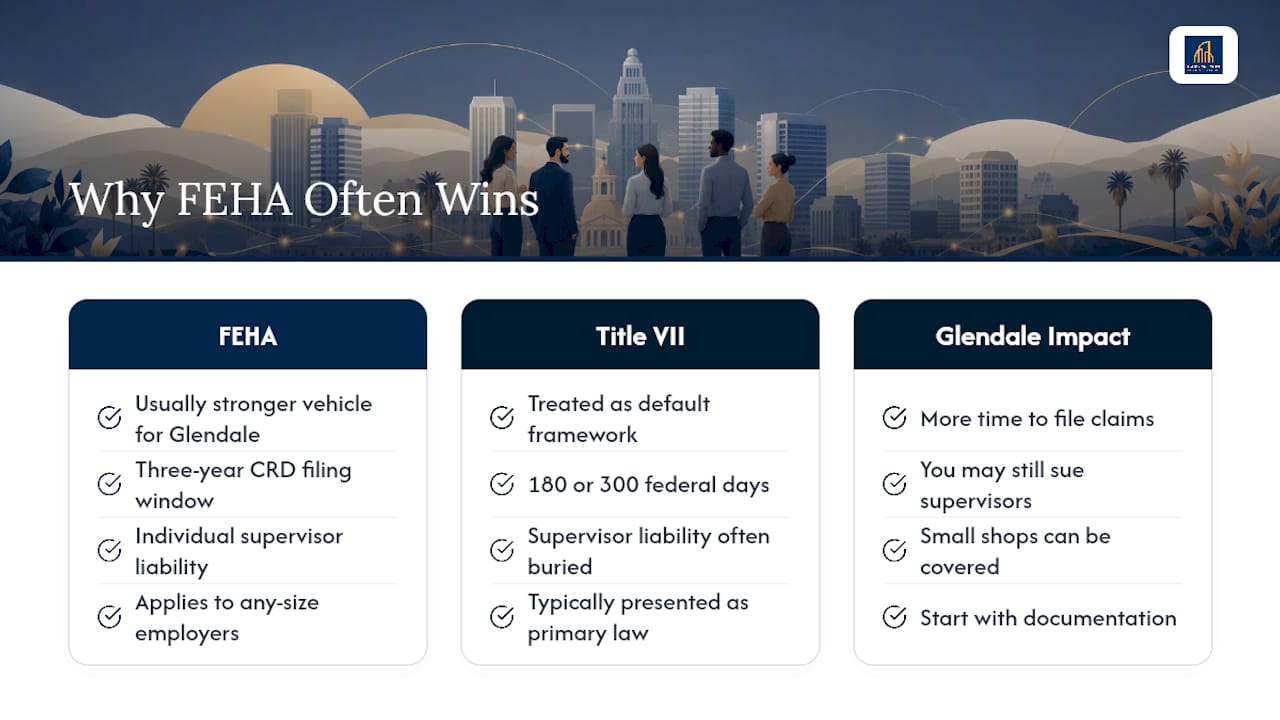
What often gets underweighted: FEHA’s harassment protections can apply regardless of employer size, including small Glendale shops with fewer than five employees. If you work somewhere small and assumed you had no protection, that assumption may be wrong.
Start with documentation, not with a decision about litigation. The paper trail you build in week one shapes every option available to you later.
— California United Law Group
How California United Law Group Can Help Glendale Employees
California United Law Group helps employees evaluate CRD and EEOC deadlines, evidence, and next steps. The firm represents California employees in workplace disputes and offers contingency-fee representation in appropriate cases, meaning attorney’s fees are typically paid from a recovery. Depending on the fee agreement, clients may still be responsible for certain litigation costs or expenses. The firm’s attorneys bring prior employer-side experience to evaluating discrimination, harassment, and retaliation claims.
If you believe you experienced national origin discrimination in Glendale, a consultation can help evaluate whether FEHA, Title VII, or both may apply, what deadlines may be approaching, and what documentation may strengthen a potential case. The firm also handles related matters, including unpaid overtime wages and potential class or representative actions when workplace violations affect multiple employees.
👉 Request a free case evaluation through California United Law Group’s contact page to discuss your situation before a filing deadline passes. A case evaluation does not guarantee representation or any particular outcome.
Sources
For primary guidance beyond this overview, consult the EEOC’s national origin discrimination page for federal examples and enforcement details, the CRD’s complaint process page for California filing procedures, and the Department of Labor’s national origin resources for additional federal context on workplace protections.
This article provides general information, is attorney advertising, and is not legal advice or a substitute for advice from a qualified lawyer about your specific circumstances. Consult a qualified legal professional about your own circumstances before acting on anything here.
- National Origin Discrimination — EEOC
- Complaint process — California Civil Rights Department (CRD)
- Reporting unfair visa-related employment practices — U.S. Department of Justice
- State Dept. of Health Services v. Superior Court, 31 Cal.4th 1026
- Atalla v. Rite Aid Corp., 89 Cal.App.5th 294
- Ortiz v. Dameron Hospital Association, 37 Cal.App.5th 568
FAQ
What Is Considered Discrimination Based on National Origin?
It may include adverse treatment tied to birthplace, ancestry, accent, native language, or cultural traits, such as being denied a promotion, harassed for how you speak, or fired under circumstances suggesting national-origin bias. The EEOC and FEHA both prohibit these actions, though FEHA’s coverage extends further into linguistic and association-based discrimination.
What Is the 80% Rule in Discrimination?
The 80% rule, more accurately called the four-fifths rule, is a statistical guideline sometimes used in disparate impact cases to compare selection rates between groups. It is a technical analytical tool used in some disparate-impact disputes, not a standalone rule that determines whether every discrimination claim succeeds.
What Evidence Is Needed to Prove Discrimination?
Claims may rely on direct evidence, such as a discriminatory remark or written policy, or circumstantial evidence, such as how similarly situated coworkers were treated, suspicious timing, or inconsistent explanations for discipline. Detailed documentation of dates, witnesses, and communications strengthens either type of case.
Who Does Title VII Not Apply To?
Title VII generally does not apply to employers with fewer than 15 employees, and independent contractors may fall outside Title VII employee protections depending on the facts. California employees at smaller businesses often still have protection under FEHA, which covers employers with five or more employees for most provisions and all employers for harassment claims.