
Yes. Documented timesheet violations have cost Torrance employees real pay, and the 2022 citation against a Torrance car wash shows how timekeeping problems can affect workers in the local area. If you suspect your paycheck has been shorted because of how your hours were tracked, you have a limited time period to act.
- Gather and preserve your evidence — pay stubs, texts about your schedule, and the names of coworkers who saw what happened.
- Consider filing a wage claim with the California Labor Commissioner’s Office (DLSE), or speaking with an employment attorney about whether a civil action may be more appropriate for your situation.
- Talk to a Torrance employment attorney, such as California United Law Group, if the amount is significant or your employer pushes back.
This article gives you general educational information, not legal advice. Every case turns on its own facts, and outcomes vary.
Key Takeaways
Documented timesheet violations, including a 2022 Torrance citation totaling roughly $815,311 for 35 workers, show that timekeeping practices can and do cost California employees real pay.
| Point | Details |
|---|---|
| Local precedent exists | A Torrance car wash was cited for $815,311 in 2022 after allegedly paying workers a flat 80 hours regardless of time worked. |
| Deadlines are limited | Many California wage claims have a three-year limitations period, while some written-contract claims may allow four years. Other deadlines may apply depending on the claim and remedy. |
| Documentation can strengthen claims | Pay stubs, personal time logs, and witness statements may strengthen a DLSE wage claim, depending on the facts. |
| Filing starts with Form 1 | DLSE Form 1, plus Form 55 for irregular hours, begins the wage claim process. |
| Consider counsel for serious cases | California United Law Group offers free consultations and contingency-fee representation for qualifying claims. Depending on the fee agreement, clients may still be responsible for certain case costs or expenses. |
Table of Contents
- Torrance Timesheet Violations That Cost California Employees Pay: The 2022 Car Wash Case
- What Timesheet Practices Typically Cause Lost Pay?
- What Are Your Rights Under California Labor Law?
- What Evidence Should You Collect Before Filing?
- How Do You File a DLSE Wage Claim in Torrance?
- What Can You Realistically Recover, and How Long Does It Take?
- When Should You Consider Legal Representation?
- How California United Law Group Can Help Torrance Employees
- Where to Verify These Details
- Sources
Torrance Timesheet Violations That Cost California Employees Pay: The 2022 Car Wash Case
In April 2022, the California Labor Commissioner’s Office reportedly cited a Torrance car wash for wage theft totaling a large sum and affecting multiple workers. Independent reporting from the Los Angeles Times confirmed the citation and put the total at more than $800,000 once fines were added to unpaid wages.
The investigation found two practices at the center of the violation:
- Employees were paid a fixed number of hours per pay period, regardless of actual hours worked.
- Workers were required to wait, unpaid, before punching in for their shifts.
Most of the $815,311 was owed directly to the affected employees, with the remainder covering statutory fines. It is a local, documented example of how timekeeping practices can result in unpaid wages for multiple workers over time.
What Timesheet Practices Typically Cause Lost Pay?
The Torrance car wash case wasn’t unusual in its methods. These timekeeping practices commonly appear in California wage-and-hour disputes:
- Off-the-clock work: being asked to prep, clean up, or finish tasks before clocking in or after clocking out, especially when the employer knows or should know the work is being performed.
- Forced unpaid waiting: being required to report or remain available before being allowed to punch in, which may raise compensable time or reporting-time pay issues depending on the facts.
- Hour shaving or shifting: an employer quietly edits or rounds your recorded hours downward.
- Fixed-hour pay: getting paid for a set number of hours (like 80 per pay period) regardless of your real schedule.
- Missed meal or rest break premiums: not receiving the extra pay owed when a break is skipped or cut short.
- Unlawful deductions: money taken from your check for reasons state law doesn’t allow.
Even small meal-period rounding discrepancies can matter. In Donohue v. AMN Services, LLC (2021) 11 Cal.5th 58, the California Supreme Court held that employers may not round meal-period time punches and that time records showing missed, short, or delayed meal periods can create a rebuttable presumption of a meal-period violation.
California courts have also addressed these issues in several employee-protection decisions. In Donohue v. AMN Services, LLC (2021) 11 Cal.5th 58, the California Supreme Court rejected rounding of meal-period time punches and recognized a rebuttable presumption when records show missed, short, or delayed meal periods. In Brinker Restaurant Corp. v. Superior Court (2012) 53 Cal.4th 1004, the Court explained that employers must relieve employees of duty, relinquish control, and provide a reasonable opportunity to take an uninterrupted 30-minute meal break. In Ferra v. Loews Hollywood Hotel, LLC (2021) 11 Cal.5th 858, the Court held that meal- and rest-break premium pay must be calculated using the regular rate of pay, not just the base hourly rate.
What Are Your Rights Under California Labor Law?
California gives employees a limited window to act, and deadlines can depend on the type of claim, the dates of the violations, and the remedy being pursued. For most wage claims involving minimum wage, overtime, or missed meal and rest breaks, you generally have three years to file. If your claim rests on a written employment contract, that window can extend to four years.
A common misconception is that a missing or incomplete timesheet defeats an employee’s claim. It does not necessarily do so. Employers have recordkeeping obligations, and an employee’s reasonable evidence may still support a wage claim when employer records are missing, incomplete, or inaccurate. You retain the right to be paid for hours you actually worked, even if your employer claims a paperwork problem caused the shortfall.
Depending on the facts and the procedure used, a wage claim or civil action may seek:
- Unpaid regular wages
- Overtime wages
- Meal- or rest-period premium pay
- Waiting-time penalties for late final paychecks
- Interest, and certain penalties or attorney fees where the law allows them.
There’s also an important distinction worth understanding before you file. An individual DLSE wage claim seeks recovery for you specifically. Reporting the same conduct to the Bureau of Field Enforcement (BOFE) may lead to a broader investigation, depending on the agency’s review and priorities. That type of enforcement can address practices affecting multiple workers, as reflected in the Torrance citation.
What Evidence Should You Collect Before Filing?
Strong documentation is often what separates a claim that gets resolved quickly from one that drags on. Start collecting these now, even before you’ve decided whether to file:
- Pay stubs and any timecards you still have
- Shift schedules, whether printed or texted to you
- Texts or emails discussing your hours or start times
- Photos of time clocks or posted schedules
- A personal, contemporaneous log of your actual start, end, and break times
- Names and brief statements from coworkers who witnessed the same practices
- Bank deposit records, and copies of any dishonored paychecks
If your hours varied week to week, use DLSE Form 55 alongside your main claim to document the variation clearly. A personal log can become especially valuable when employer records are missing, incomplete, or appear altered because it may help show the amount and timing of work performed.
Pro Tip: Estimate your unpaid overtime by comparing your personal log against your pay stub week by week. If your log shows 45 hours worked but your stub reflects 40, that five-hour gap can help you estimate the unpaid time to discuss in your claim, though the actual amount may depend on overtime rules, your regular rate of pay, and other facts.

How Do You File a DLSE Wage Claim in Torrance?
If you choose the DLSE wage-claim route, filing generally starts with DLSE Form 1, the Initial Report or Claim form.
- Complete Form 1 with your employer’s information and a description of the violation.
- Attach Form 55 if your hours were irregular.
- Include copies (never originals) of your pay stubs, logs, and any other evidence.
- Submit online, by mail, or in person at the DLSE office serving the Torrance area.
After filing, DLSE typically schedules a settlement conference first. If the parties can’t resolve it there, the case may proceed to a wage hearing, where a hearing officer reviews the evidence and issues a decision.
Common pitfalls that slow claims down include missing dates on the claim form and incomplete wage calculations. Double-check your math before submitting, and keep a copy of everything you send.
What Can You Realistically Recover, and How Long Does It Take?
Recoveries typically include back pay, overtime premiums, and meal or rest period premiums. Waiting-time penalties and certain civil penalties may add to the total where the statutory requirements are met. The availability and amount of penalties depend on the facts, the type of violation, and the procedure used.
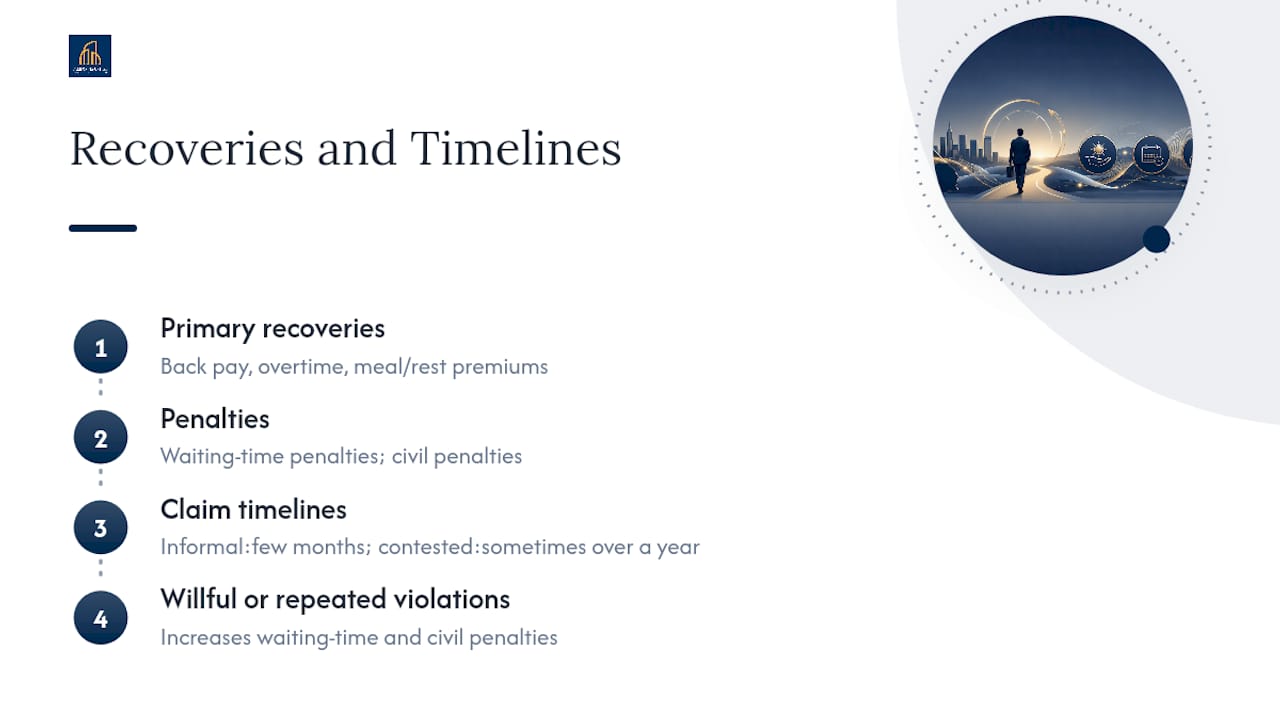
Timelines vary widely. A straightforward claim that resolves early may finish faster, while a contested case that proceeds to hearing can take much longer, sometimes more than a year depending on the district office’s caseload and the evidence. A contested case that proceeds to a full hearing can take considerably longer, sometimes over a year, depending on the district office’s caseload and the complexity of the evidence.
When Should You Consider Legal Representation?
Some situations call for more than a DLSE claim on your own. Consider talking to an attorney if the unpaid amount is substantial, your employer retaliates after you raise the issue, your records are missing or appear altered, or several coworkers were affected the same way.

This remains general information, not legal advice, and results depend entirely on your specific facts. California United Law Group offers free consultations and handles qualifying matters on a contingency-fee basis, meaning attorney fees are paid only if there is a recovery. Depending on the fee agreement, clients may still be responsible for certain litigation costs or case expenses.
How California United Law Group Can Help Torrance Employees
If you’ve read this far because your paycheck doesn’t add up, you already know the gap between filing paperwork alone and having someone who reviews your specific numbers, timeline, and evidence before you submit anything. California United Law Group offers a free case evaluation for Torrance employees who suspect their hours were shorted, whether through off-the-clock waiting, hour shaving, or fixed-hour pay like the practice found in the 2022 car wash citation. Representation is entirely optional, and attorney fees are charged only if your case results in a recovery. Depending on the fee agreement, clients may still be responsible for certain costs or expenses. This is educational information, not a promise of any particular outcome. Past enforcement actions and examples do not guarantee that any particular worker has a claim or will recover money. If you want a second set of eyes on your pay stubs and timecards, reach out to California United Law Group to start a free consultation.
Where to Verify These Details
For readers who want to confirm any figure or file a claim directly, these official sources cover the forms and rulings referenced above:
- How to file a wage claim (DLSE)
- DLSE press release on the Torrance car wash citation
- DLSE Form 1, Initial Report or Claim
- Report a violation to the Bureau of Field Enforcement
- Los Angeles Times coverage of the Torrance citation
Keep copies of every document you submit to DLSE, and review the official forms and instructions before filing rather than relying only on third-party summaries.
This article is general information, not a substitute for advice from a qualified lawyer. Consult a qualified legal professional about your own circumstances before acting on anything here.
Sources
- How to file a wage claim – DLSE
- California Labor Commissioner cites Torrance car wash
- Torrance car wash ordered to pay more than $800,000 in stolen wages plus fines – Los Angeles Times
- Initial Report or Claim (DLSE Form 1) – DLSE (English PDF)
Recommended
- Torrance Unpaid Wages: Recovering Missing Compensation – California United Law Group –
- Unlawful Hour Rounding in Torrance: Know Your Rights – California United Law Group –
- Glendale Employer Liability For Inaccurate Timesheets – California United Law Group
- Your Rights When A Torrance Final Paycheck Is Late – California United Law Group