
If you work in Long Beach and believe your employer has not paid you correctly for overtime, missed breaks, or off-the-clock work, California law may provide a path to recover unpaid wages depending on your classification, hours worked, employer knowledge, and available evidence. Depending on the facts, nonexempt employees may be able to seek back pay, meal and rest break premiums, waiting-time penalties, liquidated damages for certain minimum-wage violations, and attorney fees where authorized. Your first moves matter: write down your hours now, save every paystub, request your payroll records in writing, and consider filing a wage claim with the California Labor Commissioner’s Office (DLSE) or speaking with an employment attorney before too much time passes.
TL;DR:
- Many nonexempt Long Beach workers, including workers in retail, food service, port logistics, and healthcare support roles, may be protected under California wage-and-hour laws for unpaid wages, off-the-clock work, and missed breaks.
- Employers often shortchange workers by calculating overtime based only on base pay, neglecting bonuses and shift differentials, which increases the owed amount.
- Filing a wage claim usually requires submitting the correct DLSE forms with supporting documents such as pay stubs, time records, schedules, and communications; timing varies by office workload and whether the claim settles or proceeds to hearing.
- Recoverable remedies include back pay, liquidated damages, penalties for final wages, and attorney fees, with waiting-time penalties sometimes matching or exceeding the unpaid wages.
- Timely documentation and prompt action are critical, as missing records or lack of evidence can significantly weaken your case and extend the timeline for recovery.
Table of Contents
- Who Can File an Unpaid Overtime Claim in Long Beach
- What Counts as Unpaid Wages Under California Law
- How to File a DLSE Wage Claim: Forms, Documents, and Timeline
- Remedies and Penalties: What You Can Actually Recover
- Exemptions and Misclassification: Why a Job Title Doesn’t Settle It
- Gathering Evidence: What Matters When Records Are Incomplete
- California Overtime Rules and How Long Beach Fits In
- Retaliation Protections If You File a Wage Claim
- How State and Federal Overtime Laws Work Together
- What Happens After You File: Next Steps and Resources
- When It Makes Sense to Talk to a Lawyer
- Talk to Jared R. Sohn About Your Long Beach Wage Claim
- Editorial Perspective: What Long Beach Workers Get Wrong About Wage Claims
- Checklist: Immediate Actions and Key Legal Points
- Sources
Who Can File an Unpaid Overtime Claim in Long Beach
Many hourly workers in Long Beach may qualify to file a wage claim if their paychecks do not reflect the hours they actually worked, but the key legal question is usually whether the worker is nonexempt and whether unpaid wages, overtime, or break premiums are owed. California law protects nonexempt employees, which generally includes hourly workers and some salaried workers whose pay and actual job duties do not satisfy a recognized exemption.
Your immigration status has no bearing on your right to file. California explicitly extends wage and hour protections to all workers regardless of documentation status, a point the DLSE’s wage claim guidance reinforces for anyone worried that filing could expose them to risk.
Certain Long Beach industries see unpaid wage disputes more often than others, largely because of scheduling complexity and high turnover:
- Retail stores near the Pike Outlets and Long Beach Towne Center, where scheduling shifts and clopening shifts often blur break periods
- Restaurants and food service, where tip pooling and split shifts complicate overtime math
- Warehouse and logistics operations tied to the Port of Long Beach, where mandatory overtime and irregular schedules are common
- Healthcare support roles, including home health aides and medical office staff, where on-call time frequently goes uncompensated
If you fall into one of these categories and your pay does not match your hours, it may be worth evaluating whether you have a wage claim. A detailed breakdown of unpaid wage rights for Long Beach workers covers additional scenarios specific to this labor market.
What Counts as Unpaid Wages Under California Law
California’s overtime rules are more generous to workers than the federal standard, and understanding the triggers helps you spot a violation before it becomes routine.
- Daily overtime generally begins after 8 hours worked in a single workday, paid at 1.5 times the regular rate, unless a valid exception such as an alternative workweek schedule or qualifying collective bargaining agreement applies.
- Weekly overtime applies once you exceed 40 hours in a workweek, also at 1.5 times your rate.
- Double time generally applies after 12 hours in one day, or after 8 hours on the seventh consecutive day worked in a workweek, subject to applicable exceptions.
- Off-the-clock work can count too when the employer knew or should have known the work was being performed, such as required register prep before clocking in, paperwork after clocking out, or work texts handled off the clock.
- Missed meal and rest breaks can trigger premium pay of one additional hour at the employee’s regular rate for each workday on which a required meal or rest period was not provided, subject to the applicable rules.
Here’s a detail most workers miss: your “regular rate” for overtime purposes isn’t just your hourly wage. Non-discretionary bonuses, commissions, and shift differentials get folded into that rate, which means your overtime pay should be higher than a flat hourly calculation suggests. California courts have emphasized that regular-rate calculations may include more than the base hourly rate. For example, Alvarado v. Dart Container Corp. of California addressed how flat-sum bonuses are included in overtime calculations, and Ferra v. Loews Hollywood Hotel, LLC held that meal and rest break premium pay uses a regular-rate concept that includes nondiscretionary payments for work performed. Employers who calculate overtime off base pay alone, ignoring a quarterly bonus or a night-shift differential, are shortchanging you every pay period without necessarily doing it on purpose.
California courts have repeatedly emphasized that wage-and-hour rights depend on the actual pay structure and work performed, not labels alone. In Alvarado v. Dart Container Corp. of California, the California Supreme Court addressed how flat-sum bonuses affect overtime calculations. In Ferra v. Loews Hollywood Hotel, LLC, the Court held that meal and rest break premium pay must be calculated using a regular-rate concept that includes nondiscretionary payments for work performed. And in Ramirez v. Yosemite Water Co., the Court treated exemption status as a fact-intensive issue, with the employer bearing the burden of proving the exemption.
If your paystubs look inconsistent or your overtime rate never seems to move even when your bonus does, that’s worth investigating further. A closer look at rest break violations common in Long Beach workplaces walks through how these premiums get missed.
How to File a DLSE Wage Claim: Forms, Documents, and Timeline
Filing a wage claim with the DLSE doesn’t require a lawyer, but knowing which forms to use and what to attach makes the process smoother.
The process starts with DLSE Form 1, the Initial Report or Claim, which opens your case. Depending on your situation, you may need supplementary forms:
- Form 55 if your hours were irregular, since it helps DLSE calculate unpaid wages across inconsistent schedules
- Form 155 if your dispute involves unpaid commissions rather than straight hourly wages
The official filing instructions for DLSE Form 1 detail exactly what’s required. Alongside the completed forms, DLSE asks claimants to submit copies (never originals) of:
- Pay stubs covering the disputed period
- Time records, schedules, or punch-clock printouts
- Any dishonored or bounced paychecks
- Your written notice of employment information, if your employer provided one
- A collective bargaining agreement, if one applies to your position
You can file online, by mail, by email, or in person, according to the DLSE’s wage hearing and filing overview.
| Step | What Happens | Typical Timing |
|---|---|---|
| File claim | Submit Form 1 (plus Form 55/155 if applicable) with supporting documents | Day 1 |
| Case assigned | DLSE reviews and assigns your claim to a deputy labor commissioner | Varies by office workload |
| Settlement conference | Both parties meet informally to try to resolve the claim | Varies by DLSE office workload; often scheduled weeks or months after filing |
| Hearing (if no settlement) | Formal hearing before a hearing officer, followed by a written decision or order that may have legal effect and may be subject to further review. | Scheduled after conference, if needed |
The DLSE’s settlement conference guidance is direct about attendance: if you fail to appear at your scheduled conference without a valid excuse, your claim can be dismissed. Treat that date like a court appearance, because in practical terms, it functions like one.
Remedies and Penalties: What You Can Actually Recover
A successful wage claim in Long Beach can result in more than just the overtime that was shorted. California law may provide several remedies in addition to back pay, depending on the claim. California law stacks several remedies on top of back pay, which is part of why these claims carry real financial weight for employers who cut corners.
- Back pay for unpaid overtime and wages, often subject to a three-year limitations period for statutory wage claims, with some contract-based theories potentially subject to different deadlines
- Liquidated damages, which may effectively double certain unpaid minimum-wage amounts
- Waiting-time penalties under Labor Code Section 203, which apply when an employer willfully withholds final wages after termination or resignation and can accrue for up to 30 calendar days of the employee’s average daily wage
- Wage statement penalties under Labor Code Section 226 for inaccurate or incomplete paystubs
- Prejudgment interest on the unpaid amounts
- Attorney fees where authorized by statute, including many wage nonpayment actions, subject to the specific claim and procedural posture.
Here’s what surprises a lot of claimants: waiting-time penalties alone can sometimes rival the original unpaid wages, since they’re calculated as a full day’s pay for every day payment is late, up to a month. The DLSE’s overview of wage claim remedies confirms this three-year limitations window and the underlying penalty structure.
In cases involving systemic violations across many employees, a claim may also raise issues under California’s Private Attorneys General Act (PAGA), which is different from an individual DLSE wage claim and involves separate procedural requirements. That is a more complex track and typically requires legal guidance. That’s a separate and more complex track, typically requiring legal guidance rather than a standard DLSE claim.
Exemptions and Misclassification: Why a Job Title Doesn’t Settle It
Employers commonly defend unpaid overtime claims by arguing the worker was “exempt.” That defense usually requires more than a job title. For common white-collar exemptions, employers generally must satisfy both compensation and duties requirements.
First, the employee generally must earn compensation meeting the applicable salary threshold for the relevant period. Second, the employee’s actual day-to-day duties must primarily involve exempt executive, administrative, or professional work. Second, and often overlooked, the employee’s actual day-to-day duties must primarily involve executive, administrative, or professional work, not just a fancy title on a business card. A manager who spends most of the week ringing up sales or stocking shelves alongside hourly staff may not meet the duties test, regardless of what the offer letter says.
Two narrower exceptions also come up:
- An alternative workweek schedule, adopted through a specific employee election process, which changes how daily overtime is calculated
- A valid collective bargaining agreement that expressly addresses overtime and premium pay for union-represented workers
Pro Tip: If your job title sounds impressive but your daily tasks look identical to your hourly coworkers’ tasks, that mismatch can be important evidence of possible misclassification. Document what you actually do hour by hour, not just what your title says.
Gathering Evidence: What Matters When Records Are Incomplete
California employers are legally required to keep accurate time and payroll records, and that duty works in your favor. When an employer cannot produce reliable records, contemporaneous employee estimates and supporting documents may become especially important.
Start collecting these now, even before you decide whether to file:
- Paystubs from every pay period you believe was shorted
- Personal calendars, notes, or a simple daily log of hours worked
- Text messages or emails showing work communication outside scheduled hours
- Copies of your work schedule, including last-minute changes
- Any paychecks that bounced or were returned
When employer records are missing or incomplete, a well-documented, contemporaneous personal record, paired with witness statements from coworkers, can meaningfully strengthen your position, because when an employer cannot produce reliable records, contemporaneous employee estimates and supporting documents may become especially important.
California United Law Group helps workers organize this kind of documentation, evaluate payroll records, and prepare DLSE submission materials when filing is appropriate.
California Overtime Rules and How Long Beach Fits In
Long Beach doesn’t operate under a separate municipal overtime ordinance the way some California cities impose their own local minimum wage. Overtime pay for Long Beach employees is governed by the same statewide framework that applies everywhere in California: the daily and weekly triggers under Labor Code Section 510, plus meal and rest break premium requirements that apply uniformly across the state.

What does vary locally is enforcement pattern and industry concentration. Long Beach’s economy leans heavily on port logistics, retail, and healthcare support, sectors where scheduling irregularities and mandatory overtime are more common than in office-heavy job markets. That doesn’t change the underlying law, but it does mean Long Beach workers in those sectors may be more likely to encounter certain recurring wage issues, such as uncompensated mandatory overtime during cargo surges at the port or missed rest breaks during long retail shifts.
If your employer tells you that a local exception or port industry standard excuses nonpayment of overtime, ask for the specific legal basis. In general, no Long Beach-specific practice overrides California’s statewide overtime and break requirements. No Long Beach ordinance overrides the state-level overtime and break requirements set by the Labor Code. The California Labor Code Section 510 text applies the same way whether you work downtown, near the port, or in a strip mall off Bellflower Boulevard.
Retaliation Protections If You File a Wage Claim
California law prohibits employers from retaliating against employees for protected wage-related activity, including filing a wage claim, reporting suspected wage violations, or raising good-faith questions about pay. Retaliation can take obvious forms, like firing or demotion, but it also includes subtler moves: sudden schedule cuts, exclusion from shifts, unwarranted negative reviews, or a hostile shift in how a manager treats you after you raise the issue.
If retaliation happens, it typically creates a separate, additional claim on top of your original wage dispute. You don’t have to choose between pursuing unpaid wages and reporting retaliation. Depending on the procedure used, the wage claim and retaliation issues may be pursued together or separately.
Document any change in your treatment the same way you document your hours: dates, specifics, and anything in writing. A pattern of retaliation is usually proven through a timeline, not a single dramatic event, so don’t wait for something big to happen before you start writing things down.

How State and Federal Overtime Laws Work Together
California workers are protected by two overlapping systems: California’s Labor Code and the federal Fair Labor Standards Act (FLSA). When state and federal wage laws differ, the more employee-protective rule usually controls, subject to preemption issues and specific statutory exceptions.
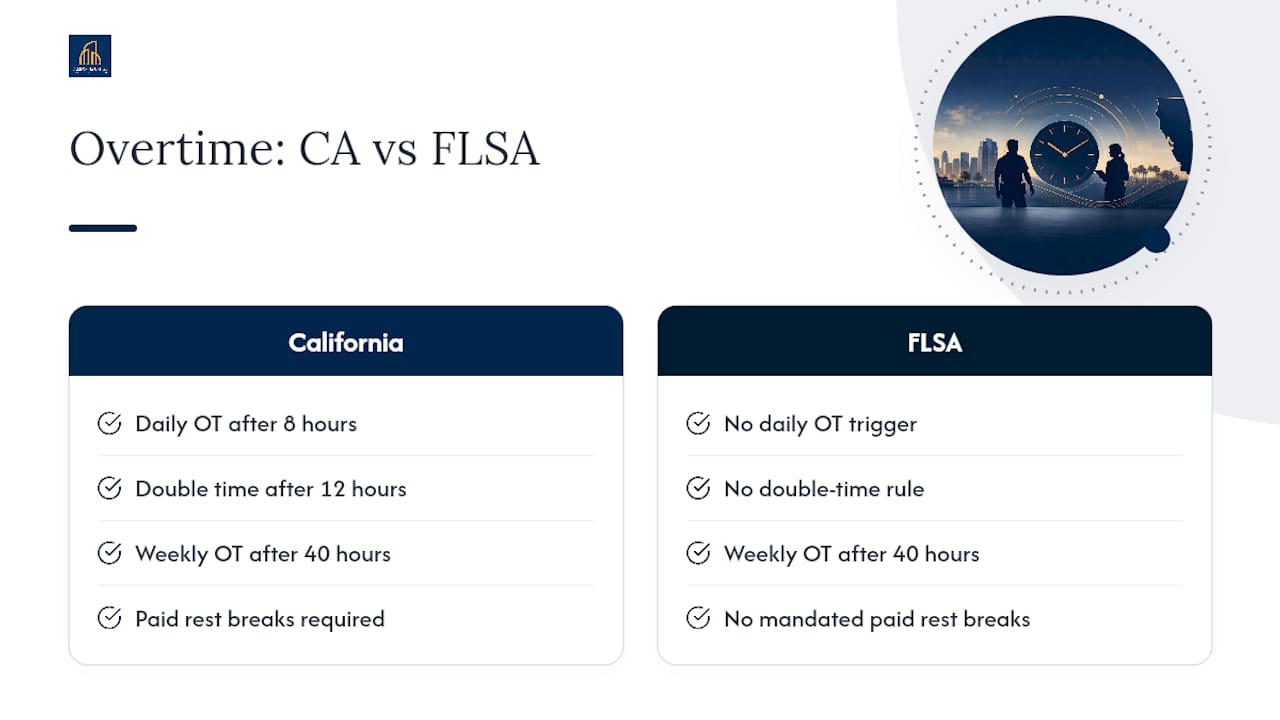
In many Long Beach wage claims, California’s rules provide stronger protections than federal law. The FLSA only requires overtime after 40 hours in a week and has no daily overtime trigger at all. California’s daily overtime rule after 8 hours, and its double-time rule after 12, simply don’t exist under federal law. The FLSA also doesn’t mandate paid rest breaks the way California does.
That means a Long Beach employee generally can’t be told “federal law says otherwise” as a valid excuse to avoid California’s stricter standards. Some workers do have the option to pursue a claim under federal law instead of, or alongside, a state DLSE claim, particularly when an employer operates across multiple states or when federal court offers a more efficient venue. But for most Long Beach workers, California’s own protections already provide the stronger remedy, which is part of why the DLSE process remains the more direct route for the majority of claims.
What Happens After You File: Next Steps and Resources
Filing your DLSE claim isn’t the end of the process, it’s the start of a timeline you’ll want to track closely. Once your settlement conference is scheduled, mark the date immediately and prepare to bring organized copies of every document you’ve gathered.
If the conference does not resolve the dispute, the case may move to a formal hearing before a deputy labor commissioner, where both sides present evidence and a written decision or order may follow. Throughout this process, you’re allowed to have a representative, though many straightforward claims proceed without one.
Beyond the DLSE itself, several resources can help you understand your options:
- Legal aid organizations serving Los Angeles County, which sometimes assist with wage claims at low or no cost
- Worker advocacy groups focused on specific industries, like port workers or restaurant staff
- Employment attorneys who may handle wage-and-hour disputes on a contingency basis, depending on the case and the written fee agreement
If your case involves complicated bonus calculations, a large amount of unpaid wages, or a pattern affecting multiple coworkers, that’s often the point where speaking with an attorney becomes genuinely useful rather than optional. A review of California United Law Group’s employment law services in Long Beach outlines how that kind of case evaluation typically works.
When It Makes Sense to Talk to a Lawyer
Legal representation tends to matter most when your case involves complex bonus or commission math, large amounts of back pay, or an employer pattern affecting multiple workers. A consultation does not guarantee representation, and an attorney-client relationship is formed only if both sides agree to it. This article is educational only and isn’t legal advice; every wage claim depends on its own specific facts.
Talk to Jared R. Sohn About Your Long Beach Wage Claim
California United Law Group represents many California employees on a contingency fee basis, depending on the case and written fee agreement. In that arrangement, attorney fees are generally paid from a recovery if the case succeeds, rather than charged upfront. For Long Beach workers dealing with unpaid overtime, that structure can make legal help more accessible for workers who are already missing wages they earned.
If you’re considering a consultation, gather what you can beforehand: paystubs, any personal notes on your hours, and copies of your work schedule. The firm can assist with organizing that documentation, conducting a forensic payroll review, and preparing DLSE submission materials if you decide to file. To schedule a free case evaluation with Jared R. Sohn, contact California United Law Group directly and describe your situation. There is no obligation attached to an initial conversation, and the consultation is intended to give you a clearer picture of whether the facts support a potential claim.
Editorial Perspective: What Long Beach Workers Get Wrong About Wage Claims
The biggest misconception we see isn’t about the law itself, it’s about timing. Workers often wait months, sometimes years, before documenting anything, assuming they’ll remember the details later or that their employer’s records will speak for themselves. Neither assumption holds up well once a claim actually gets filed.
The DLSE process rewards specificity. A claimant who shows up with dated notes, saved text messages, and organized paystubs is in a fundamentally different position than one who shows up with a general sense that “something felt off” about their pay. That’s not a knock on workers who didn’t document things in real time. Most people don’t think about employment law until a problem becomes undeniable. But it does mean the single most valuable thing you can do today, regardless of whether you ever file a claim, is start writing things down.
There’s also a persistent myth that filing a wage claim is an all-or-nothing gamble that will blow up your job. In reality, retaliation protections exist precisely because lawmakers understood that fear of retaliation would otherwise silence most legitimate claims. That protection isn’t a guarantee against every negative consequence, but it does mean retaliation itself becomes a separate, provable violation if it happens.
The conventional advice to “just talk to HR first” also deserves more scrutiny than it usually gets. HR departments represent the company, not the employee, and while raising an issue internally sometimes resolves it, it isn’t a legal prerequisite to filing a DLSE claim, and it shouldn’t be treated as the only step available to you.
— California United Law Group
Checklist: Immediate Actions and Key Legal Points
- Start documenting your hours today, including any off-the-clock work, and save every paystub you still have access to.
- Request your payroll records from your employer in writing, and keep a copy of that request.
- If you decide to file, use DLSE Form 1, adding Form 55 or Form 155 if your hours were irregular or commissions are involved.
- If the DLSE schedules a settlement conference, calendar it immediately and attend unless the DLSE excuses your absence.
| Action Item | Why It Matters |
|---|---|
| Document hours and save paystubs | Builds your evidence base before records are lost |
| Request employer payroll records | Establishes a written timeline and employer response |
| File DLSE Form 1 (plus 55/155 if needed) | Formally starts your wage claim |
| Attend your settlement conference | Missing it can result in dismissal of your claim |
This article provides general information for California workers and is not legal advice. Reading it does not create an attorney-client relationship. Consult a qualified lawyer about your own circumstances before acting on anything discussed here.