
Yes. California’s Fair Employment and Housing Act (FEHA) and, in many cases, federal Title VII protect Long Beach employees from discrimination based on gender identity and gender expression. These protections may cover hiring, firing, promotions, and workplace harassment in Long Beach, but the coverage rules can differ depending on the claim, the employer, and whether state or federal law applies. Read on for common examples, evidence to preserve, and general information about filing a claim or seeking legal guidance.
TL;DR:
- Filing with the California Civil Rights Department or EEOC may help preserve state or federal claims, but deadlines, employer-size requirements, and cross-filing rules should be reviewed carefully.
- A discrimination claim generally requires a protected characteristic, an adverse employment action, a causal link, and harm; harassment claims follow a different analysis focused on workplace conduct and the employer’s response.
- A dated written internal complaint can give the employer notice and create a record; employers should investigate and respond appropriately, including when they know or should know about harassment by customers or other nonemployees.
- Seek legal advice promptly after a termination or demotion tied to disclosure, ignored harassment reports, or retaliation, because agency filing deadlines are limited.
- Employers generally must respect a requested name and gender identity without a legal name change or medical step, though payroll records may have separate requirements.
Table of Contents
- 1. Which laws protect you from gender identity discrimination at work
- 2. What gender identity discrimination and harassment look like at work
- 3. How employees prove a gender identity discrimination claim
- 4. Filing an internal complaint or an agency charge: what to expect
- 5. When to contact an employment lawyer in Long Beach
- 6. The timeline from filing a complaint through investigation
- 7. How employers typically respond and accommodate gender identity
- 8. Protections specific to Long Beach employees
- 9. A measured view on documentation and realistic expectations
- Schedule a consultation with California United Law Group
- FAQ
- Sources
1. Which laws protect you from gender identity discrimination at work
California’s Fair Employment and Housing Act is the backbone of protection for employees who face discrimination tied to their gender identity or gender expression. California courts and jury instructions distinguish discrimination from harassment. Discrimination usually involves an official employment decision, while harassment often involves workplace conduct, comments, or treatment that creates an abusive working environment.
Federal law offers a second layer of protection. In Bostock v. Clayton County, the U.S. Supreme Court held that firing an employee merely for being gay or transgender violates Title VII because it is discrimination because of sex. Title VII may provide overlapping federal protection, but federal coverage rules and administrative deadlines can differ from FEHA.
California and federal authorities recognize these protections in several ways. Bostock v. Clayton County confirms that Title VII prohibits firing an employee merely for being gay or transgender. Roby v. McKesson Corp. explains the difference between discrimination, which usually involves official employment action, and harassment, which often involves biased interpersonal conduct in the workplace. Lusardi v. McHugh is an EEOC decision recognizing that denying a transgender employee access to a bathroom consistent with the employee’s gender identity can constitute sex discrimination under Title VII.
Two main agencies handle these claims in California, and they often work in tandem:
- The California Civil Rights Department (CRD), formerly known as DFEH, investigates state-law claims under FEHA and can issue right-to-sue letters.
- The EEOC investigates federal Title VII claims. In some cases, CRD and EEOC filing systems may allow cross-filing or shared processing, but employees should confirm that the correct agency filing has been made before any deadline expires.
- Either agency can pursue conciliation, mediation, or litigation depending on the strength of the evidence and the employer’s response.
Because FEHA’s protections are often broader than federal law, and because California’s filing deadlines differ from federal deadlines, understanding both frameworks early helps you choose the strongest path forward. A consultation with employment counsel can help determine which agency filing, deadline, and legal theory fit the facts.
2. What gender identity discrimination and harassment look like at work
Gender identity discrimination rarely announces itself. It often shows up in small, repeated actions that add up to an unlawful pattern. Recognizing these patterns is the first step toward understanding whether what happened to you may be actionable.
- Being passed over for a promotion, demoted, or terminated shortly after disclosing a gender transition or gender nonconforming identity.
- Having a supervisor or coworker repeatedly refuse to use your chosen name or correct pronouns after a clear request, depending on the context and frequency.
- Being denied access to a restroom or facility that matches your gender identity, or being singled out by a dress code enforced inconsistently.
- Facing repeated misgendering, jokes, insults, or derogatory comments about your gender identity or expression.
- Experiencing harassment from customers or vendors that your employer knew about but failed to address.
That last point carries real legal weight. Under FEHA, an employer may be responsible for harassment by a nonemployee, such as a customer, client, or vendor, if the employer knew or should have known about the conduct and failed to take immediate and appropriate corrective action. This can matter in Long Beach workplaces where employees interact directly with the public, such as retail stores, hospitality businesses, and logistics or transportation settings, because an employer’s response to reported customer harassment may become important evidence.
None of these examples alone proves a legal violation. Context, consistency, and your employer’s response all factor into whether the conduct crosses the line into unlawful discrimination or harassment.
3. How employees prove a gender identity discrimination claim
Discrimination claims and harassment claims have different legal elements, so understanding the theory matters before deciding what evidence is most important. For a discrimination claim, an employee generally must show a protected characteristic, an adverse employment action, a causal connection, and harm. For a harassment claim, the focus is generally on whether the conduct was sufficiently severe or pervasive and whether the employer can be held responsible.
Building that connection starts with documentation. The stronger and more contemporaneous your records, the easier it becomes for an investigator or attorney to see the pattern.
- Save dated emails, texts, and messages referencing the conduct or decision at issue.
- Request or retain copies of your personnel file, performance reviews, and any disciplinary notices.
- Write down names of witnesses and, if possible, ask them to note what they observed in their own words.
- Keep a personal, dated log of incidents, including what was said, who was present, and how you responded.
- Preserve copies of any internal complaint you submitted, along with your employer’s response.
Timing often matters. Agency decisions and court cases often turn on specific facts, such as whether an employer treated a transgender employee differently than similarly situated coworkers or whether management responded promptly once harassment was reported. Deadlines for filing with the CRD or EEOC are limited, so employees should avoid waiting too long while gathering evidence.
4. Filing an internal complaint or an agency charge: what to expect
Most employees face a choice early on: report the conduct internally, file with a government agency, or both. Each path has its own process and its own value.
An internal complaint, submitted in writing and dated, gives your employer formal notice and starts a record. Under FEHA, covered employers must take reasonable steps to prevent and correct discrimination, harassment, and retaliation, and a written complaint can help show what the employer knew and when. A written complaint also becomes evidence later if your employer fails to act or if retaliation follows.
Filing externally brings a government agency into the process:
- A CRD complaint opens a state-level investigation and can lead to mediation, a right-to-sue letter, or further agency action.
- An EEOC charge triggers a federal process under Title VII and may be cross-filed or coordinated with the CRD in appropriate cases.
- Agency investigations typically involve requesting documents from your employer, interviewing witnesses, and attempting informal resolution before any lawsuit is filed.
If a claim is proven, potential remedies may include back pay, reinstatement, compensatory damages, policy changes, and other relief depending on the facts, claims, forum, and applicable law. No outcome is guaranteed, and each case depends on its own facts and evidence. For related guidance on documenting harassment specifically, see our practical guide on proving workplace harassment.
5. When to contact an employment lawyer in Long Beach
Not every workplace disagreement calls for legal representation, but certain situations warrant a conversation with an attorney sooner rather than later. If you were terminated or demoted shortly after disclosing your gender identity, reported harassment and saw no meaningful response, or believe you are being retaliated against for speaking up, legal guidance may help you evaluate your options and preserve evidence.
We focus on representing employees in disputes with their employers, including claims involving gender identity discrimination, harassment, and retaliation. Our work generally includes:
- Evaluating and, when appropriate, preparing administrative complaints with the CRD or EEOC.
- Preserving evidence, including documents and witness statements, before memories fade or records are lost.
- Communicating or negotiating with employers and their counsel when appropriate.
- Representing employees in litigation when a case cannot be resolved informally.
We typically handle eligible cases on a contingency fee basis, meaning attorney’s fees are charged only if compensation is recovered; responsibility for litigation costs should be reviewed in the written fee agreement.
Pro Tip: Before a consultation, write a simple timeline of what happened, including dates, names of witnesses, and copies of any relevant documents. It makes the first conversation far more productive.
If you are ready to discuss your situation, our contact page can connect you with the firm to request a case evaluation.
6. The timeline from filing a complaint through investigation
Understanding the general sequence of events after you file a discrimination claim in California helps set realistic expectations. While every case moves at its own pace, most follow a similar arc.
After you submit a complaint to the CRD or EEOC, the agency typically issues an acknowledgment and assigns your case to an investigator. During the investigation phase, the agency may request documents from your employer, interview witnesses, and ask both parties to respond to specific allegations. This stage often takes several months, and complexity, employer cooperation, and agency workload all affect the pace.
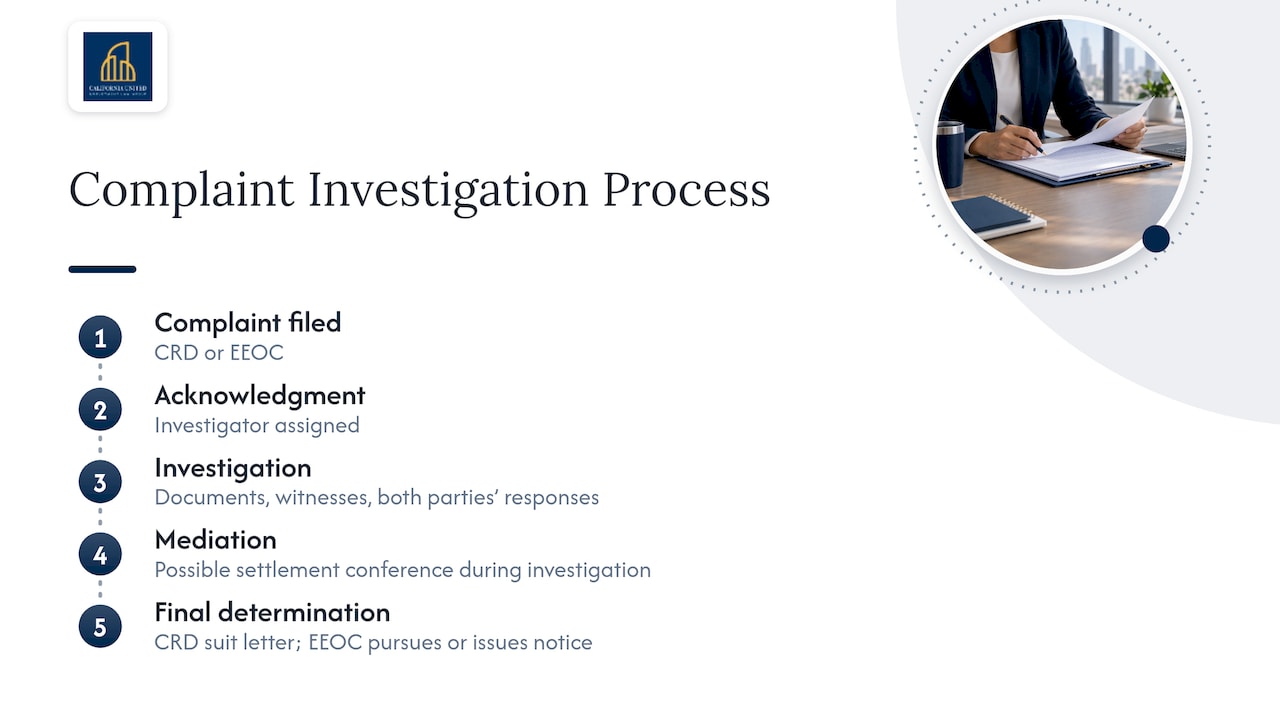
Many cases enter a mediation or settlement conference at some point during the investigation, where both sides have an opportunity to resolve the dispute without further proceedings. If mediation does not resolve the matter, the agency completes its investigation and issues a determination. For CRD complaints, this often results in a right-to-sue letter, which allows you to pursue the matter in court if you choose. EEOC charges may end with further agency action, dismissal, settlement efforts, or a notice of right to sue, depending on the facts and procedural posture.
Throughout this process, keeping your own records current, including any new incidents or employer responses, strengthens your position regardless of which stage your case reaches.
7. How employers typically respond and accommodate gender identity
Employers seeking to comply with California law often respond to a disclosure of gender identity or a workplace transition with practical, respectful steps. This often includes updating personnel records and email systems to reflect a chosen name, instructing staff to use correct pronouns, and clarifying which restroom or facility policies apply.
California law generally does not require an employee to complete a legal name change or medical procedure before being recognized by their stated gender identity in day-to-day workplace interactions. Employers generally should use an employee’s preferred name and pronouns, except where a government-issued name or legal documentation is required for a legally mandated obligation such as payroll, tax, or benefits records.
Some employers formalize this process through written policies, training for supervisors, or designated contacts for employees who want to request changes. Others handle requests informally through HR or direct conversations with a manager. The consistency of an employer’s response, and how quickly concerns are addressed, often becomes relevant if a dispute arises later. An employer’s delay, inconsistent response, or failure to follow its own policies may become relevant evidence if a complaint is later filed.
8. Protections specific to Long Beach employees
Long Beach employees generally rely on the same statewide FEHA protections that apply across California, along with any applicable federal Title VII protections. What differs locally is often the practical environment in which these protections come into play.
Long Beach’s economy includes a significant concentration of port and logistics operations, retail, hospitality, and public sector employment, each with its own patterns of workplace interaction. In public-facing roles, such as retail or hospitality, harassment by customers or other nonemployees can become legally significant if the employer knew or should have known about the conduct and failed to respond appropriately.
Employees of public employers in Long Beach may also be covered by FEHA’s protections against gender identity discrimination, in addition to applicable internal equal employment opportunity policies. If Long Beach does not provide a separate local employment-discrimination remedy beyond state and federal law, the city’s diverse workforce and industries still make these protections especially relevant for employees navigating workplace complaints.
9. A measured view on documentation and realistic expectations
Employees often want certainty about how a claim will turn out, and that certainty rarely exists in discrimination law. What does exist is control over your own documentation, and that control matters more than most people realize when a case eventually reaches an agency or an attorney’s desk.
A practical view: employees are often in a stronger position when they keep consistent records, preserve documents, and report concerns through appropriate channels when it is safe to do so. Reporting internally, when appropriate and safe, can create a record that may support a later claim. When an employer’s response appears inadequate, or retaliation follows, employees may wish to consult counsel promptly. Community legal aid organizations and employee resource groups can also provide support while you weigh your options. Every situation is fact-specific, and no two cases unfold the same way.
— California United Law Group
Schedule a consultation with California United Law Group
Facing gender identity discrimination at work is stressful enough without having to navigate the legal process alone. We represent employees in Long Beach and throughout California in FEHA and Title VII matters involving discrimination, harassment, and retaliation, including administrative filings, evidence preservation, and negotiations when appropriate.
We typically handle eligible cases on a contingency fee basis, meaning attorney’s fees are charged only if compensation is recovered; costs and fee terms should be reviewed in the written fee agreement. An initial consultation gives us the chance to review your situation, discuss your documentation, and outline realistic next steps.
Learn more about our employment law services or reach out through our contact page to schedule a case evaluation.
FAQ
How do you prove gender identity discrimination at work?
For a discrimination claim, you generally need evidence connecting your gender identity or gender expression to an adverse employment action, such as termination, demotion, discipline, or denial of a workplace benefit. Useful evidence may include dated communications, personnel records, witness statements, and a documented timeline.
Can my employer refuse to use my chosen name or pronouns?
California employers generally should use an employee’s preferred name and pronouns after a clear request, even without a legal name change, except where a legal name is required for a legally mandated obligation. A refusal or repeated failure to do so may support a discrimination or harassment claim depending on the facts.
Is misgendering someone a criminal offense in California?
In the workplace, misgendering is generally addressed as a civil employment issue, not a criminal charge. Repeated or intentional misgendering may support a FEHA discrimination or harassment claim depending on frequency, context, severity, and the employer’s response.
Can employers discriminate based on gender identity in California?
No. California’s Fair Employment and Housing Act prohibits covered employers from discriminating based on sex, gender, gender identity, and gender expression. Federal Title VII may also provide overlapping protection against discrimination because of gender identity.