
In many cases, yes. Employees in Culver City can recover unpaid wages by filing a wage claim with the California Labor Commissioner’s Office or by pursuing a civil action in court. A common first step is gathering your pay records and deciding whether to file a DLSE wage claim, pursue a civil action, or consult an employment attorney about which path fits your facts. Depending on your situation, recoverable amounts can include unpaid wages, waiting time penalties, interest, and sometimes attorney’s fees.
TL;DR:
- Claims may include unpaid regular wages, overtime, earned commissions, unused vacation, meal or rest break premiums, unlawful deductions, unreimbursed business expenses, and, when final wages were willfully unpaid, waiting time penalties.
- DLSE claims can be filed by email, mail, or in person without a lawyer; Form 55 permits reasonable hour estimates when employer records are missing.
- Deadlines vary: statutory wage claims commonly use a three-year limitations period, written contract claims may allow four years, oral contract claims may allow two years, and some penalty claims may have shorter deadlines.
- If settlement fails, the claim proceeds to a hearing; either side can appeal a favorable decision within 15 days, or 20 days if the employer is served out of state.
- Civil court may award attorney’s fees on qualifying claims, while fee recovery in DLSE proceedings and appeals depends on the claim type and procedural posture; a documented good-faith dispute can affect waiting time penalties.
Table of Contents
- What Pay and Penalties Can You Recover?
- How Do You File a DLSE Wage Claim?
- When Should You File? Deadlines That Matter
- What If Your Pay Records Are Incomplete?
- What Outcomes and Remedies Are Realistic?
- When Does It Make Sense to Talk to an Attorney?
- How California United Law Group Approaches Wage Claims
- Where Else Can Culver City Employees Get Help?
- How Long Does a Wage Claim Really Take?
- Ready to Discuss Your Unpaid Wage Claim?
- FAQ
- Sources
What Pay and Penalties Can You Recover?
Before you file anything, it helps to know what actually counts as recoverable. California wage law covers more than a missed paycheck.
- Unpaid regular wages, overtime, and commissions you earned but never received.
- Final wages owed after you quit or were let go, including unused vacation time.
- Meal and rest break premiums when your employer failed to provide required breaks.
- Unauthorized deductions taken from your paycheck without proper legal basis.
- Unreimbursed business expenses you paid out of pocket for your job.
When an employer willfully withholds final wages, the law adds a separate penalty. Waiting time penalties may equal the employee’s daily wage for each day final wages remain unpaid, up to 30 days, when the employer willfully fails to pay final wages when due. The amount and availability of penalties depend on the facts, the type of wage claim, and any applicable defenses. Other violations, such as a dishonored paycheck or legally deficient wage statement, may carry separate remedies or penalties when the statutory requirements are met. One distinction matters here: attorney’s fees are generally available in civil court actions under certain wage statutes, but the administrative DLSE process does not always provide for fee-shifting in the same way.
How Do You File a DLSE Wage Claim?
Filing with the Labor Commissioner’s Office does not require a lawyer, and the process is designed to be accessible without one. Wage claims can generally be filed with the appropriate Labor Commissioner’s office by available submission methods, and California wage protections are not limited to workers with immigration documentation.
- Locate the DLSE office that handles claims for your workplace location.
- Complete DLSE Form 1, the Initial Report or Claim, with your personal and employment details.
- Add the applicable DLSE form or schedule if your claim involves estimated hours, unpaid commissions, vacation pay, or another category requiring supporting details.
- Attach a Vacation Pay Schedule if unused vacation time is part of your claim.
- Submit supporting documents if you have them, such as pay stubs, time records, or a copy of a bounced paycheck.
- Wait for the DLSE to schedule a settlement conference once your claim is processed.
At the settlement conference, a deputy labor commissioner meets informally with both sides, sometimes speaking privately with each party, to see if the dispute can be resolved without a hearing. A settlement reached there may become a written settlement agreement. If no settlement happens, the claim moves to a formal hearing.
Pro Tip: Attach whatever documentation you have when you file, but don’t delay filing just because your records feel incomplete.
When Should You File? Deadlines That Matter
Wage claims are governed by statutes of limitations, and waiting too long can cost you the ability to recover money you are owed. Different theories can apply to the same paycheck, so a worker should not assume one deadline controls every possible claim.
- Statutory minimum wage and overtime claims generally use a three-year limitations period.
- Claims based on a written employment contract typically allow four years.
- Claims based on an oral agreement are usually limited to two years.
- Certain statutory penalty claims may have shorter deadlines, so employees should seek advice promptly if penalties are part of the claim.
Waiting time penalties may begin accruing when final wages are due if the employer willfully fails to pay all final wages owed. If your claim proceeds to a hearing and you receive a favorable Order, Decision, or Award (ODA), either side can appeal within 15 days, or 20 days if the employer is served out of state. An ODA that goes unappealed becomes enforceable, and the Labor Commissioner files it with the Superior Court as a judgment.
What If Your Pay Records Are Incomplete?
Missing records do not disqualify your claim. California places real record-keeping obligations on employers, and the DLSE process accounts for the reality that workers do not always have a perfect paper trail.
- Pay stubs and timesheets, even partial ones, help establish a pattern.
- Schedules, shift confirmations, or texts about hours worked support your account.
- Emails discussing pay rates or commission structures add context.
- Bank deposit records can corroborate what you were actually paid.
- Names of coworkers who can confirm your schedule or duties may help.
The DLSE may accept reasonable employee estimates when exact hours are unavailable, especially where employer time records are incomplete or unavailable.
Pro Tip: Start a simple, dated log of your hours and pay issues now, even if your claim covers past weeks, since ongoing documentation strengthens any claim you eventually file.
What Outcomes and Remedies Are Realistic?
Wage claims resolve in a few predictable ways, and knowing the paths ahead of time sets realistic expectations.
- A settlement reached at the conference stage, which may be faster than a contested hearing.
- An ODA issued after a formal hearing if no settlement occurs.
- An appeal of the ODA within the applicable deadline, extending the timeline.
- Court enforcement of an unappealed ODA as a collectible judgment.
Remedies can include unpaid wages, interest, waiting time penalties where legally available, and, in civil court actions, attorney’s fees and costs for qualifying minimum wage or overtime claims.
Employers sometimes raise a good-faith dispute defense, arguing they believed in good faith that wages were not owed. A genuine, evidence-supported good-faith dispute can defeat waiting time penalties, but unsupported, unreasonable, or bad-faith defenses may not qualify. An employer’s financial instability or bankruptcy can also complicate collection, which is one reason some employees choose settlement over a longer hearing process. California authorities recognize these limits. In Mamika v. Barca, the court explained that waiting time penalties are calculated using the employee’s daily wage for each day wages remain unpaid, up to 30 days. In Caliber Bodyworks, Inc. v. Superior Court, the court described Labor Code section 203 as requiring a penalty equal to the employee’s daily wages for each day unpaid, not exceeding 30 days. And in Flowers v. Los Angeles County Metropolitan Transportation Authority, the court recognized an employee’s statutory right to recover unpaid minimum wages from an employer who fails to pay them.
When Does It Make Sense to Talk to an Attorney?
Many wage claims move through the DLSE without legal representation, but certain situations call for a closer look from counsel.
- Your wage calculations involve commissions, bonuses, or irregular overtime that are hard to total accurately.
- The amount owed is substantial enough that a civil action may be worth evaluating.
- You believe you were retaliated against for raising a wage complaint.
- Your employer has appealed an ODA or refuses to pay a judgment.
- Your situation might involve multiple employees facing the same violation, raising class or PAGA considerations.
An attorney can help organize evidence, negotiate on your behalf, and represent you at a hearing or in court, including pursuing attorney’s fees where the law allows it. Many employment attorneys work on a contingency basis, meaning fees are tied to the outcome of the case. This is general information, not a prediction about your specific claim, and outcomes vary based on the facts involved.
How California United Law Group Approaches Wage Claims
We represent California employees in wage and hour disputes, from the initial DLSE filing stage through litigation when a case calls for it. Our practice centers on employment law matters exclusively, and we focus specifically on claims brought by workers, not employers.
- We help clients evaluate whether a DLSE claim or a civil action better fits their facts.
- We assist with organizing pay records, schedules, and other documentation before filing.
- We represent clients at settlement conferences and hearings when representation is appropriate.
- We handle wage and hour claims, including unpaid overtime, as a core part of our practice.
This section is informational and does not constitute legal advice. If you want to discuss your specific facts, Michelle Rapoport and our team offer confidential consultations to Culver City employees considering their options, but contacting the firm does not create an attorney-client relationship unless both sides agree to representation.
Where Else Can Culver City Employees Get Help?
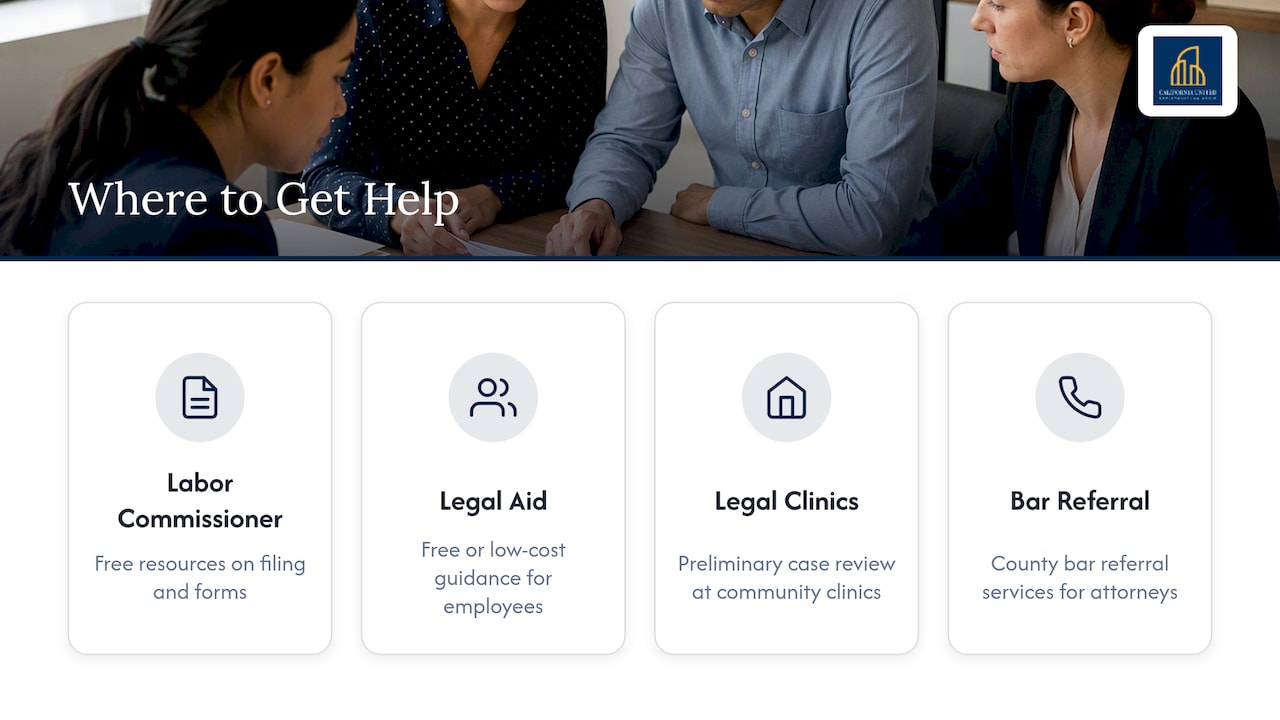
Beyond filing a claim directly, Culver City employees have a few avenues for guidance and support while a wage dispute is pending. The Labor Commissioner’s Office itself provides free informational resources on filing procedures, required forms, and what to expect at each stage, and claims can be submitted without hiring a lawyer.
Local legal aid organizations serving Los Angeles County, community legal clinics, and county bar association referral services may provide free or low-cost guidance or referrals, depending on eligibility and availability. Community legal clinics and county bar association referral services are also reasonable starting points for employees who want a preliminary read on their situation before committing to representation.
For employees who prefer direct legal representation rather than navigating the administrative process alone, consultations are available to discuss wage and hour concerns specific to Culver City workplaces. We also maintain a local resource page addressing unpaid overtime rights for Culver City employees specifically, which may answer additional questions about how these rules apply in practice.
The Labor Commissioner’s process and the court system may both be available to Culver City workers seeking unpaid wages, and California wage protections are not limited to workers with immigration documentation.
How Long Does a Wage Claim Really Take?
Straightforward DLSE claims, especially ones resolved at the settlement conference, often move faster than cases that proceed to a full hearing or get appealed. Complex claims involving large sums, disputed hours, or an employer appeal can take considerably longer.
Common delays include missing a scheduled conference, submitting incomplete documentation, or facing an employer who contests the claim at every stage. Filing promptly, showing up to every scheduled conference or hearing, and keeping organized records remain the most reliable ways to keep your case moving. For anything beyond a simple, well-documented claim, a conversation with counsel early on tends to save time later.
— California United Law Group
Ready to Discuss Your Unpaid Wage Claim?
If you are weighing whether to file a DLSE claim on your own or want representation from the outset, we are available to talk through your options. We handle wage and hour disputes and related employment matters for California workers, and we offer consultations without an upfront consultation fee. Fee arrangements, litigation costs, and any client responsibility for costs should be discussed in a written fee agreement before representation begins.
- We review your pay records and timeline to help identify what may be recoverable.
- We explain whether an administrative claim or a civil action better fits your facts.
- We represent clients at settlement conferences, hearings, or in court when litigation becomes necessary.
Whether you have already filed a claim and encountered a problem, or you have not filed anything yet, reaching out early may help you understand the available options. Visit our wage and hour page to learn more about how we handle these cases, or contact us directly to schedule a confidential consultation about your specific situation. No outcome is guaranteed, and every case depends on its own facts.
This article is general information, not a substitute for advice from a qualified lawyer. Consult a qualified legal professional about your own circumstances before acting on anything here.
FAQ
How far back can you claim unpaid wages in California?
The time limit depends on the type of claim. Statutory minimum wage and overtime claims generally use a three-year limitations period, written contract claims may allow four years, and oral contract claims may allow two years. Some penalty claims may have shorter deadlines, so filing sooner can help preserve more of the claim.
Can an employer recover overpaid wages in California?
This question involves a different legal process than recovering unpaid wages, and the rules depend heavily on how the overpayment happened and whether proper authorization existed for any deduction. Employees with questions about a deduction from their own paycheck should review their pay stub details and consider speaking with an employment attorney about their specific situation.
What is the typical settlement for unpaid wages in California?
There is no standard settlement amount, since outcomes depend entirely on the wages owed, applicable penalties, and the specific facts of each case. A DLSE settlement conference is designed to resolve claims informally, but any amount reached reflects the individual claim, not a fixed formula.
Can I sue my employer for unpaid wages in California?
Yes. Employees may be able to pursue unpaid wages through a civil lawsuit instead of, or sometimes after, filing a DLSE claim. Qualifying minimum wage or overtime claims may also allow recovery of interest and reasonable attorney’s fees.